Reza Arap Oktovian
Around the middle of this year, Ethereum, the second-largest blockchain in terms of monetary value and the bedrock for hundreds of billions of dollars worth of assets, is poised for a monumental transformation. The network will transition from its current Proof-of-Work (PoW) consensus algorithm to a more energy-efficient Proof-of-Stake (PoS) system. This undertaking, often likened to changing the engine of an airplane mid-flight, is critical, as Ethereum cannot afford to cease producing valid blocks. Unlike many other blockchains, such as Bitcoin, Ethereum’s developer community, actively supported by the Ethereum Foundation (EF) and prominent figures within the ecosystem, has agreed upon a multi-client approach to implementing the PoS protocol, frequently referred to as Ethereum 2.0. These client software implementations are developed by distinct teams and can vary by programming language, fostering a robust and decentralized ecosystem.
The Genesis of the Merge: A Decade in the Making
The concept of shifting Ethereum to Proof-of-Stake has been a subject of discussion and development for years, stemming from the inherent limitations and environmental concerns associated with Proof-of-Work. PoW mechanisms, while providing robust security, are notoriously energy-intensive, requiring significant computational power and, consequently, electricity. As Ethereum’s adoption grew, so did the scrutiny of its environmental footprint, making a transition to a more sustainable consensus model a key priority.

The journey towards "The Merge," as the transition is commonly known, has involved several developmental phases. The Beacon Chain, the foundational PoS layer, was launched in December 2020. This marked a significant milestone, establishing the PoS network that would eventually be merged with the existing Ethereum mainnet. The intention was never to replace the existing chain but to seamlessly integrate it with the PoS consensus mechanism, effectively inheriting its security and transaction history.
Understanding "The Merge": A Separation of Duties
The upcoming transition is not a simple amalgamation of two separate blockchains into one. Instead, it represents a fundamental shift in how the network achieves consensus and validates transactions. At a predetermined block height, the current PoW miners will cease their role in validating transactions. This critical duty will be entirely handed over to validators operating on the PoS system, specifically those running the Beacon Chain. This strategic separation of responsibilities enhances the network’s robustness by logically layering execution and consensus.
Post-Merge, Ethereum’s node structure will evolve. Nodes will be categorized into two primary types:

- Execution Nodes: These nodes will continue to interact with users and smart contracts via the Ethereum Virtual Machine (EVM). Their primary function will be to process and execute transactions. However, instead of validating these transactions themselves, they will forward them to validator nodes for the final consensus. In essence, execution nodes will perform duties largely similar to their current roles, but the ultimate validation will be the responsibility of the consensus layer.
- Validator Nodes (Consensus Layer): These nodes will be responsible for the crucial task of validating transactions and proposing new blocks according to the PoS protocol. They will stake Ether as collateral, incentivizing honest behavior.
While execution clients will undergo minor adjustments to accommodate the Merge, much of their core functionality, including the EVM, can be reused with modifications. The long-term vision is for execution clients to entirely shed the validation responsibilities they currently handle within the PoW framework. This architectural evolution is designed to streamline operations and improve efficiency.
The Crucial Role of Client Diversity: A Safeguard Against Catastrophe
A cornerstone of Ethereum’s strategy for a secure and resilient transition to PoS is the development and deployment of multiple, independent client software implementations. The rationale behind this multi-client approach is straightforward yet vital: it mitigates the risk of a single point of failure. If a bug, vulnerability, or flaw is discovered in one client, the other clients, built on different codebases and potentially different programming languages, will remain unaffected. This inherent redundancy is crucial for a network as complex and valuable as Ethereum.
This stands in stark contrast to the development of many other blockchain protocols. For instance, Bitcoin, while highly secure, operates with a significantly simpler protocol and a more homogenous client base. Ethereum’s complexity, a byproduct of its extensive smart contract capabilities and evolving features, inherently increases the potential for vulnerabilities. Therefore, a diverse client landscape is not merely a preference but a critical security measure.
The Peril of Centralization: The "66% Attack" Scenario
The effectiveness of client diversity hinges on a relatively even distribution of network participation across these different clients. The critical threshold is not absolute equality, but rather the avoidance of a "supermajority" in the hands of any single client. Specifically, if one client implementation is adopted by more than 33% of the network’s staking power, it introduces significant risk. This risk escalates dramatically if a client is used by more than 66% of the staking power.
In such a scenario, the intended benefit of having multiple codebases becomes largely nullified. If a serious bug or vulnerability emerges in a client controlling over two-thirds of the staking power, it could effectively grant that client a "supermajority" control over the network. This could lead to a catastrophic consensus failure. The compromised clients would possess the power to finalize blocks, potentially forcing non-buggy clients into an impossible choice: either permanently fork the chain, creating two competing versions of Ethereum, or capitulate to the buggy chain and accept the consequences of the introduced flaw.
The severity of a bug’s impact is directly proportional to the staking power controlled by the affected client:
- Below 33%: A bug in a client with less than one-third of the staking power would likely have minimal impact. The network would continue to operate smoothly, and the bug could be patched without widespread disruption.
- Between 33% and 50%: A bug in this range would be more serious but likely manageable through automatic network mechanisms, with minimal observable impact on users.
- Above 50%: A bug affecting more than half the staking power would trigger automatic recovery mechanisms, but these would likely involve network disturbances and user-facing complications.
- Above 66% (Supermajority): This represents the "game over" scenario, where the buggy client’s dominance could lead to a chain finalization that is difficult or impossible to reverse without a hard fork.
The Prysm Dominance: A Cause for Concern
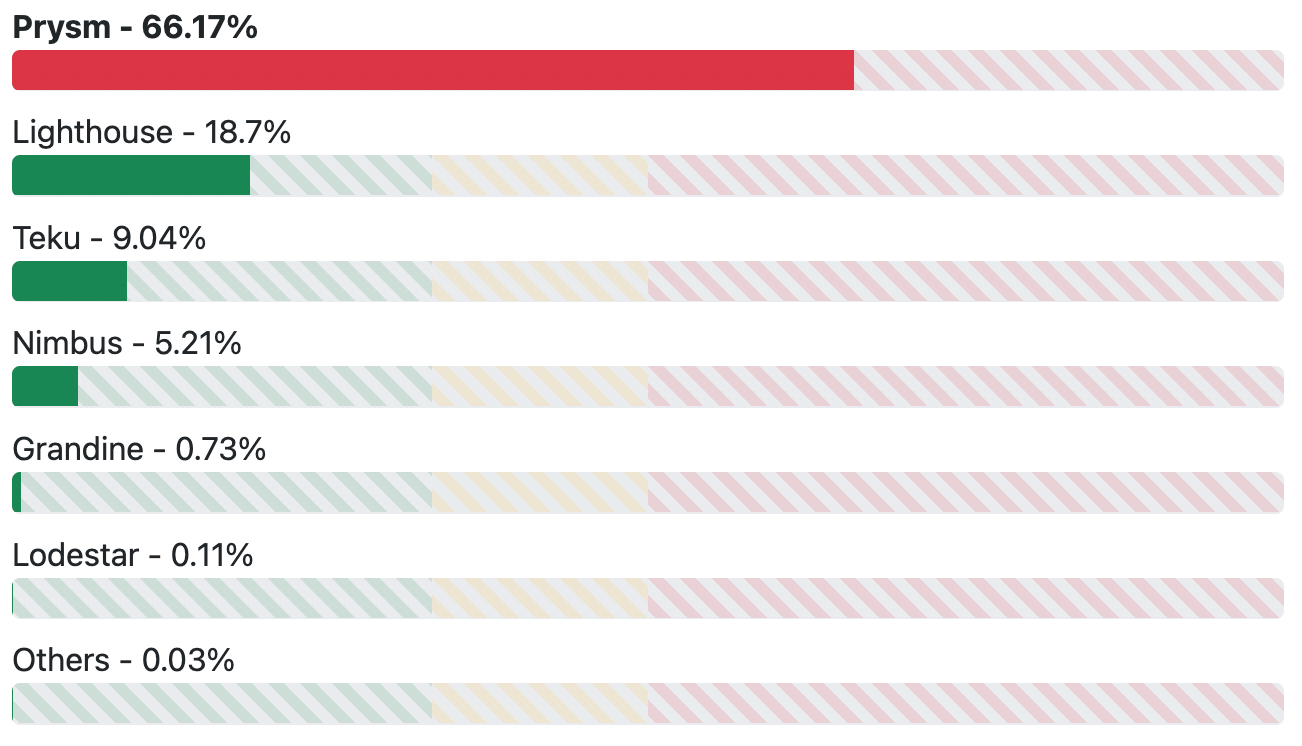
As The Merge approaches, a significant concentration of staking power has gravitated towards the Prysm client, developed by Prysmatic Labs. As of the original reporting, approximately 38% of the network’s staking power was running Prysm. While this is below the critical 66% threshold, it is still above the 33% mark that raises concerns about client diversity. This dominance presents a potential vulnerability, as any widespread exploit or bug within Prysm could have substantial repercussions for the Ethereum network’s stability and security.
Other prominent client implementations include Lighthouse, Teku, and Nimbus. While Lighthouse and Teku hold significant portions of the remaining market share, some clients like Grandine and Loadstar have minimal adoption. The illustration provided in the original article clearly depicted this distribution, highlighting Prysm’s leading position.
The Roots of Prysm’s Ascendancy: A First-Mover Advantage
The significant adoption of the Prysm client can be attributed to several key factors, as explained by Marius van der Wijden, an Ethereum core developer. A primary driver is its "first-mover advantage." As one of the earliest functional prototypes for a Proof-of-Stake beacon client, Prysm had a head start in development, optimization, and community building. This early development cycle allowed the Prysm team to refine their client and build extensive tooling, including user-friendly web interfaces and comprehensive documentation.
Furthermore, Prysm is written in Go (Golang). This programming language is known for its performance, ease of development, and readability, making it attractive to developers and auditors. Given that the widely used Geth client for Proof-of-Work is also written in Go, developers familiar with Geth could more readily understand, audit, and contribute to Prysm, further accelerating its adoption.
Execution Layer vs. Consensus Layer: A Distinction in Risk
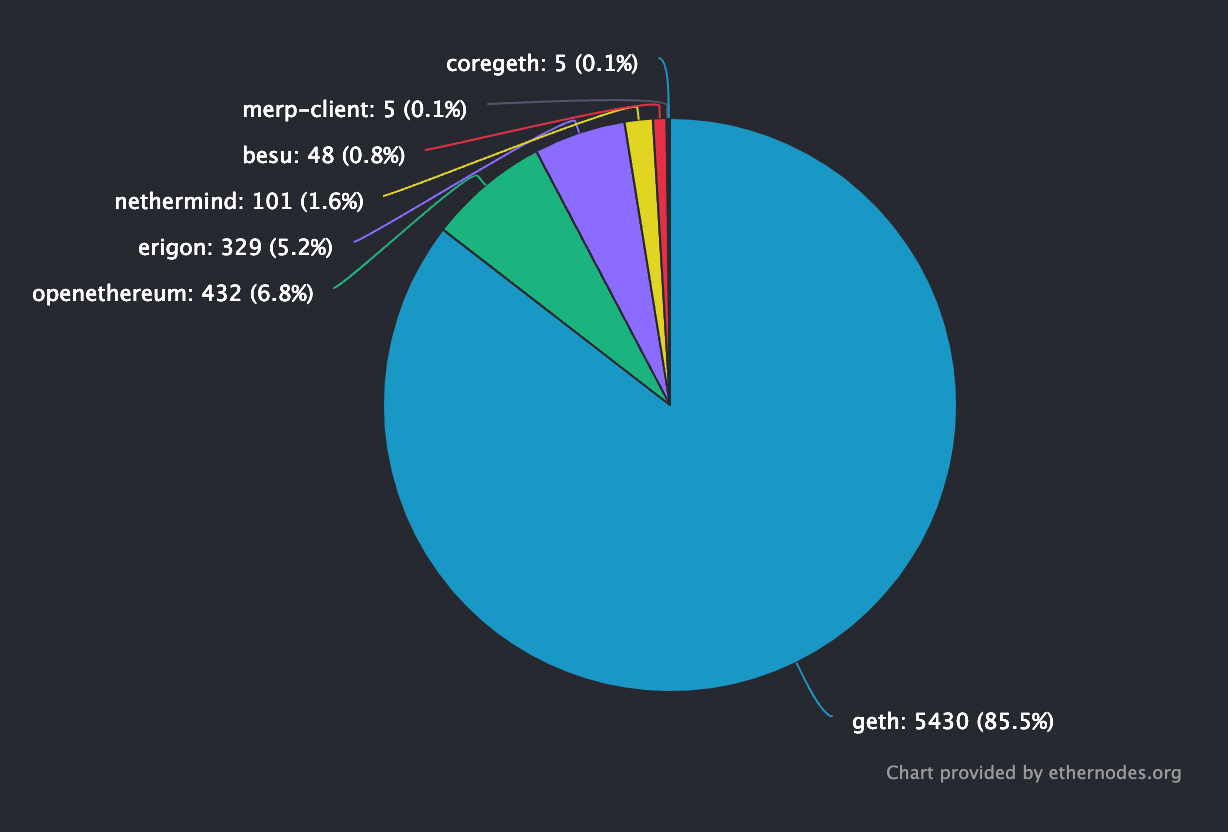
It is important to distinguish between the risks associated with execution client diversity and consensus client diversity. Currently, the Go-ethereum (Geth) client dominates the Proof-of-Work execution layer, with a market share exceeding 85%. However, in the post-Merge environment, the security implications of this concentration are significantly reduced. Execution nodes, while vital for processing transactions, do not provide the core security guarantees of the network in the same way that consensus clients do. Post-Merge, the security of the Ethereum network will primarily rest on the validators and the consensus clients they run. While a diverse execution client landscape is still desirable for overall network resilience, it does not carry the same immediate "game over" risk as a lack of diversity in the consensus layer.
The Influence of Major Staking Services: Concentrated Power
A critical factor contributing to the Prysm dominance is the role of large staking services and pools. These entities allow individuals to stake Ether without possessing the full 32 ETH required for a solo validator, thereby enabling broader participation. However, many of these major staking services have overwhelmingly adopted the Prysm client for their operations.
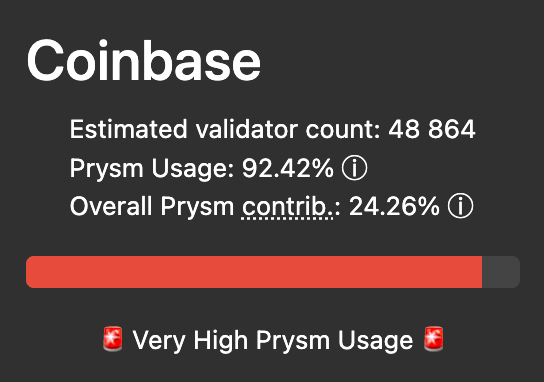
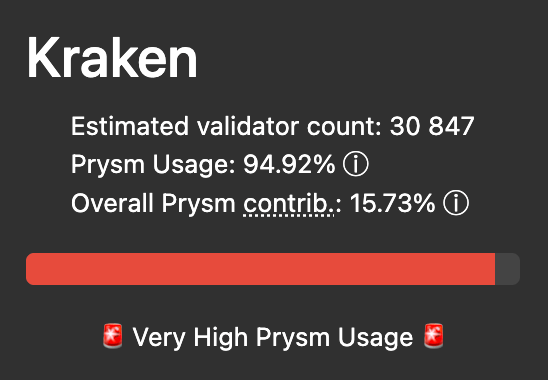
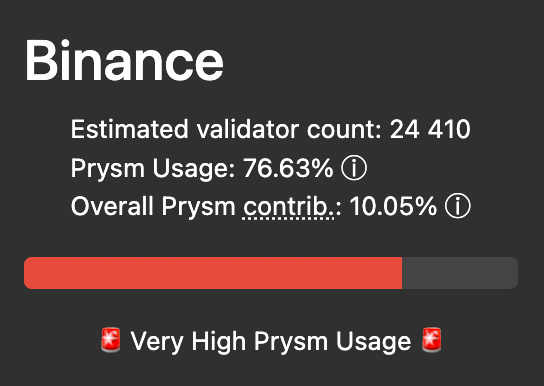
Coinbase, a prominent cryptocurrency exchange and staking provider, is a significant contributor to this concentration. With a substantial number of validators, a very high percentage of these validators were running Prysm, contributing significantly to the overall Prysm market share. Kraken, another major exchange, also initially relied heavily on Prysm due to its perceived maturity and stability. Binance, while having a slightly lower Prysm usage percentage among its validators, still represents a notable contribution to the concentration.
Lido, a leading liquid staking solution, also plays a substantial role. While Lido exhibits a lower percentage of Prysm usage compared to some other major services, its sheer volume of staked Ether means it still contributes significantly to the overall Prysm dominance.
The Decentralized Alternative: Rocket Pool’s Approach
In contrast to the centralized staking services, decentralized staking pool Rocket Pool demonstrates a far more diversified client distribution. With a much smaller overall validator count, Rocket Pool has a significantly lower percentage of its validators running Prysm, making it a negligible contributor to the Prysm dominance issue. This highlights how decentralized protocols can foster greater client diversity, albeit with a smaller overall footprint in the network’s consensus layer.
Industry Responses and Mitigation Efforts
In response to concerns about client diversity, major staking services have begun to articulate their strategies and take action. Coinbase, when queried, pointed to their commitment to security as the primary driver for their initial choice of Prysm, citing its support for remote signers, a critical security feature. However, they also indicated a growing support for other clients like Lighthouse, demonstrating an evolving approach.
Kraken has publicly stated its efforts to increase diversity by rolling out new validators built on the Teku client and migrating existing ones. This proactive stance suggests an understanding of the importance of reducing reliance on a single client.
Discussions are reportedly ongoing between major staking services and the Ethereum Foundation to address this issue. According to Marius van der Wijden, these discussions are progressing positively, with large staking pools actively working on migrating parts of their infrastructure to alternative clients. The transition process for these larger entities may take longer due to the complexity of updating their monitoring and metric systems for new clients.
The Path Forward: A Calculated Risk
Despite the less-than-ideal client distribution, the Ethereum core developers, including Marius van der Wijden, remain confident in proceeding with The Merge. The likelihood of Prysm’s dominance falling below the critical 33% threshold before the Merge is considered low. However, the developers emphasize that the risk of a consensus failure is deemed very small.
This confidence stems from robust testing and fuzzing infrastructure that continuously seeks out discrepancies between client implementations. Even in the unlikely event of a consensus failure, the community has demonstrated its ability to rapidly develop and deploy new releases to resolve forks swiftly.
Crucially, the Ethereum community has established a strong consensus that stakers running a majority client will not receive bailouts if their chosen client misbehaves. This policy underscores the shared responsibility of node operators to contribute to a healthy and diverse network. The transition to Proof-of-Stake represents a significant leap forward for Ethereum, promising enhanced energy efficiency and scalability, but its success hinges on the continued vigilance and collaborative efforts of its diverse community to ensure its security and decentralization.