admin
admin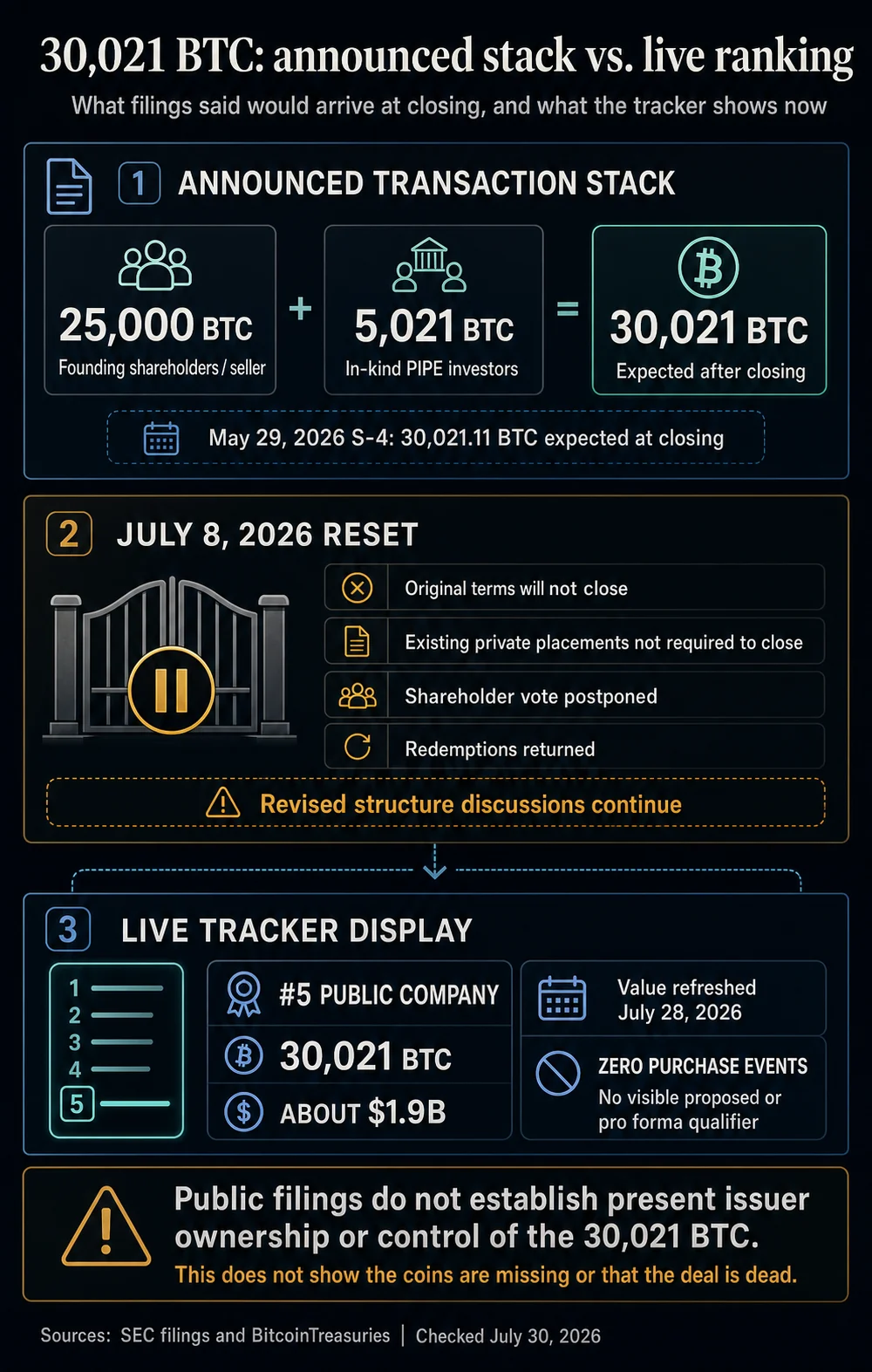
The cryptocurrency tracking platform BitcoinTreasuries has recently placed Bitcoin Standard Treasury Company (BSTR) fifth among publicly traded companies holding Bitcoin, with a reported reserve of 30,021 BTC, valued at approximately $1.9 billion as of July 30, 2026. This valuation, prominently displayed on its live profile as "BTC Holdings" and "Bitcoin Reserve," however, is juxtaposed against a complex financial landscape where the underlying transaction documents indicate that these coins are contributions intended for a corporate treasury that has not yet finalized its announced terms. The discrepancy highlights a scenario where a significant Bitcoin holding is reflected in public rankings before the completion of the financial arrangements that were meant to underpin it.
A Shifting Deal Landscape and its Public Valuation Impact
The genesis of BSTR’s prominent Bitcoin holding within the corporate rankings can be traced back to a proposed merger with Cantor Equity Partners I (CEPO), a Special Purpose Acquisition Company (SPAC). Initially, the arrangement envisioned a significant influx of Bitcoin into the combined entity. However, a pivotal shift occurred on July 8, 2026, when CEPO and BSTR announced a renegotiation of their original deal terms, exploring a new structure. This development led to the cancellation of private placements, an indefinite postponement of CEPO’s shareholder meeting, and the return of redemption shares to investors. While discussions between BSTR and CEPO are reportedly ongoing, the financing mechanism that was to account for the 30,021 BTC has effectively unraveled, creating a disconnect between the reported holdings and the completed transaction status.
From Anticipated Contributions to a Live Corporate Ranking
The initial announcement of the proposed merger, dating back to July 2025, outlined a clear plan for the acquisition of BSTR by CEPO. This plan specified that founding shareholders of BSTR would contribute 25,000 BTC, with an additional 5,021 BTC to be acquired through an in-kind private investment. The prospective combined company was slated to trade under the ticker BSTR upon the successful closure of the deal.
This structure was further solidified in a registration statement filed on May 29, 2026. The document reiterated the expectation that the public company would hold no less than 30,021.11 BTC upon closing. This figure was broken down into 25,000 BTC from the seller and 5,021.11 BTC from private placement investors. The intended mechanism involved BSTR Holdings (Cayman) and these private investors acting as contributors, with the public issuer set to receive these assets through the stipulated closing procedures.
BitcoinTreasuries’ Data Interpretation and Methodology
The cryptocurrency tracker BitcoinTreasuries, which compiles data on Bitcoin holdings of public companies, dates its rounded 30,021 BTC figure to July 22, 2025. The platform then refreshes the associated dollar valuation based on the current market price, in this case, updating to July 30, 2026. Notably, the tracker records zero purchase events for this specific holding. This suggests that BitcoinTreasuries is categorizing the contribution-based stack as a reserve without a discernible purchase history, and its profile does not currently display any visible qualifiers indicating a proposed or pro forma status.
According to BitcoinTreasuries’ publicly stated editorial policy, the data it utilizes is sourced from a variety of channels, including regulatory filings, audited financial statements, company disclosures, on-chain analysis, and third-party data providers. The policy, however, does not explicitly clarify whether contributions that are contingent on the successful closing of a transaction are considered present holdings for the purpose of its rankings. This lack of explicit guidance in the policy may contribute to the current classification of BSTR’s Bitcoin holdings.
The Unraveling Financing and its Implications
The crucial point of divergence lies in the fact that the financing underpinning the 30,021 BTC figure has effectively unraveled. Following the announcement on July 8, 2026, to revise the deal structure, private placements were rescinded, and CEPO’s shareholder meeting was indefinitely postponed. Investors who had subscribed to the SPAC’s offering were subsequently able to redeem their shares, indicating a significant setback for the original merger plan.

A prospectus supplement filed on July 9, 2026, subsequent to the deal revision announcement, offered no clarity on agreed-upon replacement terms or evidence of completed Bitcoin contributions. This filing further underscores the uncertainty surrounding the actual ownership and control of the 30,021 BTC by BSTR Holdings, CEPO, BSTR Newco, or the prospective combined issuer.
While it remains a theoretical possibility that the original seller and prospective investors may still hold the Bitcoin, the available SEC disclosures do not substantiate current ownership or control by the entities involved in the proposed merger. This situation leads to a critical observation: BitcoinTreasuries appears to be reflecting a future promise, or a contingent asset, in the same category as Bitcoin assets already confirmed to be on a company’s balance sheet.
Analysis of the Current Situation
The classification of BSTR’s Bitcoin holdings by BitcoinTreasuries presents an interesting case study in how publicly available data and corporate reporting can intersect with evolving financial transactions. The platform’s ranking of BSTR fifth among public companies with significant Bitcoin reserves is based on reported figures that were contingent on a deal that has since undergone substantial revision.
The core issue is the interpretation of "holdings" in the context of a deal that is no longer proceeding as originally planned. While the intention was for these Bitcoins to become part of the corporate treasury, the failure to close the transaction on its initial terms means that the actual transfer of these assets may not have occurred or is now subject to entirely new conditions.
Broader Implications for Corporate Bitcoin Holdings and Tracking
This situation raises pertinent questions about the reliability and timeliness of data used in corporate rankings, particularly within the volatile and rapidly evolving cryptocurrency market. For investors and analysts who rely on such rankings to assess corporate exposure to digital assets, the discrepancy between reported valuations and the underlying transactional reality can lead to misinformed decisions.
The case of BSTR highlights the importance of transparency and the need for clear disclosures regarding the status of assets, especially when they are tied to complex merger and acquisition activities. It also underscores the challenges faced by data aggregators like BitcoinTreasuries in accurately reflecting the real-time ownership and control of digital assets when deal structures are fluid.
The Path Forward for BSTR and CEPO
As BSTR and CEPO continue to engage in discussions regarding a revised merger structure, the fate of the 30,021 BTC remains uncertain. Any new agreement would need to clearly delineate the transfer of Bitcoin assets and ensure that the holdings are accurately reflected in official filings and subsequent public reporting.
Until such a definitive transaction occurs and is formally disclosed, BSTR’s inclusion in BitcoinTreasuries’ top corporate rankings appears to be based on a projection rather than a present reality. The current listing for BSTR, therefore, more closely resembles a pending deal awaiting finalization rather than a completed corporate treasury operation. This distinction is crucial for understanding the true financial standing of companies in the digital asset space.

Supporting Data and Context
The valuation of 30,021 BTC at approximately $1.9 billion as of July 30, 2026, is based on Bitcoin’s price at that time. For context, Bitcoin’s market capitalization around this period was substantial, reflecting its position as the leading cryptocurrency. The volume of Bitcoin traded daily also remained significant, indicating continued market activity and interest.
The original SPAC deal structure, involving both equity and private placement components, is a common method for taking private companies public. The inclusion of in-kind contributions of digital assets like Bitcoin in such transactions has become more prevalent as companies seek to establish or enhance their cryptocurrency reserves. However, the success of these deals is heavily dependent on the ability to meet closing conditions and secure the necessary financing.
Official Statements and Perspectives (Inferred)
While specific official statements directly addressing the discrepancy between the BitcoinTreasuries ranking and the deal status are not available in the provided content, the SEC filings themselves serve as the primary official communication. These filings indicate a renegotiation and postponement, signaling a departure from the original agreement.
From the perspective of BitcoinTreasuries, their policy suggests a reliance on official filings and disclosures. The inclusion of BSTR’s holdings, despite the deal’s uncertainty, likely stems from the initial announcements and registration statements that outlined the intended Bitcoin contributions. The platform’s methodology may prioritize the documented intent and structure of the deal as presented in regulatory documents, even if the execution has encountered delays or changes.
Broader Impact and Implications
The situation surrounding BSTR’s Bitcoin holdings serves as a cautionary tale regarding the dynamic nature of corporate finance in the digital asset sector. It highlights the potential for discrepancies between reported asset valuations and actual ownership, particularly during periods of transaction negotiation and restructuring.
For investors, this underscores the need for due diligence and a critical examination of the underlying data when evaluating companies with significant cryptocurrency holdings. Understanding the difference between promised contributions, contingent assets, and fully realized holdings is paramount.
Furthermore, it prompts a discussion about the evolution of data tracking and reporting standards for digital assets. As more companies engage with cryptocurrencies, the methodologies used to track and rank their holdings will need to adapt to accurately reflect the complexities of the market and the nature of these assets. The current scenario suggests that a more nuanced approach to classifying and reporting Bitcoin reserves, especially those tied to M&A activities, may be necessary for greater clarity and accuracy in financial reporting.