admin
admin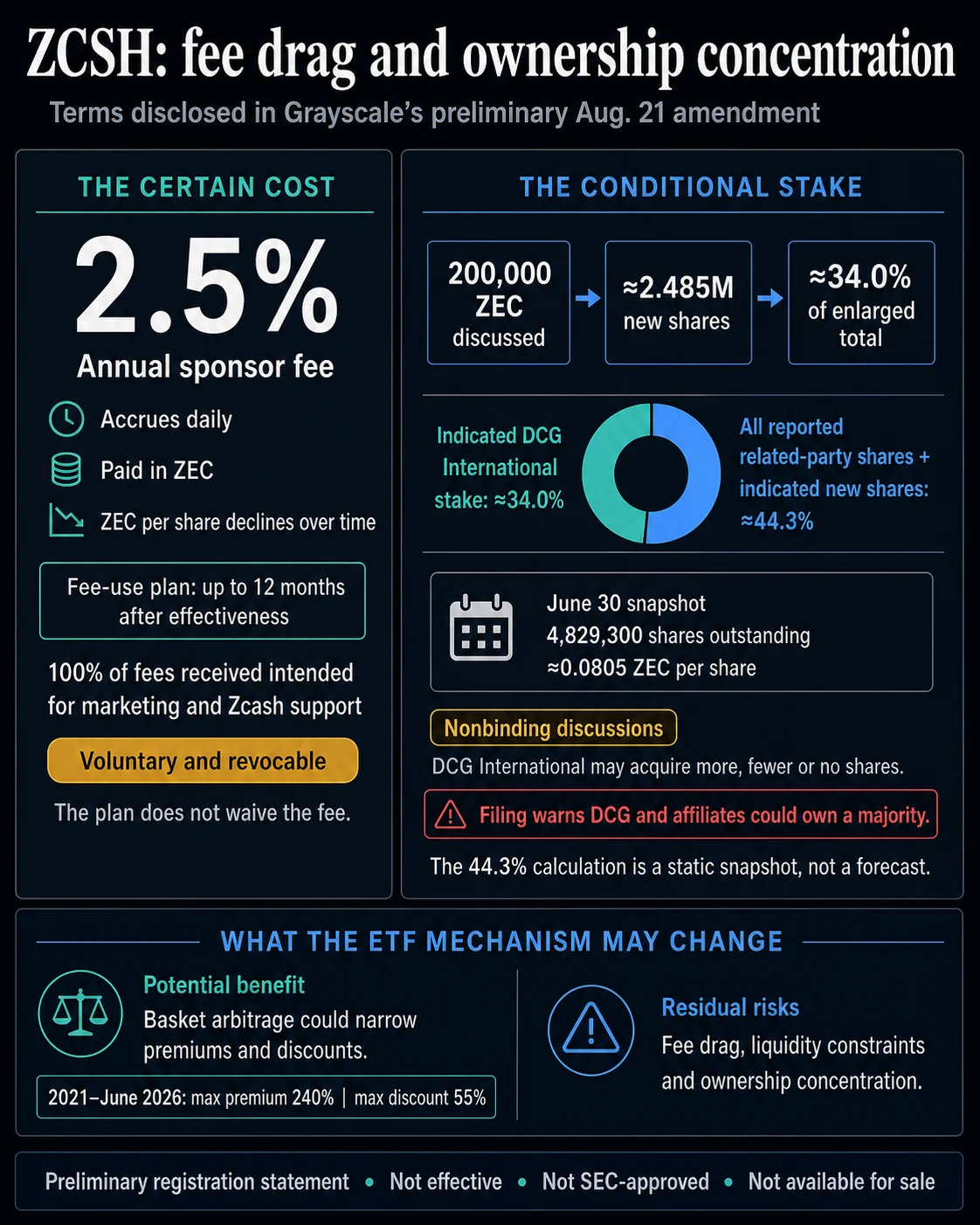
Grayscale Investments, a prominent digital asset management firm, has submitted an amendment to the U.S. Securities and Exchange Commission (SEC) proposing a significant restructuring of its Zcash Trust into an exchange-traded fund (ETF), tentatively named "The Zcash ETF" (ticker: ZCSH). This proposed transformation, detailed in an Aug. 21 SEC amendment, introduces a substantial 2.5% annual sponsor fee and raises questions about potential concentrated ownership by Digital Currency Group (DCG) and its affiliates, which could hold up to 34% of the enlarged fund. While the filing signifies a move towards a more traditional ETF structure aimed at correcting historical price tracking issues, it also brings to light complex ownership dynamics and the inherent challenges of managing privacy-centric digital assets within regulated financial products. The registration remains preliminary, meaning the securities cannot yet be sold, and the SEC has not granted approval or disapproval.
The ETF Structure and the Quest for Price Tracking
The core objective behind Grayscale’s proposed ETF conversion is to address a persistent and significant problem plaguing the existing Zcash Trust: its inability to accurately track the net asset value (NAV) of its underlying Zcash (ZEC) holdings. Historically, the trust has experienced dramatic deviations from its NAV, trading at premiums as high as 240% and discounts as deep as 55% between October 18, 2021, and June 30, 2026. During this period, the average premium stood at 53%, while the average discount was 19%. The shares closed below NAV on an astonishing 700 days.
The ETF structure is designed to mitigate these discrepancies through the involvement of authorized participants (APs). APs, who are typically large market intermediaries, play a crucial role in the creation and redemption of ETF shares. In this proposed model, APs would be able to create or redeem baskets of 10,000 shares. This mechanism is intended to create an arbitrage opportunity: when the market price of ZCSH deviates significantly from the NAV of the ZEC it holds, APs can profit by either creating new shares to sell on the open market if the ETF is trading at a premium, or by redeeming existing shares for the underlying ZEC if the ETF is trading at a discount. This continuous process is expected to exert downward pressure on premiums and upward pressure on discounts, thereby bringing the ETF’s market price into closer alignment with its NAV. As of August 20, prior to the proposed ETF structure being operational, ZCSH was reportedly trading at a discount of 1%.
A 2.5% Fee and its Implications
A key element of the proposed ETF is the introduction of a 2.5% annual sponsor fee. This fee, which already applies to the existing trust, accrues daily and is paid in ZEC. Over time, this fee effectively reduces the amount of ZEC represented by each outstanding share. This is a significant fee in the ETF landscape, particularly when compared to many traditional commodity or equity ETFs that often feature much lower expense ratios.
Grayscale has outlined a plan for the initial period following the ETF’s effectiveness, stating that for up to 12 months, all fees collected will be dedicated to trust marketing and initiatives aimed at supporting Zcash development, marketing, and education. This commitment, however, is voluntary and revocable, meaning Grayscale could alter its allocation strategy at any time, while the 2.5% fee itself would remain in place. The rationale for such a fee, especially for a privacy-focused coin like Zcash, could be attributed to the increased operational complexities, regulatory compliance, and specialized marketing required to promote such a product to a wider investor base. However, the substantial fee could present a hurdle for attracting passive investors seeking low-cost exposure.
Concentrated Ownership Concerns: The DCG Factor
The SEC filing highlights a potential concern regarding concentrated ownership by Digital Currency Group (DCG) and its affiliates. According to the amendment, a nonbinding contribution of 200,000 ZEC by a DCG affiliate, DCG International Investments Ltd., could result in that entity holding approximately 34% of the enlarged fund. This scenario has prompted a warning from Grayscale about the potential for such a substantial stake to grant DCG significant control over the trust’s limited shareholder votes. Such control could, in turn, lead to conflicts of interest with other investors.
To illustrate the potential ownership structure, the filing refers to June 30 snapshot data. On that date, the trust had 4,829,300 shares outstanding, with each share representing approximately 0.0805 ZEC. Under these conditions, a 200,000 ZEC contribution would translate into the creation of roughly 2.485 million new shares. This would bring the total number of shares outstanding to approximately 7.314 million, with the DCG affiliate’s stake constituting about 34% of this enlarged total, assuming no other market activities like creations, redemptions, or changes in the ZEC-to-share ratio.
The quarterly report from June 30 also indicated that 757,202 shares were classified as related-party holdings. When combined with the hypothetical DCG contribution, this would bring the total related-party holdings to approximately 3.242 million shares, representing around 44.3% of the enlarged fund. It is crucial to note that this figure treats these shares as a collective group without attributing them to a single DCG holder and serves solely as a snapshot based on the data available at that specific time. The actual ownership structure could vary significantly depending on the final contribution amounts, the total number of shares created or redeemed by other APs, and any shifts in affiliate holdings.
Challenges to Arbitrage and Market Stability
While the ETF structure is intended to ensure ZCSH trades close to its NAV, achieving perfect price tracking is not guaranteed. Several factors could impede the effectiveness of the arbitrage mechanism. These include:
- Cash-Order Constraints: Limitations on how APs can settle trades in cash, as opposed to in-kind, could introduce friction and prevent seamless arbitrage.
- Unavailable Liquidity Providers: The reliance on APs means that if these entities are unwilling or unable to participate in the creation or redemption process, the arbitrage mechanism can break down.
- Suspended Creations or Redemptions: In periods of extreme market volatility or due to regulatory issues, the ETF provider or the exchange might suspend the creation or redemption of shares, severing the link between the ETF’s market price and its NAV.
- Limited ZEC Market Liquidity: The underlying liquidity of Zcash in the broader market is a critical factor. If ZEC is not readily available or can only be traded at significant price differentials, APs may find it difficult or unprofitable to execute their arbitrage trades. This is particularly relevant for privacy coins, where on-ramps and off-ramps can sometimes face liquidity challenges.
Furthermore, the potential for concentrated ownership, as highlighted with DCG, could also introduce instability. If a single large holder, or a group of affiliated holders, decides to liquidate a substantial portion of their holdings, it could trigger significant price volatility and lead to renewed discounts to NAV. The perception of such large sales, even if they don’t materialize, can also spook the market and influence trading behavior.
Background and Context: The Evolution of Zcash
Zcash, launched in 2016, is a privacy-enhancing cryptocurrency that utilizes zero-knowledge proofs (zk-SNARKs) to shield transaction details, offering users a higher degree of confidentiality compared to Bitcoin. This privacy feature, while a core selling point for many users, has also presented regulatory hurdles and complexities for its integration into traditional financial products. The creation of regulated investment vehicles like ETFs for privacy coins is a significant development, signaling a growing institutional interest in digital assets that offer enhanced anonymity, but also a push by regulators to bring these assets under a more structured and transparent framework.

Grayscale’s existing Zcash Trust has been a vehicle for institutional investors to gain exposure to ZEC without directly holding the cryptocurrency. However, its performance has been marred by the aforementioned tracking errors, which can erode investor returns and diminish confidence. The proposed ETF conversion is Grayscale’s attempt to modernize this product and make it more attractive and efficient for a broader range of investors.
The SEC’s stance on cryptocurrency ETFs has been cautious, with the approval of Bitcoin ETFs in spot markets being a recent milestone after years of rejections. The approval of an ETF for a privacy coin like Zcash would represent a further step in the regulatory maturation of the digital asset space, acknowledging the potential for diverse use cases and investor demand. However, the concerns raised in the filing regarding fees and concentrated ownership will likely be scrutinized by both regulators and investors as the application progresses.
Broader Implications for the Digital Asset Market
The proposed Zcash ETF, if approved, could have several broader implications for the digital asset market:
- Mainstreaming Privacy Coins: A successful Zcash ETF could pave the way for similar regulated products for other privacy-focused cryptocurrencies, potentially increasing their legitimacy and accessibility to mainstream investors.
- Regulatory Scrutiny of Privacy Features: The ETF structure, which requires a degree of transparency and compliance, will inevitably bring the privacy features of Zcash under a more defined regulatory lens. This could lead to ongoing discussions about the balance between privacy and regulatory oversight in the digital asset space.
- Competition and Fee Structures: The 2.5% fee could set a precedent, either encouraging other ETF issuers to adopt similar pricing strategies for niche assets or prompting competition that drives fees down. Investors will weigh the benefits of access against the cost of management.
- Institutional Adoption Trends: Grayscale’s persistent efforts to convert its trusts into ETFs reflect a broader trend of institutional investors seeking regulated and accessible ways to gain exposure to digital assets. The success of this Zcash ETF could further embolden such efforts.
The journey for Grayscale’s Zcash ETF is far from over. The SEC will conduct a thorough review of the filing, considering not only the operational aspects but also the potential market impact and investor protections. The proposed structure, with its significant fee and the potential for concentrated ownership, presents a complex case that will require careful consideration from all stakeholders. The outcome of this application will undoubtedly be a closely watched event in the evolving landscape of digital asset investment products.