
 admin
admin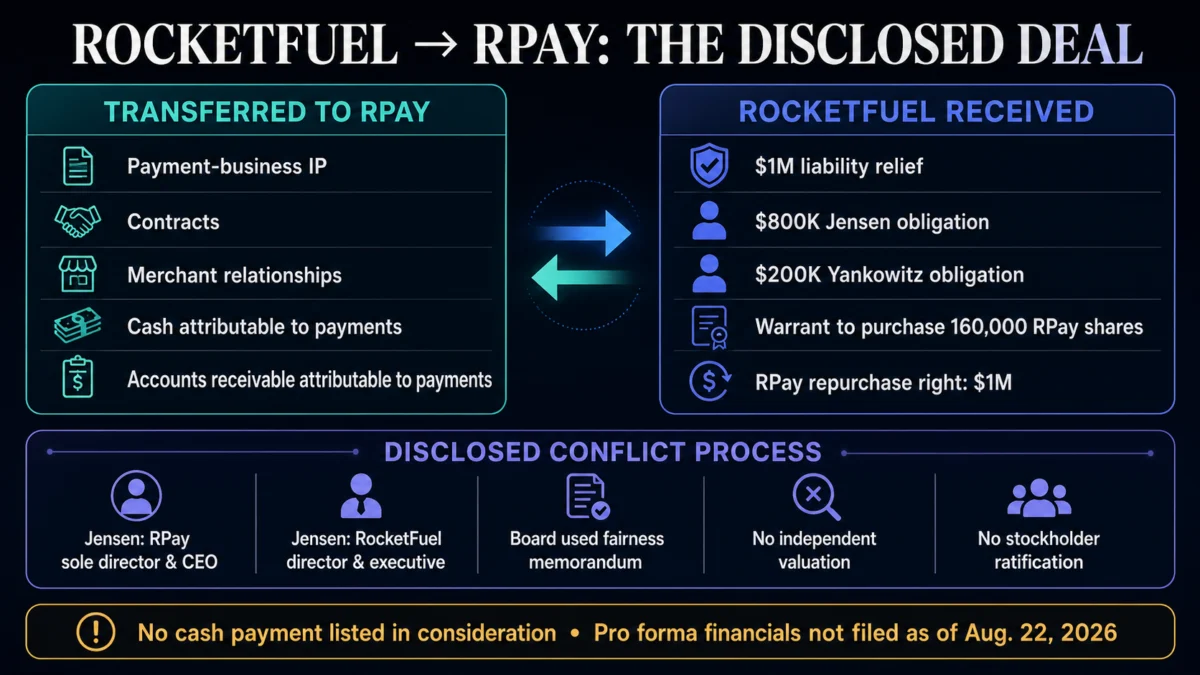
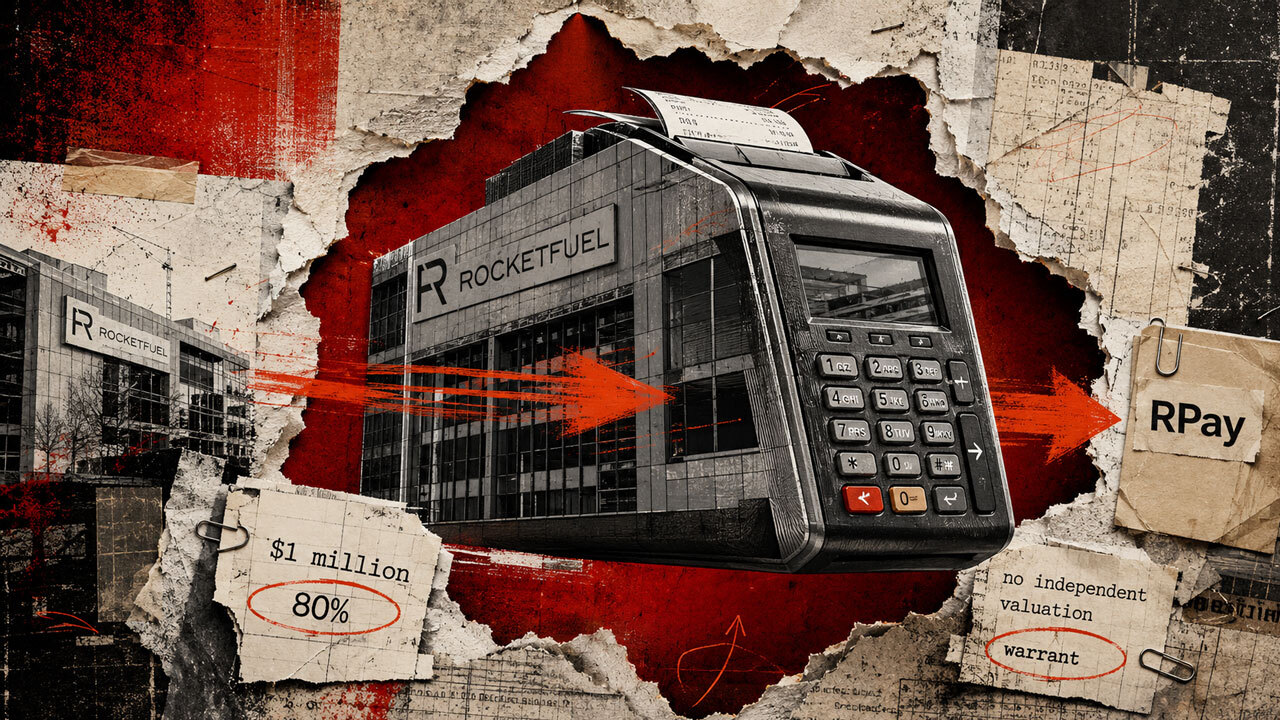
RocketFuel Blockchain has executed a significant internal transfer of its core payments business assets to a newly formed entity, RPay, in a deal that effectively cancels approximately $1 million in executive debt without the benefit of an independent valuation. The transaction, which saw substantially all assets related to RocketFuel’s payments operations, including intellectual property, contracts, merchant relationships, and associated cash and receivables, move to RPay, closed on August 13th. The disclosure of this related-person transaction was made in a regulatory filing on August 21st, raising questions about transparency and valuation in the divestment of a key business segment.
The consideration for this asset transfer is primarily rooted in debt relief. RPay has assumed two significant liabilities previously owed by RocketFuel: $800,000 in deferred compensation due to Peter M. Jensen, who concurrently serves as RPay’s sole director and CEO, and a further $200,000 owed to Bennett J. Yankowitz. Yankowitz, a former director and executive officer of RocketFuel, continues to hold a position on its advisory board. This assumption of debt by RPay resulted in RocketFuel’s immediate release from these financial obligations.
Adding another layer to the transaction’s structure, RocketFuel received a warrant to acquire 160,000 shares of RPay common stock. However, this warrant is encumbered by a $1 million repurchase right, exercisable by RPay at any point. This clause means RocketFuel did not receive the underlying shares outright nor a cash equivalent of $1 million at the time of the deal’s closing. The filing explicitly acknowledges that Jensen’s interests diverge from those of RocketFuel’s stockholders, a divergence highlighted by the assumption of his compensation claim and the specific terms governing the warrant. Yankowitz’s assumed obligation is further stipulated to be payable at a rate of $0.25 for every $1 paid to Jensen, contingent on the discretion of RPay’s board.
RocketFuel’s board of directors concluded that a stockholder vote was not mandated under Nevada Revised Statutes (NRS) 78.565, which governs major transactions. Instead, the board opted to approve the transaction based on a fairness memorandum. This internal assessment addressed the disclosed conflicts of interest but notably omitted an independent valuation of the assets being transferred or a ratification by the company’s shareholders. The absence of an independent valuation is a significant point of concern for investors and analysts scrutinizing the fairness and market value of the divestment.
A Shifting Landscape: Timeline of the Payments Business Divestment
The recent August 13th transaction represents a culmination of evolving strategic considerations for RocketFuel. The company’s initial plans, as outlined in a non-binding term sheet filed in March, envisioned a more complex multi-party divestment. This preliminary agreement contemplated the sale of both its payments business to RPay and its loyalty and rewards segment to RPoints. The March term sheet suggested a package that included approximately $1.5 million in deferred compensation assumptions, an earn-out tied to payments revenue, and warrants representing 20% fully diluted stakes in both acquiring entities.
However, the subsequent regulatory filings suggest a pivot to a solo transaction with RPay. A separate filing related to the RPoints transaction was not readily apparent in RocketFuel’s August 22nd SEC submissions, indicating that the initial dual-buyer strategy may have been significantly altered or abandoned. This divergence from the preliminary agreement raises further questions about the underlying rationale and the ultimate value being realized from the payments business. The comparison between the initial comprehensive proposal and the current RPay-only arrangement is complex, as the scope of assets and terms may have been redefined.
The financial ramifications of this latest move remain incomplete. RocketFuel categorized the RPay sale as a "significant disposition" under SEC asset and income tests, which typically necessitates the inclusion of unaudited pro forma financial statements. These statements are intended to provide investors with a clearer picture of the company’s financial position post-transaction. However, RocketFuel’s August 21st filing did not include these crucial pro forma financials, stating they would be provided in a subsequent amendment (Form 8-K/A). As of August 22nd, RocketFuel’s publicly available SEC filing history did not show any such amendment, leaving a critical piece of the financial puzzle missing for stakeholders.
Unpacking the Deal: Financials and Conflicts of Interest
The core of the transaction hinges on the assumption of liabilities totaling $1 million, effectively wiping out executive debts owed by RocketFuel. This includes $800,000 in deferred compensation owed to Peter M. Jensen, the current CEO of RPay and a director and executive officer at RocketFuel. The remaining $200,000 was owed to Bennett J. Yankowitz, a former RocketFuel executive who maintains an advisory role. The transfer of these obligations to RPay signifies a direct financial benefit to these individuals, facilitated by the sale of company assets.
In exchange for assuming these debts, RPay is transferring its core payments business assets to itself. RocketFuel, the selling entity, receives a warrant for 160,000 RPay shares. However, this warrant is subject to a $1 million repurchase option by RPay. This condition effectively means that RocketFuel’s potential upside from the warrant is capped, and the actual value realized is uncertain and subject to RPay’s future decisions. The filing’s language suggests that RPay is acquiring the assets in exchange for assuming RocketFuel’s liabilities, rather than a direct cash infusion to RocketFuel.
The disclosed conflicts of interest are central to the narrative. Peter M. Jensen, as CEO of RPay and an executive at RocketFuel, stands to benefit directly from the transaction through the cancellation of his deferred compensation and potential future value of RPay. Similarly, Bennett J. Yankowitz, also a former executive with ongoing ties to RocketFuel, benefits from the assumption of his debt. The company’s board acknowledged these diverging interests, citing them as a reason for Jensen’s "interests differ from those of stockholders generally."
The decision not to pursue an independent valuation is particularly noteworthy. In transactions involving related parties and significant asset transfers, an independent appraisal is often sought to ensure fair market value is obtained and to provide an objective basis for the transaction. The reliance on a "fairness memorandum" suggests the board believes the transaction is equitable, but without external validation, this assertion carries less weight with external observers. The absence of a stockholder vote further consolidates the board’s decision-making power, a move that could be perceived as sidestepping broader shareholder consent on a material disposition of assets.

Strategic Implications and Market Scrutiny
The divestment of RocketFuel’s payments business to an entity controlled by its own executives raises significant strategic questions. Historically, payments processing has been a critical component of many blockchain and cryptocurrency companies, offering a tangible use case for digital assets and a revenue stream through transaction fees. By offloading this segment, RocketFuel appears to be signaling a strategic shift away from this operational area. The implications for its future business model and revenue generation remain to be seen.
The lack of immediate pro forma financials also contributes to an atmosphere of uncertainty. Investors and market analysts rely on timely and comprehensive financial reporting to assess a company’s performance and prospects. The delay in providing these figures, particularly for a "significant disposition," can lead to increased scrutiny and speculation. It suggests that the full financial picture of the transaction, including its impact on RocketFuel’s balance sheet and income statement, is still being finalized or may be subject to further adjustments.
Furthermore, the structure of the deal, heavily weighted towards debt relief and a capped warrant, could be interpreted as less than optimal for RocketFuel’s shareholders. While the immediate benefit of shedding $1 million in liabilities is clear, the potential long-term value derived from the RPay warrant appears constrained. The repurchase right introduces a significant risk, and the ultimate realization of value for RocketFuel shareholders from this portion of the deal is far from guaranteed.
The decision to proceed without an independent valuation, while permissible under certain legal frameworks, is likely to attract attention from corporate governance watchdogs and investors who prioritize transparency and accountability in related-party transactions. The fairness memorandum, while a documented internal assessment, does not carry the same independent authority as a formal valuation from a third-party expert. This approach may lead to perceptions of a lack of arm’s-length negotiation, potentially impacting investor confidence.
The market’s reaction will be a key indicator of how this transaction is perceived. Investors will be looking closely at future filings, particularly the delayed pro forma financials, for a clearer understanding of the financial health of RocketFuel post-divestment. The company’s ability to articulate a compelling new strategic direction and demonstrate value creation outside of its former payments business will be crucial in rebuilding and maintaining investor trust in the wake of this complex internal transfer.








