James Watt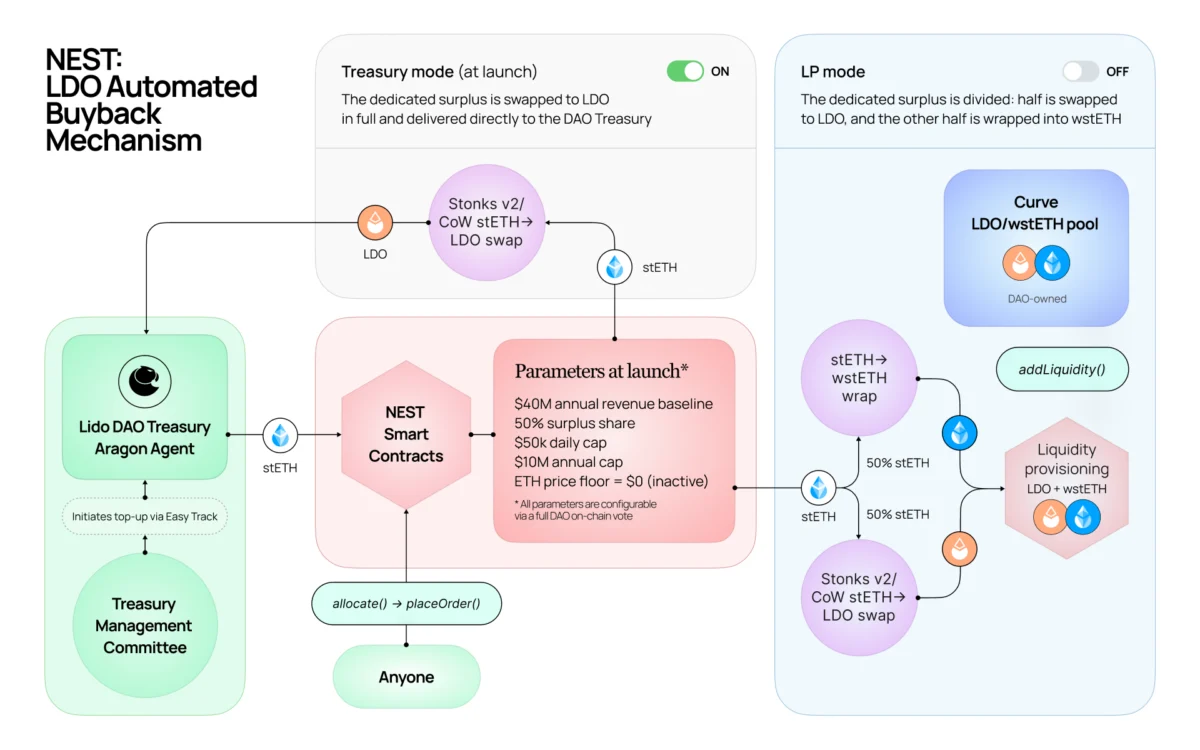
The Lido Decentralized Autonomous Organization (DAO), a leading entity in the liquid staking sector, has officially rolled out NEST (Network Economic Support Tokenomics), an innovative on-chain mechanism designed to intrinsically link the Lido protocol’s revenue success with the value accrual of its native governance token, LDO. This initiative, a direct outcome of the DAO’s publicly set strategic goals for 2025 and 2026 focused on LDO alignment, introduces an automated, transparent, and permissionless system for acquiring LDO tokens directly from the DAO’s treasury surpluses. The deployment of NEST represents a significant step forward in reinforcing the economic foundations of the Lido ecosystem, underscoring the DAO’s commitment to robust and decentralized governance principles.
Background: The Imperative for LDO Alignment
Lido DAO stands as a cornerstone of the decentralized finance (DeFi) landscape, particularly within the liquid staking derivatives (LSD) sector. By enabling users to stake their Ethereum (ETH) and other proof-of-stake assets while retaining liquidity through tokens like stETH, Lido has facilitated broader participation in network security and yielded significant growth in staked capital. The LDO token serves as the governance backbone of this expansive ecosystem, granting holders voting rights on critical protocol parameters, upgrades, and treasury management decisions.
However, a recurring challenge for many DAOs, including Lido, has been to ensure that the native governance token’s economic value is directly reflective of the protocol’s operational success and revenue generation. For Lido, this challenge was explicitly addressed in its strategic cycles for 2025 and 2026. These cycles, managed and delivered by the Lido Foundation under the DAO’s direction, prioritized "LDO alignment" – a mandate to tie LDO more directly to the Lido protocol’s burgeoning success. Community discussions and research papers, such as "A Product Line Approach to Grow Lido’s Staking Ecosystem" and "Lido’s Next Chapter," consistently highlighted the importance of strengthening this connection to foster long-term sustainability and value for LDO holders.
The strategic rationale behind NEST is multi-faceted. It aims to create a positive feedback loop where increased protocol revenue directly translates into LDO acquisition, thereby potentially reducing circulating supply and enhancing the token’s economic utility beyond pure governance. This programmatic approach replaces discretionary or committee-based buyback schemes with a transparent, verifiable, and fully automated on-chain process, aligning with Lido DAO’s ethos of decentralization and open governance.
Unpacking NEST: A Deep Dive into its Mechanism
At its core, NEST operates as a programmatic system that allocates a predefined portion of Lido protocol revenue to acquire LDO tokens. This process is triggered when staking revenue, specifically the DAO’s share, surpasses an established operational baseline. Once this threshold is met, a bounded share of the surplus revenue is systematically converted into LDO. The chosen execution venue for these acquisitions is CoW Swap, known for its efficient and MEV-protected trade execution, which helps minimize market impact and ensures optimal pricing for the DAO.
The mechanism’s design is meticulously detailed in LIP-36, a Lido Improvement Proposal that outlines its operational parameters and conditions. A fundamental principle guiding NEST is proportionality: "The more the protocol earns, the more LDO is bought." This direct correlation ensures that LDO holders benefit directly from the protocol’s growth and profitability, creating a tangible link between network activity and token value.
The development of NEST followed Lido DAO’s stringent governance standards, which prioritize transparency, security, and decentralization. Unlike simpler, more centralized buyback methods that were considered and ultimately rejected, NEST’s technical rails and mechanism design were rigorously debated and approved through fully on-chain votes. This commitment to decentralized governance extends to every aspect of the Lido ecosystem, from protocol upgrades passing through on-chain votes to stETH holders having built-in oversight via Dual Governance, and routine treasury allocations managed through optimistic Easy Track motions. This ensures that NEST, much like other critical Lido infrastructure, remains permissionless and under the full control of the DAO.
Modes of Operation: Treasury-Only vs. LP Mode
Recognizing the potential for market impact given the relative depth of on-chain LDO liquidity, NEST incorporates two distinct operational modes designed to optimize performance and flexibility:
-
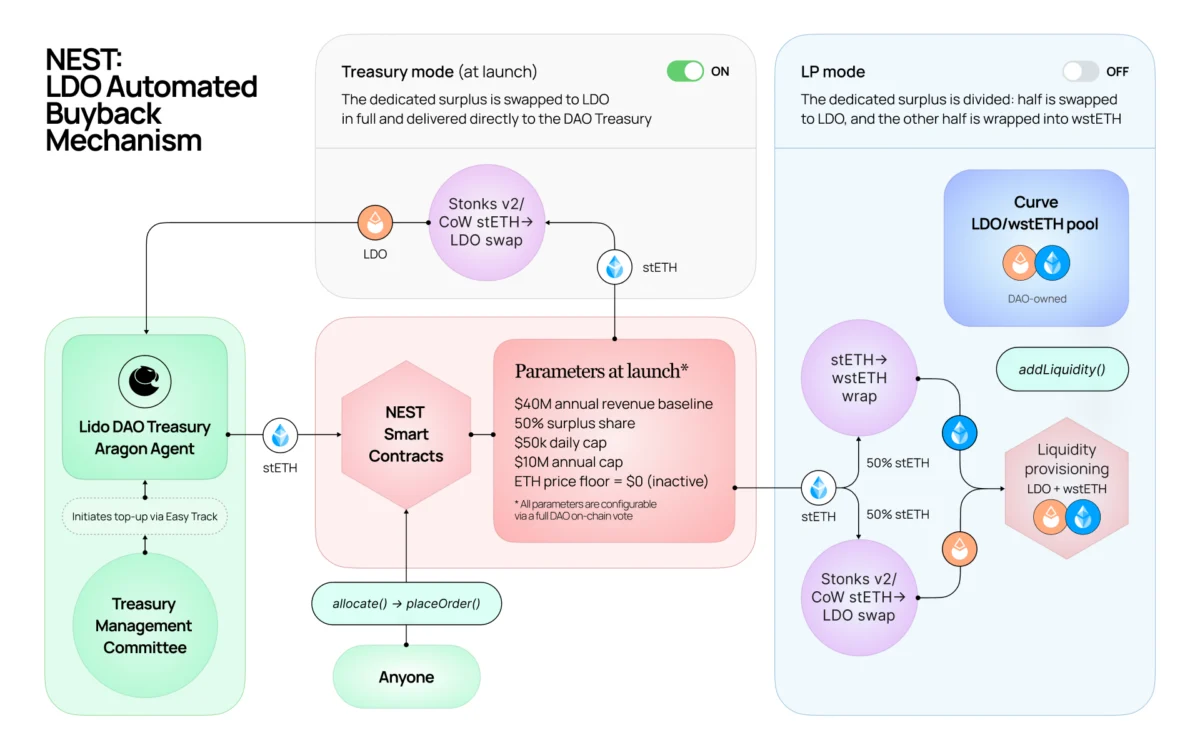
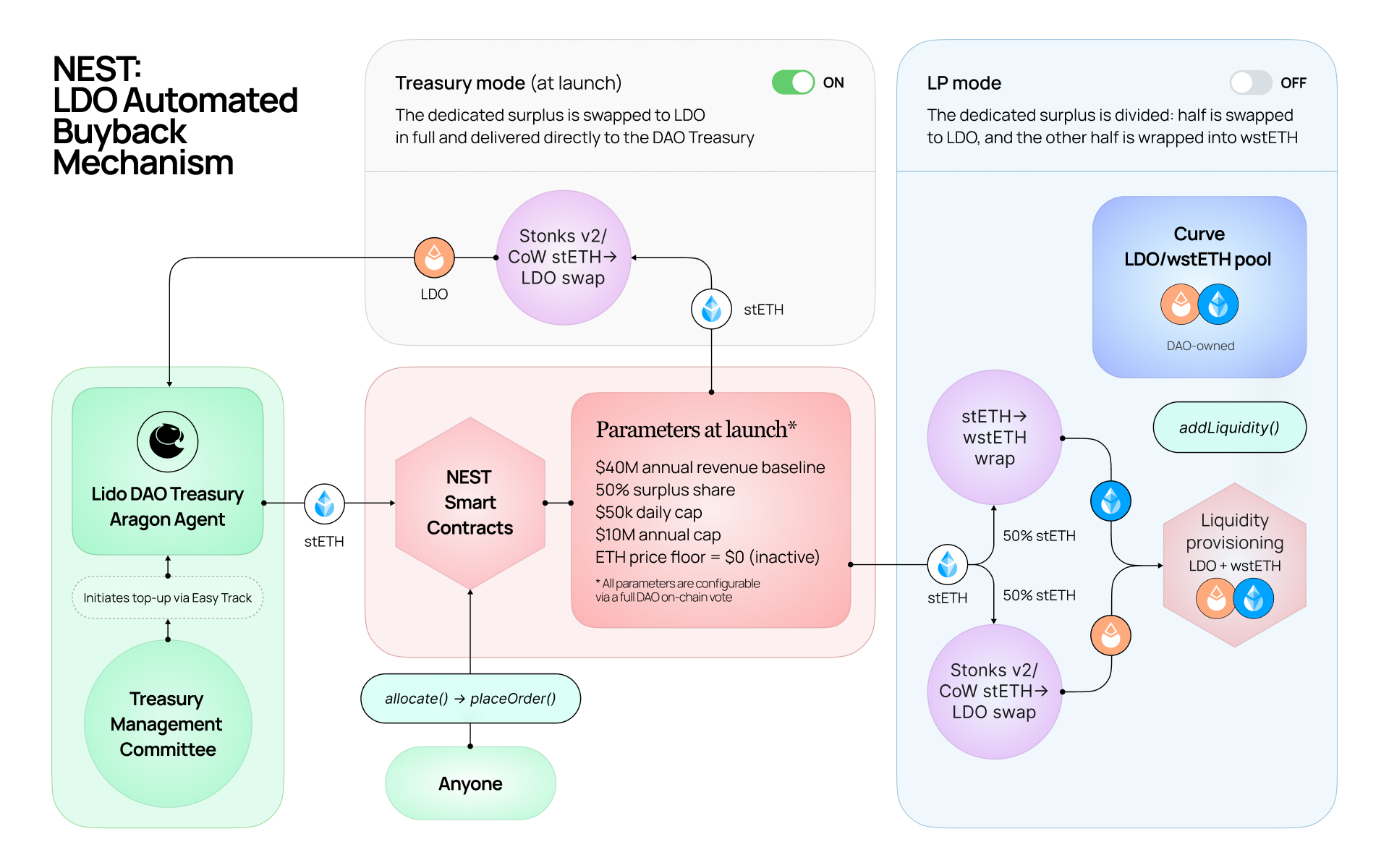
Treasury-only Mode: In this initial launch configuration, the daily allocated surplus is entirely converted into LDO tokens. These acquired LDO tokens are then transferred directly to the DAO treasury via an Aragon Agent contract (e.g.,
0x3e40D73EB977Dc6a537aF587D48316feE66E9C8c). This mode is straightforward, focusing on direct LDO accumulation for the DAO. It provides a clear, consistent mechanism for enhancing the DAO’s LDO holdings without immediately engaging in complex liquidity provision strategies. -
LP Mode (Liquidity Provision Mode): This mode is designed for future activation, subject to specific market conditions and a subsequent on-chain DAO vote. When active, the daily allocation is divided: half is used to purchase LDO, and the other half is wrapped into wstETH (wrapped staked ETH). Both assets are then deposited as DAO-owned liquidity into a dedicated Curve v2 NG pool. The resulting LP (Liquidity Provider) tokens remain under the DAO’s ownership. The primary benefit of LP mode is to enhance on-chain liquidity for LDO, potentially reducing slippage for larger trades and strengthening the LDO/wstETH pair. The Curve pool required for this mode has already been deployed, facilitating a seamless transition once the DAO decides to activate it.
NEST has been launched in Treasury-only mode, a pragmatic decision considering that the benefits of LP mode are realized most effectively under specific market dynamics. This phased approach allows the DAO to monitor NEST’s performance in its simpler form before introducing additional complexity, ensuring a measured and adaptive strategy for tokenomics management.
Governance and Flexibility: DAO Levers
A cornerstone of NEST’s design is its full on-chain and permissionless nature, empowering the Lido DAO with ultimate control. All key parameters governing NEST’s operation are set by the DAO and can be adjusted through subsequent on-chain votes. This ensures that the mechanism remains adaptable to evolving market conditions, protocol economics, and the broader strategic objectives of the DAO.
While NEST initially focuses on tracking Lido protocol staking revenue from Ethereum, its architectural design is forward-looking. It has been built to accommodate additional revenue sources as Lido’s product line expands across various blockchains and services. This modularity means that future governance votes could integrate revenue from new liquid staking offerings or other protocol activities into the NEST mechanism, further enhancing LDO’s value accrual potential and ensuring its relevance in an expanding ecosystem. This adaptability is critical for a dynamic organization like Lido, which continuously explores new avenues for growth and decentralization.
Key Parameters and Financial Projections
At its launch, NEST operates under a specific configuration of parameters, meticulously approved by the DAO:
- Revenue Baseline: The initial baseline for staking revenue, against which surpluses are calculated, is set at a specific threshold (e.g., X wstETH per day).
- Surplus Allocation Rate: 50% of the daily surplus revenue (the difference between actual revenue and the baseline) is allocated to the NEST balance.
- Daily LDO Purchase Cap: A crucial safety guardrail, this cap limits daily LDO acquisition to $50,000.
- Token Conversion Mechanism: CoW Swap is the designated platform for efficient LDO acquisition.
Each day, NEST automatically compares the DAO’s share of staking revenue against the predetermined revenue baseline. If the revenue exceeds the baseline, 50% of this difference is added to a running NEST balance. As long as this balance remains positive, NEST proceeds with daily LDO purchases, adhering strictly to the $50,000 daily cap. Should the balance turn negative, purchases are paused until new surplus revenue restores it.
This cumulative model was deliberately chosen over a simpler daily-spend approach to mitigate two primary failure modes: preventing overspending during periods of consecutively high revenue and enabling the mechanism to carry forward unused capacity during leaner periods. The $50,000 daily cap is particularly significant, acting as the primary safety mechanism. It bounds the DAO’s exposure over a typical six-day governance response window to approximately $300,000, allowing ample time for the DAO to intervene if unforeseen circumstances arise.
Extensive backtesting simulations conducted on Lido’s revenue data from 2024 to 2025 demonstrated the model’s effectiveness. The analysis showed that NEST would have successfully delivered its target spend of $7.09 million from a total of $94.18 million in rewards generated during that period. This historical validation provides strong evidence of NEST’s robust design and its ability to achieve its objectives within defined parameters. Detailed calculations, alongside comparisons with alternative design considerations, are fully documented in LIP-36 and extensively discussed on the Lido Research forum, ensuring complete transparency for the community. All these parameter values are, of course, adjustable through a full DAO vote, providing the flexibility needed as the protocol’s economics continue to evolve.
Mitigating Risks: Ensuring Robustness and Security
The implementation of any programmatic mechanism that autonomously manages and spends treasury assets introduces specific risks. The NEST mechanism’s design meticulously addresses these concerns:
- Price Impact: To mitigate significant market impact from LDO purchases, NEST employs the $50,000 daily cap and utilizes CoW Swap, an aggregator known for its ability to source liquidity across various venues and protect against maximal extractable value (MEV). This ensures that LDO acquisitions are executed efficiently with minimal market disruption.
- Operational Risk: The entire mechanism is on-chain and permissionless, meaning it operates autonomously without requiring manual intervention. This minimizes the potential for human error or manipulation, ensuring consistent execution.
- Smart Contract Risk: Given the critical nature of NEST, its smart contracts have undergone rigorous audits by leading blockchain security firms. These audits identify and rectify vulnerabilities, providing a high degree of assurance regarding the mechanism’s security and reliability. Furthermore, the design incorporates fail-safe mechanisms and limited exposure.
- Governance Risk: While the DAO controls the parameters, the mechanism’s operations are transparent and auditable on-chain. Any parameter changes require a full DAO vote, ensuring that community consensus is required for significant alterations. The daily spending cap further limits potential financial exposure during any governance dispute or delayed response.
Crucially, all LDO assets acquired through the NEST mechanism remain fully DAO-owned. Any movement or utilization of these assets outside the mechanism’s predefined operational paths would require explicit and verifiable authorization from the Lido DAO, reinforcing the principle of decentralized control and asset security.
Distinguishing NEST from the LDO Accumulation Program
It is important to differentiate NEST from the LDO Accumulation Program, a separate and distinct treasury operation approved by the Lido DAO on April 13, 2026. While both involve LDO acquisition, their nature, governance, and execution differ fundamentally. The LDO Accumulation Program is a discretionary, one-time initiative executed by a committee, allowing for flexibility in market timing and execution based on specific opportunities (e.g., "utilizing market opportunities: stETH/LDO trade"). In contrast, NEST is a structural, automated, and continuous on-chain mechanism driven by protocol revenue, operating under predefined, transparent rules without the need for committee discretion. Batch parameters, execution updates, and further details for the Accumulation Program are published separately on the Research forum, emphasizing its distinct identity from the NEST system.
Broader Implications and Future Outlook
The launch of NEST marks a pivotal moment for Lido DAO, setting a new standard for transparent and programmatic tokenomics management within the DeFi space. By directly linking protocol revenue to LDO acquisition, NEST not only enhances the economic alignment of the LDO token but also reinforces the DAO’s commitment to decentralization and long-term sustainability. It provides a clear, verifiable, and automated mechanism for value accrual, benefiting LDO holders and strengthening the overall health of the Lido ecosystem.
This move is particularly significant in the context of increasing scrutiny on DAO governance and treasury management. NEST exemplifies a best practice approach, offering a model of efficiency, transparency, and community control. As Lido continues to expand its liquid staking offerings across various blockchain networks, NEST’s flexible architecture positions it to adapt and integrate new revenue streams, ensuring LDO remains central to the protocol’s economic success. The mechanism not only solidifies LDO’s role as a governance token but also elevates its status as a direct beneficiary of Lido’s market leadership and operational efficiency, promising a more robust and resilient future for one of DeFi’s most critical infrastructures.