Layla Zulfa
Meta has officially entered the increasingly competitive arena of autonomous software engineering with the release of Muse Code, a terminal-based coding agent designed to navigate and modify massive software repositories with minimal human oversight. Powered by the company’s latest specialized model, Muse Spark 1.2, the tool represents Meta’s most significant effort to date to reclaim territory in a market currently dominated by Anthropic’s Claude Code and OpenAI’s advanced Codex iterations. The announcement, made via Meta’s AI research division on August 5, 2026, signals a shift in the industry’s focus from simple code completion to "long-horizon" agentic workflows that can span hours or even days of autonomous operation.
The Architecture of Muse Code and Muse Spark 1.2
At the heart of the new release is Muse Spark 1.2, a large language model that has been specifically "co-trained" alongside the Muse Code agentic framework. Unlike general-purpose models that are retrofitted for coding tasks, Meta asserts that Muse Spark 1.2 was developed with a training compute budget significantly scaled toward diverse coding environments and complex debugging scenarios. This co-training approach ensures that the model understands the specific tool-calling syntax and multi-step reasoning required by the agent, reducing the likelihood of "hallucinations" during complex repository-wide refactors.
Muse Code operates as an agentic layer above the terminal. It is built to handle the heavy lifting of modern software engineering: planning architectural changes, writing the necessary code, and executing validation tests to ensure the changes do not break existing functionality. One of its most distinctive architectural features is the use of persistent subagents. Rather than relying on a single monolithic process to solve a problem, Muse Code can spin up specialized sub-processes to handle specific sub-tasks—such as one subagent focusing on unit test generation while another refactors a core API. This parallelized, hierarchical approach is designed to solve difficult engineering problems faster and with higher precision than single-thread agents.
The "Restart-Safe" Innovation: A Single Source of Truth
While speed and accuracy are the standard metrics for AI models, Meta has identified a different priority for professional engineering environments: reliability. The standout feature of Muse Code is its runtime execution model. Every model call, tool execution, user approval, and file edit is recorded to a local event log. This log serves as a "single source of truth," making the entire session replay-exact.
In practical terms, this means the agent is "restart-safe." In the event of a system crash, power failure, or network interruption during a long-running task, Muse Code can read its local log and resume work at the exact point of failure. For enterprises dealing with 24-hour optimization jobs—such as the GPU kernel tuning demonstrated in Meta’s launch materials—this persistence is a critical differentiator. While competitors like OpenAI and Anthropic have focused on raw inference speed, Meta is betting that developers will value an agent that can "pick up where it left off" without wasting expensive compute cycles by starting from scratch.
Specialized Commands and Developer Workflow
Meta has integrated a series of default "skills" into the Muse Code terminal interface, designed to mirror the natural workflow of a human engineer. These commands are gated by user approval to maintain safety and oversight:
- /plan: This command instructs the agent to analyze a high-level task and break it down into a structured, multi-step plan. The agent will not proceed until the developer reviews and approves the proposed roadmap.
- /grill: Perhaps the most unique addition, this command triggers a "stress-test" mode where the agent identifies potential edge cases or flaws in its own plan. It iteratively refines the strategy until it reaches a high confidence threshold.
- /goal: Similar to the functionality found in agentic tools like Hermes, this command keeps the agent focused on the final objective, allowing it to autonomously pivot its strategy if it encounters unexpected errors during execution.
Benchmarking Performance Against the Industry
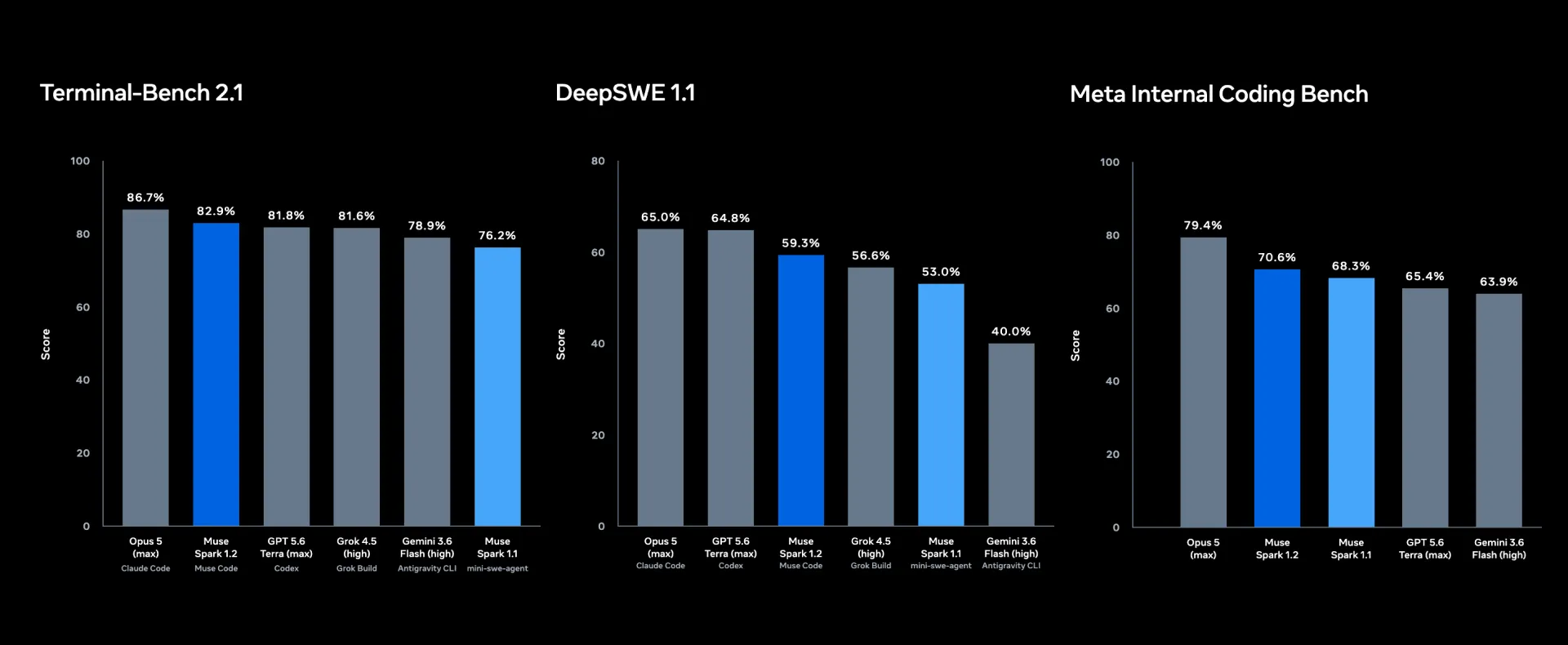
To justify its entry into a crowded market, Meta released a suite of benchmark results comparing Muse Spark 1.2 and Muse Code against the current industry leaders. The results suggest that while Meta has not yet achieved absolute supremacy in raw logic, it is firmly in the top tier of agentic performance.
On Terminal-Bench 2.1, a benchmark designed to test an agent’s ability to navigate a terminal and use command-line tools, Muse Code scored 82.9%. This puts it ahead of OpenAI’s GPT-5.6 Terra on Codex (81.8%) and xAI’s Grok Build (81.6%). However, it remains slightly behind Anthropic’s Claude Code (running on the Opus 5 model), which currently leads the field with a score of 86.7%.
In the DeepSWE 1.1 benchmark, which specifically measures the ability of an agent to resolve real-world GitHub issues (Software Engineering Intelligence), the gap was more pronounced. Muse Code achieved a 59.3% resolution rate, compared to 65.0% for Claude Opus 5 and 64.8% for OpenAI’s Codex. On Meta’s own internal coding benchmark, Muse reached 70.6%, trailing Opus 5’s 79.4%.
However, Meta argues that the true value of Muse Code is revealed through its "speedup" trajectory. In tests involving over 1,000 tool calls, the agent showed a consistent ability to improve its efficiency as a task progressed. While Opus 5 posted the highest overall gains (75% improvement over baseline), Muse Spark 1.2 maintained a competitive 61–69% improvement range. Meta’s engineers emphasize that for long-horizon tasks, the ability to maintain performance over thousands of tool calls is more vital than initial burst speed.
Multimodal Capabilities: The Video-to-Code Leap
A significant portion of Meta’s launch was dedicated to Muse Code’s multimodal capabilities, a feature that sets it apart from many text-only coding agents. In a widely circulated demonstration, a developer dropped an mp4 file—a 3D fly-through video of a residential property—directly into the Muse Code terminal.
The agent utilized Muse Spark 1.2’s multimodal vision processing to "interpret" the video content, identifying architectural features, lighting, and layout. It then autonomously generated the frontend and backend code for a visually rich, functional website, complete with a booking system and an interactive interface that mirrored the aesthetic of the video. This capability suggests that Meta is positioning Muse Code not just as a tool for backend logic, but as a comprehensive solution for rapid prototyping and frontend development based on visual assets.
Chronology of the Coding Agent Wars (2024–2026)
The release of Muse Code is the latest chapter in a two-year escalation of AI-driven development tools:
- Late 2024: The industry saw the rise of the first "agentic" wrappers around LLMs, with tools like AutoGPT and early versions of OpenDevin attempting to automate software engineering.
- Early 2025: Anthropic released the first version of Claude Code, which set a new standard for terminal-based integration and low-latency reasoning.
- Late 2025: OpenAI responded by evolving Codex into a multi-agent system capable of running parallel cloud-based subagents.
- Spring 2026: DeepSeek and other international players introduced high-efficiency, low-cost alternatives, further saturating the market.
- August 2026: Meta releases Muse Code, focusing on "restart-safe" reliability and multimodal integration as its primary competitive advantages.
Industry Implications and Safety Considerations
The introduction of an agent capable of running for 24 hours straight on high-performance hardware like Nvidia’s Hopper GPUs brings both opportunities and risks. Meta’s demo of the agent optimizing GPU kernels iteratively over 1,000 tool calls highlights the potential for AI to handle the "boring" but essential tasks of performance tuning.
However, the autonomy of such agents remains a point of contention among safety researchers. An agent that can autonomously edit large repositories and execute code for 24 hours could, if improperly constrained, introduce subtle vulnerabilities or incur significant compute costs. Meta has addressed these concerns by implementing the aforementioned approval-gated plans and the local event log, which allows developers to audit every single action taken by the agent after the fact.
Industry analysts suggest that Meta’s late entry into the market is a calculated move. By observing the limitations of early agents—specifically their tendency to fail during long tasks and their lack of multimodal "understanding"—Meta has built a tool that addresses the specific pain points of professional developers rather than just chasing benchmark scores.
Availability and Installation
Muse Code is currently in a beta testing phase. Meta has made the tool available to the developer community via a straightforward terminal installation process. Interested users can deploy the agent by executing the following command in a Unix-based terminal:
curl -fsSL https://dev.meta.ai/install.sh | bash
As the beta progresses, Meta plans to integrate Muse Code more deeply into its broader ecosystem of developer tools, with larger and more capable versions of the Muse Spark model expected to be released by the end of the year. The company’s move underscores a broader trend: the "coding assistant" era is ending, and the era of the "autonomous coding agent" has officially begun.