
 James Watt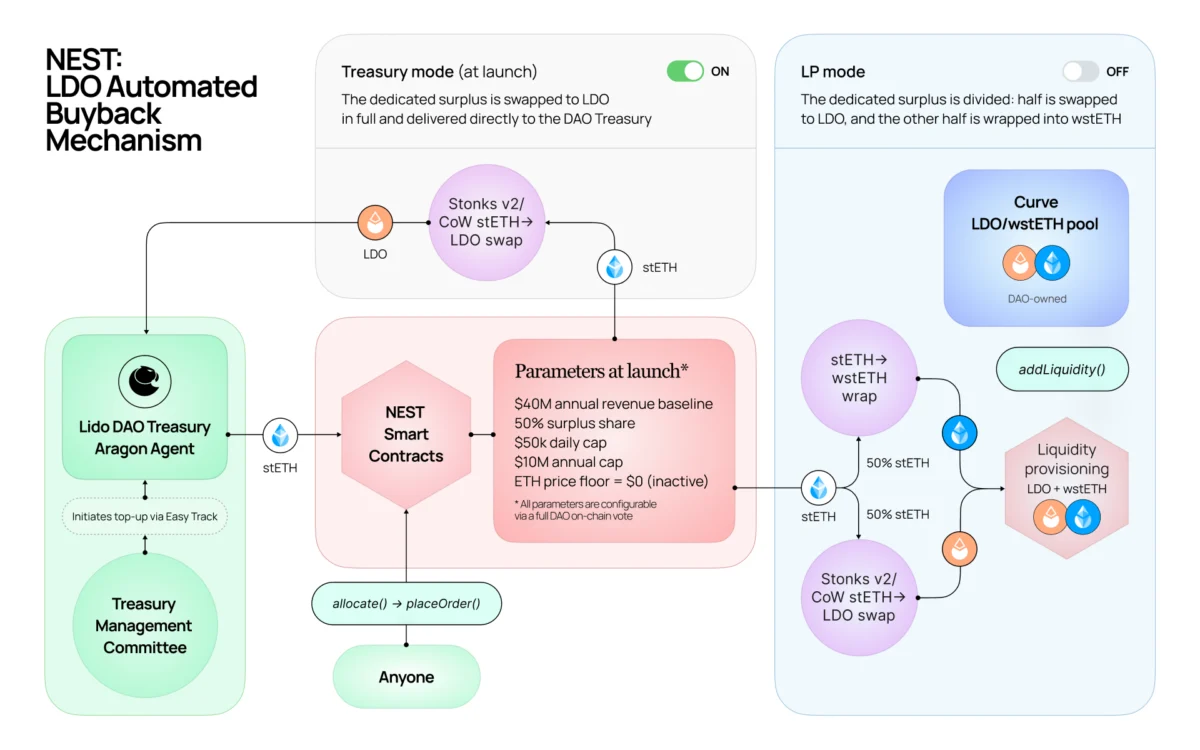
The Lido DAO, a leading decentralized autonomous organization in the liquid staking sector, has officially launched its Network Economic Support Tokenomics (NEST) mechanism. This innovative on-chain system is designed to directly link the success of the Lido protocol to the value accrual of its governance token, LDO, by utilizing DAO treasury surpluses for automated LDO acquisition. The initiative represents a significant stride in Lido’s ongoing strategic commitment to enhance the utility and economic alignment of the LDO token, a goal that has been a focal point of its open strategic cycles since 2025 and continued through 2026.
The Mandate for Alignment: Why NEST Was Born
Lido DAO operates with a robust framework of open strategic cycles, meticulously setting public goals and entrusting the Lido Foundations with their execution. Among these critical objectives for 2025, and reiterated for 2026, was a comprehensive LDO alignment strategy. This strategy aimed to forge a more direct and tangible connection between the operational success of the Lido protocol and the economic utility of the LDO token, moving beyond its primary function as a governance instrument. The underlying philosophy is that a governance token’s long-term sustainability and attractiveness are significantly bolstered when its value is intrinsically tied to the protocol it governs, creating a virtuous cycle of incentivized participation and shared success.
Lido stands as a dominant force in the liquid staking derivatives market, particularly for Ethereum, where it allows users to stake their ETH and receive stETH in return, maintaining liquidity while earning staking rewards. This innovative approach has garnered Lido a substantial market share, managing billions in staked assets and processing significant protocol revenue. The protocol’s success generates considerable treasury surpluses, derived from the fees collected on staking rewards. These surpluses form the financial bedrock for initiatives like NEST, ensuring that the mechanism is self-sustaining and directly benefits from the protocol’s growth. The imperative to strategically deploy these surpluses led to the conceptualization and development of NEST, a mechanism rooted in transparency, security, and decentralization – core tenets of the Lido DAO’s operational philosophy.
NEST’s Operational Blueprint: Automated and Transparent Buybacks
At its core, NEST is a programmatic system meticulously engineered to acquire LDO tokens using a defined portion of the Lido protocol’s revenue. This mechanism activates when staking revenue surpasses a predetermined operating baseline, converting a bounded share of the resultant surplus into LDO. The acquisition process is executed via CoW Swap, a decentralized exchange aggregator renowned for its Maximal Extractable Value (MEV) protection, ensuring efficient and fair trade execution. This systematic approach, detailed extensively in Lido Improvement Proposal (LIP-36), ensures that as the protocol’s earnings grow, so too does the volume of LDO acquired, thereby establishing a direct economic link.
The design rationale behind NEST strongly emphasizes automated buybacks that adhere to the highest standards of Web3 governance. Unlike traditional, often opaque, corporate share buyback programs, NEST is built to be entirely on-chain, permissionless, and under the full, transparent control of the Lido DAO. This commitment to decentralization is consistent with Lido’s broader governance mechanisms, where protocol upgrades are passed through fully on-chain votes, and a Dual Governance model provides stETH holders with built-in oversight of DAO decisions. Even routine treasury allocations are managed through optimistic Easy Track motions, reflecting a deep-seated belief in verifiable, community-driven decision-making. Lido DAO representatives have consistently emphasized that simpler, more centralized paths for LDO buybacks were thoroughly evaluated and ultimately rejected in favor of this robust, on-chain solution to maintain cryptographic trust and minimize counterparty risk. The technical rails for NEST were formally approved by the DAO on October 27, 2025, followed by the mechanism design approval on January 15, 2026, marking crucial milestones in its development and deployment.
Dual Modes for Optimal Performance
Recognizing the dynamic nature of on-chain liquidity, particularly for tokens like LDO, NEST’s buyback mechanism incorporates two distinct operational modes designed to optimize performance and market impact.
-
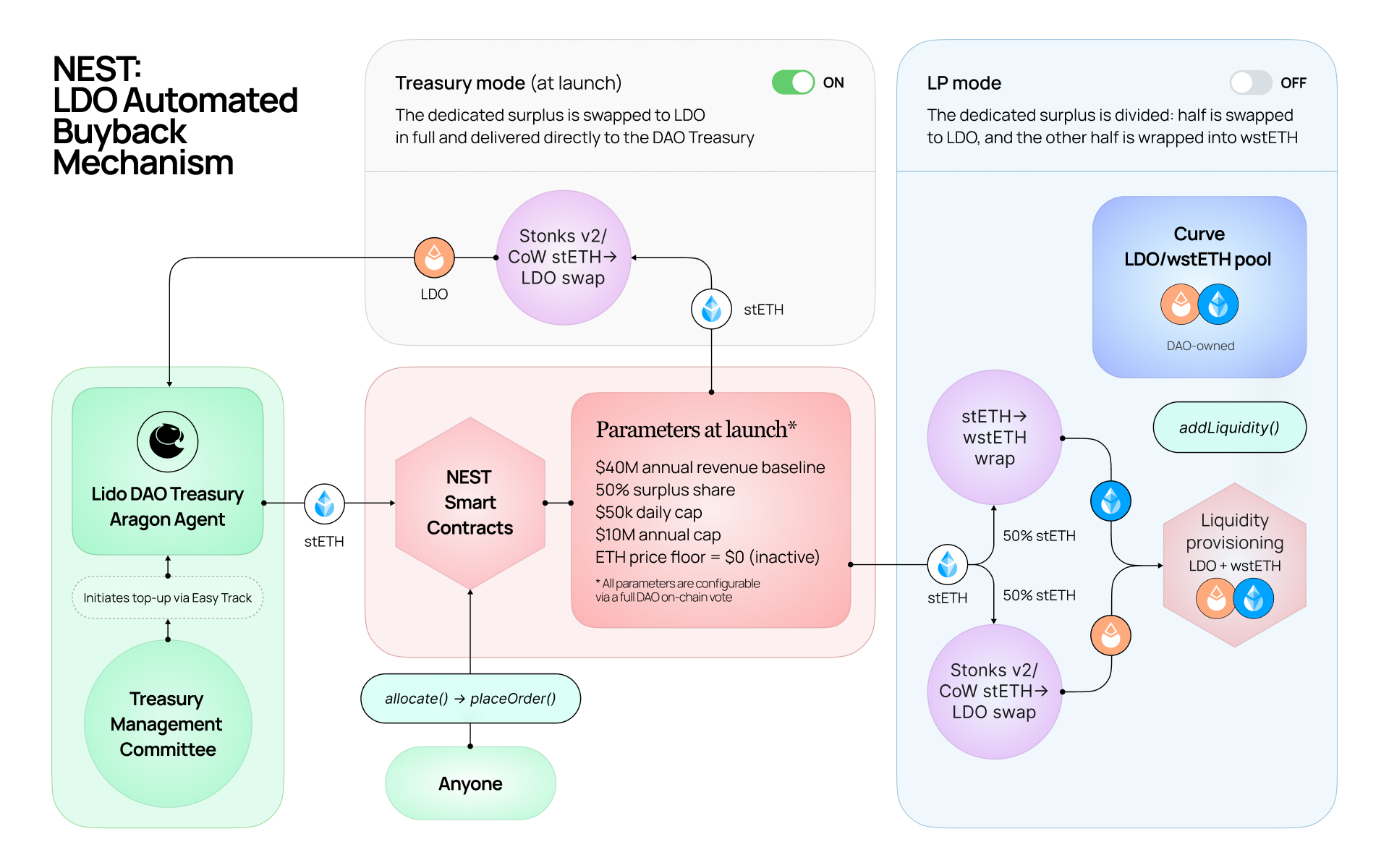
Treasury-only mode: In its initial launch phase, NEST operates in this mode. Here, the daily allocation of surplus revenue is entirely converted into LDO tokens. These acquired LDO tokens are then channeled directly into the DAO treasury via a dedicated Aragon Agent contract (0x3e40D73EB977Dc6a537aF587D48316feE66E9C8c). This mode is straightforward, focusing on direct accumulation of LDO by the DAO.
-
LP mode (Liquidity Provision mode): This mode offers a more nuanced approach. When activated, the daily allocation is split: half is used to purchase LDO, and the other half is wrapped into wstETH (wrapped staked Ethereum). Both components are then deposited as DAO-owned liquidity into a specialized Curve v2 NG pool. The resulting LP tokens, representing the DAO’s share of the liquidity pool, remain under full DAO ownership. The LP mode is designed to not only acquire LDO but also to enhance on-chain liquidity for the LDO/wstETH pair, which can contribute to more stable trading conditions and reduce slippage for larger trades.
The decision to launch NEST in Treasury-only mode was strategic, as LP mode delivers its full benefits primarily under specific market conditions, particularly when the Curve pool’s depth and activity warrant active liquidity provision. However, the foundational infrastructure for the Curve pool is already deployed, ensuring that a seamless transition to LP mode can be executed with only a single on-chain DAO vote when market conditions align. This inherent flexibility underscores the forward-thinking design of NEST, allowing the DAO to adapt its strategy to optimize for either direct accumulation or liquidity enhancement as needed.
Precision Engineering: Understanding NEST’s Core Parameters
The operational parameters governing NEST are meticulously defined and entirely controlled by the Lido DAO through on-chain votes, ensuring a fully permissionless and adaptable system. While NEST initially focuses solely on Lido protocol staking revenue, its architecture is built for scalability, capable of accommodating additional revenue sources from Lido’s expanding product line through future governance votes.
At launch, the NEST configuration approved by the DAO operates under a cumulative model. Each day, the mechanism performs a critical comparison: it measures the DAO’s share of staking revenue against a predefined revenue baseline. The difference, representing the surplus, is then subjected to a specific allocation rule – 50% of this difference (the share set at launch) is added to a running NEST balance. As long as this running balance remains positive, NEST proceeds to purchase LDO tokens daily, adhering to specified caps. Conversely, if the balance dips into negative territory, purchases are automatically paused until new protocol surplus replenishes it.
This cumulative model was a deliberate design choice, engineered to circumvent two common pitfalls of a purely daily-spend approach: the risk of overspending during a series of exceptionally profitable days, and the inability to carry forward unused purchasing capacity from less profitable periods. A key safety guardrail is the $50,000 daily cap on LDO purchases. This cap prudently bounds the protocol’s exposure, limiting it to approximately $300,000 over a six-day governance response window, providing ample time for the DAO to intervene if necessary.
To validate its efficacy and robustness, the NEST model was rigorously backtested against historical revenue data from 2024–2025. The results were compelling: the model would have successfully delivered its target spend of $7.09 million from a total of $94.18 million in protocol rewards during that period. This data provides concrete evidence of NEST’s ability to operate efficiently and predictably within its defined parameters. Comprehensive calculations and detailed comparisons against alternative designs are publicly documented in LIP-36 and discussed extensively on the Lido Research forum, upholding the DAO’s commitment to transparency. Crucially, all parameter values within NEST are fully adjustable through a complete DAO vote, empowering the community to fine-tune the mechanism as Lido’s protocol economics and the broader market evolve.
Fortifying the Mechanism: Risk Mitigation Strategies
The introduction of a programmatic mechanism that autonomously manages and spends treasury assets daily inherently introduces a unique set of risks. The NEST mechanism has been meticulously designed to address each of these potential vulnerabilities:
- Governance Response Window: The daily purchasing cap of $50,000 serves as a primary safeguard. By limiting daily expenditure, it provides a sufficient buffer for the DAO to react to unforeseen circumstances. With a typical six-day governance voting window, the maximum exposure before a DAO decision can be enacted is approximately $300,000. This controlled exposure ensures that any potential issues can be addressed before they escalate significantly.
- Smart Contract Security: Given that NEST is an on-chain mechanism handling significant assets, its smart contracts are subject to the highest standards of security. This includes rigorous independent audits by leading blockchain security firms and formal verification processes to mathematically prove the correctness of the code. These measures are designed to identify and eliminate vulnerabilities, ensuring the integrity and reliability of the system.
- External Dependencies: NEST relies on external protocols for its operations, notably CoW Swap for LDO acquisition and Chainlink oracles for reliable price feeds. To mitigate risks associated with these dependencies, the design incorporates fallback mechanisms and safeguards. CoW Swap’s unique batch auction and MEV protection capabilities inherently reduce market manipulation risks during LDO purchases, while Chainlink’s decentralized oracle network provides robust and tamper-proof data feeds, crucial for accurate revenue calculations.
- Market Impact: To prevent large, sudden market movements that could be caused by significant buy orders, NEST implements daily purchasing caps. Furthermore, its integration with CoW Swap, which optimizes trade execution across multiple liquidity sources and protects against MEV, helps to minimize market impact and ensure efficient LDO acquisition without causing undue price volatility.
A fundamental principle underpinning NEST is that all assets acquired through the mechanism remain under the explicit ownership and control of the Lido DAO. Any movement or utilization of these NEST-purchased assets outside of the mechanism’s pre-defined operational paths requires explicit and direct authorization through a full DAO vote. This ensures that the community retains ultimate sovereignty over its treasury, reinforcing the decentralized nature of the entire operation.
Distinction from Other Initiatives: The LDO Accumulation Program
It is crucial to differentiate NEST from the LDO Accumulation Program, a separate and distinct treasury operation approved by the Lido DAO on April 13, 2026. While both involve LDO acquisition by the DAO, their design, governance, and execution methodologies are fundamentally different. The LDO Accumulation Program is a discretionary, one-time initiative executed by a designated committee, allowing for flexible responses to specific market opportunities. It is not a structural, programmatic mechanism like NEST. Batch parameters, execution updates, and further details for the LDO Accumulation Program are published separately on the Lido Research forum, emphasizing its distinct nature and purpose. NEST, by contrast, is an ongoing, automated, and rule-based system embedded directly into the protocol’s economic fabric.
Broader Implications and Future Outlook
The launch of NEST marks a pivotal moment for Lido DAO and its LDO token holders. For LDO holders, the mechanism introduces a tangible source of demand for the token, directly tied to the protocol’s revenue performance. This could lead to enhanced price stability and a stronger value proposition for LDO, transforming it from merely a governance token into one with a more robust economic foundation. By aligning the interests of token holders more closely with the operational success of the protocol, NEST incentivizes active participation and long-term commitment to the Lido ecosystem.
For the Lido protocol itself, NEST strengthens its long-term sustainability and competitive edge in the fiercely contested liquid staking market. It demonstrates a mature approach to DAO treasury management, leveraging protocol surpluses in a transparent and economically beneficial manner. The ability to expand NEST’s architecture to include additional revenue sources in the future, as Lido’s product line diversifies, positions the protocol for sustained growth and innovation. This forward-looking design suggests a strategic vision that anticipates future market developments and the evolving needs of its community.
Market observers and analysts are likely to view NEST as a significant development, potentially setting a new benchmark for tokenomics design within the broader DeFi ecosystem. It exemplifies how decentralized autonomous organizations can implement sophisticated, on-chain value accrual mechanisms that are both transparent and highly resistant to manipulation. This innovative approach provides a compelling alternative to traditional corporate finance strategies, showcasing the unique advantages of Web3’s decentralized and programmable nature. Lido Foundation representatives, while not issuing direct statements for this announcement, have historically underscored the DAO’s unwavering commitment to decentralization and transparent governance, principles that NEST embodies fully.
In conclusion, NEST represents more than just an LDO buyback mechanism; it is a structural evolution in Lido’s tokenomics, designed to fortify the LDO token’s economic alignment with the protocol’s success. Through its transparent, automated, and risk-mitigated design, NEST is poised to become a cornerstone of Lido DAO’s long-term strategy, enhancing value for its community and further cementing its position as a leader in the decentralized finance landscape.









