admin
admin
The European Union’s Markets in Crypto-Assets (MiCA) regulation is reshaping the global digital asset landscape, leading to a significant slowdown in new cryptocurrency exchange listings and a strategic shift in trading pair offerings. This comprehensive regulatory framework, designed to standardize and supervise the burgeoning crypto market across all EU member states, has exerted considerable influence even before its full implementation in December. The impact is particularly evident in the United States, where heightened regulatory scrutiny, coupled with political considerations surrounding the upcoming 2024 Presidential elections, has created an environment of caution for exchanges and digital asset firms.
MiCA’s extensive reach extends beyond EU borders, encompassing any business offering services to EU customers or utilizing the Euro. This extraterritorial scope means that global exchanges, even those not headquartered within the EU, must comply with its stringent rules. The regulation addresses a wide array of digital assets, including stablecoins, and establishes clear guidelines for their issuance, trading, and custody. While not the EU’s first foray into crypto regulation, MiCA is distinguished by its explicit targeting of the rapidly expanding Decentralized Finance (DeFi) sector within the region.
The initial phase of MiCA’s implementation, focusing on stablecoin legislation that went live at the end of June, has already prompted significant adjustments. Companies worldwide are recalibrating their operations to adhere to the new requirements, with some, like Kraken, reportedly considering the delisting of Tether (USDT) in Europe due to MiCA-related concerns. This proactive adaptation underscores the perceived gravity of the regulation and its potential to influence global market practices.
Regulatory Headwinds in the US Amplify Global Caution
The intensifying regulatory pressure in the United States has undeniably contributed to the prevailing cautious sentiment in the global crypto market. With digital assets, particularly Bitcoin, becoming an increasingly prominent feature in the political discourse leading up to the 2024 Presidential elections, uncertainty surrounding future policies has put both established and emerging companies on edge. This political dimension adds another layer of complexity to an already evolving regulatory environment.
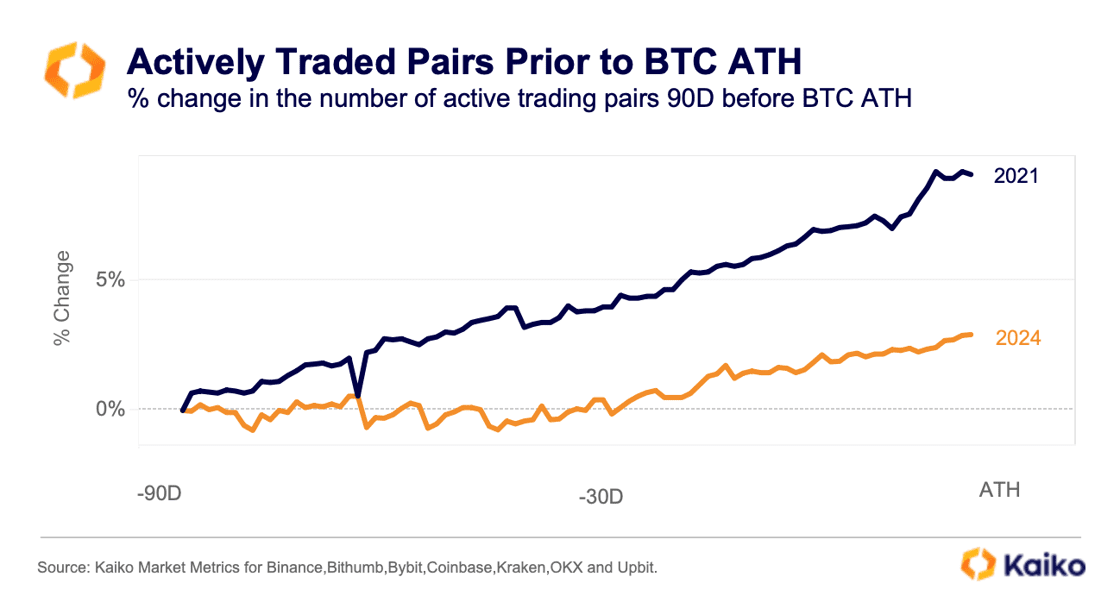
Data compiled by Kaiko, a leading cryptocurrency market data provider, offers compelling evidence of this shift. The rate at which new trading pairs are being listed on centralized exchanges has demonstrably slowed since the zenith of the 2021 bull run. This deceleration is particularly noticeable among exchanges serving customers in the EU and the US. Kaiko’s analysis reveals a stark decline in the growth rate of new trading pairs, falling from a robust 9% prior to Bitcoin’s all-time high in 2021 to a mere 3% in the lead-up to its 2024 peak. This indicates a significant recalibration of listing strategies by exchanges, prioritizing consolidation and compliance over aggressive expansion.

Exchange-Specific Trends Reveal Divergent Impacts
Examining the data at the exchange level provides a more granular understanding of these trends. Binance, a dominant player in the global cryptocurrency market, has experienced a slower pace of new trading pair growth compared to its peers. Its active trading pairs remain 14% below their 2022 peak. While MiCA’s influence is a contributing factor to this slowdown, Binance has also been navigating a broader global slowdown in recent months.
Furthermore, the exchange has faced substantial regulatory challenges in various jurisdictions worldwide. The ongoing legal proceedings against its founder and former CEO, Changpeng Zhao, including charges brought forth by the U.S. Department of Justice, have cast a long shadow. The significant fines and potential prison sentence sought by the DOJ, coupled with the legal battles faced by Binance.US in the past year, have undoubtedly impacted its global market dominance and likely influenced its approach to listing new assets.
In contrast, Bybit has demonstrated remarkable resilience, with its active trading pairs reaching an all-time high during the market rally in May. This robust performance can be largely attributed to its customer base, with a significant majority located in countries outside the EU. Consequently, Bybit appears to be largely insulated from the direct impact of MiCA.
A similar trend is observable in South Korean exchanges. Bithumb, in particular, has witnessed rapid growth in new listings, even surpassing Upbit in this regard. This surge has, in turn, attracted increased regulatory attention from South Korean authorities, who are still in the process of developing a comprehensive regulatory framework for the industry. The dynamic regulatory landscape in emerging markets, often characterized by a more permissive approach, contrasts sharply with the tightening grip seen in established economies like the EU and the US.
The Rise of Stablecoin Pairs and Emerging Market Resilience
The overall slowdown in new exchange listings, coupled with a discernible shift towards listing more stablecoin pairs, has contributed to a deceleration in the broader growth trajectory of the cryptocurrency market. This strategic pivot towards stablecoins can be interpreted as a response to regulatory demands for greater transparency and predictability, as well as a reflection of investor demand for less volatile trading options.
However, emerging markets are exhibiting a notable degree of resilience and continued demand for cryptocurrencies. Several factors are fueling this trend. Persistent inflation, currency volatility in certain regions, and a relative lack of stringent regulatory oversight in some developing economies are driving individuals and businesses towards digital assets as a store of value and a medium of exchange. This divergence highlights the multifaceted nature of the global crypto adoption curve, where regulatory environments play a pivotal role in shaping market dynamics.
Broader Implications and Future Outlook
The current regulatory climate, spearheaded by MiCA in the EU and ongoing scrutiny in the US, signals a maturing phase for the cryptocurrency industry. While the immediate impact is a slowdown in new listings and a period of strategic adjustment, the long-term implications could be far-reaching. The increased regulatory clarity provided by frameworks like MiCA, despite initial hurdles, is crucial for fostering institutional adoption and building greater investor confidence.
For exchanges, the path forward likely involves a more selective and compliance-driven approach to listing new assets. This may lead to a more curated ecosystem, where projects with robust legal compliance and clear utility are prioritized. The focus might shift from sheer volume of listings to the quality and sustainability of the assets being introduced to the market.
The divergence between regulated markets and emerging economies also presents an interesting dynamic. As mature markets grapple with regulatory complexities, emerging markets may continue to see organic growth driven by local economic conditions and a higher appetite for risk. This could lead to the rise of new regional crypto hubs and innovation centers.
The data from Kaiko underscores a significant transformation. The era of unbridled expansion in exchange listings appears to be giving way to a more measured and regulated approach. This evolution, driven by regulatory pressures and the increasing institutionalization of the crypto space, is likely to continue shaping the market for the foreseeable future. The challenge for regulators and industry players alike will be to strike a balance that fosters innovation while safeguarding investors and maintaining financial stability. The next few years will be critical in observing how these regulatory frameworks evolve and how the global cryptocurrency market adapts to this new paradigm.