Nila Kartika Wati
OKX Europe, a prominent cryptocurrency exchange operating across the European Union and European Economic Area, has launched a new one-way conversion feature, enabling its customers to seamlessly deposit Tether’s USDT and convert it into Circle’s USDC. This strategic move provides a regulated migration pathway for users as the European Union’s groundbreaking Markets in Crypto-Assets (MiCA) regulation significantly limits support for stablecoins that do not meet its stringent authorization requirements, a category that currently includes the world’s largest stablecoin, USDT. The initiative underscores a broader industry pivot towards compliance as the EU’s comprehensive crypto framework fully came into effect on July 1.
The newly implemented feature, detailed in a company announcement shared with industry media, allows customers to deposit their existing USDt (USDT) holdings into their OKX Europe accounts. Following the deposit, these tokens can then be converted into USDC (USDC), which is recognized as one of the largest stablecoins actively pursuing or already aligned with the regulatory standards set by the European Union’s MiCA framework. This functionality is crucial for users who find their current crypto platforms in Europe are no longer able to accept USDT or are planning to automatically convert customer balances into compliant alternatives, thereby offering a user-centric solution to navigate the evolving regulatory landscape.
The Regulatory Imperative: MiCA’s Transformative Impact on Stablecoins
The European Union’s Markets in Crypto-Assets (MiCA) regulation represents a landmark legislative effort, positioning the EU at the forefront of global cryptocurrency regulation. Adopted in June 2023, MiCA aims to establish a harmonized legal framework for crypto-assets across all 27 EU member states and the three EEA countries (Iceland, Liechtenstein, and Norway). The regulation is designed to foster innovation while ensuring investor protection, market integrity, and financial stability, and to prevent market abuse and illicit financial activities. Its phased implementation saw rules for stablecoins and e-money tokens take effect in late 2024, with the full framework rolling out on July 1, 2024.
A cornerstone of MiCA’s provisions is its rigorous approach to stablecoins, categorizing them into "e-money tokens" (EMTs) and "asset-referenced tokens" (ARTs). EMTs are stablecoins that aim to maintain a stable value by referencing only one fiat currency, akin to traditional electronic money. ARTs, on the other hand, derive their value by referencing any other value or right, or a combination thereof, including one or several fiat currencies, one or several crypto-assets, or one or several commodities. Both categories are subject to strict requirements, including authorization by a competent national authority, robust reserve backing, comprehensive whitepapers, and stringent governance structures. Issuers must hold reserves in highly liquid, low-risk assets, segregated from their own operating funds, and held with credit institutions. These requirements are particularly impactful for stablecoin issuers, demanding significant operational and structural changes to comply with European standards.
Tether’s Deliberate Stance Against MiCA Authorization
In stark contrast to the proactive compliance efforts seen from many other market participants, Tether, the issuer of USDT, has explicitly chosen not to seek MiCA authorization for its flagship stablecoin. This decision has been a significant driver behind the widespread restrictions and delistings of USDT across European crypto platforms. Tether CEO Paolo Ardoino has been an outspoken critic of the MiCA framework, particularly its reserve requirements.
Ardoino has repeatedly argued that MiCA’s stipulations, which mandate that a portion of stablecoin reserves be held with European credit institutions, introduce unnecessary risks for stablecoin issuers. In a May 2025 interview, he characterized the framework as "very dangerous when it comes to stablecoins," suggesting that such requirements could expose stablecoin issuers to the potential fragilities of the traditional banking system. He maintained that Tether’s primary focus remains on maintaining robust, diversified reserves and prioritizing global accessibility, even if it meant sacrificing support on European exchanges. This position was reiterated in a July 2025 post on X (formerly Twitter), where Ardoino stated that Tether would only reconsider seeking MiCA authorization "when MiCA becomes safer for consumers and stablecoin issuers." This steadfast stance highlights a philosophical divergence between Tether’s operational principles and the regulatory philosophy underpinning MiCA, creating a fragmented regulatory environment for the global stablecoin leader.
OKX Europe’s Proactive Approach and User Empowerment
OKX Europe’s introduction of the one-way conversion feature is a clear demonstration of its commitment to navigating the complex regulatory landscape while prioritizing user needs and regulatory adherence. By offering this elective conversion, OKX distinguishes itself from platforms that have opted for automatic, platform-imposed deadlines, providing users with discretion and control over their assets. The exchange explicitly stated that conversions could be completed at the customer’s discretion, rather than under pressure from an exchange-mandated timeline.
This approach is particularly beneficial for users whose existing platforms in the EU or EEA have either already ceased supporting USDT or have announced plans for automatic conversion of balances. For these users, OKX Europe provides a safe harbor, allowing them to consolidate their USDT holdings and convert them into a MiCA-compliant asset like USDC within a regulated environment. Operating under a MiCA license, OKX Europe serves customers across 30 EU and European Economic Area countries, solidifying its position as a compliant and user-friendly gateway to the European crypto market. The exchange’s strategy aligns with the overarching goal of MiCA: to provide clarity, stability, and consumer protection within the digital asset space.
The Stablecoin Landscape: USDT’s Global Dominance Meets European Regulatory Headwinds
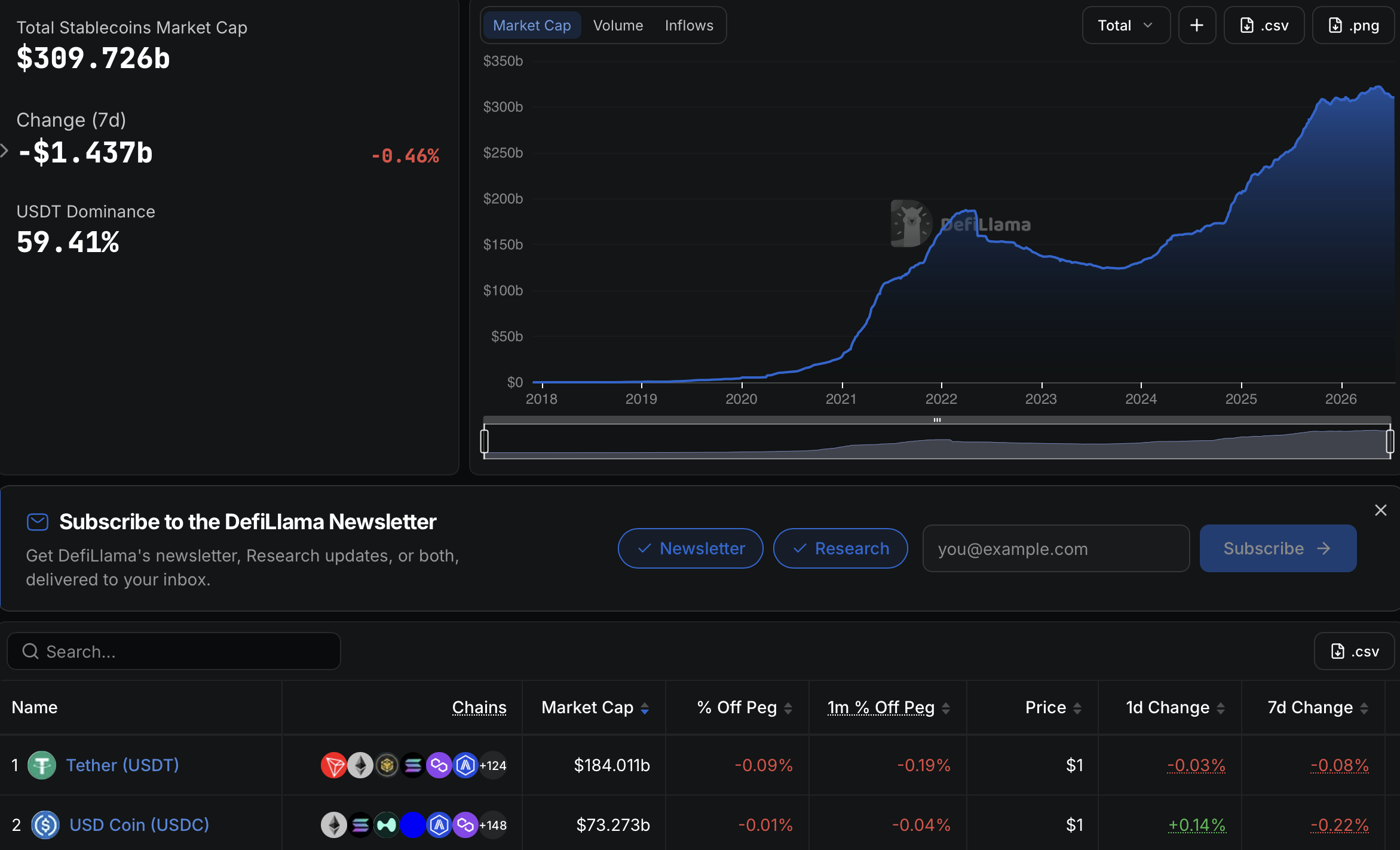
Globally, USDT remains the undisputed leader in the stablecoin market. According to data from DefiLlama, Tether accounts for approximately 59% of the nearly $310 billion total stablecoin market capitalization. With a market capitalization hovering around $184 billion, USDT’s dominance is a testament to its first-mover advantage, widespread adoption, deep liquidity across numerous exchanges, and significant utility in decentralized finance (DeFi) ecosystems, particularly in emerging markets where it often serves as a primary on-ramp and off-ramp for fiat currencies.
In contrast, Circle’s USDC holds a significant, but smaller, share of the market, with a market capitalization of approximately $73 billion. However, USDC has actively positioned itself as a stablecoin committed to regulatory compliance across various jurisdictions. Circle has engaged proactively with regulators globally, seeking to align its operations and reserve management with evolving legal frameworks. This proactive stance makes USDC a natural fit for MiCA compliance, allowing it to become the preferred stablecoin for regulated European entities. The European market, with its substantial economic influence and a growing appetite for digital assets, presents a critical battleground where regulatory compliance is proving to be a more decisive factor than mere market size or historical dominance. The current situation thus creates a significant divergence: while USDT remains the global hegemon, its path in the regulated European market is increasingly constrained, paving the way for compliant alternatives like USDC to gain substantial traction.
Broader Industry Reactions and Emerging Precedents
The actions taken by OKX Europe are not isolated but reflect a broader trend within the European crypto industry as platforms adapt to MiCA. The most prominent example beyond OKX is the digital banking platform Revolut, which recently announced its decision to cease supporting USDT for its customers in the European Economic Area and Switzerland. Revolut has given its users until August 31 to either sell or withdraw their USDT holdings, after which any remaining balances will be automatically converted into their base currency. This move by a mainstream financial application highlights the significant regulatory pressure on all entities operating within the EU/EEA.
Many other European platforms are also quietly restricting USDT deposits, delisting trading pairs, or advising users to convert their holdings into MiCA-compliant alternatives. This collective industry shift underscores the seriousness with which MiCA is being treated and the speed at which the European crypto ecosystem is recalibrating. The European Securities and Markets Authority (ESMA) has also been actively involved in the MiCA rollout, notably adding new Crypto-Asset Service Providers (CASPs) to its MiCA register, signaling the ongoing formalization of the regulatory landscape and the expectation that all market participants will either comply or cease operations within the regulated sphere. These precedents establish a clear message: to operate within the EU, stablecoin issuers and the platforms facilitating their trade must adhere to the prescribed regulatory standards.
Implications and Future Outlook
The unfolding scenario carries significant implications for various stakeholders within the cryptocurrency ecosystem. For European users, the primary benefit is increased regulatory certainty and enhanced consumer protection. While they might experience a temporary reduction in the variety of stablecoin choices, the shift towards MiCA-compliant assets is intended to safeguard their investments and ensure greater transparency and stability.
For exchanges operating in the EU, the imperative is clear: adapt or face market exclusion. Platforms like OKX Europe, by proactively introducing features like the one-way USDT to USDC conversion, are demonstrating their commitment to compliance, which can serve as a competitive advantage. However, this adaptation also entails operational challenges and significant costs associated with implementing new systems, legal frameworks, and compliance protocols.
For Tether, the decision not to seek MiCA authorization implies a strategic withdrawal from a major economic bloc. While USDT’s global dominance is unlikely to be immediately threatened, this move will lead to a loss of market share within the EU, potentially compelling Tether to reconsider its stance in the long term or to focus its growth efforts more intensely on other regions with less stringent or different regulatory frameworks. The fragmentation of the global stablecoin market along regulatory lines appears increasingly likely.
Conversely, for USDC and other stablecoins pursuing MiCA compliance, this presents a substantial opportunity for growth and increased adoption in the European market. By becoming "white-listed" assets, they are poised to capture the market share relinquished by non-compliant stablecoins, strengthening their position as reliable, regulated digital currencies.
Ultimately, the broader stablecoin market is entering a new phase characterized by regulatory divergence. The tension between the desire for decentralized, permissionless innovation and the increasing demands for regulatory oversight will continue to shape the landscape. While global stablecoin leaders like USDT may maintain their dominance in less regulated environments, the European Union’s MiCA framework is undeniably carving out a distinct, regulated ecosystem where compliance is paramount. The actions of OKX Europe, therefore, are not merely a technical update but a significant indicator of how the global crypto market is evolving in response to mature and comprehensive regulatory frameworks. The coming months will likely see further adjustments as the industry fully internalizes and responds to the new reality of MiCA.