
 James Watt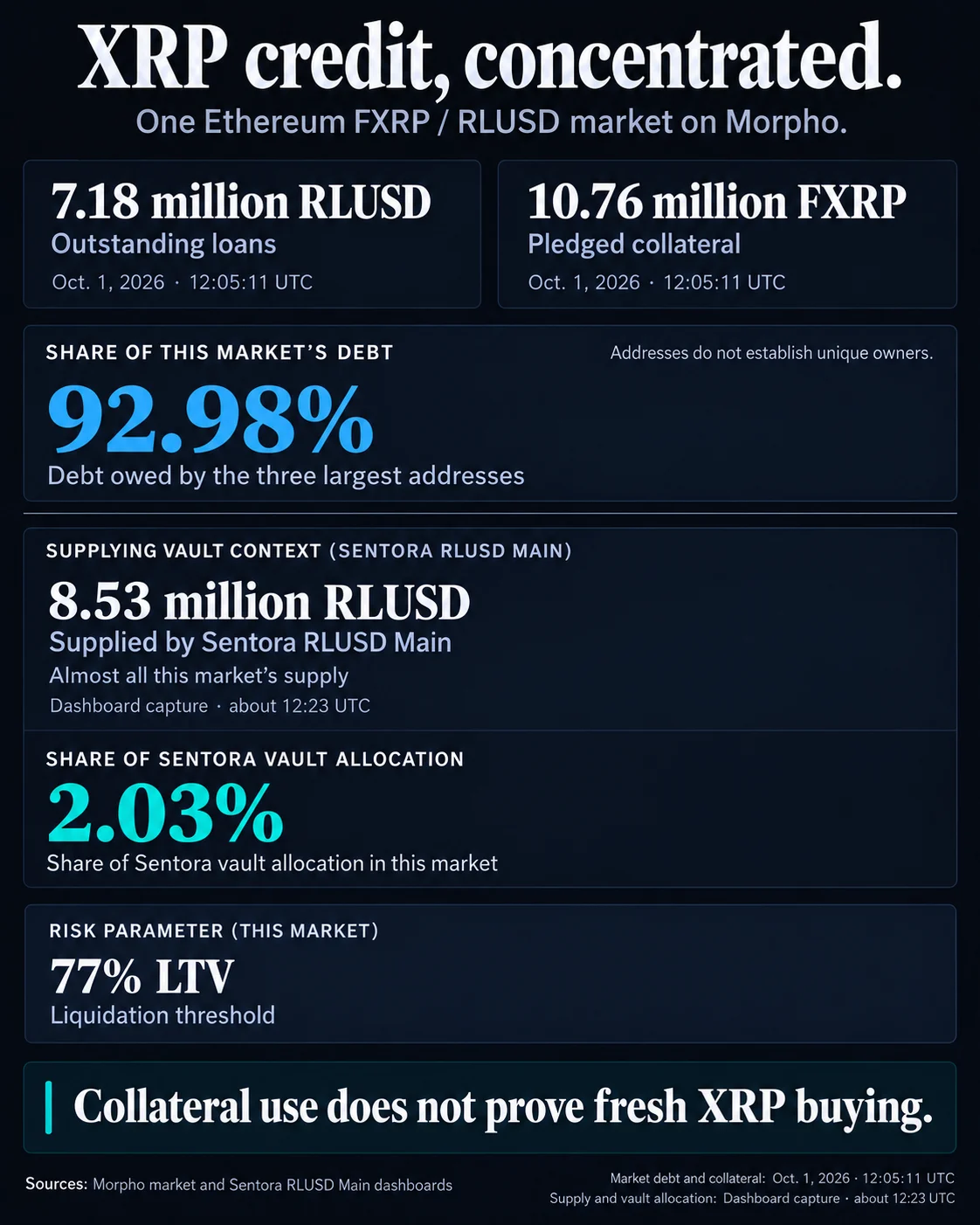
The decentralized finance (DeFi) ecosystem has reached a significant milestone as XRP begins to support live dollar-denominated borrowing on the Ethereum blockchain, marking a pivotal shift in the asset’s utility from a pure payment currency to a sophisticated collateral asset. This development is facilitated through a specialized market on Morpho, a decentralized lending protocol, where FXRP—a tokenized representation of XRP issued via the Flare Network—serves as the primary collateral. As of October 1, the market recorded approximately 7.18 million RLUSD in outstanding loans backed by 10.76 million FXRP. However, despite the technical achievement of cross-chain credit, the market’s current structure reveals a high degree of concentration, with a mere three addresses accounting for 93% of the total debt, raising questions about the immediate breadth of adoption among the wider XRP community.
The Infrastructure of XRP-Backed Credit on Ethereum
The emergence of XRP borrowing on Ethereum is the result of a multi-layered technical integration involving the XRP Ledger (XRPL), the Flare Network, and the Morpho protocol. The process begins with Flare’s FAsset system, which allows users to mint FXRP by locking native XRP. This tokenized version is then bridged to Ethereum, where it can be utilized within the vast DeFi ecosystem.
The primary utility of this market is to allow XRP holders to access liquidity in the form of Ripple’s RLUSD stablecoin without liquidating their underlying XRP positions. This "hold and borrow" strategy is a cornerstone of DeFi, typically used by long-term investors who wish to maintain market exposure while funding operational costs or pursuing other investment opportunities. However, the transition from native XRP to bridged FXRP introduces a layer of complexity. Borrowers must navigate bridge dependencies, smart contract risks on both Flare and Ethereum, and the specific redemption protocols of the FAsset system. These factors represent a departure from the relative simplicity of holding XRP directly on its native ledger or within a centralized exchange.
Analyzing the Concentration of Debt and Liquidity
The current state of the Morpho FXRP/RLUSD market is characterized by an extreme concentration of both borrowing and lending activity. Data from October 1 indicates that of the $7.2 million in outstanding debt, nearly 93% is held by three primary wallets. This concentration suggests that the market is currently being utilized by a small group of sophisticated actors, likely institutional investors or "whales," rather than a retail-driven movement.
The implications of this concentration are twofold. First, it makes the market’s total value locked (TVL) and borrowing volume highly sensitive to the actions of a few individuals. A single large repayment could effectively collapse the market’s current statistics, while a new loan from a similar entity could double it. Second, the identity of these addresses remains obscured by the pseudonymous nature of blockchain technology. It is entirely possible that multiple addresses are controlled by the same entity, suggesting that the actual number of participants could be even lower than the address count implies.
On the supply side, the market is equally concentrated. The Sentora RLUSD Main vault has provided the lion’s share of liquidity, supplying approximately 8.53 million RLUSD. While this represents a significant commitment to the FXRP market, it only accounts for 2.03% of Sentora’s total vault allocations. This indicates that while the market is currently small, there is substantial "dry powder" available to meet future demand should more XRP holders decide to bridge their assets to Ethereum. Sentora’s current limit for this specific market is set at 10 million RLUSD, providing a ceiling for immediate growth.
Liquidation Risks and Market Stability
In any overcollateralized lending environment, the stability of the market is tethered to the price of the collateral. Morpho utilizes a liquidation threshold of 77%, meaning that if the value of the debt exceeds 77% of the collateral value, the position becomes eligible for liquidation.
As of the latest data, the largest borrowers maintain healthy buffers. The top position can withstand a decline of approximately 45% in the FXRP-to-RLUSD exchange rate before facing liquidation. The subsequent two largest positions have slightly smaller, yet still robust, buffers of around 38%. These margins suggest that the dominant players are managing their risk conservatively, likely anticipating the inherent volatility of the cryptocurrency markets.
However, smaller participants are in a more precarious position. One notable wallet, holding 121,000 RLUSD in debt against 133,000 FXRP, would reach its liquidation threshold after a 21% price decline. While September saw some minor liquidations, the market has not yet experienced "bad debt"—a scenario where the collateral value falls below the debt value before it can be liquidated. A significant market downturn would serve as a critical stress test. If a major position were to be liquidated, the liquidator would be required to absorb a massive amount of FXRP. Whether that liquidator would then sell the FXRP on the open market, bridge it back to Flare, or hold it as a long-term asset would determine the broader impact on XRP’s price stability.

Chronology of XRP’s DeFi Expansion
The path to the current Morpho market has been paved by several years of development aimed at increasing the interoperability of the XRP Ledger.
- August 2024: The Morpho market for FXRP/RLUSD is officially launched, marking the first major instance of XRP-backed dollar borrowing on Ethereum.
- September 2024: The market experiences its first minor liquidations, testing the automated smart contracts and proving the functional viability of the liquidation engine.
- October 2024: Data reveals the 93% concentration of debt, highlighting the institutional-heavy nature of early adoption.
- Present Day: The XRPL community and developers are currently reviewing security audits for a native lending protocol that would eliminate the need for bridges and tokenization.
This timeline illustrates a strategic move by the Ripple and Flare ecosystems to capture a share of the DeFi market, which has historically been dominated by Ethereum-native assets like ETH and WBTC.
The Shift Toward Native Lending on the XRP Ledger
While the Ethereum-based Morpho market provides a valuable bridge, the long-term goal for many in the XRP community is the implementation of native lending directly on the XRP Ledger (XRPL). This proposed architecture is currently undergoing rigorous security reviews and "mathematical proofs" to ensure that the market cannot be drained by malicious actors.
Native lending would fundamentally change the user experience. Instead of minting FXRP and bridging it to Ethereum—a process that involves multiple transaction fees and smart contract risks—XRP holders could lock their assets directly on the XRPL to earn yield or access credit. This model is expected to utilize fixed-term credit and pre-underwritten loans, a departure from Morpho’s continuous, overcollateralized model.
The introduction of native lending, however, presents its own set of economic questions. Critics argue that more lending does not necessarily equate to more demand for the underlying XRP token. If existing holders simply move their XRP from cold storage into a lending pool, the "circulating supply" might decrease, but no new capital has entered the ecosystem. For lending to drive price appreciation, it must attract new participants who buy XRP specifically to use it as a productive asset within the lending markets.
Broader Implications for the XRP Ecosystem
The development of credit markets for XRP signals the asset’s maturation. For years, XRP was primarily viewed through the lens of Ripple’s cross-border payment solutions. By integrating with DeFi protocols like Morpho and Flare, XRP is being repositioned as a versatile financial instrument.
The concentration of debt among a few large wallets suggests that institutions are currently "testing the waters." These entities are likely evaluating the reliability of the Flare bridge and the liquidity of the RLUSD stablecoin before committing larger sums. If these early positions remain stable and the native XRPL lending protocol is successfully launched, it could pave the way for a more decentralized and robust credit market.
Furthermore, the success of RLUSD is inextricably linked to these lending markets. As Ripple’s native stablecoin, RLUSD needs "sinks"—use cases where it can be held and utilized. Providing a stable medium for borrowing against XRP is perhaps the most logical use case for RLUSD, creating a closed-loop economy between Ripple’s stablecoin and its native token.
Conclusion: A Bifurcated Path Forward
The XRP ecosystem is currently at a crossroads between cross-chain experimentation and native optimization. The Morpho market on Ethereum has successfully demonstrated that XRP can function as high-quality collateral in a decentralized environment, even if that activity is currently limited to a small number of participants.
The true test of XRP’s DeFi utility will come from two fronts: the diversification of the borrower base on Ethereum and the successful deployment of native lending on the XRPL. If the market remains concentrated among three addresses, it will be viewed as a niche tool for whales. However, if the friction of bridging is removed through native protocols, and if a wider array of institutional and retail participants begin to leverage their XRP, the asset could finally shed its reputation as a "dormant" token and become a central pillar of the decentralized financial landscape. The comparison between these two paths—Ethereum-based bridging versus native ledger lending—will ultimately reveal whether the future of XRP lies in its ability to integrate with other chains or in its ability to build a self-sustaining economy of its own.









