
 admin
admin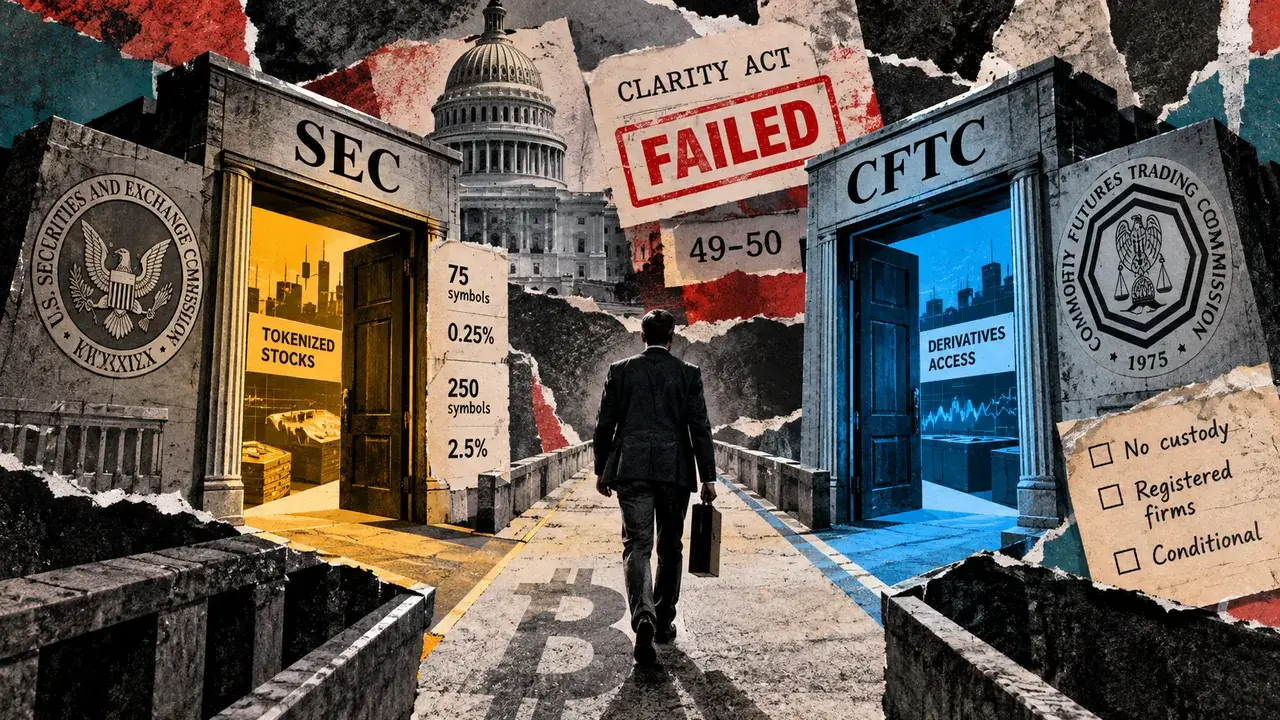
Two days after the United States Senate narrowly failed to advance the CLARITY Act, a landmark piece of legislation aimed at establishing a comprehensive regulatory framework for digital assets, federal regulators unveiled two distinct, albeit narrower, pathways for crypto-linked market access under existing legal structures. The Securities and Exchange Commission (SEC) introduced a five-year pilot program enabling permissioned trading venues to facilitate the exchange of tokenized U.S. stocks utilizing automated market maker technology. Concurrently, the Commodity Futures Trading Commission (CFTC) expanded existing staff no-action relief, allowing qualifying software providers to connect users to regulated derivatives markets without the burdensome requirement of registering as introducing brokers for such activities.
While these actions are designed to support the development of tangible products and services in the burgeoning digital asset space, they do not replicate the comprehensive market-structure legislation that Congress has yet to pass. The SEC’s initiative is deliberately constrained by limitations on scope and specific conditions, while the CFTC’s approach continues to rely on the involvement of registered derivatives firms for crucial functions such as user onboarding, trading, and custody. Furthermore, the CFTC’s relief is rooted in a staff position that carries the inherent risk of modification or withdrawal.
SEC Establishes a Five-Year Pilot Program Utilizing Existing Authority
The timing of these regulatory moves was conspicuously direct. On September 15th, the Senate voted 49-50 against cloture on a motion to proceed to H.R. 3633, colloquially known as the CLARITY Act. This procedural outcome signified a failure to advance the bill for further debate and amendment, rather than a definitive vote on its merits. The proposed legislation, which had garnered significant attention and debate, aimed to provide much-needed clarity on the jurisdictional boundaries between the SEC and CFTC regarding digital assets and to establish a more robust regulatory framework. Its failure to progress in the Senate underscored the ongoing challenges in achieving legislative consensus on cryptocurrency regulation.
In the immediate aftermath of this congressional setback, on September 17th, SEC Chairman Paul Atkins explicitly linked the Senate’s inaction to the Commission’s subsequent regulatory initiative. In a statement accompanying the release of the "Innovation Exemption," Atkins emphasized that the SEC was acting within its existing statutory authority. He characterized the exemption as a temporary "bridge" designed to foster innovation while awaiting more durable, long-term rulemaking. This approach reflects a strategy of leveraging existing legal tools to address emerging market needs without overstepping the agency’s mandate, pending broader legislative action.
The SEC’s order establishes a novel category of trading platform: a "Tokenized Securities Venue" (TSV). Qualifying venues will be permitted to bring together buyers and sellers of tokenized U.S. stocks through permissioned automated market maker liquidity pools. Crucially, these TSVs will not be subject to the full regulatory oversight typically imposed on registered exchanges under the Securities Exchange Act of 1934. Additionally, certain firms that provide tokenized stocks from their proprietary accounts may receive conditional relief from the definition of a "dealer" for those specific activities.
These exemptions are set to remain in effect until September 17, 2031, unless modified by the SEC. Their carefully defined limitations are intended to ensure that this experimental phase remains contained, allowing regulators to observe market dynamics without disrupting the broader U.S. equity market. The scale of operation for any single TSV and its affiliated entities is strictly capped. For "Tier 1" stocks – generally those with higher market capitalization and liquidity – the limit is set at 75 distinct symbols, with trading volume restricted to no more than 0.25% of the previous month’s average daily share volume for each specific stock. For "Tier 2" stocks, the allowances are slightly more generous, permitting up to 250 symbols and 2.5% of average daily share volume.
A critical requirement for eligible tokenized stocks is that they must faithfully preserve the economic and governance rights associated with their traditional, non-tokenized counterparts. This includes ensuring that dividend distributions and voting rights are maintained. The exemption explicitly excludes synthetic-exposure tokens, rights, warrants, primary issuances, and initial offerings, focusing solely on the tokenization of existing equity securities.
Issuers of the underlying stocks also retain a significant degree of control. Before a TSV can trade stock tokenized by an unaffiliated third party, the venue must provide formal notification to the issuer and observe a mandatory waiting period of at least 30 calendar days following receipt of such notification. If an issuer lodges an objection within this timeframe, the tokenized stock in question will be prohibited from trading on that particular TSV. This provision aims to balance the potential benefits of tokenization with the established rights and interests of corporate issuers.
While the underlying blockchain technology may operate on a public and permissionless basis, the market itself is explicitly permissioned. TSVs are mandated to establish stringent access standards, requiring the verification of participants or their associated wallet addresses. Furthermore, they must maintain transparency regarding circumstances under which access may be denied or limited. The smart contracts governing these operations must be publicly accessible and auditable, with the TSV retaining ultimate responsibility for delegated verification processes.
This regulatory approach substitutes comprehensive exchange oversight with a tailored set of conditions, rather than eliminating market safeguards altogether. TSVs are required to publicly disclose transaction data, maintain meticulous records, cease trading activity when the underlying stock is halted on its primary exchange, clearly articulate operational risks to participants, and report any significant systems events.
It is imperative to note that this exemption does not absolve participants from other applicable federal securities laws. The order explicitly preserves requirements under the Securities Act of 1933, federal antifraud and antimanipulation rules, and sanctions compliance obligations. Depending on their specific activities, participants may still be subject to oversight from the SEC, self-regulatory organizations (SROs), and anti-money laundering (AML) regulations. The exemption is narrowly defined to cover the specific TSV model and does not extend to other forms of securities activities undertaken outside this framework.
CFTC Expands Interface Access to Derivatives Markets While Retaining Centralized Control
On the same day as the SEC’s announcement, the CFTC’s Market Participants Division issued Letter 26-25, a significant development that generalizes relief previously granted on a case-by-case basis. This new letter expands upon the relief provided in March to a firm named Phantom (Letter 26-09), making it available to passive software providers on substantially similar terms. Notably, this broadened relief is not limited to cryptocurrency wallets but extends to any software facilitating access to regulated derivatives markets.
Under Letter 26-25, qualifying software providers can engage in several activities that might otherwise trigger registration requirements as introducing brokers or associated persons. These activities include displaying market and position data, marketing specific derivatives contracts and registered firms, soliciting users, receiving revenue-sharing or transaction-based fees, and transmitting user-directed orders. This allows for enhanced user experience and discovery without forcing new intermediaries into the complex and costly registration process.
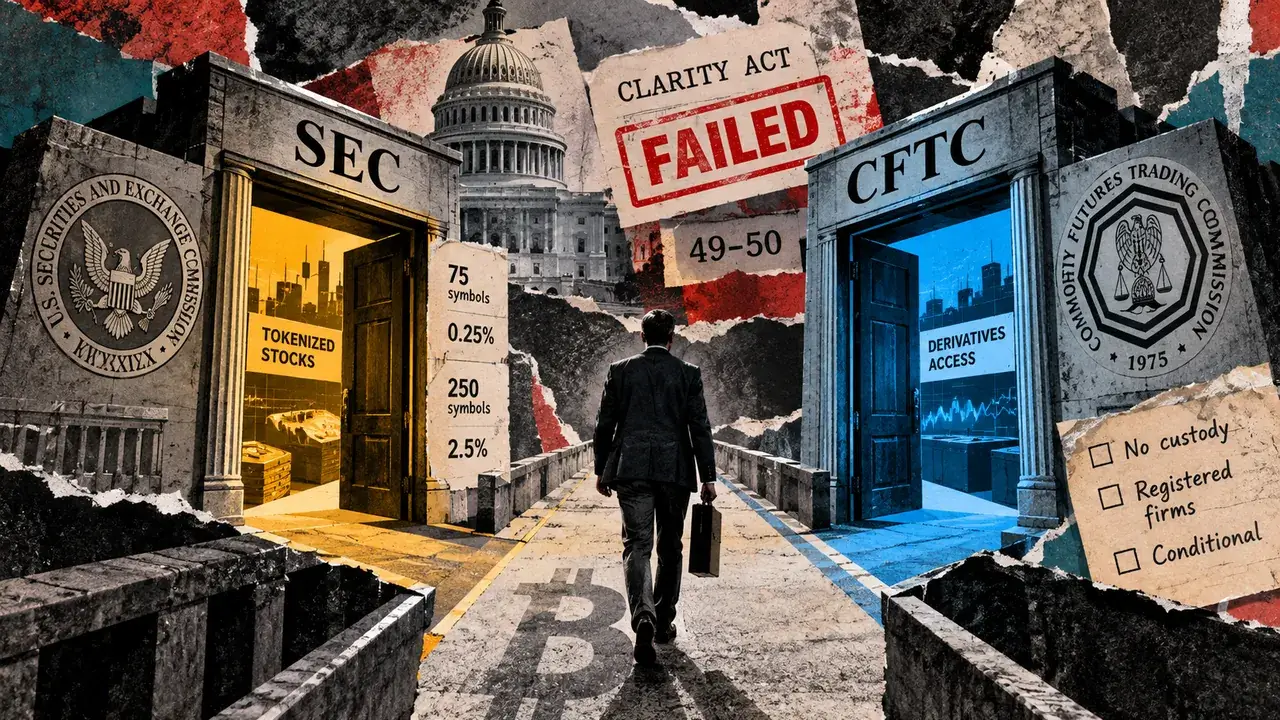
However, the relief is deliberately narrow in scope. Qualifying providers are strictly prohibited from holding customer assets, generating explicit buy or sell signals, or exercising discretionary control over order routing or execution. Letter 26-25 specifically addresses whether the Division will recommend enforcement action for failure to register as an introducing broker or associated person for these covered activities. It does not provide a general exemption from other potential registration categories or applicable laws.
A core tenet of the CFTC’s approach is that users must be directly onboarded with a designated contract market, a futures commission merchant (FCM), or an introducing broker. Users must retain the ability to reach these registered entities independently of the software provider. Furthermore, all funds securing derivatives positions must remain with a derivatives clearing organization (DCO) and/or a clearing-member FCM, ensuring that customer assets are held within established, regulated infrastructure.
The software provider operating under this relief also assumes a set of conditions designed to mitigate risks and ensure compliance. These include comprehensive conflict of interest and risk disclosures, marketing controls that are modeled on existing National Futures Association (NFA) rules, robust recordkeeping requirements, adherence to regulatory notices, and joint liability with each participating registered firm for any violations connected to the covered activities.
This regulatory framework effectively carves out a clearer role for digital wallets and other interface technologies without migrating the core functions of regulated markets into the software layer. A provider can indeed make derivatives markets more discoverable and accessible, but the actual trading execution remains within the purview of designated exchanges. Registered firms are responsible for user onboarding, and collateral is held by DCOs or FCMs.
The legal foundation of this CFTC relief is considered less durable than the SEC’s time-limited Commission order. Letter 26-25 represents the current views of a specific division within the CFTC, is not binding on the Commission itself, and can be modified, suspended, or terminated at any time. Unless earlier amended, its operational lifespan is tied to the eventual implementation of relevant Commission rulemaking or guidance on the matter.
Useful Permits Fall Short of Establishing Comprehensive Market Structure
The actions taken by the SEC and CFTC address distinct registration challenges within the digital asset ecosystem. Their common characteristic is the creation of conditional operating space without establishing broad, unconditional market-wide rights.
For tokenized stocks, access to trading platforms is contingent upon the TSV’s adherence to specific permissioning standards, the acceptance of symbol and volume caps, the absence of issuer objections, and ongoing compliance with the terms of the SEC’s order. In the realm of regulated derivatives, the interface provider must maintain a passive role, with users, collateral, and trade execution remaining firmly within the established framework of registered market infrastructure.
This deliberate design makes the new regulatory routes beneficial for controlled product launches. Companies can develop products and services by adhering to clearly defined conditions, rather than waiting for the protracted legislative process to conclude. Users may gain more accessible pathways to participate in markets for tokenized equities or regulated derivatives. Crucially, these initiatives provide regulators with an opportunity to observe real-world market activity before codifying permanent rules.
However, this carefully constructed approach also introduces a degree of uncertainty. Neither the SEC’s order nor the CFTC’s letter definitively settles the ongoing allocation of authority between the two agencies concerning digital assets. Moreover, neither action grants an unconditional right for any venue, wallet, or user to enter these nascent markets. Other applicable federal and state regulatory obligations remain outside the scope of this narrow relief, and future agency interpretations could significantly alter the economic viability of relying on these pathways.
As of the announcement, no specific company has publicly declared its intention to launch operations under these new September 17th frameworks. The CFTC letter indicates that, following the initial relief granted to Phantom, other similarly situated providers and their legal counsel had made inquiries, suggesting potential interest.
The true practical test for these initiatives will be the public commitments made by market participants. For the SEC’s tokenized stock venue pathway, this will involve formal notices from operators willing to accept the imposed caps, disclosure duties, and the issuer objection process. Subsequently, evidence of liquidity development within these defined limits will be crucial. On the CFTC front, it will require software providers to enter into formal agreements with registered derivatives firms, submit the necessary undertakings, and demonstrate in practice that their interfaces remain passive.
Ultimately, market behavior will dictate whether these conditional access routes can scale into sustainable channels. Factors such as the frequency of issuer objections, the efficiency of participant onboarding, the growth of liquidity, transaction volumes, and any subsequent regulatory modifications will reveal whether these pathways evolve into durable market conduits or remain confined to the realm of experimental initiatives.
The recent actions by the SEC and CFTC demonstrate a pragmatic approach, proving that progress in U.S. crypto market access can indeed occur without immediate congressional action. However, they have not yet conclusively shown whether temporary exemptions and revocable staff relief can provide the certainty, uniformity, and jurisdictional clarity that comprehensive legislation is intended to deliver. The long-term implications will hinge on how effectively these frameworks foster innovation while safeguarding market integrity and investor protection.








