admin
admin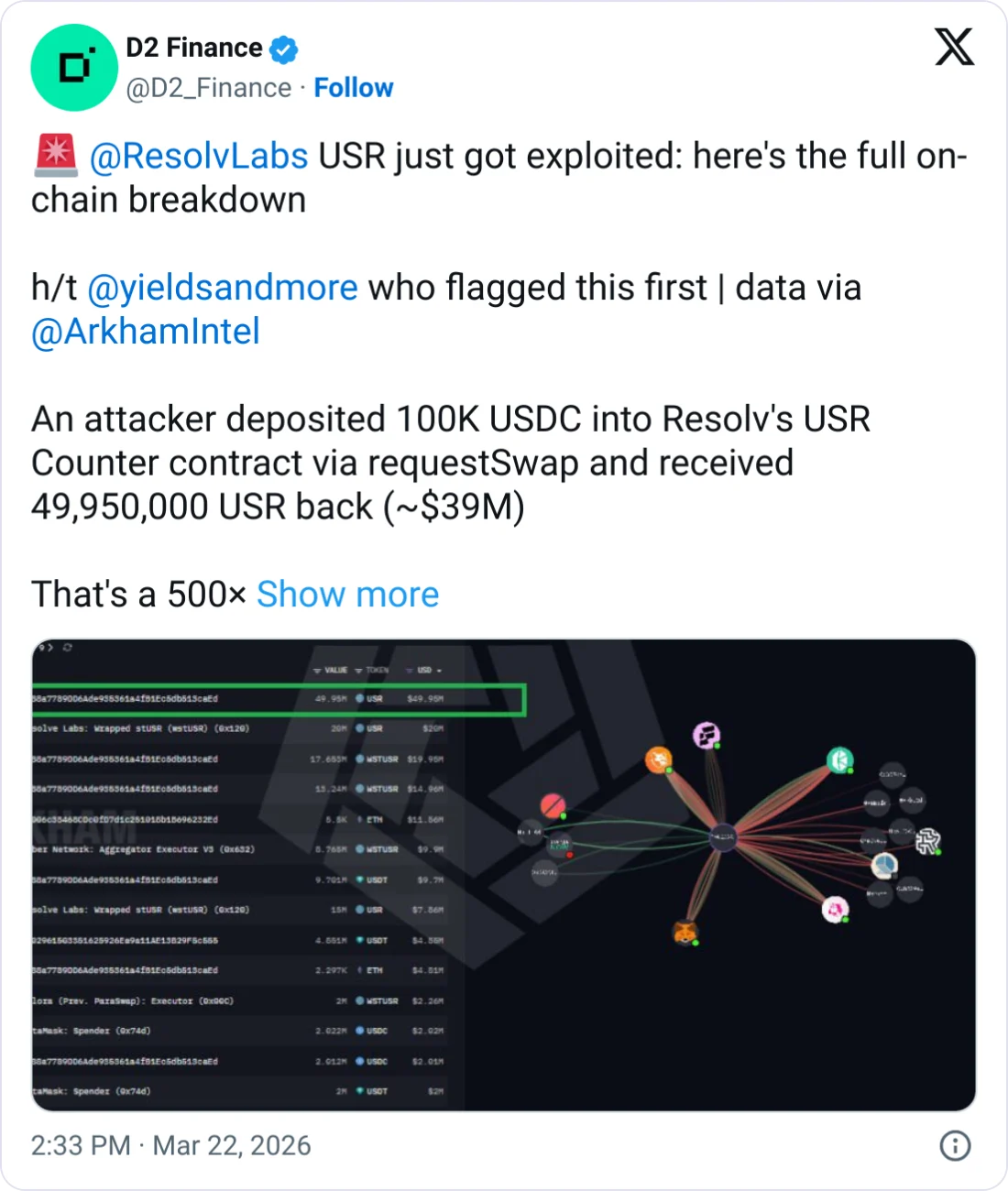
The decentralized finance ecosystem faced a significant security breach on Sunday as Resolv Labs, a protocol specializing in yield-generating stablecoin solutions, fell victim to a sophisticated smart contract exploit. The attack resulted in the unauthorized minting of 80 million Resolv USR (USR) tokens, leading to a catastrophic loss of the token’s parity with the United States dollar. Initial forensic data suggests the attacker was able to extract approximately $25 million in value by liquidating the unbacked tokens across various decentralized exchanges, causing the stablecoin to plummet as low as 2.5 cents on certain liquidity pools before a partial recovery.
Technical Breakdown of the Minting Exploit
The breach centered on a fundamental flaw within the USR token’s minting contract. According to on-chain data verified by multiple security firms, the attacker initiated the exploit by depositing a relatively small sum of $100,000 in USD Coin (USDC). Under normal protocol operations, such a deposit should have yielded an equivalent amount of USR tokens. However, due to a failure in the contract’s validation logic, the attacker was able to mint 50 million USR tokens from this single transaction.
Shortly after the initial breach, the attacker executed a secondary transaction, minting an additional 30 million USR tokens. Blockchain security firm PeckShield confirmed the second wave of minting, bringing the total volume of unbacked tokens to 80 million. The rapid influx of these tokens, which lacked the necessary collateralization, immediately compromised the protocol’s internal accounting and the market’s trust in the asset’s stability.
Market analysts at D2 Finance provided a preliminary technical assessment of the vulnerability. They suggested that the minting function on the USR contract was fundamentally broken, citing three potential points of failure: a manipulated price oracle, a compromised off-chain signer, or a critical lack of amount validation between the initial minting request and the final transaction completion. This "broken" function allowed the attacker to bypass the standard 1:1 minting ratio that governs stablecoin issuance, effectively creating money out of thin air within the Resolv ecosystem.
Chronology of the Attack and Market Reaction
The exploit unfolded with remarkable speed, leaving the Resolv Labs team and liquidity providers with little time to react before the initial damage was done.
At approximately 2:21 AM UTC on Sunday, the attacker executed the first minting transaction, generating 50 million USR. Within minutes, the attacker began a "textbook DeFi hack cashout," moving the illicitly gained tokens to high-liquidity decentralized protocols. By swapping the unbacked USR for established stablecoins like USDC and Tether (USDT), the attacker was able to secure value before the market could adjust to the sudden supply inflation.

The impact on liquidity pools was instantaneous. On Curve Finance, the primary trading venue for USR, the USR/USDC pool experienced a "flash-crash." At 2:38 AM UTC—just 17 minutes after the exploit began—the price of USR hit a floor of 2.5 cents. The massive sell pressure overwhelmed existing buy orders, leading to extreme slippage. D2 Finance reported that multiple failed transactions were visible on-chain during this period, indicating a desperate rush by arbitrageurs and panicked holders to exit their positions as liquidity evaporated.
Following the liquidation of USR into other stablecoins, the attacker moved to the final stage of the exit strategy: converting the holdings into Ether (ETH). This move is a common tactic among crypto-exploiters to move funds into a more volatile but highly liquid and censorship-resistant asset before potentially utilizing mixing services to obfuscate the money trail.
Official Responses and Protocol Suspension
In the wake of the volatility, Resolv Labs issued an official statement via social media, acknowledging the security breach. The team confirmed the unauthorized minting of 50 million tokens—later updated by third-party analysts to include the additional 30 million—and announced an immediate suspension of all protocol functions.
"The team has currently paused all the protocol functions to prevent further malicious actions and is actively working on recovery," the project stated. By pausing the smart contracts, Resolv Labs aimed to prevent the attacker from minting further tokens and to stop any remaining collateral from being drained. However, by the time the pause was implemented, a significant portion of the protocol’s liquid value had already been extracted.
The incident has also drawn commentary from the broader DeFi security community. Analysts noted that the speed of the attacker’s "exit playbook" suggests a high level of preparation. The urgency of the cashout—characterized by D2 Finance as running "at full speed"—highlights the window of opportunity attackers seek to exploit before protocol administrators can intervene.
Impact on the Stablecoin Ecosystem and USR Price
As of the latest market data, the USR token remains significantly depegged. While it has recovered from its sub-five-cent lows, it is currently trading at approximately 87 cents on major decentralized exchanges, representing a 13% discount from its intended $1.00 peg. The recovery to the 80-cent range is largely attributed to the exhaustion of the attacker’s immediate sell pressure and speculative buying from high-risk traders betting on a protocol bailout or successful recovery.
The total estimated loss of $25 million places this exploit among the more significant DeFi events of the quarter. It serves as a stark reminder of the "oracle risk" and "contract logic risk" inherent in algorithmic or partially collateralized stablecoin models. Unlike fully reserved stablecoins backed by traditional financial assets, decentralized stablecoins like USR rely entirely on the integrity of their code and the accuracy of external data feeds to maintain their value.

Broader Context of Crypto Security Trends
The Resolv Labs exploit occurs during a period of fluctuating security metrics within the cryptocurrency industry. Data from the early months of the year shows a volatile landscape for digital asset safety. In January, the industry saw a staggering $385 million lost to various exploits and hacks. Conversely, February saw a sharp decline in protocol-level breaches, with losses totaling approximately $49 million.
Market researchers had previously noted a shift in attacker behavior, with a growing preference for phishing scams and social engineering over direct smart contract exploits. The Resolv Labs incident, however, signals that protocol-level vulnerabilities remain a potent threat, particularly for newer or less-audited projects in the "yield-bearing" stablecoin sector.
The emergence of malware such as the "Ghostblade" crypto-stealer, recently flagged by Google Threat Intelligence, further complicates the security environment. While Ghostblade focuses on end-user credential theft, the Resolv exploit demonstrates that the infrastructure of DeFi itself remains a primary target for sophisticated actors capable of identifying and exploiting logic errors in complex financial code.
Implications for DeFi Governance and Future Security
The fallout from the Resolv Labs breach is likely to trigger a renewed focus on the "circuit breaker" mechanisms within DeFi protocols. The delay between the initial exploit and the pausing of the protocol allowed tens of millions of dollars to exit the ecosystem. Future protocol designs may look toward more automated, AI-driven security monitors that can freeze functions the moment an anomalous minting event is detected.
Furthermore, the role of decentralized exchanges (DEXs) like Curve Finance in these events is under scrutiny. While DEXs provide essential liquidity, they also facilitate the rapid "washing" of exploited tokens. The high slippage and rapid price drops seen during the USR crash illustrate the fragility of liquidity pools when faced with a sudden, massive influx of unbacked assets.
For Resolv Labs, the path to recovery remains uncertain. Re-establishing a peg after a major exploit requires either a massive injection of new capital to back the unauthorized tokens or a controversial "haircut" for existing holders, where the supply is manually rebased or migrated to a new contract. Given the current 13% depeg, the protocol faces a crisis of confidence that may prove difficult to overcome in a competitive stablecoin market.
As the investigation continues, the DeFi community will be looking for a full post-mortem from Resolv Labs, including a detailed audit of how the minting validation failed and what steps will be taken to compensate affected users. For now, the event serves as a cautionary tale regarding the risks of high-yield stablecoin protocols and the persistent threat of smart contract vulnerabilities in the decentralized finance landscape.