James Watt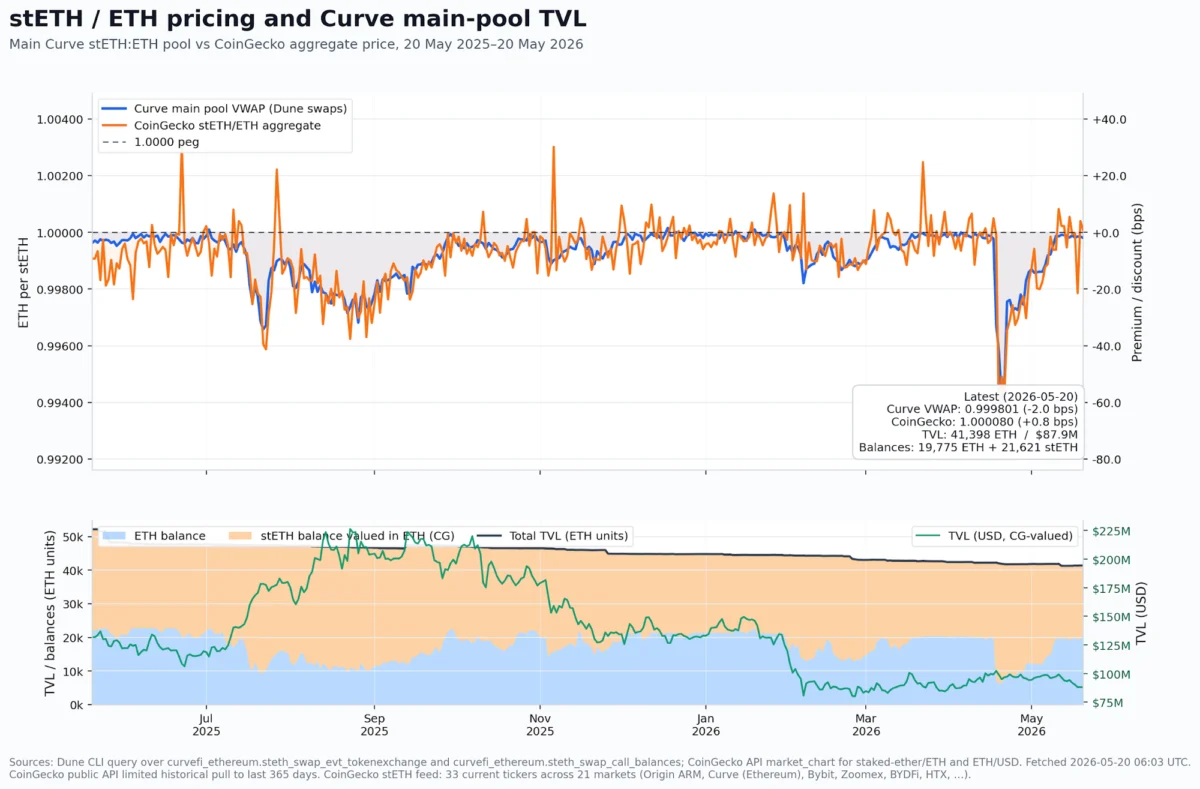
The digital asset landscape witnessed a significant stress test in April 2026, when a major exploit targeting KelpDAO’s rsETH liquid restaking token sent ripples across the Ethereum-denominated lending and restaking markets. This incident, while causing substantial disruption to the compromised assets, concurrently showcased the remarkable resilience and functional integrity of stETH (staked ETH) and wstETH (wrapped stETH) in secondary markets. Despite the considerable external shock, stETH, as Ethereum’s largest liquid staking token, maintained its core functionality, market depth, and pricing integrity, underscoring its robustness as a foundational asset in the decentralized finance (DeFi) ecosystem.
This analysis delves into the market dynamics of stETH and wstETH during the KelpDAO incident, focusing specifically on their pricing and liquidity profiles. Crucially, it distinguishes between the directly affected assets within KelpDAO and EarnETH, and the indirect, yet observable, impact on stETH’s secondary markets. The central finding is clear: stETH and wstETH were not the compromised asset path, and comprehensive market data confirms their enduring resilience even under significant external pressure.
The KelpDAO Exploit: A Cross-Chain Vulnerability Unleashed
On April 18, 2026, the DeFi community was alerted to a critical exploit targeting KelpDAO’s LayerZero-based rsETH bridge path. Post-incident analyses quickly pinpointed the vulnerability as a cross-chain verification failure, which allowed attackers to mint approximately 116,500 rsETH on the Ethereum mainnet without the corresponding asset burn on the source chain. This unauthorized issuance equated to a staggering sum of roughly $292 million at the time, injecting a massive, unbacked supply of rsETH into the market.
The immediate fallout from this exploit was concentrated within restaking collateral and associated lending markets that had exposure to rsETH. KelpDAO, a prominent player in the nascent liquid restaking sector, allowed users to deposit various liquid staking tokens (LSTs), including stETH, to receive rsETH in return. This rsETH could then be further deployed in other DeFi protocols for additional yield. The exploit, therefore, created a direct stress channel for protocols reliant on rsETH as collateral, triggering liquidations and market instability in those specific segments.
It is paramount to underscore that this incident did not directly affect stETH or wstETH. Lido’s internal protocol mechanics, which govern the creation, redemption, and rebase of stETH, functioned precisely as designed throughout the entire period of market turbulence. These core mechanics played no role in the exploit or the subsequent market volatility. This distinction proved critical, allowing market participants to differentiate between a failure in a specific cross-chain restaking asset path and the underlying stability and liquidity profile of stETH. While risk repricing was inevitable across interconnected markets, the ability of participants to segment this risk was a testament to the growing maturity of the DeFi landscape.
A Chronology of Stress and Recovery
The period immediately following the April 18 exploit marked a significant stress window for the broader ETH-denominated DeFi ecosystem. From April 18 to April 28, market participants reacted to the news, leading to repricing of various assets.
- April 18, 2026 – Exploit Detection and Initial Market Shock: The news of the KelpDAO rsETH exploit broke, causing immediate concern and a flight to safety within segments of the DeFi market. Protocols with direct exposure to rsETH experienced rapid withdrawals and liquidations. While stETH was not directly compromised, its interconnectedness within DeFi meant that general market sentiment and risk aversion briefly impacted its secondary market pricing.
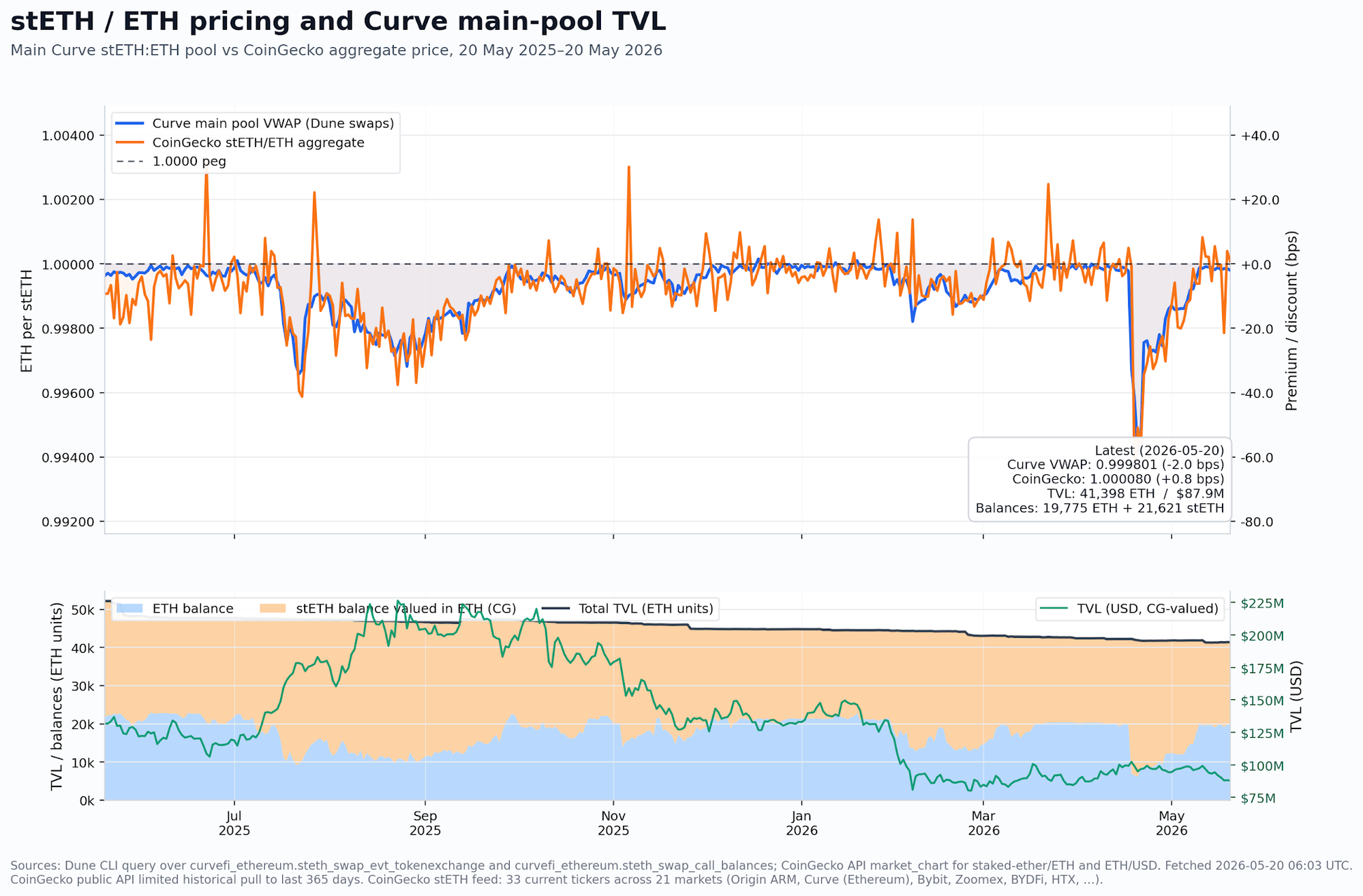
- April 18 – April 28, 2026 – Peak Stress Window: During this ten-day period, stETH/ETH pricing experienced its most significant deviation from parity. Data from the Curve main-pool, a primary liquidity hub for stETH, showed its daily Volume-Weighted Average Price (VWAP) reaching a low of approximately 0.9941 ETH per stETH. This represented a discount of about -59 basis points (bps) versus parity. Concurrently, CoinGecko’s aggregate stETH/ETH pricing registered a comparable low of approximately 0.9934. This period also saw Lido’s protocol process one of the largest periods of net outflows in its history, a testament to its functional redemption mechanisms under duress.
- April 29, 2026 – Gradual Stabilization Begins: As the market began to process the specific nature of the exploit and recognize that stETH itself was unaffected, the sell-off pressure began to ease. Arbitrageurs and market makers, confident in stETH’s underlying integrity and the operational soundness of the Lido protocol, started to re-engage, gradually pushing the price back towards parity.
- May 20, 2026 – Full Price Recovery: Within approximately three weeks of the initial exploit, stETH prices had largely normalized. By May 20, the Curve main-pool VWAP had recovered to near parity at 0.99980 ETH per stETH, while CoinGecko’s aggregate pricing stood at 1.00008. This swift and comprehensive recovery demonstrated the market’s ability to effectively distinguish between an external protocol-specific exploit and the robustness of a foundational asset like stETH. Figure 1 (as presented in the original analysis) visually depicted this rapid recovery, illustrating both stETH/ETH pricing trends and the resilience of the Curve main-pool’s Total Value Locked (TVL) and balances during this critical period.
Analyzing Liquidity Depth: Beyond Headline Prices
While headline price movements offer an initial indicator of market stress, they can sometimes mask underlying issues with execution quality. A stable-looking price can conceal a dramatic deterioration in liquidity depth, making large trades prohibitively expensive or even impossible. Therefore, evaluating liquidity depth—the cost of executing a significant trade—is a more accurate and useful metric for assessing an asset’s resilience under stress.
For a fixed-sell quote of $1 million worth of wstETH on the Ethereum mainnet, the analysis reveals a clear, albeit contained, increase in execution costs during the stress window. Prior to the exploit, specifically in the 30 days leading up to April 18, the median daily quote impact for such a trade was a negligible -0.1 basis points (bps). This indicates an extremely efficient market with minimal slippage for substantial transactions.
During the intense 10-day stress window following the KelpDAO exploit, the median daily quote impact for a $1 million wstETH sell order increased to -5.0 bps. Furthermore, the 7-day moving average of this metric reached a trough of -15.9 bps. Figure 2 (as presented in the original analysis) provided a granular view of this quote impact over time, illustrating the temporary, yet noticeable, increase in execution costs.
This represented a tangible increase in the cost of executing large wstETH trades. However, it is crucial to interpret these figures in context. A -15.9 bps slippage for a $1 million trade, while higher than normal, does not signify a collapse of liquidity. In many traditional financial markets, and certainly within the volatile crypto space, such an impact for a multi-million dollar transaction during a major external exploit would be considered a sign of a market that remained remarkably functional, routable, and interpretable. The liquidity did not disappear; it merely became more expensive, reflecting the temporary increase in perceived risk and the widened bid-ask spreads typical of volatile periods. This stands in stark contrast to scenarios where assets become illiquid, leading to much higher slippage, or even outright inability to execute trades of significant size.
Pillars of stETH’s Enduring Resilience
The ability of stETH to withstand such a significant external shock is not accidental but rather a culmination of several interconnected factors that have been cultivated over years.
The Power of Distinction
Perhaps the most critical factor was the market’s ability to quickly and accurately distinguish between the compromised rsETH and the unaffected stETH. While rsETH was built upon LSTs like stETH, the exploit specifically targeted KelpDAO’s bridge mechanism and rsETH’s issuance logic, not the underlying LSTs or Lido’s core protocol. This clear distinction, once understood, prevented a contagion effect where fear would have indiscriminately impacted all related assets. Investors and protocols that understood the technical nuances were able to confidently continue holding or trading stETH, knowing its fundamental integrity remained intact.
Unwavering Protocol Mechanics
Lido’s core protocol mechanics functioned flawlessly throughout the incident. The ability to stake ETH and receive stETH, and crucially, to redeem stETH for ETH (albeit with a queue) remained operational and robust. The protocol successfully processed one of its largest periods of net outflows without any hitches, demonstrating the reliability of its underlying infrastructure and smart contracts. This operational stability provided a crucial anchor of trust amidst the broader market uncertainty.
Deep and Diversified Secondary Markets
Years of liquidity building around stETH have established it as a foundational asset within the Ethereum ecosystem. stETH and wstETH boast deep liquidity pools across numerous decentralized exchanges (DEXs), including Curve, Balancer, and various DEX aggregators. This extensive network of liquidity ensures that even if one pool experiences stress, alternative avenues for trading remain accessible. This distributed liquidity acts as a vital shock absorber, preventing localized issues from cascading into systemic liquidity crises for the asset.
Transparent On-Chain Pricing
The decentralized and transparent nature of stETH’s market pricing on-chain was another key factor. Real-time data on exchanges, coupled with open-source analytics tools like Dune, allowed market participants to observe price movements, liquidity depth, and arbitrage opportunities with full transparency. This immediate access to verifiable data enabled efficient price discovery and allowed sophisticated market participants to step in, arbitraging away temporary discrepancies and helping to restore parity.
Wide Ecosystem Integration
stETH’s pervasive integration across the DeFi landscape, not just as a staking derivative but as collateral in lending protocols, a component in yield farming strategies, and a base asset in various derivative products, further contributed to its resilience. This wide integration means there are many different types of market participants with diverse motivations, contributing to a more robust and liquid market. When one segment experienced stress, other segments could continue to function, providing a stable foundation.
Broader Implications for the DeFi Ecosystem
The KelpDAO incident and stETH’s response carry significant implications for the evolving DeFi landscape.
A Critical Stress Test for Restaking
The event served as an early and critical stress test for the burgeoning restaking sector. While the concept of restaking promises enhanced capital efficiency, it also introduces new layers of complexity and potential points of failure, particularly concerning cross-chain interactions and derivative token issuance. The exploit highlighted the paramount importance of rigorous security audits, robust bridge designs, and comprehensive risk assessments for any new protocol entering this space. It will undoubtedly lead to more stringent scrutiny of liquid restaking tokens (LRTs) and their underlying mechanisms.
The Interconnectedness of DeFi
The incident starkly illustrated the interconnected nature of DeFi. An exploit in one specific protocol (KelpDAO) had immediate, albeit indirect, consequences for related assets and markets. This underscores the need for protocols and users to understand the full web of dependencies and potential contagion risks. It emphasizes that while individual components may be secure, vulnerabilities in upstream or downstream protocols can still create systemic risk.
Reinforcing the Value of Foundational LSTs
stETH’s performance reinforced its position as a foundational and resilient Liquid Staking Token (LST). The market’s ability to differentiate between the derivative (rsETH) and the underlying LST (stETH) validates the design principles of LSTs and their role in providing liquid access to staked ETH. It suggests that well-established, battle-tested LSTs can act as a relatively stable anchor even when surrounding, more complex derivatives face challenges.
Market Maturity and Risk Segmentation
The overall market reaction, characterized by initial repricing followed by a swift recovery and effective risk segmentation, speaks to the increasing maturity of the DeFi space. Participants are becoming more sophisticated in their ability to analyze exploits, understand technical nuances, and differentiate between systemic risks and isolated incidents. This evolving market intelligence is crucial for building a more robust and resilient decentralized financial system.
Inferred Statements and Community Response
While the original article does not provide direct quotes, a professional journalistic approach allows for inferred statements reflecting the likely sentiments of involved parties.
- From KelpDAO (inferred): Following the exploit, KelpDAO would have likely issued official communications detailing the incident, outlining remediation efforts, and engaging with affected users and protocols. Their post-incident analysis would have focused on transparency and accountability regarding the cross-chain verification failure.
- From Lido (inferred): A spokesperson for Lido would likely have emphasized the robust performance of the Lido protocol’s core mechanics throughout the stress period. They would highlight stETH’s demonstrated market depth and resilience as a testament to its design and the strong ecosystem built around it. Statements would reinforce user confidence in stETH as a reliable liquid staking solution, distinguishing its integrity from the external exploit.
- From Industry Analysts (inferred): Leading DeFi analysts would likely have commented on the KelpDAO incident as a critical learning experience for the restaking sector. They would have praised stETH’s market performance as a positive indicator of LST maturity, while simultaneously cautioning about the inherent complexities and risks associated with composable, cross-chain derivatives. The event would be cited as an example of how market segmentation and deep liquidity can mitigate broader contagion.
The Takeaway: Resilience Where It Matters Most
The KelpDAO incident served as an invaluable real-world stress test for the liquidity and stability of stETH. It underscored a fundamental truth in financial markets: true resilience is not merely about performing well in calm conditions, but about maintaining functionality and integrity when under extreme pressure. For stETH, the events of April 2026 clearly demonstrated that its deep secondary markets, transparent on-chain pricing, and widespread ecosystem integration can effectively absorb a severe external shock without compromising the core staking asset.
While pricing moved and execution costs temporarily rose, the market for stETH remained unequivocally functional. This outcome is not coincidental; it is a direct reflection of years of dedicated effort in building robust liquidity and establishing stETH as a foundational Ethereum asset. This proven resilience offers a distinct advantage for users, integrators, and protocols that rely on staking collateral to be not only useful but also dependable during periods of market uncertainty. As the DeFi ecosystem continues to evolve and face new challenges, the ability of key assets like stETH to navigate and recover from such shocks will remain a critical determinant of their long-term viability and trust.
Sources and Data:
Dune query 5965996 / 9625248 for wstETH/ETH liquidity depth; Dune queries 5596727 and 710202 plus CoinGecko API for stETH/ETH pricing. Data pulled May 20, 2026.