
 James Watt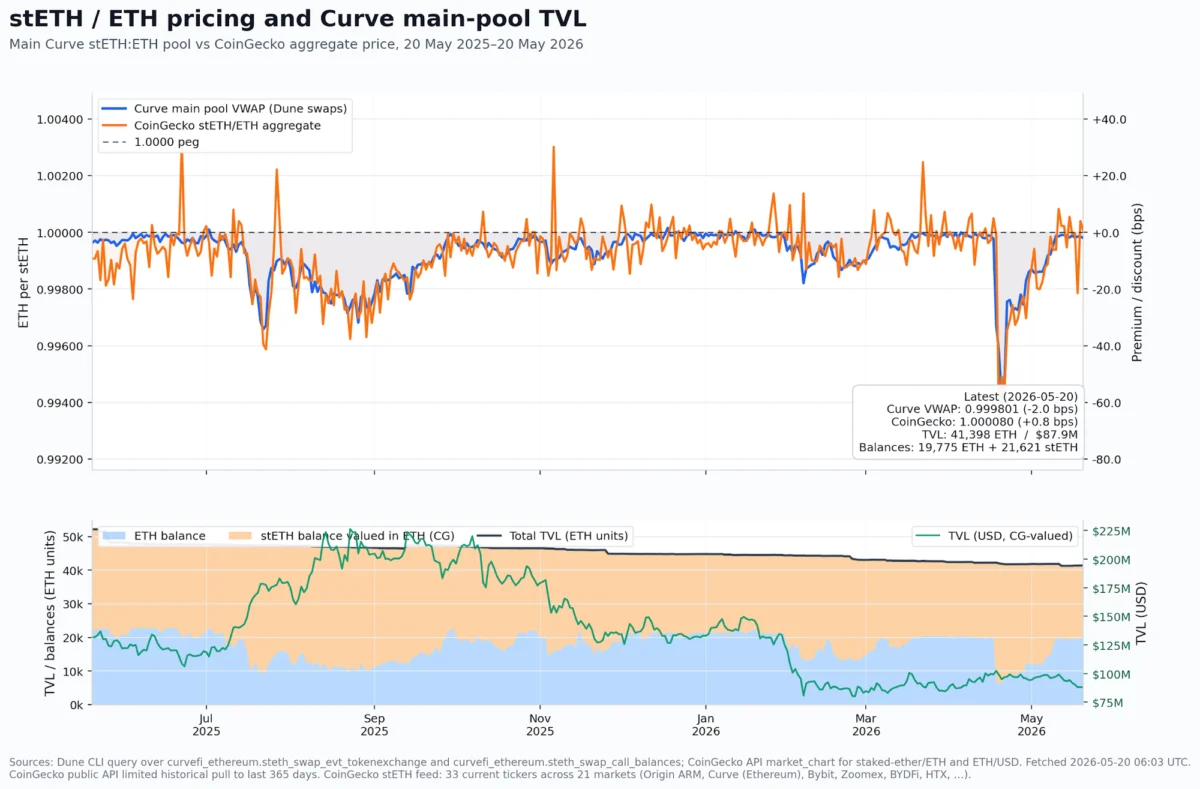
The decentralized finance (DeFi) ecosystem faced a significant stress test in April 2026 when the KelpDAO rsETH exploit sent ripples through restaking and ETH-denominated lending markets. This incident, while impacting a specific cross-chain restaking asset path, paradoxically served to underscore the functional resilience and deep liquidity of core liquid staking tokens (LSTs) like stETH and its wrapped counterpart, wstETH. Despite a palpable market shock and temporary price adjustments, stETH maintained its operational integrity and demonstrated an impressive capacity for recovery, highlighting its foundational role within the Ethereum economy. This analysis delves into the specifics of the KelpDAO incident, its immediate market effects, and the underlying factors that enabled stETH to weather the storm with remarkable stability, providing crucial insights into the maturity and robustness of the broader DeFi infrastructure.
Understanding the Ecosystem: Liquid Staking, Restaking, and Cross-Chain Bridges
To fully grasp the implications of the KelpDAO exploit, it is essential to understand the intricate web of technologies involved. At its core, Ethereum’s Proof-of-Stake mechanism allows users to stake their ETH to secure the network and earn rewards. Liquid Staking Tokens (LSTs), such as Lido’s stETH, emerged as an innovation to address the illiquidity of staked ETH, enabling users to receive a tokenized representation of their staked assets that can be traded, lent, or used in other DeFi protocols. This unlocked significant capital efficiency for stakers, transforming a formerly locked asset into a dynamic, yield-bearing primitive.
Restaking protocols, like KelpDAO, represent a further evolution, allowing users to re-purpose their staked ETH or LSTs (like rsETH, a liquid restaking token) to secure additional protocols beyond Ethereum itself, thereby earning additional rewards. While offering enhanced capital efficiency and yield opportunities, restaking introduces new layers of complexity and potential attack vectors.
Cross-chain bridges are critical infrastructure enabling the transfer of assets and data between different blockchain networks. These bridges rely on various verification mechanisms to ensure that assets burned on one chain are accurately minted on another, and vice versa. The security of these bridges is paramount, as any vulnerability can lead to catastrophic losses, as tragically demonstrated by numerous past exploits. The KelpDAO rsETH bridge, built on LayerZero technology, was designed to facilitate cross-chain movements of rsETH, connecting liquidity across disparate blockchain environments.
The KelpDAO Exploit: A Detailed Chronology of the Shockwave
The genesis of the market turbulence began on April 18, 2026, when malicious actors successfully exploited a critical vulnerability within KelpDAO’s LayerZero-based rsETH bridge path. Post-incident forensics revealed that the exploit stemmed from a cross-chain verification failure, a sophisticated attack vector where approximately 116,500 rsETH tokens were illicitly minted on the Ethereum mainnet without a corresponding burn of assets on the source chain. This unauthorized issuance, valued at roughly $292 million at the time, represented a significant supply shock and an immediate threat to the integrity of the restaking and lending markets collateralized by rsETH.
The immediate fallout was concentrated on restaking collateral and lending protocols that held exposure to rsETH. Liquidations loomed, and market participants scrambled to assess their risk. Crucially, and a point of distinction that proved vital for market stability, the exploit did not directly compromise Lido’s core staking protocol or the fundamental mechanics governing stETH. Lido’s internal systems continued to operate as intended, processing staking and unstaking requests without interruption. However, the broader market, reacting to the substantial exploit, repriced risk across the entire ETH-denominated asset class, with particular scrutiny on derivative tokens.
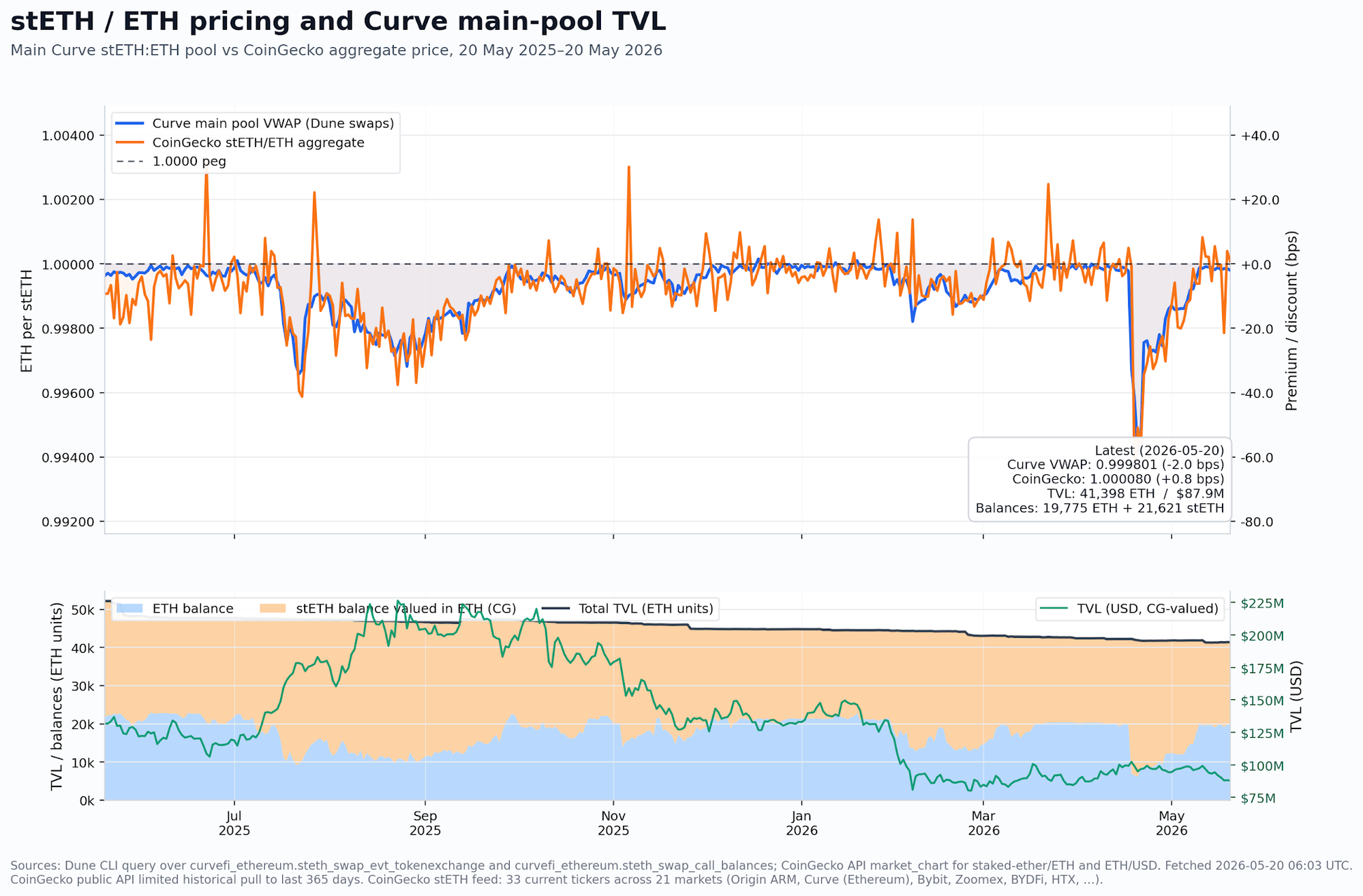
The period immediately following the exploit, from April 18 to April 28, 2026, constituted the primary stress window. During this time, stETH experienced a temporary depeg from its ETH parity. Data from the Curve main-pool showed the daily Volume Weighted Average Price (VWAP) for stETH reaching a low of approximately 0.9941 ETH per stETH, representing a deviation of about -59 basis points (bps) from parity. Concurrently, CoinGecko’s aggregated stETH/ETH pricing registered a comparable low of approximately 0.9934. While these deviations were notable, especially for an asset expected to trade near parity, they were relatively contained given the magnitude of the external shock. The market’s ability to distinguish between the compromised rsETH and the unaffected stETH proved instrumental in preventing a more severe downturn.
By May 20, 2026, just over a month after the exploit, market confidence had largely returned. The Curve VWAP for stETH had rebounded significantly, trading near parity at 0.99980 ETH, with CoinGecko’s aggregate price showing an even stronger recovery at 1.00008 ETH. This rapid and near-complete recovery demonstrated the market’s capacity to absorb, differentiate, and ultimately normalize pricing after a major external event, a testament to the underlying robustness of stETH’s liquidity and its perception as a reliable asset.
Market Response: stETH Pricing and Stability Under Pressure
The immediate aftermath of the KelpDAO exploit saw a clear, albeit temporary, re-evaluation of risk across the DeFi landscape. While the incident itself was contained to the rsETH bridge, the interconnected nature of DeFi meant that all related assets, especially those deeply integrated into lending and collateral systems, faced scrutiny. The stETH/ETH trading pair, a bellwether for liquid staking health, experienced a measurable dip, as depicted in market data.
Figure 1, which compares market pricing from the main Curve stETH:ETH pool with CoinGecko’s aggregate stETH/ETH price, vividly illustrates this dynamic. The top panel shows a clear divergence from parity during the stress window. The -59 bps deviation on Curve’s VWAP and the -66 bps deviation on CoinGecko’s aggregate price represented a tangible cost for those needing to liquidate large stETH positions quickly. However, the swiftness of the recovery is equally significant. The fact that stETH returned to near-parity within weeks, even surpassing it briefly on CoinGecko, signals strong underlying demand and an efficient market mechanism that capitalized on the temporary arbitrage opportunity. This indicates that market participants viewed the depeg as a temporary dislocation rather than a fundamental flaw in stETH itself.
The lower panel of Figure 1, showcasing the Curve pool’s ETH and stETH balances and Total Value Locked (TVL), provides additional context. While specific TVL fluctuations during the exact stress window are not detailed in the provided data, the overall stability of such a large liquidity pool is crucial. A deep pool with substantial ETH and stETH balances acts as a shock absorber, enabling large trades without causing excessive price impact. The continued operation and relatively stable balances within this pool, even as prices moved, suggest that the core liquidity infrastructure remained intact and functional. This reinforces the idea that while price discovery reacted to the external event, the ability to execute trades and maintain market order persisted.
Assessing Liquidity Depth: Beyond Headline Prices
While headline prices offer a snapshot of market sentiment, a more granular understanding of market health during a crisis comes from analyzing liquidity depth. The ability to execute large trades without significant slippage is a critical indicator of a market’s resilience. In the context of the KelpDAO exploit, the question was not just if stETH could be traded, but at what cost.
For a $1 million fixed-sell wstETH quote on the Ethereum mainnet, the execution quality indeed deteriorated, but liquidity did not evaporate. Prior to the exploit, the median daily quote impact across 236 observations was a mere -0.1 basis points (bps), indicating extremely efficient execution for substantial orders. During the 10-day stress window following the exploit, this median quote impact rose to -5.0 bps. Furthermore, the 7-day moving average reached a trough of -15.9 bps, as illustrated in Figure 2.
This increase in execution cost, from nearly negligible to a measurable slippage, was a direct consequence of heightened market uncertainty and increased selling pressure. Traders needing to exit large positions faced higher costs, reflecting a temporary reduction in available liquidity at the tightest spreads. However, it is crucial to emphasize that this was an increase in cost, not a disappearance of liquidity. A 15.9 bps impact for a $1 million trade, while higher than normal, still represents a relatively small friction in the context of a major external exploit. For comparison, in less liquid traditional markets, or during more severe crypto crises, slippage for such notional values can easily climb into percentages, making large-scale operations impractical or prohibitively expensive.
The fact that wstETH/ETH execution remained measurable, routable, and interpretable throughout this period speaks volumes about the underlying market infrastructure. It indicates that automated market makers (AMMs), arbitrageurs, and market participants continued to provide liquidity, albeit at a higher premium. This sustained functionality meant that even under significant pressure, institutional and large individual traders could still adjust their positions, preventing a complete seize-up of the market that could have cascaded into broader systemic risks.
Disentangling the Impact: Why stETH Remained Comparatively Resilient
The relative resilience of stETH during a period of considerable market stress can be attributed to several key factors:
- Clear Asset Differentiation: The market was able to distinguish between the compromised rsETH, which suffered from a specific cross-chain bridge vulnerability, and stETH, which was not directly affected. While rsETH’s value was intrinsically linked to its restaking functionality and the integrity of its bridge, stETH’s value is fundamentally tied to staked ETH and the security of the Ethereum protocol itself. This clear distinction prevented a contagion effect where the failure of one derivative asset would undermine its underlying primitive.
- Lido Protocol Integrity: Lido’s core protocol mechanics functioned flawlessly throughout the incident. Staking, unstaking (via withdrawals), and reward distribution continued without interruption. This operational stability reassured stETH holders that the fundamental value proposition of their asset remained intact, irrespective of external market volatility stemming from other protocols. The protocol processed one of its largest periods of net outflows in its history, demonstrating its robustness under stress.
- Deep and Diverse Secondary Markets: stETH benefits from years of liquidity building across a multitude of decentralized exchanges, centralized exchanges, and lending protocols. The Curve stETH:ETH pool, a primary liquidity hub, is one of the deepest pools in DeFi, capable of absorbing significant trade volumes. This distributed liquidity base, coupled with active arbitrageurs, quickly worked to re-establish parity once the initial shock subsided. The broad ecosystem integration of stETH means that liquidity is not concentrated in a single point of failure but is spread across numerous venues.
- Transparent On-Chain Pricing: The open and transparent nature of blockchain transactions allowed market participants to continuously monitor stETH’s pricing and liquidity depth in real-time. This transparency enabled efficient price discovery and allowed sophisticated traders to identify and capitalize on arbitrage opportunities, which in turn helped to restore parity faster.
- Perception as a Foundational Asset: Over time, stETH has evolved into a foundational building block within the Ethereum DeFi ecosystem. Its long track record, audited codebase, and robust community support contribute to its perception as a relatively safer, more established asset compared to newer, more experimental derivatives. This perception fosters greater confidence, even during periods of market stress.
Broader Implications for DeFi and Cross-Chain Security
The KelpDAO incident and stETH’s subsequent resilience offer several critical takeaways for the broader DeFi landscape:
- The Criticality of Asset Differentiation: This event highlighted the importance for investors and protocols to thoroughly understand the risk profiles of different derivative assets. While LSTs and LRTs (Liquid Restaking Tokens) both offer tokenized exposure to staked ETH, their underlying mechanisms, dependencies, and attack surfaces can vary significantly.
- Bridge Security Remains a Paramount Concern: The exploit, rooted in a cross-chain verification failure, serves as yet another stark reminder of the inherent risks associated with bridge technology. As DeFi expands across multiple chains, the industry must continue to prioritize robust security audits, formal verification, and innovative bridge designs to mitigate these systemic vulnerabilities. Redundancy and multi-sig security measures, alongside continuous monitoring, are non-negotiable.
- Stress Testing is Essential: The incident provided an invaluable real-world stress test for liquid staking tokens. It demonstrated that deep secondary markets and wide ecosystem integration are not merely conveniences but critical features that enable an asset to absorb severe external shocks without compromising its core functionality.
- Maturity of the DeFi Market: The market’s ability to swiftly differentiate between a protocol-specific exploit and a foundational asset’s integrity, coupled with the rapid price recovery, indicates a growing maturity within the DeFi space. Participants are becoming more sophisticated in their risk assessments, moving beyond panic to nuanced analysis.
Looking Ahead: Lessons Learned and Future Resilience
The KelpDAO exploit, while a negative event for those directly impacted, has provided invaluable lessons for the entire DeFi ecosystem. It reinforces the need for continuous vigilance in security, particularly for nascent and complex protocols like restaking and cross-chain bridges. For established assets like stETH, the incident served as a powerful validation of its design principles and the extensive liquidity infrastructure built around it.
The outcome reflects years of concerted effort in fostering liquidity, transparency, and broad integration for stETH. This foundational status, coupled with robust underlying protocol mechanics, proved to be a decisive advantage when markets were under pressure. It underscores that for any asset aiming to be a core collateral or liquidity primitive in DeFi, its utility must extend beyond quiet, bullish markets to function effectively and predictably during periods of extreme volatility and uncertainty.
Conclusion: The Enduring Strength of Foundational Assets
The April 2026 KelpDAO rsETH exploit was a significant test for the liquid staking and restaking ecosystem. While it exposed vulnerabilities in a specific cross-chain restaking asset path, it simultaneously showcased the enduring strength and resilience of stETH. The incident demonstrated that deep secondary markets, transparent on-chain pricing, and wide ecosystem integration are not just desirable features but essential safeguards that enable a foundational asset to absorb a severe external shock. Pricing moved, execution costs rose, but critically, the market remained functional, preventing a broader systemic collapse. This outcome is a testament to the robust architecture and sustained liquidity development around stETH, solidifying its position as a reliable and resilient asset for users, integrators, and protocols within the dynamic world of decentralized finance. The lessons learned from this event will undoubtedly contribute to the ongoing evolution and hardening of the entire DeFi landscape, emphasizing the critical importance of resilience where it truly matters.









