admin
admin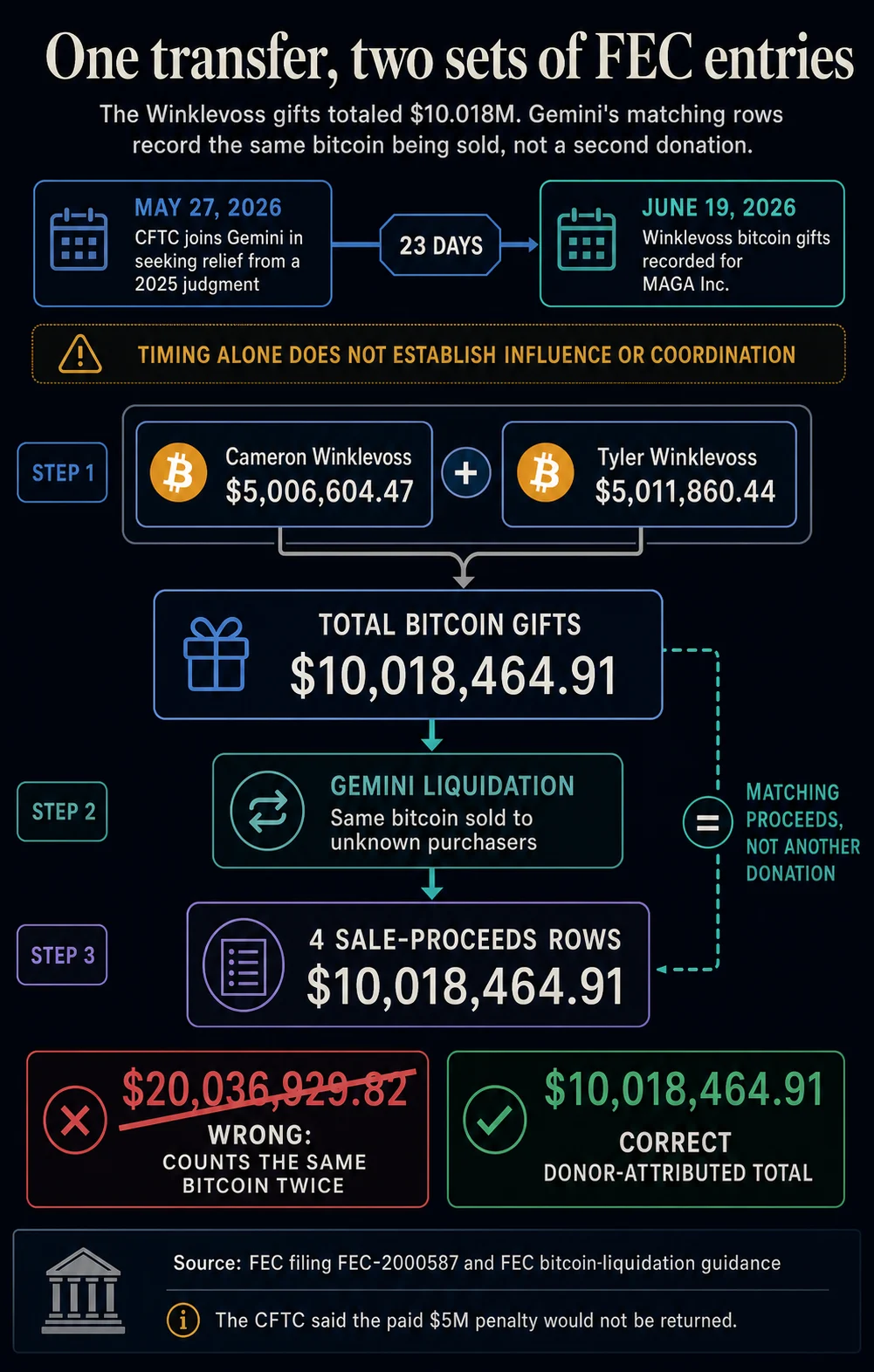
Newly filed Federal Election Commission (FEC) records reveal a significant financial contribution from Gemini exchange co-founders Cameron and Tyler Winklevoss to MAGA Inc., the primary Super PAC supporting former President Donald Trump. The Winklevoss twins collectively donated approximately $10.018 million in Bitcoin to the PAC on June 19, 2026. This substantial contribution occurred just 23 days after the Commodity Futures Trading Commission (CFTC) announced its decision to join Gemini in seeking relief from a 2025 judgment. While the timing has drawn attention, FEC filings indicate that the listed Gemini rows represent the liquidation of the donated Bitcoin, not a separate $10 million donation from the exchange itself.
The FEC filing details the transaction, showing that MAGA Inc. sold the donated Bitcoin through Gemini, an exchange founded and operated by the Winklevoss twins. The donation, totaling $10,018,464.91, was broken down into two primary allocations: $5,006,604.47 attributed to Cameron Winklevoss and $5,011,860.44 to Tyler Winklevoss. The filings explicitly state that the Bitcoin was sold through Gemini to "unknown purchasers," a standard practice under FEC regulations for the sale of donated cryptocurrency where the buyer’s identity is not disclosed and does not constitute a separate contributor.
The close proximity of the Winklevoss twins’ Bitcoin donation to the CFTC’s announcement regarding Gemini has raised questions about potential influence or coordination. However, the FEC records, as presented, offer no direct evidence to establish a causal link between the political contribution and the regulatory agency’s action. They do not indicate that the donations influenced the CFTC’s decision, that the agency coordinated with the donors, or that any form of quid pro quo arrangement was in place. The timing, while notable, does not inherently prove impropriety.

Background of the CFTC’s Involvement
The CFTC’s decision to seek relief from the 2025 judgment against Gemini stemmed from a comprehensive review of the case. According to the agency’s statement, its reassessment concluded that the initial complaint against Gemini would likely not have been pursued under current enforcement standards. Key factors influencing this re-evaluation included identified credibility issues with a crucial whistleblower account and perceived weaknesses in the evidentiary basis. The agency also noted that certain supporting materials, which had been requested by a commissioner, were not provided prior to the case’s authorization, potentially impacting the thoroughness of the initial review.
Furthermore, the CFTC cited instances where Gemini’s defense was allegedly impeded by privilege and relevance objections. The agency also expressed concerns that regulatory authority might have been improperly utilized as leverage in settlement negotiations. The agency further acknowledged Gemini’s status as a victim of fraud and a shifting federal policy landscape concerning digital assets, which likely contributed to their decision to re-evaluate the existing judgment.
Timeline of Events
The sequence of events leading up to the FEC filing and the CFTC’s action is critical to understanding the context:
- 2025 (Specific Date Unspecified): A judgment is initially issued against Gemini.
- Early 2025: FEC filings indicate that the Winklevoss twins made prior contributions to MAGA Inc., totaling approximately $1.015 million in Bitcoin.
- May 28, 2026: The CFTC and Gemini file an amended joint motion with the court. In this motion, the parties request that the court vacate the consent order or, alternatively, lift its remaining prospective provisions, including a permanent injunction. The $5 million penalty that had been imposed in 2025 had already been paid by Gemini and remained satisfied, with no provision for its return.
- June 19, 2026: Cameron and Tyler Winklevoss donate approximately $10.018 million in Bitcoin to MAGA Inc. The FEC filings show that this Bitcoin was subsequently liquidated through Gemini.
- July 21, 2026: Newly filed FEC records detailing the June 19 donation are made public, bringing the timing of the contribution relative to the CFTC’s action into focus.
Supporting Data and FEC Regulations
FEC regulations mandate that political committees selling donated Bitcoin must disclose the exchange through which the sale occurred. This requirement ensures transparency regarding the handling of donated assets. The buyer of such Bitcoin can remain anonymous, and their identity does not count as a contributor to the political committee. The specific detail of the FEC filing naming Gemini as the exchange used for liquidation aligns with these established rules.

The total donation of $10,018,464.91 is precisely accounted for in the four separate rows within the FEC filing that name Gemini, reinforcing the interpretation that these entries represent the liquidation of the same block of Bitcoin donated by the twins. This detail is crucial in differentiating the transaction from a hypothetical scenario where Gemini itself made a separate $10 million contribution. The filing, therefore, clarifies that the Winklevoss twins liquidated their donated Bitcoin via their own exchange.
Broader Implications and Scrutiny
The substantial Bitcoin donation from the Winklevoss twins to MAGA Inc., particularly given its timing relative to the CFTC’s actions concerning Gemini, is likely to intensify scrutiny of the CFTC’s independence. This situation arises at a critical juncture as lawmakers are actively debating potential legislation to grant the agency a more prominent role in shaping the structure of the cryptocurrency market. The concentration of significant financial influence from a small group of industry executives on political committees, while their companies are subject to regulatory enforcement, highlights a growing concern regarding the intersection of campaign finance and regulatory policy.
The proximity of the events—a significant political donation occurring mere weeks before a regulatory agency decides to modify its stance on a case involving the donors’ company—underscores the complexities and potential perceptions of influence in campaign finance. While the FEC filings provide a factual account of the transaction and the CFTC’s public statements explain their reasoning, the confluence of these events inevitably invites public and congressional examination. This situation serves as a stark illustration of how significant financial stakes within the digital asset industry can translate into political contributions, potentially shaping the environment in which regulatory decisions are made and perceived. The twenty-three-day interval, while not constituting evidence of influence in itself, is close enough to warrant careful consideration and further analysis of the dynamics at play between political donations, corporate interests, and regulatory oversight.
The ongoing debate surrounding the CFTC’s authority and independence in the digital asset space, coupled with the increasing financial power of cryptocurrency executives, places such transactions under a microscope. The transparency provided by FEC filings allows for this level of scrutiny, enabling the public and policymakers to assess the potential for undue influence. As the digital asset industry matures and its economic footprint expands, the mechanisms by which its leaders engage with the political process will continue to be a subject of significant interest and potential reform. The Winklevoss twins’ recent donation and the CFTC’s revised stance on Gemini represent a high-profile instance of these complex interactions.