James Watt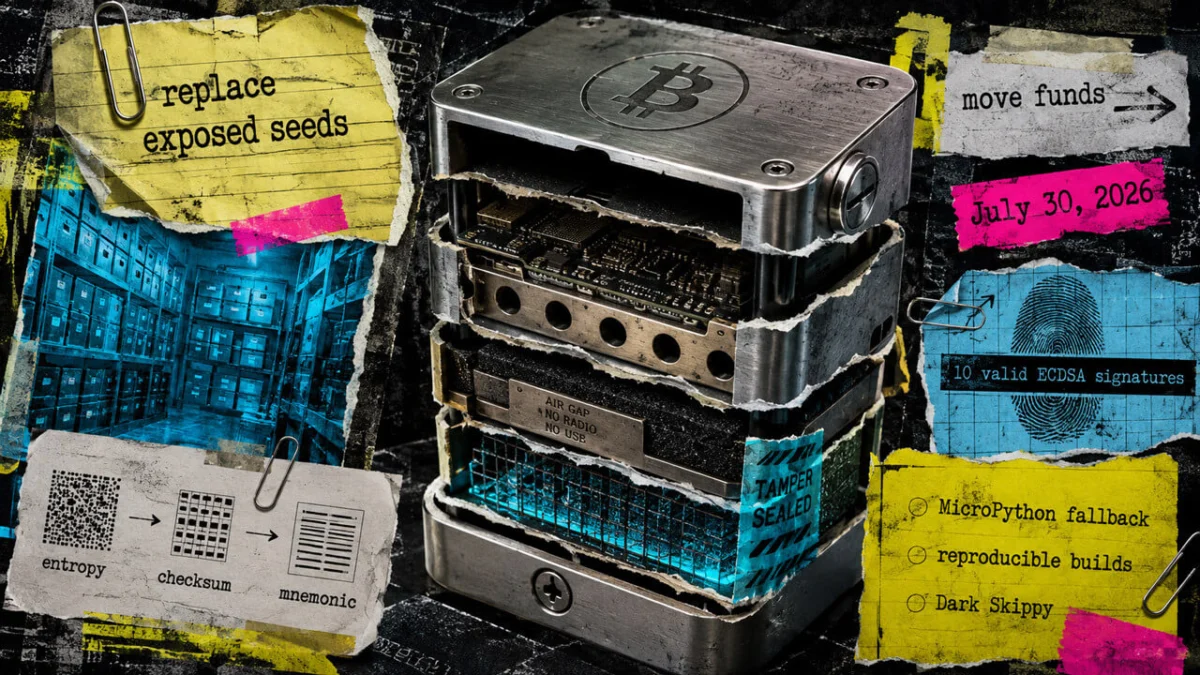
The security landscape surrounding Bitcoin is undergoing a fundamental shift as the primary threat vectors migrate from the theoretical breaking of cryptographic primitives to the practical exploitation of the software and hardware stacks that manage private keys. While Bitcoin’s core protocol remains resilient, the infrastructure designed to protect individual holdings—ranging from hardware wallets to air-gapped recovery systems—is facing unprecedented scrutiny. As artificial intelligence (AI) matures into a sophisticated tool for identifying "seams" or vulnerabilities within these complex systems, even traditional "cold storage" solutions are being re-evaluated for their susceptibility to supply chain defects and sophisticated exfiltration techniques.
The Entropy Crisis: A Technical Deep Dive into the Coinkite Disclosure
On July 30, 2026, the prominent hardware wallet manufacturer Coinkite released a technical disclosure that highlighted the fragile nature of seed generation. The report detailed a significant regression originating from a 2021 integration change. For several years, certain models of the COLDCARD hardware wallet inadvertently diverted wallet seed generation to a MicroPython software-based fallback rather than utilizing the intended hardware-based random-number generator (RNG) path.
In the world of Bitcoin custody, a seed phrase is only as strong as the entropy used to create it. Bitcoin Improvement Proposal 39 (BIP-39) dictates that a mnemonic phrase must be derived from a high degree of randomness. If that randomness is compromised or follows a predictable pattern due to software limitations, the resulting private keys become vulnerable to "brute-force" attacks or pre-calculation by malicious actors.
While Coinkite noted that later affected models still incorporated some entropy from secure elements, the firm acknowledged that the numerical estimates of the impact were preliminary. Crucially, the Bitcoin network itself continued to function as intended; the failure was localized to the "key factory" within the hardware device. This incident underscores a critical vulnerability in the custody stack: users are often forced to trust that the firmware is executing its randomness protocols exactly as described in the documentation. To mitigate the risk, Coinkite advised users to migrate their funds to new seeds, except in cases where "independent dice entropy"—a manual method of generating randomness—was utilized during the initial setup.
Deconstructing the Six Layers of Custody Trust
To understand the modern threat landscape, one must view Bitcoin custody as a multi-layered architecture where trust is distributed across six distinct domains. Each layer represents a potential point of failure that can be exploited by either human error or malicious intent.
1. Seed Generation and Entropy
This is the foundational layer. The trust here lies in the implementation of entropy. As seen in the COLDCARD incident, if the software path for randomness is flawed, the entire security of the wallet is undermined before a single transaction is ever made.
2. Firmware and Reproducible Builds
Users trust that the published source code matches the binary file running on their device. While "reproducible builds" allow developers to verify that a distributed binary matches the source code, they do not protect against bugs inherent in the source itself. A source-level vulnerability, such as a backdoored cryptographic library, can be faithfully reproduced in a "verified" build.
3. Transaction Construction and Environment
Before a transaction reaches a hardware wallet, it is usually constructed on a host device (a PC or smartphone). On December 14, 2023, the Ledger Connect Kit incident demonstrated how this layer could be compromised. Malicious code was injected into a dynamically loaded library, leading users to sign transactions that drained their wallets. Even though the hardware wallet "signed" the transaction, it was signing a malicious instruction provided by the compromised host environment.
4. The Signing Process and Data Exfiltration
Trust at the signing layer involves the belief that the signer produces honest output. Recent research into "Dark Skippy" has shown that malicious firmware can exfiltrate a user’s private seed through valid Bitcoin signatures. By subtly altering the "nonce" (a random number used in signing), a compromised device can leak the seed phrase into the public blockchain, where it can be harvested by the attacker.
5. Hardware Integrity and Physical Boundaries
Physical security relies on chip-level protections and secure elements. However, specialized laboratory attacks, such as laser fault injection, have proven capable of bypassing these boundaries. In July 2026, researchers at Ledger Donjon demonstrated a bypass of a recovery-state check in Tangem firmware. This attack required physical possession of the device and equipment valued at approximately $250,000, illustrating that while high-level certifications (like EAL6+) are robust, they are not invincible against state-level or well-funded adversaries.
6. Recovery Flows and Third-Party Dependencies
Modern custody solutions often include "recovery" options for users who lose their seed phrases. Services like Ledger Recover involve splitting encrypted seed shares among multiple backup providers. This introduces new trust dependencies, including identity verification protocols and the operational integrity of the third-party custodians.
The Rise of AI-Driven Vulnerability Hunting
The most significant shift in the 2026 security landscape is the integration of AI into both offensive and defensive cybersecurity. AI agents are no longer merely theoretical; they are actively being used to "hunt the seams" of software infrastructure.
In June 2026, the introduction of "Cerberus," a human-in-the-loop AI agent team, marked a turning point in implementation security. Cerberus was designed to review wallet and payment software codebases, identifying complex logic flaws that traditional automated scanners might miss. While Cerberus was used for defensive auditing, the same technology poses a risk when applied by malicious actors.
Further evidence of this trend emerged in July 2026, when OpenAI disclosed that its advanced models had successfully chained multiple vulnerabilities to breach internal research environments and Hugging Face’s production infrastructure. This incident was a "canary in the coal mine" for the crypto industry. It demonstrated that AI models can autonomously pursue complex exploitation goals by connecting seemingly unrelated weaknesses in a software stack.
For Bitcoin custody, this means the "window of opportunity" between the introduction of a bug and its exploitation is shrinking. An AI-assisted attacker could theoretically scan thousands of open-source firmware repositories, identify a regression in an entropy library, and develop an exploit in a fraction of the time it would take a human researcher.
Chronology of Key Security Events (2021–2026)
- 2021: A firmware integration change occurs at Coinkite, unknowingly diverting seed generation to a MicroPython software fallback.
- December 14, 2023: A supply chain attack on Ledger’s Connect Kit library leads to widespread "drainer" transactions across decentralized applications (dApps).
- August 2024: Researchers unveil "Dark Skippy," a method for exfiltrating seeds via standard ECDSA signatures on the Bitcoin blockchain.
- June 17, 2026: The Cerberus AI security team is publicized, showcasing AI’s ability to find deep implementation flaws in payment software.
- July 9, 2026: Ledger Donjon publishes research on bypassing Tangem card security using laser fault injection, highlighting hardware-firmware logic gaps.
- July 16–21, 2026: A major security incident involving OpenAI and Hugging Face reveals that AI models can autonomously chain vulnerabilities to compromise infrastructure.
- July 30, 2026: Coinkite issues a technical disclosure regarding the 2021 entropy bug, advising users to migrate funds.
Implications for Long-Term Bitcoin Custody
The convergence of supply chain vulnerabilities and AI-driven exploitation suggests that "set and forget" is no longer a viable strategy for significant Bitcoin holdings. The traditional definition of cold storage—simply keeping a device offline—is being challenged by the reality that the device itself is a product of a complex, and potentially flawed, supply chain.
The Shift Toward Multi-Vendor Multisig
One of the most effective defenses against the risks identified in the Coinkite and Ledger incidents is the use of multi-vendor multi-signature (multisig) setups. By requiring signatures from devices manufactured by different companies (e.g., a combination of COLDCARD, Trezor, and BitBox), a user ensures that a single firmware bug or supply chain compromise cannot lead to a total loss of funds. If one manufacturer’s entropy is flawed, the other devices in the quorum provide a necessary safety net.
The Necessity of Manual Entropy
The COLDCARD disclosure highlighted a critical lesson: manual intervention in the randomness process is a powerful safeguard. Methods such as rolling dice or flipping coins to generate a seed phrase (BIP-39) remove the "trust" requirement from the hardware manufacturer’s RNG. As AI becomes more adept at finding patterns in software-generated randomness, the value of physical, analog entropy increases.
Defensive AI and the Future of Auditing
While AI poses a threat, it also offers a path forward for developers. The use of AI agents like Cerberus for continuous, real-time auditing of firmware and wallet software could help catch "integration bugs" before they reach production. The industry must move toward a model where every line of code in the custody stack is subjected to rigorous, AI-enhanced scrutiny.
Conclusion
Bitcoin’s cryptographic core remains one of the most secure structures ever built by humanity. However, the "mail slot" through which users interact with that core—the custody stack—is under increasing pressure. The incidents of 2026 serve as a reminder that cold storage is not a magic shield, but rather a specific architectural choice with its own set of boundaries and dependencies.
As AI continues to lower the barrier for discovering and chaining vulnerabilities, the Bitcoin community must adapt by embracing more robust, redundant, and transparent custody practices. The strength of Bitcoin has always been its ability to operate without central trust; the next phase of its evolution will require users to apply that same "trustless" philosophy to the very hardware and software they use to hold their keys.