James Watt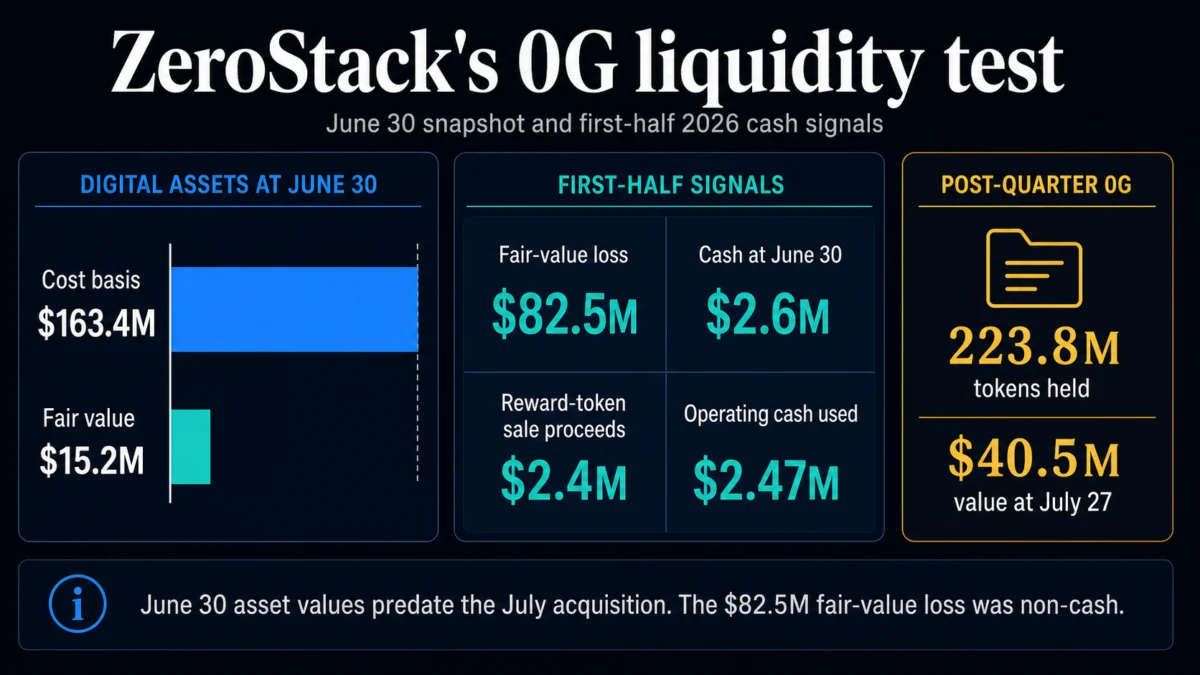
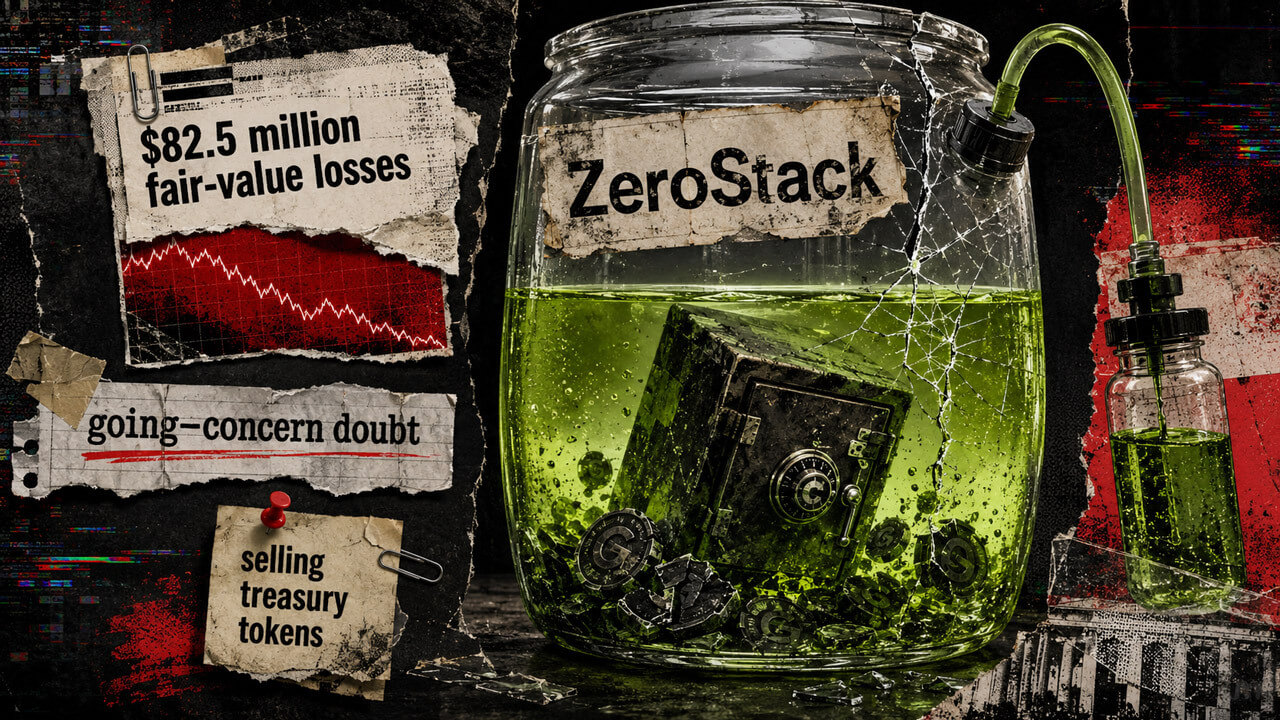
ZeroStack, a digital asset enterprise heavily concentrated in the artificial intelligence-focused 0G token ecosystem, has signaled a precarious financial future in its latest regulatory filings. According to the company’s Form 10-Q filed on July 31, 2026, for the quarter ended June 30, management has expressed "substantial doubt" regarding the firm’s ability to continue as a going concern. This admission comes on the heels of a catastrophic decline in the market value of its primary digital asset holdings, which plummeted from a cost basis of $163.33 million to a fair value of just $15.17 million by the end of the second quarter.
The company’s strategy for survival now rests almost entirely on its ability to monetize staking rewards generated by its 0G token treasury. However, the volatility of the crypto market and the specific liquidity constraints of the 0G token have led management to concede that these plans may not be sufficient to guarantee the company’s operational viability over the next twelve months.
A Deep Dive into the Financial Contraction
The financial snapshot provided in the June 30 filing paints a picture of a company struggling with extreme asset devaluation and mounting deficits. ZeroStack reported a net loss of $61.3 million for the first half of 2026. This figure was exacerbated by a non-cash, fair-value remeasurement loss of $82.5 million. While these markdowns are accounting-based and do not represent a realized cash outflow, they severely impact the company’s balance sheet and its ability to secure traditional financing.
As of June 30, ZeroStack’s liquidity position was dangerously thin. The company reported just $2.6 million in cash and cash equivalents against a negative working capital of $600,000. Perhaps most concerning for long-term investors is the accumulated deficit, which has ballooned to $339.1 million. The company’s digital asset portfolio, which includes 75.1 million 0G tokens and a nominal amount of Bitcoin, saw its value erode by over 90% relative to its acquisition cost. Specifically, the 0G tokens, which cost the company $163.33 million to acquire, were valued at only $15.17 million at the end of the reporting period.
The Staking-Reward Survival Strategy
To address its immediate liquidity needs, ZeroStack has pivoted toward a "staking-for-survival" model. During the first half of 2026, the company recognized $3.78 million in digital-asset revenue derived from 6.62 million 0G tokens earned through staking activities. These earnings are net of validator commissions, which typically range between 1% and 2%.
Of these rewards, ZeroStack liquidated 4.94 million tokens, yielding approximately $2.4 million in cash proceeds. This revenue was almost entirely consumed by the company’s operating activities, which required $2.47 million in cash over the same six-month period. Essentially, the company is operating at a break-even level where every token earned through staking is immediately sold to cover payroll, rent, and infrastructure costs.
Management stated that it expects to fund ongoing operations primarily through the monetization of these rewards. While the company maintains that its underlying staked tokens remain in accessible wallets and can be withdrawn at any time, they cautioned that this does not equate to immediate cash availability. The 0G token market is characterized by fluctuating prices and varying levels of liquidity, meaning a sudden attempt to liquidate a large portion of the treasury could lead to significant price slippage, further devaluing the remaining holdings.
Chronology of the 0G Portfolio Expansion
The timeline of ZeroStack’s asset acquisition reveals a complex series of transactions involving related parties and significant post-quarter developments.
March 31, 2026: A Form 8-K filing detailed the initial contribution of 142,232,948 0G tokens to a subsidiary known as Texas Blocker. This entity was designed to hold and manage a significant portion of the ecosystem’s tokens.
June 30, 2026: At the close of the second quarter, ZeroStack’s internal holdings stood at 75.1 million 0G tokens. The fair value of these tokens was recorded at approximately $0.20 per token, a sharp decline from the average cost basis of roughly $2.17 per token.
July 20, 2026: ZeroStack finalized the acquisition of Texas Blocker. This move was a critical "subsequent event" noted in the 10-Q filing. Upon closing, ZeroStack received 147,990,763 tokens from the subsidiary.
July 27, 2026: Following the merger of holdings, ZeroStack reported a total treasury of 223,773,990 0G tokens. Using the closing price of approximately $0.18 on that date, the total fair value of the company’s digital assets was estimated at $40.5 million.
The discrepancy between the 142.2 million tokens originally slated for Texas Blocker and the 147.9 million tokens received upon closing (a difference of roughly 5.7 million tokens) suggests that Texas Blocker was actively staking its holdings prior to the acquisition. While the filing does not explicitly attribute the entirety of this difference to staking rewards, the math aligns with the company’s broader strategy of utilizing rewards to bolster asset counts.
Related-Party Dynamics and Governance
The acquisition of Texas Blocker has drawn scrutiny due to the close ties between the leadership of the involved entities. Texas Blocker was originally formed by ZeroStack’s current CEO, Daniel Reis-Faria, and its CFO, Dany Vaiman. Furthermore, the filing reveals that Zero Gravity Labs—the core development team behind the 0G protocol—owned 51% of Texas Blocker as of June 30.
Adding another layer to the corporate structure, ZeroStack’s Executive Chairman, Michael Heinrich, served as the CEO of Zero Gravity Labs at the time the Texas Blocker transaction was finalized. These overlapping roles suggest a highly centralized governance model where the lines between the protocol developers, the asset holders, and the corporate management of ZeroStack are blurred. While such structures are common in early-stage crypto ecosystems, they often present challenges regarding fiduciary duties and conflict-of-interest management, especially when the company is facing a "going concern" crisis.

Market Conditions and the 0G Token Ecosystem
The 0G token is the native asset of an AI-focused decentralized infrastructure project. Like many "AI+Crypto" tokens that gained popularity in 2025, 0G has faced a harsh market correction in 2026. As of August 1, 2026, the token was trading near $0.15, with a rolling 24-hour trading volume hovering between $6.8 million and $7.5 million.
For a company like ZeroStack, which holds over 223 million tokens, the daily trading volume of the asset is a critical metric. If the company needs to sell millions of tokens to cover a monthly burn rate, it risks overwhelming the daily buy-side liquidity. If ZeroStack were to sell even 10% of its monthly staking rewards at once, it could represent a significant portion of the daily volume, leading to downward price pressure. This creates a "death spiral" risk: lower token prices require the company to sell more tokens to meet USD-denominated obligations, which in turn drives the price lower.
Implications and Future Outlook
The "going concern" warning is a standard accounting disclosure under ASC 205-40, but in the context of a crypto-heavy balance sheet, it carries significant weight. It indicates that there is a high probability the company will not be able to meet its obligations as they become due within one year of the financial statement issuance date.
For ZeroStack to navigate this crisis, several factors must align:
- Token Price Stability: The price of 0G must remain at a level where staking rewards can cover the $2.5 million+ bi-annual operating expenses.
- Staking Yields: The network inflation and reward rates of the 0G protocol must remain high enough to provide the necessary token volume.
- Market Liquidity: The broader market for AI tokens must remain liquid enough for ZeroStack to exit positions without catastrophic slippage.
- Capital Infusion: Given the negative working capital and massive accumulated deficit, the company may eventually need to seek outside equity or debt financing, though its current balance sheet makes it an unattractive candidate for traditional lenders.
The situation at ZeroStack serves as a cautionary tale for the "treasury-heavy" business model in the cryptocurrency sector. While holding native tokens allows a company to align its interests with the protocol it supports, it also exposes the corporate entity to extreme idiosyncratic risk. When the token’s value drops by 90%, the company’s ability to function is compromised, regardless of the technological merits of the underlying AI project.
As of the latest filing, management has not announced a formal restructuring or a shift in its business model. For now, the company’s survival is tethered to the daily fluctuations of the 0G token, making it a high-stakes experiment in decentralized finance as a corporate treasury strategy. Investors and industry observers will be watching the third-quarter filings closely to see if the Texas Blocker acquisition provided the necessary cushion or if the "substantial doubt" will transition into a more formal declaration of insolvency.