James Watt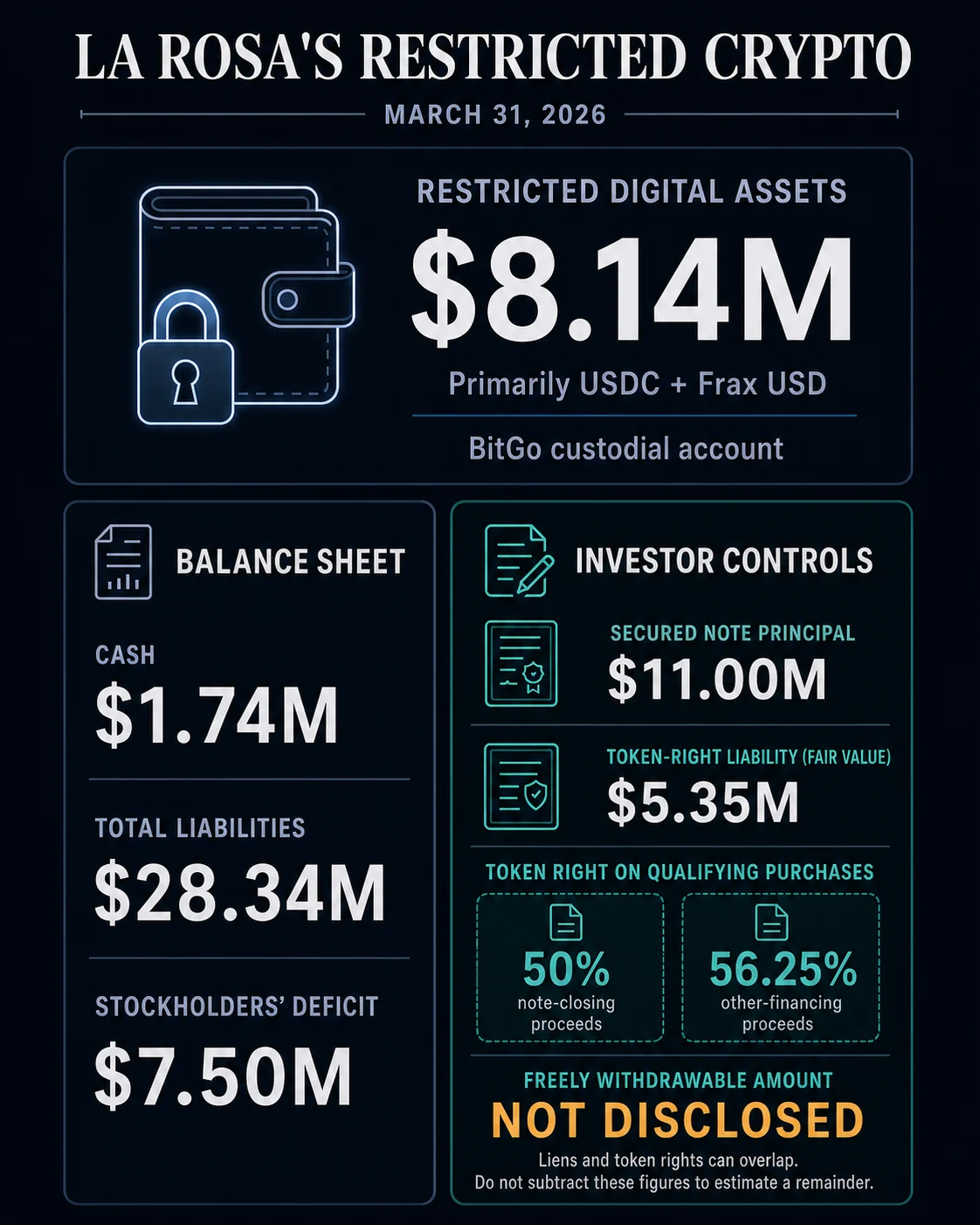
Real estate services firm La Rosa Holdings Corp. recently disclosed a digital asset treasury totaling $8.14 million as of March 31, 2026, a move that highlights the company’s aggressive pivot toward integrating cryptocurrency into its corporate balance sheet. However, a closer examination of the company’s delayed first-quarter SEC filing reveals a complex web of restrictions, liens, and investor rights that leave the actual liquidity of these assets in significant doubt. While the $8.14 million figure represents a substantial portion of the company’s recorded assets, the filing notably omits the specific amount that is freely withdrawable or usable for daily operations. This lack of transparency comes at a critical time for the company, which is currently grappling with a $13.47 million quarterly net loss and a "going concern" warning from its management.
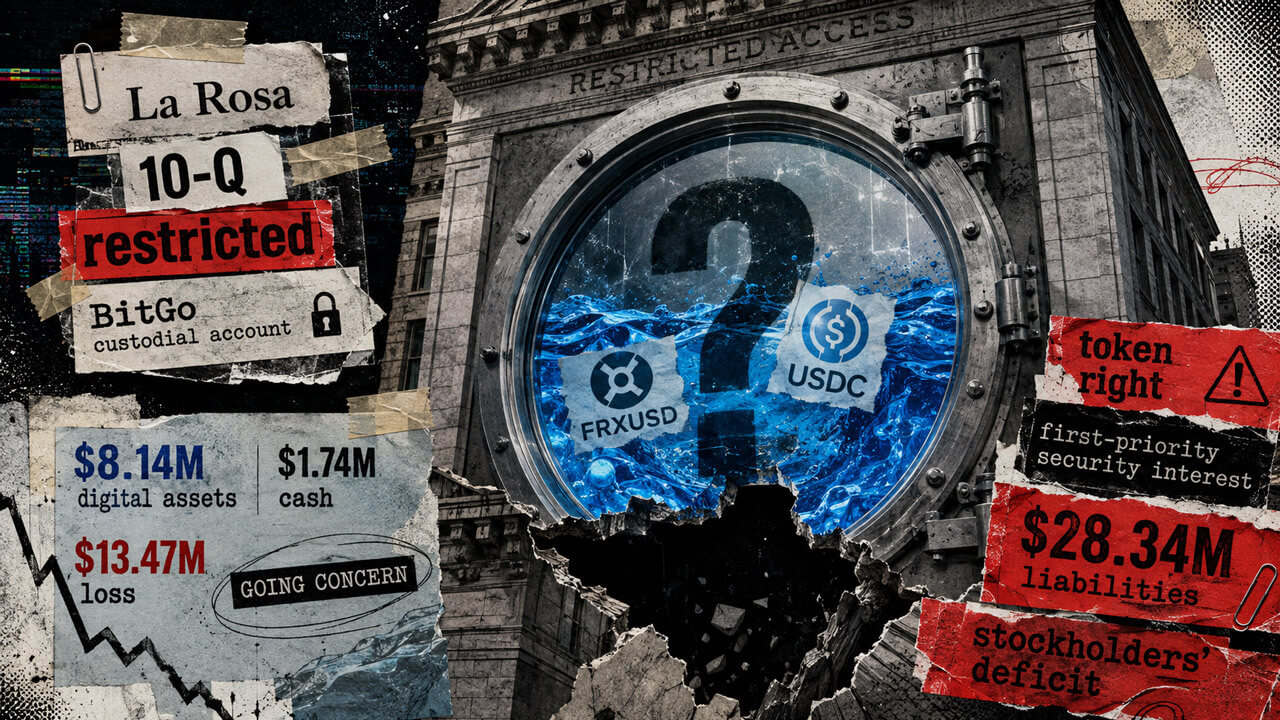
The digital assets, primarily composed of the stablecoins USD Coin (USDC) and Frax USD (FRAX), are held in a restricted custodial account with BitGo. According to the company’s 10-Q filing, any movement of these funds—including withdrawals, transfers, or liquidations—is strictly governed by compliance with La Rosa’s existing financing agreements. This restriction is not merely a procedural hurdle but a fundamental limitation on the company’s working capital. At the end of the first quarter, La Rosa reported a cash balance of just $1.74 million against total liabilities of $28.34 million. With a stockholders’ deficit of $7.5 million, the company’s ability to access its crypto reserves could determine its short-term survival.
The Mechanics of Restricted Liquidity and Investor Liens
The primary barrier to La Rosa’s liquidity is a senior secured convertible note issued on January 8, 2026. The note carries a principal amount of $11 million, though it was issued for a purchase price of $9.9 million. This instrument serves as the cornerstone of the company’s current financing strategy but imposes heavy burdens on its asset base. The note bears a 10% annual interest rate, payable monthly, and is set to mature 24 months from the date of issuance. By the end of the first quarter, La Rosa measured the value of this note at $14.57 million.
Under the terms of the agreement, the investor holds a first-priority security interest in substantially all assets purchased with the proceeds from the initial closing of the note. This includes the bulk of the digital assets currently sitting in the BitGo account. Furthermore, any remaining assets not covered by the initial priority are subject to a second-priority interest, trailing behind a separate lien established in February 2026. This tiered structure of security interests creates a scenario where the $8.14 million in crypto is effectively collateralized twice over, making it nearly impossible for the company to liquidate the tokens without the express consent of its creditors or the full satisfaction of the underlying debt.
Beyond the liens, a secondary layer of complexity exists in the form of "token rights" granted to the investor. This agreement entitles the investor to a significant portion of the tokens purchased with the proceeds of the financing. Specifically, if the investor exercises these rights, they are entitled to 50% of the tokens bought with the net proceeds of the January note and 56.25% of tokens purchased with certain subsequent financing. As of the end of the quarter, La Rosa recorded a $5.35 million current liability representing the fair value of this contract. Because the liens and the token rights may apply to the same pool of assets, calculating the company’s net equity in its crypto holdings is a difficult task for external analysts. The filing fails to clarify if the $5.35 million liability is intended to be satisfied by the $8.14 million asset pool, or if these are independent obligations.
A Chronology of Financial Distress and Strategic Pivots
To understand La Rosa’s current predicament, one must look at the sequence of events leading up to the 2026 first-quarter filing. The company has undergone a series of radical capital restructurings over the past year to maintain its listing on the Nasdaq and attract new capital.
In July 2025, La Rosa executed its first of three recent reverse stock splits. This was followed by a second split in January 2026, and a third 1-for-10 reverse split in April 2026. These maneuvers are typically employed by companies whose share prices have fallen below the minimum requirements for major exchanges. Despite these efforts, the company received a deficiency notice from Nasdaq regarding a failure to meet the minimum stockholders’ equity requirement, which stood at a negative $1.85 million as of December 31, 2025.
The pivot to digital assets was framed by management as a "Digital Asset Treasury to Scale AI Infrastructure Strategy." In a press release dated March 31, 2026, the company claimed it had added over $6.4 million in net assets to its balance sheet through this strategy. However, the subsequent 10-Q filing painted a more nuanced and arguably more concerning picture. While the press release suggested that only $3.9 million of the reserve was restricted under the token right, the official SEC filing categorized the entire $8.14 million balance as restricted, citing the broader reach of the financing controls and liens.
The financial performance during the first quarter of 2026 further underscores the company’s volatility. The $13.47 million net loss was driven largely by a $10.50 million charge related to the issuance of the senior secured note. Operating cash flow remained deeply negative, with $1.76 million used in operations during the quarter. This burn rate, combined with the restriction on its largest asset class, led management to issue a "going concern" warning, stating that existing capital would likely be insufficient to cover projected operating expenses for the next 12 months.
Accounting Standards and Valuation Discrepancies
La Rosa’s reporting of its digital assets follows the standard accounting practice of recording tokens at historical cost less impairment. Under this framework, the company recognizes losses if the value of the tokens drops below the purchase price but is prohibited from recognizing gains above the carrying value until the assets are sold or disposed of. This accounting method can often lead to a "hidden" value on the balance sheet if the market price of the assets increases, but it also means the $8.14 million figure may not reflect the real-time market value of the USDC and FRAX holdings.
The filing is also notable for what it does not contain. Missing from the disclosure are the specific quantities of tokens held, the exact split of funding sources used to acquire them, and the status of any "deliveries" made to the investor under the token rights agreement. Without these details, it is impossible to determine the "break-even" point for the company’s crypto strategy. If the value of the tokens were to decline significantly, the impairment charges could further erode the company’s already precarious equity position. Conversely, if the tokens appreciate, the benefit to La Rosa may be capped by the investor’s right to claim up to 56.25% of the holdings.

Subsequent Events and the Path Toward Compliance
Following the close of the first quarter on March 31, La Rosa continued to seek external funding to bridge its liquidity gap. The company reported two Series D closings that provided $500,000 in capital, followed by a Series E round that brought in $250,000 in gross proceeds. While these infusions provide some breathing room, they are small relative to the company’s $12.06 million in current liabilities.
By May 31, 2026, the company’s digital asset holdings had reportedly grown to $10.3 million. This increase was funded by the deployment of $6.7 million from the initial note closing and $3.6 million from an equity line of credit. Despite this growth in the total balance, the fundamental question of liquidity remained unanswered in subsequent updates. The company submitted a compliance plan to Nasdaq to address its equity deficiency, but the success of this plan likely hinges on the company’s ability to either reclassify its restricted crypto as unrestricted or to successfully convert its debt into equity.
Analysis of Broader Implications
The case of La Rosa Holdings serves as a cautionary tale for the "corporate crypto treasury" trend. While companies like MicroStrategy have successfully used Bitcoin as a reserve asset, La Rosa’s approach involves using restricted stablecoins as collateral for high-interest debt. This creates a circular financial structure where the assets intended to provide stability are themselves tied up in the obligations used to acquire them.
For the real estate sector, which is traditionally capital-intensive and reliant on stable cash flows, the introduction of complex crypto-financing adds a layer of systemic risk. If La Rosa cannot resolve the liquidity questions surrounding its BitGo account, it may find itself in a position where it is "asset-rich" on paper but "cash-poor" in practice, unable to meet payroll or vendor obligations despite holding millions in digital tokens.
The upcoming quarterly filings will be a moment of truth for the firm. Investors and regulators will be looking for a clear breakdown of token quantities, a definitive statement on the freely withdrawable balance, and evidence that the company can move beyond its cycle of reverse splits and debt issuance. Until then, the $8.1 million crypto balance remains a significant but inaccessible figure on a balance sheet that is under extreme pressure. The intersection of real estate, AI infrastructure, and decentralized finance has created a unique corporate profile for La Rosa, but without a resolution to its liquidity constraints, the strategic pivot may struggle to achieve its intended goal of scaling the company’s operations.