
 James Watt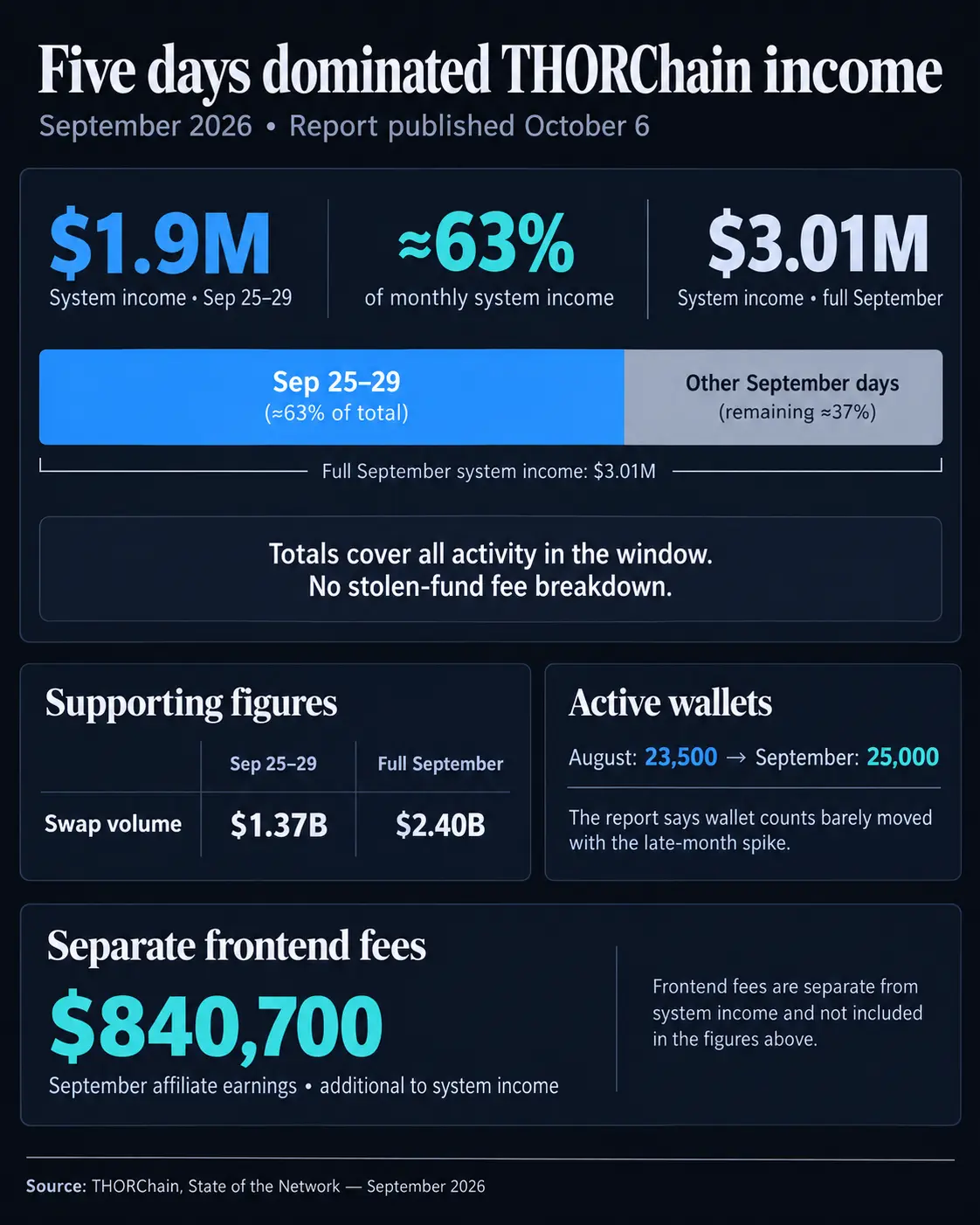
The decentralized cross-chain liquidity protocol THORChain experienced a significant surge in financial activity during September 2026, marking its most productive period in over a year. According to official "State of the Network" data, the protocol generated $3.01 million in total system income throughout the month, representing the highest monthly revenue figure recorded since March 2025. This financial performance was underpinned by a robust increase in swap volume, which climbed to $2.40 billion—a level of activity not seen since June 2025. While these figures suggest a period of rapid expansion for the network, a granular analysis of the data reveals that the vast majority of this growth was concentrated within a five-day window and was closely tied to a high-profile security breach at the Bitget cryptocurrency exchange.
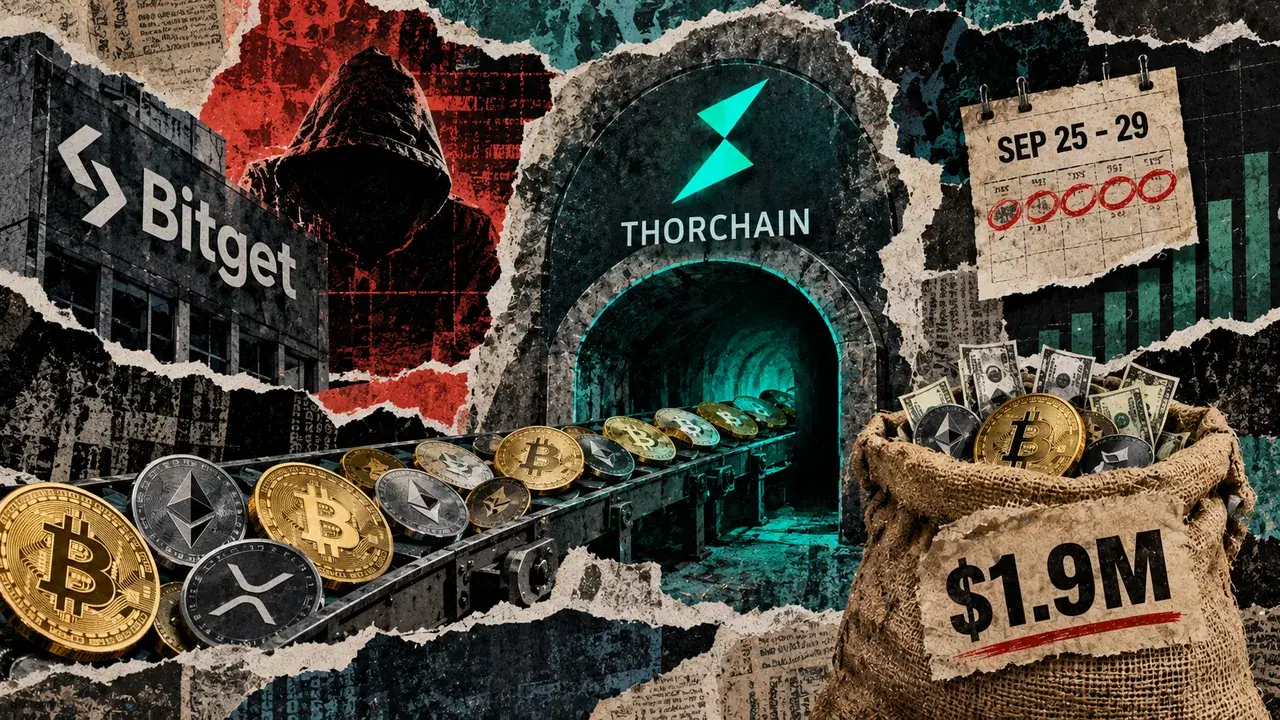
The intersection of decentralized finance (DeFi) infrastructure and centralized exchange security became a focal point for the industry in late September. Approximately $1.37 billion, or 57% of THORChain’s total monthly swap volume, occurred between September 25 and September 29. During this same brief interval, the network generated approximately $1.9 million in income, accounting for roughly 63% of the entire monthly total. This concentration of activity coincided directly with the movement of funds linked to the Bitget exploit, an event that saw nearly $387.5 million in digital assets moved to attacker-controlled addresses.
Chronology of the September Activity Spike
The month of September began with relatively standard performance metrics for THORChain. Through the first three weeks of the month, the protocol maintained a steady but modest pace of transactions, consistent with the broader market’s cooling volatility. However, the landscape shifted dramatically following the breach of Bitget’s security infrastructure.
On September 25, the network began to see an influx of high-value transactions. THORChain representatives noted that between September 25 and September 29, daily swap volumes fluctuated between $190 million and $460 million. This period of intense activity was characterized by large-scale transfers across multiple blockchains, including Bitcoin, Ethereum, and BNB Chain. The protocol’s ability to facilitate native, non-custodial swaps between these disparate networks made it a primary conduit for the movement of the large capital blocks associated with the exploit.
By September 30, as the movement of the contested funds slowed, THORChain’s volume began to normalize toward its earlier baseline. The suddenness of the spike and its subsequent tapering highlighted the episodic nature of the month’s record-breaking performance. For observers of the protocol, the data underscored a significant reliance on high-value, event-driven transactions to drive top-line revenue growth.
The Bitget Exploit and the Ethics of Protocol Neutrality
The Bitget hack serves as the primary backdrop for THORChain’s September performance. According to reports from the exchange, the $387.5 million loss involved a variety of assets that were quickly transitioned into more liquid or harder-to-trace formats. As the hackers began the process of "laundering" or moving the haul, they utilized THORChain’s unique architecture, which allows users to swap native assets like BTC for ETH without the need for wrapped tokens or centralized intermediaries.
In the wake of the exploit, Bitget and various blockchain security firms reportedly sought the assistance of major infrastructure providers to freeze or intercept the stolen assets. THORChain, however, maintained a steadfast position on protocol neutrality. The project’s leadership rejected calls for selective intervention or the blacklisting of specific wallet addresses.
In an official communication, THORChain argued that its network is a decentralized, permissionless utility, analogous to the base layers of Bitcoin or Ethereum. The protocol’s stance is that a decentralized exchange (DEX) should not have the power to censor transactions, as doing so would undermine the fundamental value proposition of the technology. THORChain clarified the distinction between a "network halt"—an emergency measure used to protect the protocol itself from technical failure—and the targeted censorship of individual participants.
To support this position, the protocol referenced its own history. In May 2021, THORChain suffered a major exploit in which attackers stole approximately $10.7 million from liquidity pools. Even in that instance, the protocol did not implement blacklists against the attackers’ addresses for future swaps, prioritizing the integrity of its permissionless code over the recovery of assets through centralized-style intervention. This philosophy of "code as law" remains a polarizing but consistent feature of the THORChain ecosystem.
Discrepancy Between Financial Growth and User Expansion
While the revenue and volume figures for September suggest a thriving ecosystem, the underlying wallet data provides a more nuanced perspective. The surge in income did not stem from a broad-based influx of new retail or institutional users, but rather from a small number of participants executing exceptionally large transactions.
The number of active wallets on THORChain saw only a marginal increase, rising from 23,500 in August to 25,000 in September. Similarly, new wallet creation edged up slightly from 21,800 to 22,400. These figures indicate that the user base grew by roughly 6%, whereas swap volume nearly quadrupled from August’s $613 million, and income increased fivefold from the previous month’s $615,000.
This disparity suggests that the "velocity" of capital per wallet reached an extraordinary peak during the final week of the month. THORChain’s internal analysis confirmed that wallet activity barely responded to the volume spike, confirming that the $1.37 billion moved during the Bitget-linked window was driven by a highly concentrated group of actors. For the protocol’s long-term health, this raises questions about the sustainability of its economic model if it remains dependent on rare, high-magnitude events rather than consistent, diversified retail flow.
Yield Performance and Liquidity Provider Returns
The massive influx of fees during the late-September period had a profound impact on the yields offered to liquidity providers (LPs) and RUNE token holders. THORChain utilizes a "Slip-Based Fee" model, meaning that larger swaps that cause more price slippage result in higher fees paid to the network. The high-value transactions associated with the Bitget funds likely incurred substantial slippage fees, which were then distributed to the protocol’s participants.
On September 29, the seven-day annualized return for RUNE reached a staggering 69.03%. Simultaneously, the yield for TCY climbed to 29.74%. These figures represent some of the highest returns available in the DeFi sector during that period. However, THORChain officials have cautioned that these yields are "trailing" measures. As the high-fee days of late September move out of the rolling calculation window, these yield percentages are expected to undergo a sharp downward correction toward historical norms.
Frontend affiliates, who provide the interfaces through which users interact with the THORChain protocol, also saw a windfall. Affiliates earned a total of $840,700 in September. Interestingly, a significant portion of these fees—approximately $669,000—was attributed to unidentified or "ghost" affiliates, further suggesting that the entities moving the Bitget-linked funds may have been using custom or private interfaces to interact with the protocol.
Broader Implications for the DeFi Landscape
The events of September 2026 highlight the ongoing tension between the decentralized ethos of DeFi and the regulatory and security needs of the broader crypto industry. THORChain’s refusal to intervene in the movement of stolen funds reinforces the "unstoppable" nature of decentralized protocols, but it also invites scrutiny from regulators who view such platforms as potential vulnerabilities in the global fight against financial crime.
For THORChain, the challenge moving forward is to translate the visibility gained during this high-volume period into recurring, legitimate trading flow. The protocol has demonstrated that its liquidity pools can handle massive, billion-dollar volumes under pressure without systemic failure. This technical resilience is a selling point for institutional integrators and high-frequency traders who require deep, cross-chain liquidity.
However, if the protocol cannot attract a more diverse and consistent user base, its economic metrics will remain volatile and tied to the "black swan" events of the crypto world. Liquidity providers must weigh the potential for massive short-term yields against the risk of periods of low activity and the reputational risks associated with permissionless systems.
As October begins, the industry will be watching to see if THORChain’s volume normalizes to pre-hack levels or if the protocol can maintain a new, higher baseline of activity. The "State of the Network" for the coming months will serve as a litmus test for whether THORChain is evolving into a mainstream financial utility or remaining a specialized tool for large-scale, often controversial, capital movements. For now, the September records stand as a testament to the protocol’s capacity, even if the source of that volume remains a subject of intense industry debate.








