admin
admin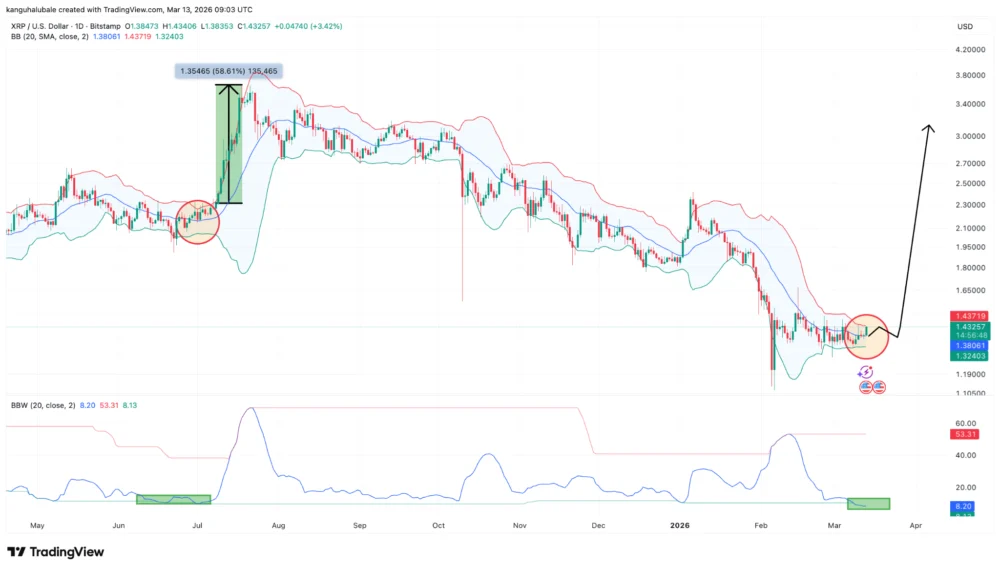
The digital asset XRP demonstrated renewed bullish momentum on Friday, climbing 3% to trade above the $1.40 mark as a confluence of technical patterns and on-chain metrics suggested the cryptocurrency is positioned for a significant upward breakout. Market analysts and technical observers have identified a rare alignment of volatility indicators and supply-side constraints that historically precede explosive price movements. This recent price action follows a period of intense consolidation, where the asset has navigated a complex landscape of institutional flows and shifting retail sentiment. As the broader cryptocurrency market seeks direction, XRP’s internal market structure reveals a tightening "volatility squeeze" that has captured the attention of high-volume traders and long-term investors alike.
The Bollinger Band Squeeze: A Precursor to Volatility
At the heart of the current bullish thesis is the behavior of the Bollinger Bands on the daily XRP/USD chart. Bollinger Bands are a sophisticated technical analysis tool consisting of a simple moving average and two standard deviation lines. Traders utilize these bands to measure market volatility and identify overbought or oversold conditions. When the bands contract significantly—a phenomenon known as a "squeeze"—it indicates a period of low volatility that typically ends with a sharp, high-volume move in either direction.

Current data indicates that the daily XRP Bollinger Bands have reached their narrowest point in eight months. This level of compression has not been observed since the lead-up to the asset’s significant rally in mid-2025, when XRP surged approximately 60% to reach a multi-year peak of $3.66. Technical analysts, including those from The Crypto Basic, have noted that such extreme tightening often serves as a coiled spring. The historical precedent suggests that once the price breaks through the upper boundary of these bands, the resulting momentum can lead to an "explosive run."
In addition to the Bollinger Band squeeze, XRP is currently navigating a symmetrical triangle structure. This chart pattern represents a period of indecision where the highs are becoming lower and the lows are becoming higher, converging toward a single point. Analysts from XRP Update suggest that this volatility compression, paired with a stabilizing Relative Strength Index (RSI), indicates that the market is preparing for a "significant breakout." A daily candlestick close above the $1.50 resistance level is widely considered the primary confirmation signal required to validate this upward momentum.
Chronology of Recent Price Action and Market Development
The path to the current $1.40 level has been marked by a series of strategic consolidations and institutional milestones. Over the past several months, XRP has faced a rigorous testing of its support levels, particularly around the $1.30 psychological threshold.

- Mid-2025 Peak: XRP achieved a multi-year high of $3.66 following a breakout from a similar Bollinger Band compression. This rally established the upper limits of the current multi-year trading range.
- The Descent into Consolidation: Following the peak, the asset entered a prolonged downtrend, forming the upper trendline of what is now recognized as a weekly "falling wedge" pattern.
- Q4 2025 – Q1 2026 Stability: During this period, XRP found consistent support near $1.30, allowing the Relative Strength Index to reset from overbought conditions.
- The "Friday" Surge: The 3% increase on Friday represents the first major attempt to challenge the $1.50 resistance level in the current cycle, backed by a noticeable increase in social sentiment and on-chain accumulation.
- Ripple Corporate Action: Parallel to the price action, Ripple Labs announced a substantial share buyback program, intending to repurchase $750 million in shares through April. This move is seen as a signal of corporate strength and a method to consolidate the company’s valuation, which indirectly bolsters investor confidence in the XRP ecosystem.
Weekly Chart Analysis: The Falling Wedge and RSI Recovery
While the daily charts focus on immediate volatility, the weekly timeframe provides a broader perspective on XRP’s long-term trajectory. Technical analysts have identified a classic "falling wedge" pattern that has been developing since July 2025. In technical analysis, a falling wedge is characterized by a series of lower highs and lower lows that converge as the downtrend loses steam. This pattern is overwhelmingly regarded as a bullish reversal structure.
The price of XRP has been compressing between two descending trendlines for several months. Currently, the asset is testing the upper boundary of this wedge. If a confirmed breakout occurs above this trendline, the projected bullish target—calculated by measuring the widest part of the wedge and projecting it from the breakout point—sits at approximately $2.55. This would represent a staggering 78.5% increase from current price levels.
Supporting this weekly breakout thesis is the Relative Strength Index (RSI). The weekly RSI has recently rebounded from oversold territory, a move that historically signals fading selling pressure and the entry of new buyers. Market historians point to the period between July and September 2022, where a similar RSI recovery preceded an 85% rally for XRP. For the current bullish trend to shift into a long-term structural bull market, observers emphasize that the price must not only break $1.50 but also sustain a position above the $1.73 to $2.00 "supply zone," where heavy historical selling has occurred.

On-Chain Metrics: The Exchange Supply Crunch
One of the most compelling arguments for an XRP price appreciation comes from on-chain data regarding exchange reserves. According to data from Glassnode, the total supply of XRP held on centralized exchange addresses has plummeted to 12.8 billion tokens. This is the lowest level of exchange-held XRP since May 2021.
A declining balance on exchanges is traditionally interpreted as a bullish indicator for several reasons:
- Reduced Sell-Side Pressure: Fewer tokens available on exchanges mean there is less immediate liquidity for sellers to dump onto the market.
- Cold Storage Migration: Large-scale holders, or "whales," typically move their assets off exchanges and into private cold storage when they intend to hold for the long term. This reflects growing confidence in the asset’s future value.
- Supply-Demand Imbalance: With the available supply on exchanges shrinking, even a modest increase in demand can lead to disproportionate price increases, as buyers must bid higher to entice sellers.
This "supply shock" provides a fundamental backdrop to the technical patterns seen on the charts. While technicals suggest when a move might happen, the exchange reserve data suggests why the move could be particularly aggressive.

Institutional Divergence: Spot ETF Outflows
Despite the bullish technical and on-chain signals, the institutional sector presents a more nuanced picture. Spot XRP exchange-traded funds (ETFs) have recently experienced a period of cooling interest. Data from SoSoValue indicates that spot XRP ETFs recorded five consecutive days of net outflows, totaling approximately $50.8 million.
This institutional redemption could serve as a temporary headwind for XRP’s recovery. ETF outflows often reflect short-term profit-taking by institutional managers or a rotation of capital into other assets like Bitcoin, which recently saw inflows of $167 million. However, market analysts suggest that the impact of ETF outflows may be mitigated by the sheer volume of retail and whale accumulation seen in the on-chain data. The divergence between institutional "paper" selling and on-chain "physical" accumulation often creates a volatile environment where the asset eventually follows the lead of the decreasing circulating supply.
Broader Implications and Market Outlook
The potential for a "significant breakout" in XRP carries implications for the broader altcoin market. As one of the highest-capitalization assets in the space, a major move in XRP often serves as a catalyst for "altseason," a period where alternative cryptocurrencies outperform Bitcoin.

If XRP manages to clear the $1.50 confirmation level and move toward the $2.55 wedge target, it would likely be driven by a combination of the following factors:
- Legal and Regulatory Clarity: Ongoing developments in the regulatory landscape regarding Ripple and the SEC continue to influence investor sentiment. Any further positive legal news could act as the final trigger for the Bollinger Band breakout.
- Corporate Stability: Ripple’s $750 million share buyback provides a floor of confidence, suggesting the company is well-capitalized and focused on long-term value creation rather than short-term liquidity.
- Global Liquidity Cycles: As central banks around the world navigate interest rate shifts, increased global liquidity often finds its way into high-beta assets like XRP.
In conclusion, XRP stands at a critical technical juncture. The tightening of the Bollinger Bands to an eight-month low, the formation of a multi-month falling wedge, and the multi-year low in exchange supply all point toward a period of high volatility. While institutional ETF outflows suggest a cautious stance from some professional investors, the underlying market structure remains heavily skewed toward a bullish resolution. Traders will be closely watching the $1.50 and $1.73 levels in the coming days to confirm whether this "volatility squeeze" will result in the explosive run that many indicators now predict. As with all digital asset investments, the path forward remains subject to market risks and volatility, requiring investors to weigh technical optimism against the realities of institutional flows and macroeconomic shifts.