
 admin
admin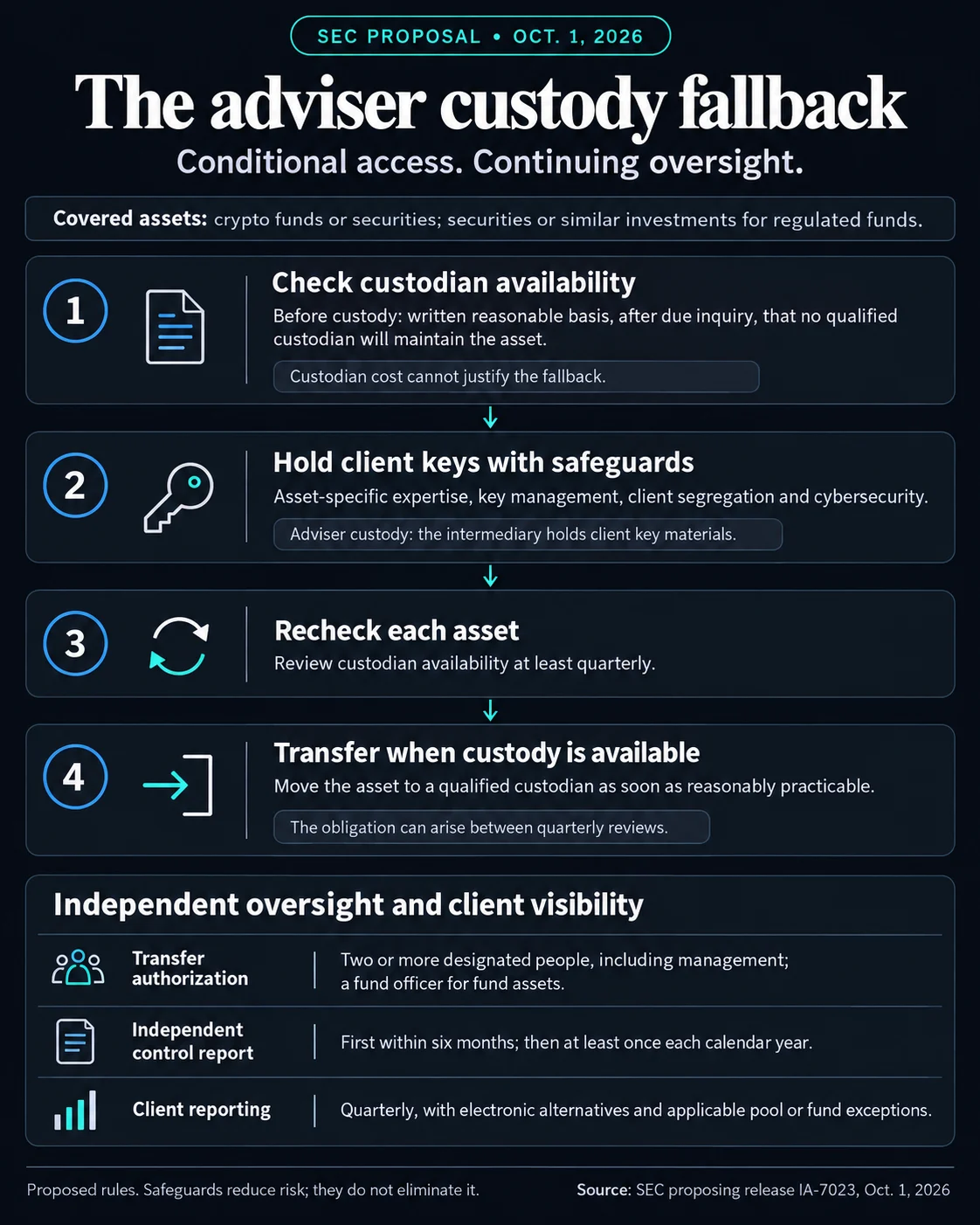
The U.S. Securities and Exchange Commission (SEC) has put forth a proposed rule change that could significantly alter how investment advisors manage cryptocurrency assets for their clients. This new framework, termed a "crypto custody fallback," is designed to allow registered investment advisors to hold certain client crypto assets directly when an eligible, third-party custodian is unavailable. While the proposal aims to broaden investment choices and enhance accessibility, its economic analysis suggests a substantial cost burden that may disproportionately favor larger advisory firms, potentially limiting its adoption by smaller entities.
The core of the proposal, approved by the SEC on October 1st, 2026, offers a conditional pathway for advisors to act as custodians for "covered client crypto assets." This provision is triggered only when an advisor, after thorough due diligence, determines that no qualified custodian is available for a specific asset. The SEC’s accompanying economic analysis projects that the significant expenses associated with implementing and maintaining the required safeguards could lead many smaller firms to forgo offering these crypto-related services.
According to the SEC’s economic modeling, the estimated annual cost for an advisor utilizing this self-custody option could reach approximately $433,833. This figure is derived from several key components, notably the requirement for an independent internal control report, which the SEC estimates at $376,000 annually, and recurring internal compliance work, projected at $57,833 per year. While these figures represent a substantial investment, the SEC acknowledges that they do not encompass all potential costs, specifically excluding significant technology investments related to software, hardware, and integrated systems necessary for secure crypto asset management.
The implications for clients are multifaceted. For those working with larger, well-resourced advisors, this fallback mechanism could unlock access to a broader range of digital assets that might otherwise be inaccessible. Conversely, clients of smaller firms that opt out of offering the service due to cost constraints might find their investment options limited. This divergence in service availability could create a tiered investment landscape within the advisory sector.
SEC Commissioner Hester Peirce, a notable proponent of innovation in digital assets, has clarified that the proposed "self-custody" by an advisor differs fundamentally from an individual investor holding their own assets. In this scenario, the advisor acts as an intermediary, safeguarding critical client materials, which could include a non-controlling portion of a digital asset. Crucially, clients would still be reliant on the advisor’s security protocols and operational integrity. For typical advisory clients, the rule amendments would primarily apply to crypto assets classified as funds or securities. For regulated fund accounts, the scope would extend to securities and similar investments.
Unpacking the Estimated Annual Costs
The SEC’s detailed economic analysis, particularly within Table 8 of the proposal, breaks down the projected annual expenses for advisors. The most significant recurring cost is the independent internal control report, estimated at an average of $376,000 annually. This is complemented by an estimated $57,833 for ongoing internal compliance activities.
Beyond these recurring costs, the analysis also accounts for an initial investment in internal compliance work, estimated at $173,499. When combined, these figures form the subtotal of $433,833 for the annual operational burden of the self-custody fallback. It is critical to note that this subtotal is explicitly stated to exclude a range of technology-related expenses, including the acquisition and maintenance of specialized software, hardware, and the complex systems required to manage digital assets securely. Furthermore, the proposal also outlines separate recordkeeping and disclosure requirements, which are detailed in other sections of the SEC’s analysis and are not factored into this specific operational cost estimate.
The figures for the independent control report are based on an inflation-adjusted prior estimate from the SEC’s Paperwork Reduction Act analysis, utilizing a historical cost model. The actual cost of these reports can fluctuate significantly depending on the specific digital assets being held, the complexity of the safeguarding systems employed, and the specialized expertise required to audit different blockchain networks.
The SEC’s calculation assumes that approximately 823 registered advisors, representing about 5% of the total 16,442 registered advisors, would potentially utilize this self-custody option. However, the agency cautions that the actual adoption rate could be lower, influenced by the considerable financial and operational hurdles involved.
The Impact of Scale on Access and Cost
The economic analysis explicitly anticipates a divergence in adoption based on firm size. Smaller advisory firms, facing tighter budget constraints, may find the cost of compliance prohibitive and therefore elect not to offer self-custody services. In contrast, larger advisory firms, with greater financial resources and established operational infrastructure, are more likely to be able to meet the stringent safeguards mandated by the SEC.
A key factor in the economic viability of this fallback for larger firms is the potential to spread certain costs across a wider client base, a diverse portfolio of assets, or even across affiliated business units. This ability to amortize expenses can create a significant competitive advantage. The proposal does not establish a fixed minimum firm size for offering the service, but rather implies that the economic feasibility is intrinsically linked to the firm’s overall scale and resource allocation capabilities.
For instance, an advisor managing a substantial volume of traditional assets might only allocate a small fraction of its business to cryptocurrency. However, if this advisor has the necessary infrastructure and expertise in place, the incremental cost of adding self-custody for a limited pool of crypto assets might be manageable. Conversely, an advisor specializing in digital assets might already possess the requisite expertise and technological infrastructure, making the transition to the proposed fallback less of an incremental burden.
The principle of cost allocation is crucial here. A fixed cost associated with implementing robust security measures will weigh more heavily on a small number of client assets than on a large portfolio. Firms with the capacity to distribute these costs across their broader business operations, rather than solely burdening clients who utilize the self-custody service, will likely find the option more financially sustainable.
The SEC anticipates that many of these direct costs associated with self-custody will likely be passed on to clients through fees or other expense charges. The complexity of managing a greater number of digital assets and navigating diverse blockchain networks will invariably necessitate more sophisticated controls and specialized auditing services, thus increasing absolute costs. The primary benefit, therefore, stems from the potential to leverage and reuse existing infrastructure and expertise.

Regarding the cost of specialized auditing, the SEC notes a potential bottleneck. Increased demand for accountants and auditors with expertise in assessing cryptocurrency controls could lead to scarcity and higher pricing for these services, particularly impacting smaller advisors who may have less bargaining power with these specialized professionals.
An Option with Conditional Availability
The proposed fallback mechanism for advisors to hold client crypto assets is not a perpetual authorization but rather a conditional provision. An advisor can only opt for this self-custody arrangement if they possess a written, reasonable basis, established after thorough due inquiry, that no qualified custodian is available to hold a specific asset.
This determination must be made before the advisor takes custody of the asset and must be reassessed at least on a quarterly basis. Critically, the SEC explicitly states that the cost of engaging a qualified custodian cannot be the sole justification for opting for the self-custody fallback. The decision must be based on the genuine unavailability of an eligible custodian for that particular asset, assessed under the proposed conditions.
Once an advisor becomes aware that a qualified custodian has become available for an asset previously held under the fallback provision, the advisor is obligated to transfer the asset to that custodian as soon as reasonably practicable. This obligation can arise at any point between the quarterly reviews, and the proposal does not prescribe a uniform deadline for such transfers across all situations.
This dynamic nature of custodian availability introduces a layer of complexity and potential cost for advisors. A firm might invest in the infrastructure and expertise to support a particular asset under self-custody, only to be required to move it to an external custodian shortly thereafter. This could lead to stranded costs or a situation where the remaining unsupported assets are too few to justify the ongoing expense of the self-custody infrastructure.
If, by the due date for the independent control report, no client crypto assets remain in the advisor’s self-custody, the report requirement may be waived. This provision could mitigate costs for advisors who engage in short-lived self-custody arrangements. However, advisors continuing to hold other covered client crypto assets under self-custody would still be subject to the full reporting obligations.
Safeguards Mandate Independent Scrutiny
The substantial financial outlay associated with the proposed fallback is intrinsically linked to the rigorous safeguards designed to protect client assets. This shift in asset holding introduces inherent risks, including potential misuse, misappropriation, and operational errors. The SEC’s framework aims to mitigate these risks through a combination of robust controls and independent oversight.
As highlighted in a statement by SEC Commissioner Mark Uyeda, the proposed conditions encompass a broad spectrum of requirements, including specialized safeguarding expertise, robust cybersecurity measures, annual reviews, comprehensive reporting, and transparent client disclosures. To implement these safeguards effectively, advisors would need to demonstrate asset-specific expertise, implement secure key management systems, enforce dual authorization for critical actions, and ensure the segregation of each client’s assets.
The first independent control report is mandated within six months of an advisor taking custody of crypto assets and at least annually thereafter. This report is designed to provide an objective assessment of the design, implementation, and operational effectiveness of the advisor’s internal controls. It will also include a verification of the reconciliation of the advisor’s records with the blockchain network itself, providing an external validation of asset holdings.
This independent scrutiny goes beyond an advisor’s self-assessment of their capabilities. It introduces a layer of accountability and assurance for clients and regulators alike. In addition to the independent reports, advisors will be required to provide quarterly client reporting, with provisions for electronic alternatives and exemptions for qualifying audited pools and regulated funds. This regular client communication aims to enhance transparency, allowing clients to monitor their balances and transactions, thereby complementing the technical safeguards. While the accountant’s report addresses the integrity of the systems, client reporting ensures visibility into the actual holdings.
It is important to note that these protections, while extensive, do not entirely eliminate custodial risk. The SEC cautions that the mere expenditure of funds on compliance does not automatically equate to effective safeguarding. A firm’s capacity to absorb compliance costs is a distinct consideration from its actual ability to implement systems that reliably protect client assets.
Exploring Alternatives to Mitigate Scale Advantages
While the SEC’s proposal introduces significant cost considerations, Commissioner Hester Peirce, in a statement from September 30, 2025, has previously acknowledged conditional staff no-action relief for certain state trust companies and identified national and state banks as other potential custodians for digital assets. The October proposal further expands this landscape by permitting eligible state trust companies to custody crypto assets, subject to their own due diligence and safeguard assessments.
Where an eligible institution, such as a state trust company or a bank, already supports a particular crypto asset for custody, clients may gain access to that asset without their advisor needing to establish the complex and costly self-custody fallback arrangement. The economic advantage of these alternative custodian arrangements would be contingent on the specific asset and the custodian’s existing service offerings. It is important to recognize that an institution authorized to provide crypto custody services does not necessarily maintain every asset that a client might wish to hold.
Ultimately, the success of this SEC proposal hinges on its ability to deliver usable access to a wider array of digital assets at an acceptable cost and with robust protection for investors. The SEC’s economic analysis suggests a potential benefit for advisors with substantial resources and the capacity to leverage existing infrastructure. However, the extent to which clients broadly benefit will depend on a complex interplay of factors: the actual implementation costs incurred by advisory firms, the pricing and availability of independent auditing services, and the continued expansion of custodian support for a diverse range of digital assets by eligible institutions. The regulatory landscape for digital assets remains dynamic, and this proposal represents a significant step in addressing the custodial challenges inherent in this evolving market.








