
 James Watt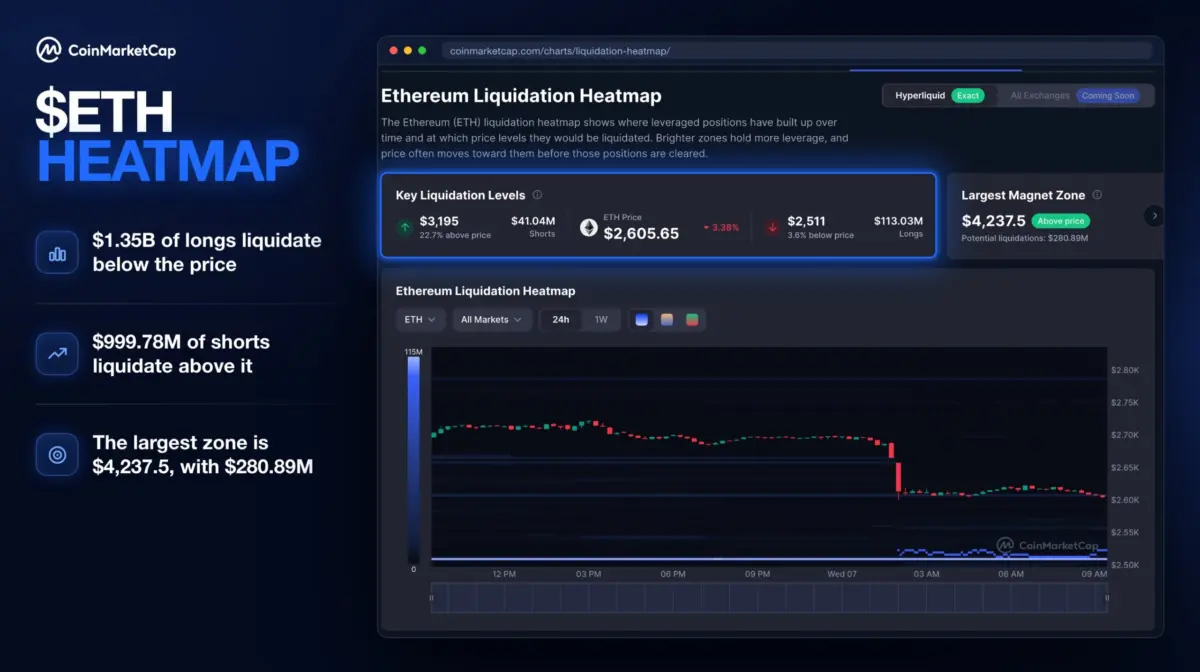
The Ethereum market is currently navigating a period of intense volatility as the second-largest cryptocurrency by market capitalization slides toward the critical $2,500 psychological support level, placing approximately $1.35 billion in leveraged long positions at immediate risk of liquidation. Data aggregated from CoinMarketCap and various on-chain analytics platforms indicates a growing imbalance in the derivatives market, where bullish traders are increasingly exposed to a "long squeeze" if the downward price action persists. This technical vulnerability is compounded by a sharp reversal in institutional sentiment, evidenced by the largest single-day outflow from U.S.-based spot Ether exchange-traded funds (ETFs) in nearly a month.
As of the latest trading sessions, Ethereum’s price has retreated by approximately 5.9%, falling to the $2,570 range. This movement represents a decisive break from the $2,700 consolidation zone that had previously acted as a buffer against selling pressure. The shift in market structure has narrowed the safety margin for many leveraged participants, with the nearest major pressure point identified at $2,511. On the Hyperliquid exchange alone, roughly $112.83 million in long positions are clustered around this threshold. While the price hovered near $2,605 earlier in the day, the cushion protecting these positions has shrunk from 7.4% to a precarious 3.6% within a 24-hour window.
The Mechanics of the $1.35 Billion Liquidation Threat
The $1.35 billion figure represents a cumulative total of long exposure across multiple price tiers below the current market value. In contrast, short sellers—those betting on further price declines—face a significantly lower risk profile, with approximately $999.78 million in short positions vulnerable to liquidation should the price unexpectedly pivot upward. The disparity between long and short exposure suggests that the market remains "top-heavy," a condition where a majority of traders are positioned for growth despite deteriorating technical indicators.
Liquidation heatmaps, which visualize the concentration of stop-loss and liquidation orders, show that the $2,500 to $2,550 range is a high-density zone. If Ethereum’s price penetrates these levels, it could trigger a "cascade effect." In such a scenario, the forced closure of long positions requires the automatic selling of ETH into an already thinning order book, which in turn drives the price lower, hitting the next set of liquidation triggers. This feedback loop is a primary concern for analysts, as it often leads to rapid, "flash-crash" style devaluations that decouple from fundamental value.
The impact of this volatility is already being felt. Within the last 24 hours, CoinGlass reported that $233.36 million in total Ethereum positions were liquidated. Of this total, long traders accounted for a staggering $221.87 million, or roughly 95% of the total wipeout. The intensity of the selling was particularly concentrated in a 12-hour window, during which $216.11 million in long exposure was erased. Notably, the crypto market’s largest single liquidation event occurred on Binance, where a $26.64 million ETHUSDC position was forced closed, signaling that even high-net-worth "whale" accounts are not immune to the current drawdown.
Institutional Retreat: A Six-Day Outflow Streak
The technical weakness in Ethereum’s price is being exacerbated by a significant cooling of institutional interest in the United States. On October 6, spot Ether ETFs recorded net outflows of approximately $202 million. This figure represents the largest single-day withdrawal since mid-September and marks a significant acceleration of a bearish trend. The current outflow streak has now extended to six consecutive trading sessions, with a total of $408 million leaving the funds during this period.
Contextualizing these figures reveals the suddenness of the shift. In the five sessions preceding October 6, total withdrawals amounted to $206 million. The fact that a single day nearly matched the combined outflows of the previous week suggests a rapid re-evaluation of risk by institutional fund managers. Previously, Ethereum had shown resilience, maintaining a price point near $2,700 despite consistent selling. However, the latest data suggests that the "absorption capacity" of the market has been reached, and ETF selling is now translating directly into spot price depreciation.
Despite this recent retreat, the broader picture for Ether ETFs remains one of significant scale. Since their launch in July, these funds have amassed a cumulative $13.55 billion in net inflows. The current $400 million withdrawal represents a retraction of roughly 3% of that total, indicating that while short-term sentiment has soured, a massive pool of institutional capital remains committed to the asset. The critical question for the coming weeks is whether these institutions will view the $2,500 level as an attractive "buy-the-dip" opportunity or if the outflows signal the beginning of a larger structural rotation out of Ethereum.

Derivatives and Sentiment: A Divergence Between Retail and Professional Traders
An analysis of market positioning reveals a fascinating divergence between different classes of traders. Despite the massive liquidations of the past 24 hours, bullish sentiment remains surprisingly prevalent among retail-oriented accounts. On Binance, the long-to-short ratio for ETH/USDT accounts stands at 3.32, while OKX reports a ratio of 2.13. Even among Binance’s largest traders, the ratio remains skewed toward longs at 2.34 by account count and 1.62 by position size.
This persistent optimism among traders suggests that many are attempting to "catch the falling knife," betting that the $2,500 support will hold. However, professional market indicators tell a different story. Funding rates—the periodic payments made between long and short traders to keep the perpetual futures price aligned with the spot price—have turned negative.
According to CoinGlass, Ethereum’s open-interest-weighted funding rate recently dipped to -0.0041%. Negative funding rates indicate that short sellers are in the majority and are willing to pay a premium to maintain their bearish bets. This shift suggests that the "smart money" or more aggressive speculators are increasingly positioning for further downside. When high long-to-short ratios (retail optimism) collide with negative funding rates (professional bearishness), it often results in a volatile "shakeout" where the more leveraged side is eventually forced out of the market.
Chronology of the Breakdown: From $2,700 Stability to $2,500 Uncertainty
The current market condition is the result of a multi-week erosion of support. To understand the gravity of the $2,500 test, one must look at the timeline of the past month:
- Late September: Ethereum successfully tested the $2,700 resistance-turned-support level multiple times. Market sentiment was buoyed by expectations of a broader "Uptober" rally in the crypto sector.
- October 1–5: Spot Ether ETFs began showing signs of fatigue, recording five straight days of modest outflows totaling $206 million. During this time, ETH price remained relatively stable, leading many to believe the institutional selling was being neutralized by retail and DeFi demand.
- October 6: A massive $202 million outflow hit the ETF market. Simultaneously, Ethereum’s price broke below the $2,650 level, triggering the first wave of minor liquidations.
- October 7 (Last 24 Hours): The break below $2,600 accelerated. In a matter of hours, $221 million in long positions were wiped out. Funding rates flipped negative for the first time in the current cycle, and the price began its descent toward the $2,570 mark.
This chronology suggests that the current price action is not a random fluctuation but a direct response to a drying up of institutional demand at a time when the derivatives market was over-leveraged to the upside.
Broader Implications and the Path Forward
The struggle for Ethereum to maintain its valuation has broader implications for the decentralized finance (DeFi) ecosystem and the wider altcoin market. As the primary collateral asset for the majority of DeFi protocols, a sharp drop in ETH’s price often leads to a secondary wave of liquidations within lending platforms like Aave and Compound. While the $1.35 billion risk discussed here pertains primarily to centralized exchange derivatives, the "on-chain" liquidation risk could add further sell pressure if the $2,400 level is breached.
Market analysts are now focused on the $2,500 level as the ultimate "line in the sand." Historically, this price point has served as both a psychological anchor and a zone of high liquidity. If Ethereum can stabilize here, the negative funding rates could actually set the stage for a "short squeeze," where short sellers are forced to buy back ETH to close their positions, driving the price back toward $2,700.
However, if $2,500 fails to hold, the lack of significant support levels until the $2,200 range becomes a glaring concern. The current environment is a test of Wall Street’s conviction. If institutional investors see the $2,500 mark as an entry point, the reversal in ETF flows could provide the necessary spot demand to counter the derivatives-driven volatility. Conversely, if redemptions continue at the current pace, the $1.35 billion liquidation map may transition from a theoretical risk to a market-clearing reality.
In the immediate term, traders are advised to monitor the volume-weighted funding rates and the net flow data from the major ETF providers. These metrics will serve as the primary indicators of whether the market is finding a floor or if the current deleveraging event has further room to run. As Ethereum teeters on the edge of this critical threshold, the interplay between institutional outflows and retail leverage will likely dictate the direction of the crypto market for the remainder of the month.








