admin
admin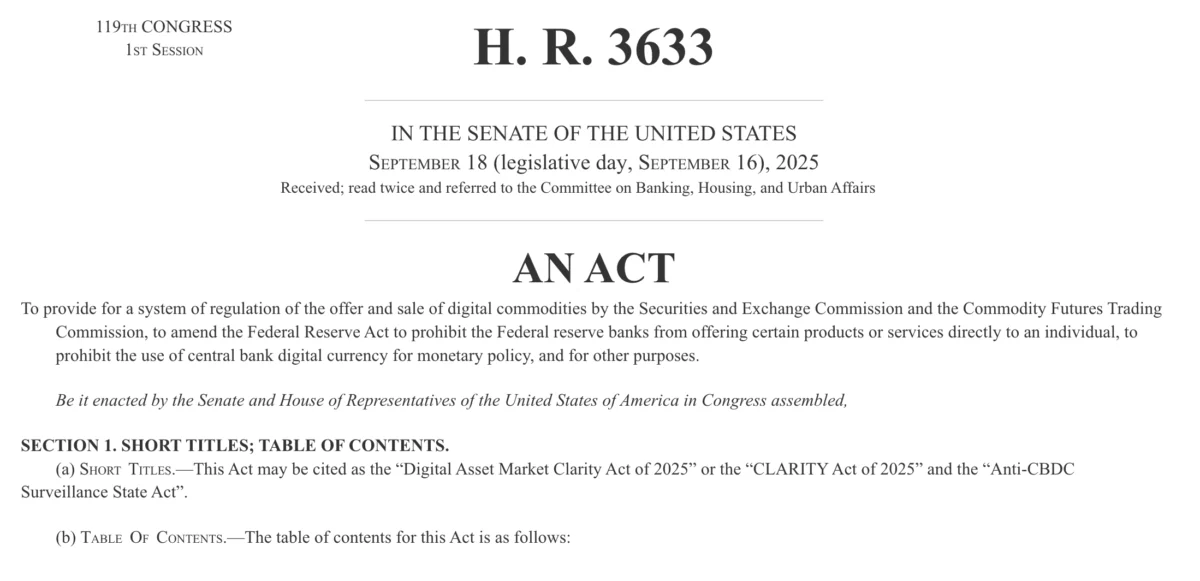
The United States government has taken a significant step toward establishing a comprehensive regulatory framework for digital assets as the White House and key members of the Senate Committee on Banking, Housing, and Urban Affairs have reportedly reached a tentative agreement regarding the treatment of stablecoin yields. This "agreement in principle" aims to resolve a months-long legislative impasse that had threatened to derail the Digital Asset Market Clarity Act of 2025, colloquially known as the CLARITY Act. The breakthrough, led by Republican Senator Thom Tillis of North Carolina and Democratic Senator Angela Alsobrooks of Maryland, represents a bipartisan effort to balance the rapid innovation of the cryptocurrency sector with the structural stability of the traditional American banking system.
At the heart of the compromise is a specific restriction on the distribution of yield to holders of stablecoins maintained in "passive balances." According to statements made by Senator Alsobrooks following a series of high-level negotiations, the deal is designed to prevent a massive migration of capital from traditional savings accounts to digital asset platforms—a phenomenon often referred to as "deposit flight." By prohibiting stablecoin issuers from offering interest or yield on tokens held passively by users, lawmakers hope to protect the liquidity of the domestic banking sector while still allowing for the technological advancements inherent in blockchain-based payment systems.
The Legislative Evolution: From the GENIUS Act to CLARITY
The path to this tentative deal has been marked by both rapid progress and sudden friction. To understand the current breakthrough, it is necessary to examine the chronology of stablecoin legislation over the past year. In late 2025, the United States successfully passed the GENIUS stablecoin framework, which established the foundational requirements for stablecoin reserves, auditing standards, and federal oversight. The GENIUS Act was hailed as a landmark achievement, providing the first clear definitions for "qualified stablecoin issuers" and requiring one-to-one backing by highly liquid assets, such as US Treasury bills and cash.
Following the success of the GENIUS Act, the CLARITY Act was introduced as a more expansive market structure bill. Its primary objective was to define the jurisdictional boundaries between the Securities and Exchange Commission (SEC) and the Commodity Futures Trading Commission (CFTC) regarding digital assets, while also addressing the specific mechanics of stablecoin usage in commerce and decentralized finance (DeFi). While the bill initially enjoyed broad support, it hit a significant roadblock in January 2026.
The primary point of contention was the issue of yield-sharing. Major industry players, including the San Francisco-based exchange Coinbase, argued that for stablecoins to be truly competitive and innovative, issuers should have the right to share the interest earned on reserve assets with the token holders. This stance created a direct conflict with the banking industry and federal regulators, who viewed yield-bearing stablecoins as functional equivalents to unregulated high-yield savings accounts. The resulting deadlock stalled the CLARITY Act for the first quarter of 2026, leading to fears that the US would fall behind other jurisdictions, such as the European Union and Hong Kong, in providing a clear legal environment for crypto-firms.
Addressing the Threat of Deposit Flight
The banking industry’s opposition to yield-bearing stablecoins is rooted in fundamental economic concerns. Currently, the average interest rate on traditional US savings accounts remains significantly lower than the yields offered by government securities. If stablecoin issuers—who back their tokens with Treasury bills yielding 4% to 5%—were permitted to pass those earnings directly to users, the incentive for consumers to keep money in traditional bank accounts would diminish.

Data from the Federal Reserve suggests that US commercial banks hold approximately $17 trillion in total deposits. Even a 5% shift of these funds into yield-bearing digital assets could result in a $850 billion drain on bank liquidity. Such a shift would potentially impair the ability of regional and community banks to issue loans, thereby affecting mortgages, small business lending, and overall economic growth.
Senator Alsobrooks emphasized that the new agreement seeks to mitigate this risk. "I think what it will do is to allow us to protect innovation, but also gives us the opportunity to prevent widespread deposit flight," Alsobrooks stated. By drawing a line at "passive balances," the bill effectively distinguishes between stablecoins used as a medium of exchange (which would not bear yield) and other types of digital investment products that might fall under different regulatory categories.
Industry Pushback and the Technical Definition of "Passive Balances"
While the tentative deal offers a path forward for the CLARITY Act, it has not been met with universal acclaim within the crypto industry. The distinction of "passive balances" remains a point of technical and legal ambiguity that industry leaders insist must be clarified before the bill moves to a final vote.
Senator Tillis has acknowledged these concerns, noting that the crypto industry must "vet" the agreement. The core of the industry’s concern lies in how "passive" is defined. If a user holds a stablecoin in a self-custodied wallet without actively trading it, it is clearly a passive balance. However, the status of stablecoins locked in smart contracts, used as collateral in DeFi protocols, or held in "staking" programs remains unclear.
Critics, including executives from the Gnosis ecosystem, have warned that the CLARITY Act risks handing too much power to centralized players. If only certain types of "active" participation allow for yield, centralized exchanges and large-scale financial institutions may be the only entities with the infrastructure to facilitate those activities, potentially freezing out decentralized protocols and individual users.
Furthermore, the White House Council of Advisors for Digital Assets, led by Executive Director Patrick Witt, has argued that the banking industry’s fears may be exaggerated. Witt has suggested that the legalization and regulation of dollar-pegged stablecoins could actually benefit the US banking system by bringing a wave of fresh, transparent capital into the regulated financial environment. Proponents of this view argue that stablecoin issuers are among the largest buyers of US Treasury debt, which supports the strength of the dollar and provides a stable source of funding for the federal government.
The Role of Senator Cynthia Lummis and Ethics Language
A pivotal figure in the advancement of the CLARITY Act is Wyoming Senator Cynthia Lummis, a long-time advocate for digital asset policy. Speaking at the DC Blockchain Summit, Lummis expressed high confidence in the bill’s eventual passage, stating, "We are so close" to a final comprehensive framework.

A spokesperson for Senator Lummis confirmed that while the yield issue was a major hurdle, the Senator is also focused on refining "ethics language" within the bill. This aspect of the legislation is intended to prevent conflicts of interest among regulators and ensure that government officials involved in digital asset oversight are held to rigorous transparency standards. The inclusion of robust ethics provisions is seen as a necessary step to garner the support of more skeptical members of Congress who are concerned about the "revolving door" between the crypto industry and regulatory agencies.
Broader Implications for the Global Digital Economy
The resolution of the stablecoin yield debate in the United States carries significant implications for the global financial landscape. As the world’s reserve currency, the US dollar’s digital representation is a matter of international importance. If the CLARITY Act is successfully passed and signed into law, it will provide the most definitive regulatory structure for stablecoins in any major economy.
From a fact-based analysis, the passage of the bill could lead to:
- Institutional Adoption: With clear rules on yield and reserves, large institutional investors and corporate treasuries may feel more comfortable holding and using stablecoins for cross-border settlements and liquidity management.
- Market Consolidation: Smaller stablecoin issuers who cannot meet the rigorous compliance and non-yield-bearing requirements of the CLARITY Act may be forced to merge with larger entities or exit the US market.
- Technological Standardization: The bill likely mandates specific technical standards for interoperability, ensuring that various stablecoins can function across different blockchain networks and with traditional banking interfaces.
- Strengthening of the Dollar: By creating a regulated, US-based ecosystem for digital dollars, the CLARITY Act could solidify the dollar’s dominance in the digital age, countering the rise of foreign central bank digital currencies (CBDCs).
Next Steps and Finalization
Despite the optimism surrounding the "agreement in principle," the deal is not yet finalized. The White House has maintained a cautious stance, with spokespeople declining to provide specific details on the negotiations until a formal document is drafted. The Senate Committee on Banking, Housing, and Urban Affairs is expected to review the refined text of the CLARITY Act in the coming days, after which it will undergo a period of public and industry comment.
The timeline for a floor vote remains fluid, but supporters of the bill hope to see it move through the Senate by the end of the current legislative session. The successful passage of the CLARITY Act would represent a rare moment of bipartisan cooperation in a polarized political climate, signaling that both parties recognize the strategic importance of the digital asset industry to the future of American finance.
As the industry awaits the specific language regarding "passive balances," the consensus among observers in Washington is that the momentum has shifted toward action. The compromise on stablecoin yield, while restrictive to some, provides the necessary safeguards to satisfy the traditional banking lobby and the White House, clearing the most significant hurdle for the CLARITY Act’s journey into law.