Nila Kartika Wati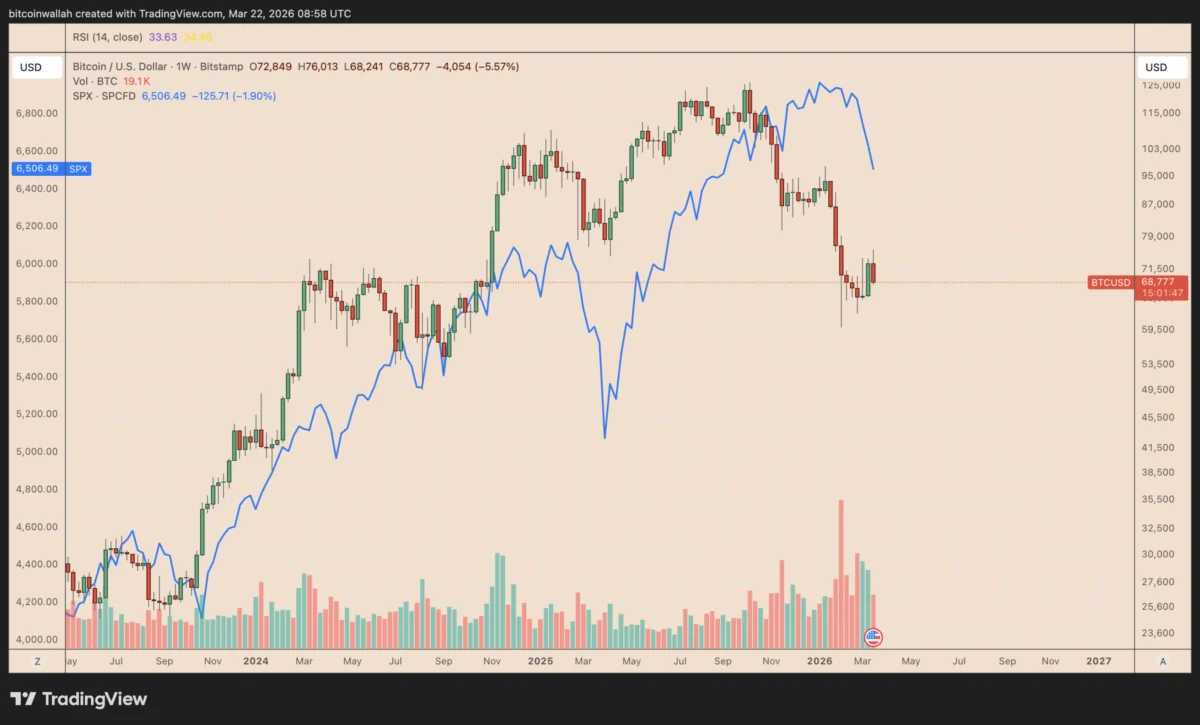
Bitcoin (BTC) experienced a significant reversal this week, shedding much of the gains previously attributed to the US-Iran geopolitical tensions and returning to a pronounced correlation with the broader downtrend observed in traditional risk assets, particularly US equities. This re-established synchronicity between the leading cryptocurrency and benchmark stock indices is now signaling a potentially deeper downside risk for the digital asset market, echoing historical patterns that have often preceded substantial price corrections.
As of Sunday, Bitcoin’s price had retreated by 5.65% week-to-date, settling around the $68,700 mark. This decline occurred in parallel with a notable downturn in the stock market, where the S&P 500 (SPX), a key indicator of US equity performance, closed the week down 1.90%. This parallel movement underscores a shift in market sentiment, moving away from Bitcoin’s temporary "safe haven" narrative during the geopolitical flare-up and back towards its established identity as a risk-on asset, highly susceptible to macroeconomic pressures and investor appetite for risk.
The Fleeting Geopolitical Rally and Market Reassessment
The initial surge in Bitcoin’s value following the escalation of tensions between the United States and Iran had briefly reignited discussions about its potential as a digital safe haven, akin to gold, during times of global instability. Reports of heightened military activity in the Middle East, including drone attacks and retaliatory strikes, often lead investors to seek perceived hedges against conventional market volatility. For a short period, Bitcoin appeared to fulfill this role, demonstrating resilience and even upward momentum when other risk assets faltered. The conflict, which saw direct engagement and threats of retaliation, initially prompted a flight to perceived safety, with Bitcoin seeing inflows as some investors sought alternatives to traditional financial instruments.
However, as the immediate crisis subsided without further significant escalation, and broader economic concerns resurfaced, Bitcoin’s trajectory quickly realigned with that of traditional equities. This swift pivot suggests that while geopolitical events can offer transient boosts or dips, the fundamental drivers of Bitcoin’s price, particularly in the current market cycle, remain deeply intertwined with global liquidity, interest rate expectations, and overall risk sentiment. The initial "safe haven" narrative, while compelling during moments of acute crisis, proved to be fleeting as the market recalibrated to prevailing economic realities.
A Looming Bearish Signal from Renewed Correlation
A significant warning sign for the Bitcoin market emanates from a crucial weekly correlation metric comparing BTC’s performance against the S&P 500. This metric, specifically the 20-week rolling correlation coefficient between BTC and SPX, has shown a sharp recovery. As of Saturday, it registered at 0.13, a notable rebound from its recent nadir of approximately -0.5. A positive correlation coefficient indicates that the two assets are moving in the same direction, while a negative one suggests they are moving inversely. The rapid shift from a negative or near-zero correlation to a positive one is what has historically preceded significant downturns in the Bitcoin market.
Market analyst Tony Severino highlighted this pattern, stating, "It is a warning sign that the stock market is going to collapse and take BTC with it." This sentiment is rooted in observations from previous market cycles where similar sharp increases in BTC-SPX correlation were followed by substantial declines in Bitcoin’s value. Historically, these periods of re-established correlation have heralded average Bitcoin market declines of approximately 50%. The analyst’s stark warning underscores the gravity with which market technicians view this particular metric, suggesting that the current alignment is not merely coincidental but potentially predictive.

Historical Precedent: Echoes of Past Market Corrections
An examination of past market cycles reveals a recurring pattern where Bitcoin’s price movements lagged by several months, often unfolding after periods characterized by "bull traps." These bull traps typically involved Bitcoin rallying alongside a rising correlation with the S&P 500, only for the price to quickly reverse and fall below the resistance level, trapping the "bullish" traders in losing positions.
For instance, in 2018, during the extended cryptocurrency bear market, a similar recovery in the BTC-SPX correlation was observed. Following an initial period of decoupling, as Bitcoin’s nascent institutional adoption began, it eventually started moving more in lockstep with broader markets. This increased correlation preceded a significant leg down in Bitcoin’s price, which ultimately saw it plunge from highs near $20,000 to lows around $3,000 in December 2018. The market, then less mature, was particularly sensitive to shifts in global risk appetite, and the re-establishment of correlation served as an early indicator of a sustained downturn, with the decline lasting several months.
Again, in 2020, following the initial shock of the COVID-19 pandemic, Bitcoin briefly demonstrated a strong correlation with equities during the rapid sell-off in March. While it later decoupled somewhat during the subsequent liquidity-driven rally, periods of renewed correlation in late 2020 and early 2021, particularly when combined with signs of market overextension, contributed to the volatility that preceded mid-cycle corrections. However, the most striking examples often manifest when the broader macroeconomic environment turns bearish.
The 2022 bear market provides perhaps the most direct historical parallel. After a period of relatively low correlation, as the Federal Reserve embarked on aggressive interest rate hikes to combat inflation, Bitcoin’s correlation with the S&P 500 strengthened considerably. This increasing alignment was a harbinger of the deep corrections that followed, seeing Bitcoin fall from its all-time highs near $69,000 in November 2021 to lows below $16,000 by late 2022. In this instance, the tightening of monetary policy affected both traditional tech stocks and risk assets like Bitcoin, solidifying their correlated downtrend. The "bull traps" during this period saw Bitcoin make temporary recoveries, often rallying by 10-20% alongside equity market bounces, only to be dragged down further by sustained equity market weakness once the correlation reasserted itself. These historical episodes underscore the analytical weight given to the current resurgence in BTC-SPX correlation, suggesting a potential repeat of past patterns where speculative gains are ultimately wiped out.
Potential Downside Targets and Analyst Consensus
Should this historical pattern of a 50% average drop repeat from Bitcoin’s current price point of approximately $68,700, it would imply a downside target of roughly $34,350. This projection aligns with the views of multiple analysts who have previously forecasted Bitcoin to potentially bottom out in the range of $30,000 to $40,000 during 2026, depending on the severity and duration of the broader market correction. These lower targets are often predicated on a combination of factors, including the anticipated impact of continued monetary tightening, potential global economic slowdowns, and the psychological re-evaluation of risk assets by investors. Some technical analysts point to key support levels around these figures from previous market cycles, suggesting strong confluence zones for a potential bottom. Others factor in the typical post-halving corrections seen in previous cycles, where an initial surge is followed by a period of consolidation and potential retesting of lower price bands.
Macroeconomic Headwinds: A Confluence of Bearish Factors
The bearish outlook for both Bitcoin and traditional equities over the coming months is further supported by a complex interplay of challenging macroeconomic conditions. These factors collectively contribute to a "risk-off" environment, where investors tend to divest from volatile assets in favor of safer havens or less risky investments.

-
Elevated Oil Prices: Global oil prices have remained stubbornly high, fueled by ongoing geopolitical instability, supply chain disruptions, and robust demand, particularly from emerging economies. High oil prices are a significant contributor to inflation, as they increase production and transportation costs across nearly all sectors of the economy. This ultimately squeezes corporate profit margins, reduces consumer purchasing power by increasing costs for essentials like fuel and food, and acts as a drag on overall economic growth and equity markets. For Bitcoin, which often trades as a growth-tech proxy, this translates into reduced investment appetite as higher energy costs filter through the global economy.
-
Persistent Inflation Concerns: Despite efforts by central banks, inflation remains a persistent concern in many major economies. While headline inflation rates may have cooled from their peaks, core inflation, which excludes volatile food and energy prices, has proven stickier than anticipated. This continued inflationary pressure erodes the real returns on investments and pushes central banks to maintain restrictive monetary policies for longer than initially anticipated. High inflation also means that the cost of capital remains elevated, making borrowing more expensive for businesses and consumers, thus dampening economic activity and investment.
-
Lower Odds of Federal Reserve Interest Rate Cuts: A pivotal factor influencing market sentiment is the Federal Reserve’s stance on interest rates. Recent economic data, including resilient labor markets, surprisingly strong consumer spending, and persistent inflation, has significantly lowered the market’s expectations for aggressive interest rate cuts in the near future. The Fed has consistently indicated its data-dependent approach, prioritizing price stability as its primary mandate. If inflation proves difficult to tame, the Fed may maintain higher rates for an extended period or even consider further hikes. Higher interest rates typically weigh heavily on risk assets like Bitcoin and growth stocks. This is because higher rates increase the discount rate used in valuation models, reducing the present value of future earnings, and they also make safer, fixed-income investments more attractive in comparison. The prospect of "higher for longer" interest rates is a significant headwind for assets that thrive on cheap liquidity and investor speculation, directly impacting capital flows into riskier assets.
MicroStrategy’s Strategic Pause Adds to Cautious Outlook
Adding another layer to the cautious market sentiment is the recent pause in corporate accumulation of Bitcoin, particularly from MicroStrategy (MSTR). MicroStrategy, led by executive chairman Michael Saylor, has become one of the largest corporate holders of Bitcoin globally, consistently expanding its BTC reserves through strategic capital raises, often via the sales of its STRC preferred stock. The company’s strategy has been widely watched as a bellwether for institutional interest and conviction in Bitcoin.
According to data resource STRC.LIVE, MicroStrategy did not purchase any Bitcoin via the sales of its STRC preferred stock this week. This marks a notable break in its aggressive accumulation strategy, which has seen the company become a continuous buyer in the market. The company’s last announced acquisition, made on March 16, saw it add a substantial 22,337 BTC, valued at approximately $1.57 billion at the time. This purchase brought MicroStrategy’s total holdings to an impressive 761,068 BTC. During the period leading up to this acquisition and immediately after, Bitcoin had rallied by around 10.50%, notably outperforming US stocks. MicroStrategy’s sustained, large-scale buying has often been cited as a significant institutional demand driver, providing a floor for Bitcoin’s price during periods of market uncertainty and contributing to its upward momentum.
The absence of fresh purchases from such a prominent and consistent institutional buyer this week is noteworthy. While MicroStrategy’s strategy is long-term and its pauses are not necessarily indicative of a change in conviction, the temporary cessation of this major buying pressure leaves Bitcoin more exposed to potential sell-offs in the broader stock market and less cushioned against macroeconomic headwinds. In a market environment where retail sentiment can be fickle and other institutional flows (like Bitcoin ETF outflows) are being closely watched, the temporary absence of a significant corporate accumulator can amplify negative price action and contribute to increased volatility. It suggests a wait-and-see approach, potentially reflecting the broader market’s uncertainty regarding current valuations and future economic trajectory. This pause, whether strategic or simply a timing decision, removes a consistent source of demand that has often counteracted selling pressure.
The "Bull Trap" Phenomenon Revisited
The concept of a "bull trap" is particularly relevant in the current market context. A bull trap occurs when a security’s price breaks above a resistance level, attracting buyers who believe a new uptrend is beginning, only for the price to quickly reverse and fall below the resistance level, trapping the "bullish" traders in losing positions. As noted, Bitcoin’s declines in 2020 and 2022 were often preceded by such bull traps, where BTC rallied alongside rising SPX correlation before ultimately reversing course and wiping out those gains.

In the present scenario, Bitcoin’s initial rally driven by the US-Iran tensions could be interpreted in hindsight as a form of a bull trap. Investors who bought into the "safe haven" narrative saw their gains quickly eroded as Bitcoin re-correlated with risk assets. This pattern underscores the importance of a cautious approach, especially when asset correlations are shifting rapidly and macroeconomic fundamentals remain challenging. Traders and investors are advised to be wary of rallies that lack fundamental catalysts or are not supported by sustained institutional inflows, as these can often be fleeting and lead to significant reversals. The recent price action aligns with the classic bull trap formation, where a temporary surge entices buyers before the underlying bearish trend reasserts itself.
Broader Impact and Implications for the Crypto Market
The renewed correlation between Bitcoin and traditional equities, coupled with significant macroeconomic headwinds and a pause in major corporate accumulation, paints a cautious picture for the crypto market in the near term. This confluence of factors challenges the narrative of Bitcoin as a completely uncorrelated asset or a pure digital gold alternative. Instead, it reinforces its position as a high-beta risk asset, highly sensitive to global liquidity conditions and investor risk appetite.
- Investor Sentiment: A sustained period of correlation with a declining stock market could further dampen investor sentiment in the crypto space. The allure of uncorrelated returns is a key driver for many crypto investors, and if Bitcoin consistently mirrors equity downturns, some may reconsider their allocation and diversification strategies.
- Market Volatility: The current environment suggests continued high volatility. Rapid shifts in correlation, coupled with geopolitical uncertainties and evolving monetary policy, can lead to sharp price swings, making effective risk management crucial for all market participants, from retail traders to institutional funds.
- Strategic Re-evaluation: Both retail and institutional investors may begin to re-evaluate their strategies. The "buy the dip" mentality that has historically rewarded Bitcoin holders might face tougher tests if macroeconomic conditions deteriorate further and traditional market declines become more protracted. This could lead to a more discerning approach to crypto investments, favoring projects with demonstrable utility over pure speculation.
- Focus on Fundamentals: In such an environment, the focus may shift more acutely to the underlying fundamentals of specific crypto projects, rather than broader market sentiment driving all digital assets uniformly. Projects with strong use cases, robust development, and clear value propositions might fare better than speculative ventures as investors seek tangible value.
Furthermore, other related market indicators, such as Bitcoin options signaling fear despite relatively low BTC ETF outflows, add to the complexity. While spot Bitcoin ETFs have seen outflows in recent weeks, suggesting some profit-taking or reallocation by certain investors, the options market reflects a hedging behavior and a general apprehension about future price movements. This divergence highlights a nuanced market, where different participant segments are reacting to the prevailing conditions in varied ways, indicating a growing caution among sophisticated derivatives traders. The overall market structure appears to be bracing for potential turbulence, even as the longer-term bullish case for Bitcoin remains a topic of considerable debate among proponents.
Conclusion
Bitcoin’s recent price action, characterized by the erosion of geopolitical gains and a strong re-correlation with the S&P 500, serves as a potent reminder of the complex interplay between cryptocurrency markets and broader macroeconomic forces. The historical precedent of sharp correlation recoveries preceding significant BTC declines, amplified by persistent inflation, elevated oil prices, and reduced expectations for Federal Reserve rate cuts, suggests a challenging period ahead. The temporary pause in MicroStrategy’s aggressive Bitcoin accumulation further underscores the fragility of institutional support in the face of market uncertainty. While Bitcoin’s long-term potential remains a subject of debate, the near-term outlook necessitates a cautious approach, with market participants closely monitoring global economic indicators and traditional asset performance as key drivers for the cryptocurrency’s trajectory.
This article does not contain investment advice or recommendations. Every investment and trading move involves risk, and readers should conduct their own research when making a decision. While we strive to provide accurate and timely information, Cointelegraph does not guarantee the accuracy, completeness, or reliability of any information in this article. This article may contain forward-looking statements that are subject to risks and uncertainties. Cointelegraph will not be liable for any loss or damage arising from your reliance on this information.