Nila Kartika Wati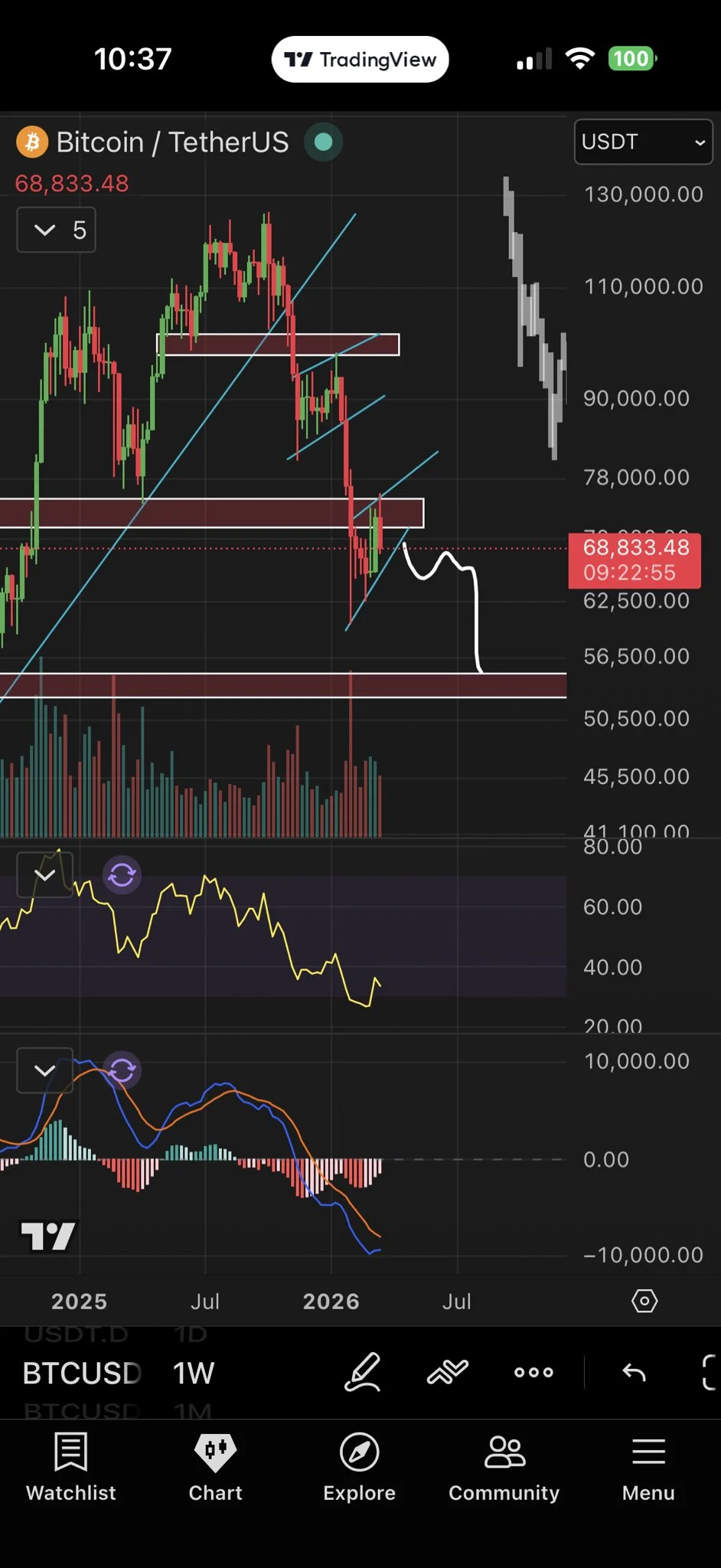
Bitcoin (BTC) found itself navigating treacherous waters on Sunday, trading below the significant $69,000 threshold as the market braced for a pivotal weekly candle close. This period of heightened volatility followed a weekend dip that saw the leading cryptocurrency test levels near $68,000, reigniting debates among analysts regarding critical support levels and the potential trajectory for the coming weeks. The market’s reaction to these price movements was swift and decisive, leading to substantial liquidations across both long and short positions, underscoring the delicate balance of current investor sentiment.
The recent price action has positioned Bitcoin at a crucial juncture, with technical indicators presenting a complex and often contradictory picture. The immediate focus has been on Bitcoin’s interaction with a key trend line, particularly the 200-week Exponential Moving Average (EMA), a historically significant indicator that has recently demonstrated an "unreliable" nature. Adding to the technical complexity, the market is simultaneously observing the formation of a "golden cross" on shorter timeframes, a signal typically interpreted as bullish, while longer-term outlooks continue to harbor bearish predictions. This confluence of signals creates a highly uncertain environment, demanding careful scrutiny from market participants.
The Weekend’s Volatility and Liquidation Cascade
The weekend’s trading began with a distinct shift in momentum, as bearish forces gained traction heading into Saturday’s daily close. This selling pressure intensified, pushing BTC/USD lower and triggering a cascade of liquidations in the derivatives market. According to data compiled by CoinGlass, the 24 hours leading up to the time of writing saw over $300 million in long positions and nearly $100 million in short positions liquidated. This total of approximately $400 million in liquidations highlights the rapid and often unforgiving nature of the cryptocurrency market, where leveraged positions can be wiped out swiftly by sudden price swings.

Liquidations occur when a trader’s leveraged position is automatically closed by an exchange due to a lack of sufficient margin to cover potential losses. For long positions, this happens when the price drops significantly, while for short positions, it occurs when the price rises. The substantial volume of long liquidations over the weekend indicates that many traders had bet on continued upside, only to be caught off guard by the downturn. Such large-scale liquidations can exacerbate price movements, as forced selling (or buying) by exchanges adds to the prevailing market pressure, creating a feedback loop that can accelerate price drops or rallies. The psychological impact of such events can also be profound, fostering fear and uncertainty among traders and prompting a more cautious approach to leverage.
The Unreliable Anchor: Bitcoin’s 200-Week EMA
A central point of contention and observation in the current market landscape is Bitcoin’s interaction with its 200-week Exponential Moving Average (EMA). This long-term moving average has historically served as a robust indicator of Bitcoin’s macro trend, often acting as a reliable support level during significant market bottoms. In previous bear cycles, such as those in 2015, 2019, and the COVID-19 induced crash of 2020, a retest or brief dip below the 200-week EMA frequently marked the capitulation phase, preceding a sustained recovery. Even during the 2022 bear market, the 200-week EMA provided a temporary floor before a further decline.
However, the narrative surrounding the 200-week EMA appears to have shifted in 2026. This year, the indicator has been described as "unreliable" due to its failure to consistently provide the expected support. Bitcoin’s price action has repeatedly challenged and sometimes breached this level without a definitive bounce, leading analysts to question its enduring efficacy as a steadfast support in the current market cycle. The weekend’s dip brought BTC/USD back into a critical showdown with this moving average, specifically near the $68,300 mark.
Trader and analyst Rekt Capital weighed in on this development last week, emphasizing the importance of a clear retest from above for the 200-week trend line to serve as a foundational support for future upside continuation. His analysis suggests that for the indicator to regain its historical significance, Bitcoin needs to firmly establish it as support rather than merely hovering around it. Rekt Capital also articulated a less optimistic scenario: "More, there’s also a chance that Bitcoin could simply meander in and around the 200-week EMA for a while, never really turning it into convincing resistance, never really turning it into convincing support, before ultimately breaking down into additional Macro Downside over time anyway," he noted on X. This statement underscores the potential for prolonged uncertainty, where the market fails to commit to either a bullish reversal or a deeper capitulation, leaving investors in a state of prolonged indecision. The implications of the 200-week EMA losing its traditional predictive power are significant, potentially signaling a maturing market where historical patterns might require re-evaluation or are subject to new influences.

Bearish Undercurrents: The $50,000 Target
While some analysts focus on the immediate technical battlegrounds, others maintain a more decidedly bearish outlook, projecting significant downside for Bitcoin. Trader Roman, for instance, reiterated his firm conviction in a $50,000 target, and potentially even lower. His analysis is rooted in a lack of what he describes as "bear market exhaustion" signals on higher time frames (HTF).
Roman elaborated on his reasoning, stating on X that "There are still 0 signs of bear market exhaustion on HTF. No divs, no bear PA exhaustion, no momentum loss, etc." To unpack his terminology, "HTF" refers to higher time frames, such as weekly or monthly charts, which provide a broader perspective on market trends, filtering out shorter-term noise. "Divs" refers to divergences, specifically bullish divergences, where the price makes a lower low but an oscillator (like the Relative Strength Index or RSI) makes a higher low, often signaling a potential reversal. "Bear PA exhaustion" refers to patterns in price action that indicate the selling pressure is waning, such as decreasing volume on downward moves or candlestick patterns that suggest buyer entry. "Momentum loss" relates to the slowing of the downward trend’s velocity.
The absence of these key indicators on higher time frames suggests to Roman that the current bearish momentum is still firmly in control and has not yet run its course. His conviction in seeing Bitcoin reach $50,000, and potentially even lower, reflects a belief that the market still needs to undergo a more significant correction or capitulation event before a sustainable recovery can begin. This perspective highlights the importance of analyzing market structure and momentum beyond just immediate price levels, looking for fundamental shifts in supply and demand dynamics that would signal a true bottom. If Roman’s prediction were to materialize, it would represent a substantial decline from current levels, likely triggering widespread fear and potentially a further wave of liquidations.
A Glimmer of Hope? The Golden Cross
Amidst the prevailing bearish sentiment and the struggles at key support levels, a potential silver lining emerged in the form of a "golden cross" on shorter time frames. This technical event occurred as the 21-day Simple Moving Average (SMA) crossed above its 50-day equivalent, a pattern traditionally interpreted as a bullish signal. A golden cross suggests that recent short-term price momentum is strengthening relative to the medium-term trend, often preceding periods of sustained upward movement.

Historically, golden crosses in Bitcoin’s chart have frequently coincided with the beginning or continuation of bullish phases, signaling a shift in market sentiment and renewed buying interest. However, the efficacy of such signals is always subject to broader market context and the strength of other technical and fundamental factors.
Commenting on this development, Keith Alan, co-founder of the trading resource Material Indicators, offered a cautiously optimistic perspective. "The Golden Cross will likely deliver some short term bullish momentum. Must watch to see if it develops into something durable," he acknowledged in an X post. Alan’s assessment reflects the nuanced view that while the golden cross is a positive technical sign, its long-term impact is not guaranteed and requires further confirmation through sustained price action. His concluding remark, "For now…the range game continues," encapsulates the prevailing sentiment of consolidation and indecision that has characterized Bitcoin’s trading recently.
It is also pertinent to recall earlier technical signals that painted a starkly different picture. Earlier in March, the BTC/USD chart produced two "death crosses" – a bearish counterpart to the golden cross, where a shorter-term moving average crosses below a longer-term one (e.g., the 50-day SMA crossing below the 200-day SMA). These death crosses typically imply more downside pressure and had sparked warnings from some analysts of a potential collapse below $40,000. The emergence of a golden cross now, after a period of bearish signals, creates a dynamic tension in the market, with conflicting indicators pulling in different directions and leaving investors to weigh the relative strengths of these signals.
Broader Market Dynamics and Macroeconomic Influences
Bitcoin’s recent price movements do not occur in a vacuum but are influenced by a broader array of market dynamics and macroeconomic factors. The cryptocurrency market, with a total capitalization often fluctuating in the trillions, is increasingly sensitive to global financial conditions, investor risk appetite, and regulatory developments.

The approval of spot Bitcoin Exchange-Traded Funds (ETFs) in the United States earlier in the year was a monumental event, bringing significant institutional capital into the Bitcoin ecosystem. While these ETFs initially saw substantial inflows, their performance and net flows have become a key metric for market sentiment. Periods of slowed inflows or net outflows from these ETFs can exert downward pressure on Bitcoin’s price, as they represent a significant demand channel.
On the macroeconomic front, the global interest rate environment, inflation concerns, and geopolitical stability continue to play a crucial role. Central bank policies, particularly those of the U.S. Federal Reserve, regarding interest rate hikes or cuts, profoundly impact the liquidity available in financial markets and investor willingness to allocate capital to risk assets like cryptocurrencies. Higher interest rates typically make safer, yield-bearing assets more attractive, potentially drawing capital away from volatile assets. Conversely, expectations of interest rate cuts can stimulate risk-taking. Inflationary pressures can also be a double-edged sword for Bitcoin; while some view it as a hedge against inflation due to its finite supply, persistent high inflation can lead to tighter monetary policies that dampen overall market enthusiasm.
The interplay of these factors creates a complex backdrop against which Bitcoin’s technical signals are interpreted. The "range game" described by Keith Alan is not just a function of internal market mechanics but also a reflection of broader economic uncertainties that are keeping both institutional and retail investors on edge, preventing a decisive break in either direction.
The Path Forward: Navigating Uncertainty
As Bitcoin navigates this period of critical technical retests and conflicting signals, the path forward remains shrouded in uncertainty. The immediate future hinges significantly on how Bitcoin closes its weekly candle and whether it can establish clear support above key levels like the 200-week EMA, or conversely, if it breaks down further.

For traders, the current environment necessitates extreme caution and a focus on managing risk. Increased volatility and the potential for rapid price swings mean that stop-loss orders and careful position sizing are paramount. The "range game" implies that short-term trading opportunities may exist within established boundaries, but a definitive trend requires patience.
For long-term holders, the current consolidation phase might be viewed as a period of accumulation, particularly if they believe in Bitcoin’s fundamental value proposition and its long-term growth potential. However, even long-term strategies must consider the possibility of deeper corrections, as indicated by some analysts’ bearish targets.
The market will be closely watching for a decisive move that can break the current range. A sustained break above resistance levels, potentially fueled by renewed institutional interest or positive macroeconomic news, could validate the golden cross and propel Bitcoin higher. Conversely, a failure to hold critical support, especially the "unreliable" 200-week EMA, coupled with a lack of "bear market exhaustion" signals, could confirm the bearish predictions and pave the way for a test of significantly lower price targets. The coming days and weeks will be crucial in determining whether Bitcoin can regain its upward momentum or if it is destined for a more protracted period of consolidation or even a deeper retracement.
This article does not contain investment advice or recommendations. Every investment and trading move involves risk, and readers should conduct their own research when making a decision. While we strive to provide accurate and timely information, Cointelegraph does not guarantee the accuracy, completeness, or reliability of any information in this article. This article may contain forward-looking statements that are subject to risks and uncertainties. Cointelegraph will not be liable for any loss or damage arising from your reliance on this information.