James Watt
This budgetary development comes at a critical juncture for the U.S. Treasury, which is already grappling with a national debt exceeding $39 trillion. The request for $200 billion is not merely a fiscal hurdle for the Biden-Harris or subsequent administrations; it serves as a high-stakes benchmark for how the cost of modern warfare is perceived in an era of digital finance. By framing the cost in Bitcoin, analysts are highlighting the "inflationary tax" inherent in deficit spending, contrasting the government’s ability to issue debt with the immutable supply cap of the blockchain network.
The Magnitude of the $200 Billion Request
The $200 billion supplemental request is intended to cover a wide range of military exigencies, including carrier strike group deployments in the Persian Gulf, the replenishment of precision-guided munitions, and enhanced missile defense layers for regional allies. However, the proposal has arrived in Congress to immediate bipartisan friction. Fiscal conservatives have raised alarms over the lack of offsetting cuts, while some progressive lawmakers have questioned the long-term strategic objectives of a direct confrontation with Tehran.
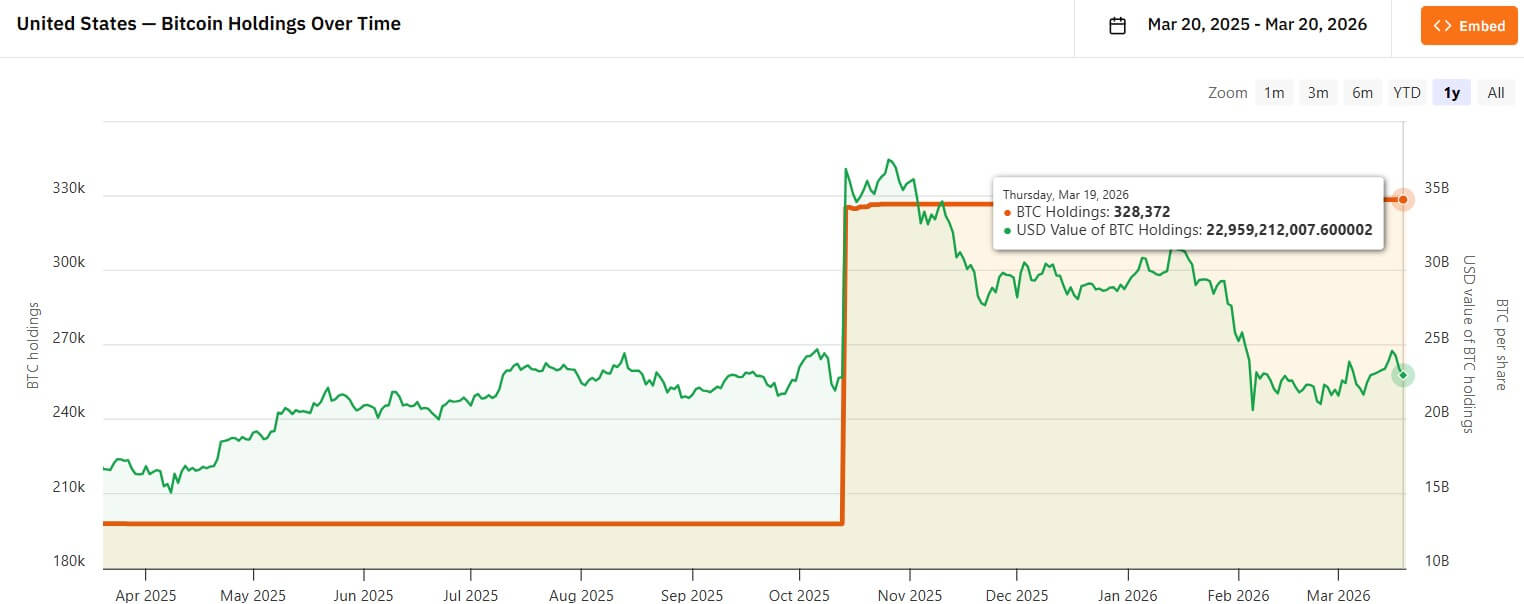
To put the $200 billion figure into perspective, one must look at the current distribution of Bitcoin. The U.S. government is currently one of the largest nation-state holders of Bitcoin, primarily through seizures related to criminal investigations. According to data from BitcoinTreasuries, U.S. government-related entities hold approximately 328,372 BTC. The new war request is equivalent to roughly 8.6 times the entire current U.S. government Bitcoin reserve.

The disparity becomes even more pronounced when compared to the private sector. MicroStrategy, the largest corporate holder of Bitcoin, has spent years aggressively accumulating a treasury of 761,068 BTC. The Pentagon’s request for a single theater of war is 3.7 times larger than MicroStrategy’s entire cache. Similarly, BlackRock’s iShares Bitcoin Trust (IBIT), which saw record-breaking inflows following its 2024 launch, holds roughly 785,629 BTC. The war bill represents 3.6 times the holdings of the world’s largest Bitcoin exchange-traded fund.
Chronology of the Conflict and Fiscal Escalation
The road to this $200 billion request has been marked by a rapid escalation of regional tensions and a corresponding increase in military outlays. The timeline below outlines the key events leading to the current budgetary crisis:
- Late 2024: Following a series of maritime disruptions in the Strait of Hormuz, the U.S. increased its naval presence, initially utilizing existing Pacific and Atlantic fleet budgets.
- January 2025: Direct kinetic exchanges between U.S. forces and Iranian-backed proxies intensified, leading to a $45 billion emergency drawdown of munitions.
- March 2025: The Trump administration, during a brief but pivotal policy shift, issued an executive order establishing a Strategic Bitcoin Reserve, intended to hedge against dollar volatility. This move signaled a growing official recognition of Bitcoin as a legitimate reserve asset.
- Early 2026: Full-scale hostilities necessitated a permanent "wartime footing" in the Middle East. The Pentagon exhausted its initial 2026 defense appropriations by the end of the first quarter.
- March 20, 2026: The Pentagon officially transmitted the $200 billion supplemental request to the White House, citing the need for "sustained regional dominance and deterrence."
This sequence of events underscores how quickly military costs can spiral beyond original projections, forcing the Treasury to rely on massive bond issuances to bridge the gap.
Comparative Data: A Scale Beyond Scarcity
The most striking aspect of the $200 billion figure is how it measures against the total available and future supply of Bitcoin. The Bitcoin network is hard-coded to never exceed 21 million coins. Currently, there are approximately 20,003,043 BTC in circulation. This leaves fewer than 997,000 BTC left to be mined over the next century.

The $200 billion war request is equivalent to 2.83 times the entire amount of Bitcoin that will ever be issued for the remainder of the network’s existence. This comparison serves as a stark reminder of the "hard money" properties of Bitcoin versus the "soft money" properties of the U.S. dollar. While the U.S. can, in theory, authorize $200 billion in new spending through the issuance of Treasury notes—effectively creating new money—it is physically and mathematically impossible to "authorize" the creation of 3 million new Bitcoin.
Furthermore, the request dwarfs the combined holdings of the top 100 public Bitcoin treasury companies, which hold a collective 1,176,615 BTC. It even surpasses the estimated 1.096 million BTC held by Bitcoin’s anonymous creator, Satoshi Nakamoto. Even if every major Bitcoin ETF and the world’s largest exchange, Binance, pooled their resources, they would still fall short of the value required to cover this single military bill. Binance’s recent proof-of-reserves update showed approximately 639,000 BTC in user-backing wallets; the war bill is 4.4 times that amount.
Institutional and Political Reactions
The sheer size of the bill has drawn criticism from both financial leaders and political figures. Brian Armstrong, CEO of Coinbase, remarked on social media that such spending highlights why capital is increasingly migrating toward decentralized assets. "Bitcoin is a check and balance on inflation," Armstrong stated. "When spending gets too far out of hand, capital moves to Bitcoin because it cannot be debased by a legislative vote."
In Washington, the proposal is meeting significant headwinds. Members of the House Appropriations Committee have requested a detailed audit of previous expenditures before approving the new $200 billion. "We are asking for a sum that is larger than the entire annual budgets of many of our closest allies," noted one senior lawmaker. "We cannot continue to finance these operations through pure debt issuance without considering the long-term impact on the dollar’s purchasing power."

The debate is further complicated by the 2025 Executive Order regarding the Strategic Bitcoin Reserve. Proponents of the reserve argue that the U.S. should be accumulating Bitcoin to offset the very debt the Pentagon is now proposing. They suggest that as the dollar loses value relative to scarce assets like Bitcoin, the national debt becomes increasingly difficult to manage without aggressive monetary expansion.
Economic Implications: The Fiat-Bitcoin Divergence
The ability of the U.S. government to request and potentially spend $200 billion on a war effort is a testament to the flexibility of the fiat currency system. Under the current regime, the Treasury Department issues debt, which is then purchased by domestic and foreign investors or the Federal Reserve. This allows for immediate liquidity to fund urgent national priorities, such as defense.
However, this flexibility comes with the risk of currency debasement. As the total supply of dollars increases to accommodate war spending and debt interest, the value of each individual dollar tends to decline relative to finite goods and assets. This is the "inflationary" cost that Bitcoin advocates point to when they use the cryptocurrency as a benchmark.
From a journalistic and analytical perspective, the $200 billion request illustrates three primary economic trends:
- The Normalization of Massive Debt: Multi-hundred-billion-dollar supplemental requests are becoming standard, even as the national debt hits unprecedented levels.
- Bitcoin as a Macro-Benchmark: Investors are no longer just looking at gold or the CPI to measure inflation; they are using Bitcoin’s fixed supply to gauge the true scale of government expansion.
- The Conflict of Reserves: The U.S. is simultaneously exploring "Strategic Bitcoin Reserves" while continuing the very deficit spending that makes such reserves necessary as a hedge.
Future Outlook and Strategic Consequences
If the $200 billion request is approved, it will likely be funded through the issuance of new Treasury bonds, further increasing the $39 trillion debt load. This will occur at a time when interest rates remain volatile, potentially making the cost of servicing that debt even higher.
For the Bitcoin market, the psychological impact of these figures is significant. Every time a major government expenditure is "priced in Bitcoin," it reinforces the narrative of Bitcoin as an "exit ramp" from a debt-based monetary system. If the conflict with Iran persists and further supplemental bills are required, the "Bitcoin cost" of the war will likely continue to be a focal point for institutional investors looking for stores of value that are immune to geopolitical and fiscal volatility.
As the White House faces this bill, the decision will not only impact the tactical situation in the Middle East but will also signal to global markets how the U.S. intends to manage its fiscal responsibilities in an era where "hard money" alternatives are becoming increasingly accessible and visible. The $200 billion war bill is a line item in a budget, but in the context of 3 million Bitcoin, it is a historic marker of the modern economic divide.