James Watt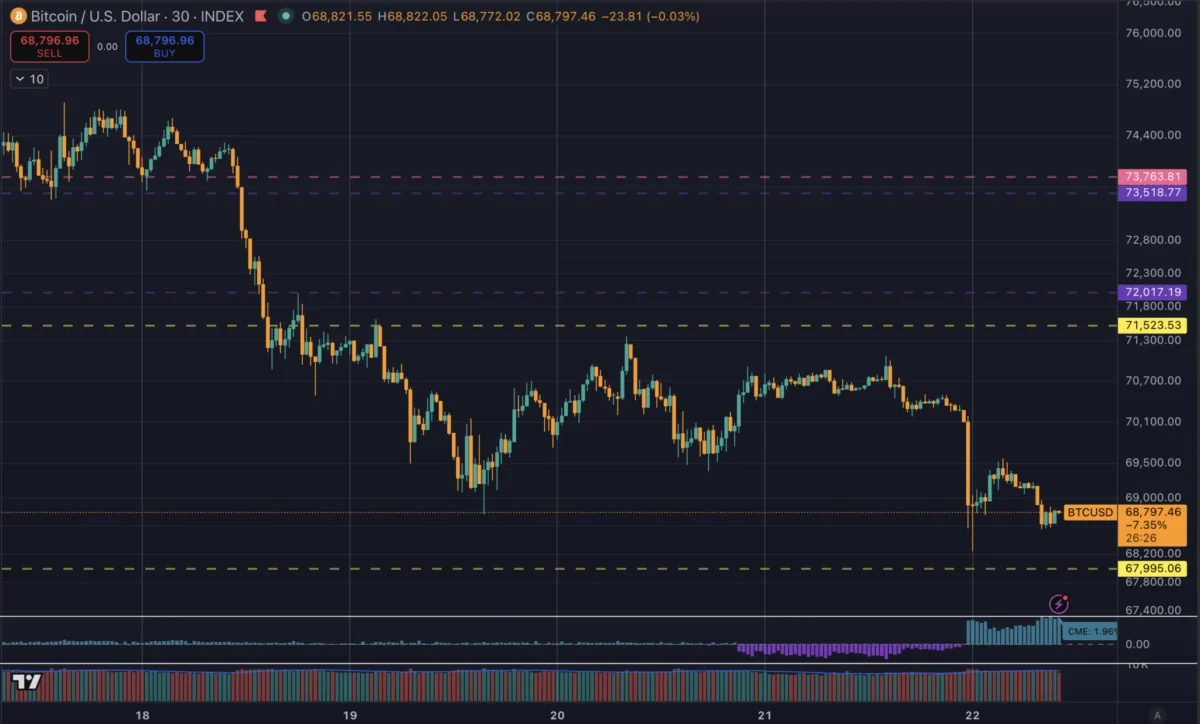
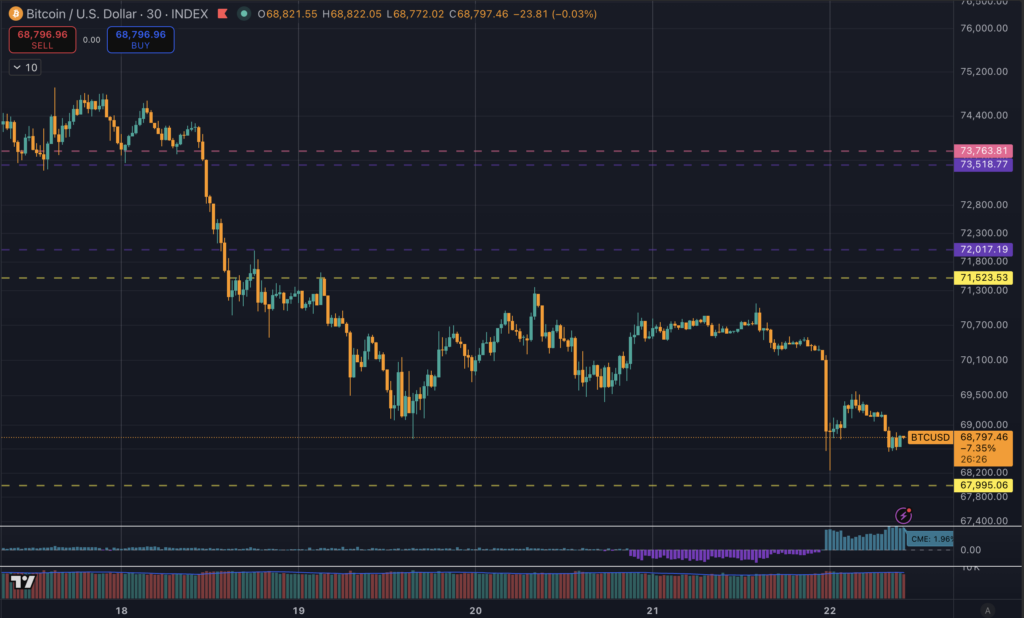
The global cryptocurrency market experienced a sharp contraction during weekend trading as geopolitical tensions in the Middle East reached a new flashpoint. Bitcoin, the world’s largest digital asset by market capitalization, saw its price tumble by approximately 2.8% in a matter of hours, falling from a local high of $70,400 to a low of $68,200. This sudden volatility was triggered by a social media post from President Donald Trump on his Truth Social platform, in which he issued a direct and severe ultimatum to the Iranian government regarding the ongoing blockade of the Strait of Hormuz.
The President’s message, which transitioned the diplomatic tone from tentative de-escalation to renewed aggression, threatened to "obliterate" Iran’s entire power grid and civilian energy infrastructure if the strategic waterway was not reopened to international shipping within 48 hours. This escalation caught market participants off guard, particularly as previous rhetoric from the administration had suggested a possible path toward winding down the conflict. The immediate repricing of Bitcoin serves as a stark reminder of the asset’s role as a 24/7 liquid proxy for global risk, reacting to geopolitical shocks well before traditional equity and commodity markets can open for regular sessions.
The Catalyst: A Shift in Diplomatic Posture
The sudden downturn in the digital asset market is directly attributable to the timing and severity of the White House’s communication. For much of the preceding week, market sentiment had begun to stabilize on the back of reports that the administration was exploring diplomatic "off-ramps" to avoid a full-scale regional war. However, the overnight Truth Social post effectively dismantled that narrative. By targeting Iran’s power plants—critical civilian infrastructure—the administration signaled a shift toward "total pressure" tactics that extend beyond mere military skirmishes.

The Strait of Hormuz remains the world’s most important oil chokepoint. Approximately one-fifth of the world’s total oil consumption passes through the strait daily. A prolonged closure or a military conflict in the region threatens to send global energy prices soaring, complicating the inflation outlook and forcing central banks to reconsider their monetary easing cycles. Bitcoin’s immediate 2.8% drop reflects the market’s attempt to price in this heightened probability of a major energy supply disruption and the subsequent "risk-off" environment that would likely follow in traditional finance.
Chronology of the Weekend Escalation
To understand the severity of the market reaction, it is necessary to examine the sequence of events over the 48 hours leading up to the price crash.
- Friday Evening: Reports emerge from Washington suggesting that the administration is in the early stages of discussing a framework for a ceasefire or a temporary "cooling-off" period. Bitcoin reacts positively, testing the $70,000 resistance level as traders bet on a reduction in geopolitical risk.
- Saturday Morning: Despite the rumors of de-escalation, Iranian forces maintain their positions near the Strait of Hormuz, and state media in Tehran reaffirms the country’s right to defend its territorial waters. Bitcoin consolidates in the $70,200 to $70,400 range.
- Saturday Night (The Trigger): President Trump issues the Truth Social post, demanding the immediate reopening of the strait and setting a 48-hour deadline. The threat to "obliterate" power plants introduces a new level of target-specific aggression.
- Sunday Early Morning: Bitcoin prices begin a rapid descent, falling $2,200 in a high-volume sell-off. The price hits a low of $68,200 as automated trading algorithms and leveraged long positions are liquidated.
- Sunday Midday: A partial rebound occurs as some investors view the $68,000 level as a buying opportunity, pushing the price back toward $69,500. However, the recovery lacks sustained momentum, and by press time, the asset has softened again to approximately $68,700.
Technical Market Structure and "War Range" Analysis
Despite the violence of the move, market analysts note that Bitcoin had been trading within a well-defined structural range prior to the shock. Data from Glassnode and other on-chain analytics providers suggest that Bitcoin is currently navigating a "war range" established since the onset of the conflict. This range is bounded on the lower end by a Realized Price of approximately $54,400 and on the upper end by a "True Market Mean" near $78,400.
The failure to sustain a breakout above $70,000 is significant. For the past two weeks, $70,000 has acted as a psychological and technical pivot point. While Bitcoin had shown resilience by outperforming gold and stocks during the initial phases of the conflict, it has repeatedly failed to convert the $70,000 level into a support floor. The drop to $68,200 represents a failed test of this breakout, suggesting that while the market is not in a state of total collapse, it lacks the conviction to push into higher price discovery amid such extreme geopolitical uncertainty.

Furthermore, Bitcoin dominance has remained steady at around 58%. This indicates that while Bitcoin is selling off, it is still being preferred over "altcoins," which typically suffer much steeper losses during periods of global instability. The concentration of capital in Bitcoin suggests that institutional players are treating the asset more like a macro-hedge and less like a speculative venture, even if that hedge is currently being sold for liquidity.
The Role of Derivatives and Hedging
A critical factor in why the move was sharp but not entirely disorderly lies in the composition of the current market. Recent data shows that options open interest has overtaken perpetual futures in terms of total volume. This shift is vital for market stability. In previous years, such a geopolitical shock might have triggered a "long squeeze," where cascading liquidations in the futures market would have sent prices down 10% or 15% in minutes.
In the current environment, more traders are utilizing protective options structures—such as puts—to hedge their downside risk. This means that when a shock like the Truth Social post occurs, the selling is more "surgical" and less "indiscriminate." Traders are adjusting their delta-neutral positions rather than being forced out of the market by margin calls. However, this also means that the "bid" for Bitcoin is more cautious, as market participants wait for more clarity on the 48-hour ultimatum before committing new capital.
Broader Economic and Geopolitical Implications
The threat to Iranian power plants carries implications that extend far beyond the cryptocurrency markets. If the US were to follow through on such a threat, it would likely lead to a significant escalation in kinetic warfare, potentially involving other regional powers and affecting global trade routes beyond the Strait of Hormuz.

From a macro perspective, the "Trump Ultimatum" introduces three primary risks:
- Energy Inflation: A strike on energy infrastructure or a total blockade of the strait could push crude oil prices well above $100 per barrel, reigniting inflationary pressures that have only recently begun to cool in Western economies.
- Dollar Strength: Typically, in times of war, the US Dollar strengthens as a safe haven. A surging DXY (Dollar Index) often acts as a headwind for Bitcoin and other risk assets, as it makes dollar-denominated assets more expensive and tightens global liquidity.
- The "Transmission Line" Effect: Because Bitcoin trades 24/7, it often acts as the "first responder" to news. Analysts are watching to see if the 2.8% drop in Bitcoin is a precursor to a gap down in the S&P 500 and Nasdaq when markets open on Monday morning.
Official Responses and Inferred Reactions
While the Iranian government has not yet issued a formal diplomatic cable in response to the 48-hour ultimatum, state-aligned media outlets in Tehran have characterized the threat as "psychological warfare." Historically, Iran has responded to such threats with shows of military force, including naval exercises or missile tests, which could provide further downside triggers for global markets in the coming days.
In Washington, reaction to the President’s post has been split along familiar lines. Supporters of the administration argue that a "peace through strength" approach is necessary to break the maritime deadlock and protect global commerce. Critics, however, warn that such blunt rhetoric leaves little room for diplomacy and risks a "proportionality" crisis if civilian infrastructure is targeted.
Conclusion: The Credibility Test Ahead
Bitcoin now faces a critical credibility test. In the short term, the asset’s ability to reclaim the $70,000 level will be the primary indicator of whether the market views the latest escalation as a temporary "air pocket" or the beginning of a deeper structural repricing.
If the 48-hour deadline passes without a resolution or if further military action is taken, the market will likely shift its focus toward the lower half of the Glassnode range, testing the $62,000 and $60,000 support levels. Conversely, if the aggressive rhetoric leads to a diplomatic breakthrough—a "forced reopening" of the strait—Bitcoin could see a rapid relief rally as the "war premium" is priced out of the market.
For now, the lesson for investors is straightforward: the digital asset market remains highly sensitive to the social media-driven diplomacy of the current administration. Bitcoin has proved it can repair the damage from initial shocks, but it has yet to prove it can ignore them. Until the geopolitical path in the Middle East becomes easier to handicap, Bitcoin will likely continue to function as a high-speed transmission line for global anxiety, pricing the world’s most dangerous developments in real-time.