admin
admin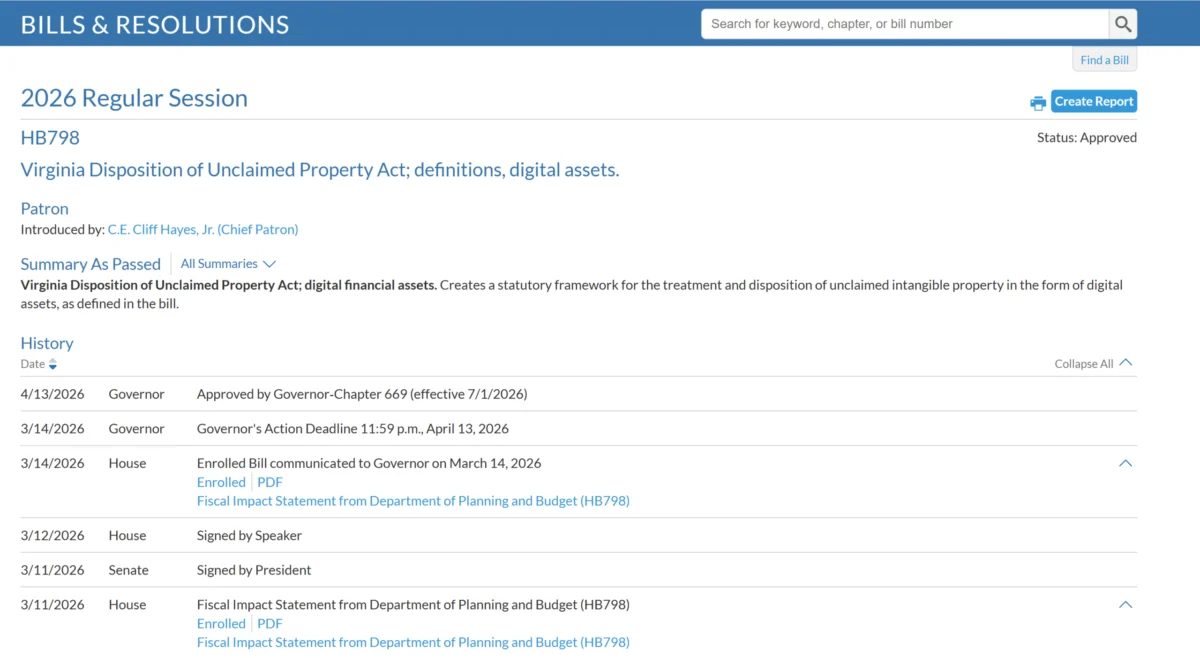
The Commonwealth of Virginia has officially modernized its financial statutes by integrating digital assets into its existing unclaimed property framework, establishing a comprehensive set of rules for the custody, reporting, and liquidation of abandoned cryptocurrencies. On Monday, Governor Abigail Spanberger signed House Bill 798 into law, marking a significant shift in how the state handles blockchain-based assets that have been deemed abandoned by their rightful owners. The legislation, which amends the state’s Disposition of Unclaimed Property Act, introduces specific protections for digital asset holders, most notably requiring that such assets be transferred to the state in their original form rather than being immediately liquidated into fiat currency.
The passage of HB 798 represents a proactive approach to the evolving digital economy, ensuring that Virginia’s Department of the Treasury is equipped to manage modern financial instruments. By establishing clear guidelines for custodians—such as centralized cryptocurrency exchanges and digital wallet providers—the law seeks to balance the state’s duty to protect consumers with the unique technical and market-driven characteristics of the digital asset class. The measure was met with support from both industry leaders and advocacy groups, who viewed the "in-kind" transfer requirement as a critical safeguard against the forced sale of assets during market volatility.
Technical Provisions of House Bill 798
At the core of the new legislation is the mandate for in-kind transfers. Under traditional unclaimed property laws, states often liquidate physical assets or securities shortly after they are remitted to the state treasury. However, HB 798 explicitly requires that custodians of unclaimed digital assets transfer those assets "in-kind," meaning the state must receive the actual tokens or coins rather than a cash equivalent. This provision is designed to preserve the potential upside of the assets for the original owners, should they come forward to reclaim them at a later date.
Furthermore, the law imposes a strict timeline on when the state can sell these assets. According to the bill’s text, the state administrator is prohibited from directing a holder to liquidate reported but unremitted digital assets for at least one year following the filing of an unclaimed property report. "The administrator may subsequently direct such holder of unclaimed digital assets to liquidate the reported but unremitted digital assets not less than one year following the filing of a report," the legislation clarifies. This holding period acts as a buffer, preventing the state from selling assets during temporary market downturns and ensuring that owners have a window of opportunity to reclaim their property in its original digital form.
The legislation also provides a clear definition of when a digital asset account is considered "abandoned." Virginia has set a five-year inactivity clock for these accounts. An account is deemed abandoned if there has been no owner-generated activity for five consecutive years. Activity is defined by specific indicators of engagement, such as the owner logging into the platform, conducting a transaction, or communicating in writing with the custodian regarding the account. This five-year threshold aligns digital assets with other forms of intangible property already covered under Virginia’s existing statutes, providing a sense of regulatory consistency across different asset classes.
Legislative Chronology and Context
The journey of HB 798 through the Virginia General Assembly reflects a growing recognition among state lawmakers of the need for "crypto-native" legislation. The bill was introduced as part of a broader effort to update the Commonwealth’s financial code to reflect the reality of the 21st-century economy. Throughout the legislative session, the bill underwent several reviews to ensure that the technical requirements for state-managed digital asset custody were feasible.
The timeline of the bill’s progression highlights the bipartisan interest in the matter:
- Introduction: The bill was initially drafted to address gaps in the Disposition of Unclaimed Property Act, which did not explicitly mention digital assets, leading to ambiguity for exchanges operating within the state.
- Committee Review: Financial subcommittees examined the implications of state-held crypto, focusing on the security risks of the Treasury Department managing private keys or utilizing third-party institutional custodians.
- Floor Votes: The measure passed with significant support, as legislators recognized the "in-kind" provision as a pro-consumer protection that prevents the state from inadvertently "shorting" its citizens by selling their assets at a loss.
- Gubernatorial Action: Governor Spanberger’s signature on Monday finalized the transition of the bill into law, setting an effective date that allows the Treasury Department to establish the necessary infrastructure for receiving digital remissions.
Comparison with National Trends
Virginia is not alone in its pursuit of digital asset escheatment reform. The state joins a growing cohort of U.S. jurisdictions that are refining their unclaimed property laws to account for Bitcoin, Ethereum, and other digital currencies. However, the specific nuances of Virginia’s law distinguish it from other states.
For instance, in May 2023, Arizona Governor Katie Hobbs signed a law that allows the state to take ownership of unclaimed crypto after a shorter three-year inactivity period. Unlike Virginia’s focus on eventual return to the owner, Arizona’s framework allows for the placement of these assets into a state-managed reserve fund. Similarly, California has advanced legislation to bring digital assets under its unclaimed property rules, though the debate in Sacramento has often centered on the immediate liquidation of assets to fund state programs—a path Virginia has pointedly avoided with its one-year holding mandate.

By opting for a five-year inactivity period and an in-kind transfer requirement, Virginia has positioned itself as one of the more "holder-friendly" states. This approach is seen as a way to attract blockchain businesses to the Commonwealth by providing a clear, predictable, and fair regulatory environment.
Industry Reactions and Stakeholder Impact
The response from the cryptocurrency industry has been largely positive. Paul Grewal, the Chief Legal Officer of Coinbase, one of the world’s largest digital asset exchanges, praised the move on social media. Writing on X, Grewal characterized the legislation as "some good news out of Virginia," noting that the update to the unclaimed property statute ensures assets are escheated in-kind, which he views as a win for the long-term interests of crypto users.
The Virginia Blockchain Council, a prominent advocacy group in the state, also lauded the bill’s passage. The council had previously labeled the proposal an "important step" toward modernizing the Commonwealth’s financial infrastructure. In a statement, the council claimed that the law "signals the Commonwealth’s continued engagement with emerging technologies" and helps solidify Virginia’s reputation as a forward-thinking jurisdiction for financial innovation.
From a practical standpoint, the law places new compliance obligations on digital asset custodians. Exchanges must now implement robust tracking systems to monitor user activity and identify accounts that have reached the five-year inactivity mark. They must also prepare for the technical process of transferring various tokens to state-controlled wallets, a process that requires significant security protocols to prevent loss or theft during the transfer.
Broader Implications and Economic Analysis
The inclusion of digital assets in unclaimed property rules has significant economic implications for both the state and the individual. Unclaimed property is a major source of non-tax revenue for many states; collectively, U.S. states hold billions of dollars in unclaimed funds, ranging from forgotten bank accounts to uncashed payroll checks. As the total market capitalization of the digital asset industry remains in the trillions, the potential value of abandoned crypto accounts represents a substantial new category of property for the state to manage.
However, the "in-kind" requirement introduces a unique fiscal dynamic. If the state were to liquidate assets immediately, it would realize a cash value that could be used for state obligations (though it remains a liability to the owner). By holding the assets in-kind for at least a year, the state assumes the role of a "HODLer"—a term used in the crypto community for long-term investors. If the value of the assets increases significantly during the state’s custody, the owner benefits upon reclamation. Conversely, if the value drops, the owner receives the original asset, but its purchasing power may have diminished.
Analysts suggest that this law could also serve as a template for other states seeking to avoid the legal challenges associated with the "takings clause" of the U.S. Constitution. If a state sells a citizen’s Bitcoin at $30,000 and the citizen returns when Bitcoin is worth $100,000, the citizen might argue that the state’s forced liquidation constituted an unconstitutional taking of property value. By maintaining the asset in-kind, Virginia effectively sidesteps this legal risk.
Future Outlook for Virginia’s Digital Economy
The enactment of HB 798 is part of a larger trend of pro-crypto legislation in the Commonwealth. Recently, other lawmakers have introduced bills aimed at allowing state-managed funds to invest in digital assets, further integrating blockchain technology into the state’s financial portfolio. These moves, combined with the new unclaimed property rules, suggest a coordinated effort to make Virginia a hub for digital finance on the East Coast.
As the law takes effect, the Virginia Department of the Treasury will likely need to partner with institutional-grade custody providers to ensure the secure storage of escheated assets. The success of this program will depend on the state’s ability to navigate the complexities of blockchain transactions while maintaining the high standard of transparency required for public financial management.
For the residents of Virginia, the message is clear: the state is watching the digital horizon. While the goal remains the reunification of property with its rightful owners, the Commonwealth has established a safety net that respects the unique nature of digital wealth, ensuring that even if an account is forgotten, its value—and its form—remains protected under the law.