James Watt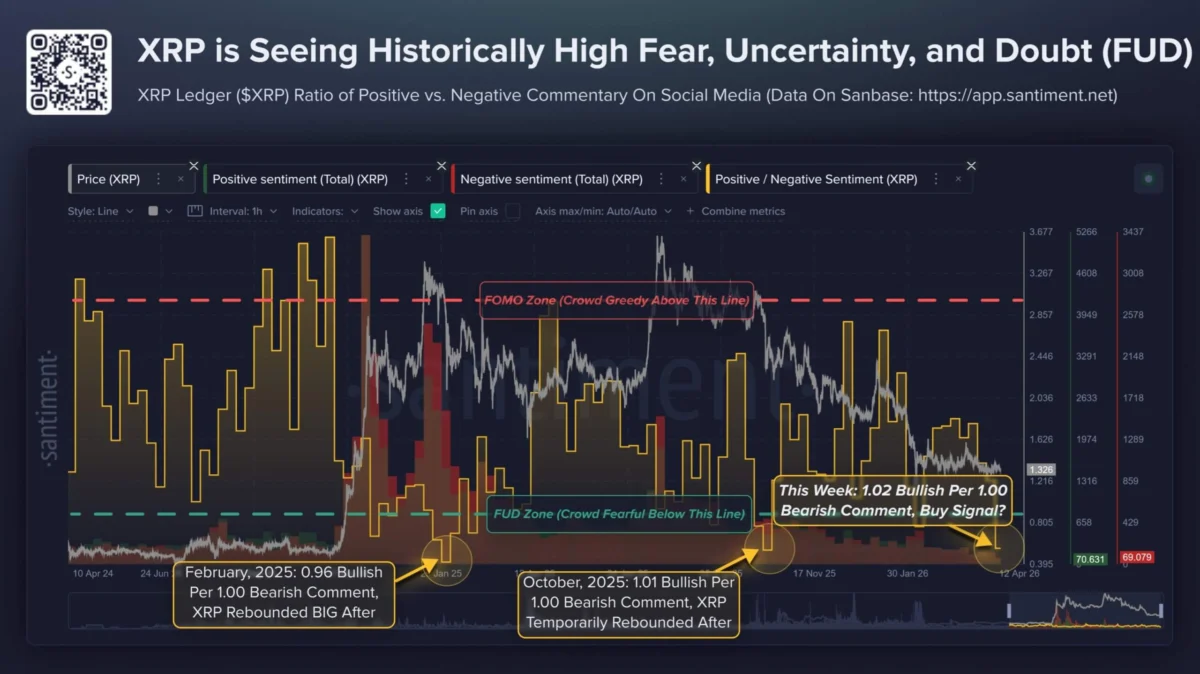
The digital asset XRP has demonstrated a significant recovery in April, reclaiming a valuation of $1.35 and marking a pivotal shift in market sentiment following a protracted period of volatility. After experiencing a grueling downturn that saw the asset lose 63% of its market value over several months, the current rally is being underpinned by a combination of institutional-grade privacy enhancements, expansive retail adoption in Japan, and a reversal in exchange-traded fund (ETF) flow dynamics. According to data from Cryptorank, XRP is currently positioned to secure its first positive monthly close since September 2025, signaling a potential end to the bearish trend that has characterized the asset’s performance for the better part of the last year.
The recovery comes at a time when global investors are increasingly rotating capital into riskier assets. This shift is evidenced by the dramatic turnaround in capital flows reported by SoSoValue. In March, US-based XRP ETFs faced substantial headwinds, recording over $31 million in net outflows as macroeconomic concerns prompted a flight to safety. However, April has seen a reversal of this trend, with approximately $12 million in net inflows into US XRP spot products. This institutional interest is mirrored on a global scale; CoinShares reports that global XRP exchange-traded products (ETPs) have attracted roughly $20 million in net inflows this month alone, cementing XRP’s position as the third most popular digital asset for institutional capital in 2026, trailing only Bitcoin and Solana.
Institutional Privacy and the Evolution of the XRP Ledger
The primary catalyst for the renewed institutional interest is a series of fundamental upgrades to the XRP Ledger (XRPL), specifically aimed at addressing the requirements of traditional financial (TradFi) institutions. Historically, the inherent transparency of public blockchains has served as a barrier to entry for major financial players. On standard public ledgers, all transaction details—including counterparty identities, transaction volumes, and wallet balances—are visible to the public. For institutions, this level of transparency is often untenable, as it allows competitors and automated trading bots to monitor proprietary strategies and corporate liquidity movements.
To mitigate these concerns, the XRPL has integrated programmable privacy through the implementation of zero-knowledge (ZK) proofs. Developed through a collaboration between XRPL Commons and Boundless, a RISC-V ZK verifier now operates directly on the ledger. This cryptographic advancement allows for the verification of transaction validity without the necessity of revealing the underlying data. Consequently, the XRPL has become the first major public blockchain to offer native, programmable privacy and compliance controls.
The rollout of these features is scheduled in distinct phases. In the second quarter of 2026, the ledger will introduce "Smart Escrows," which will mandate a valid ZK proof before funds can be released. This will be followed by the launch of "Smart Vaults," designed to facilitate entirely private financial ecosystems. These tools allow institutions to cross-reference transactions against Know Your Customer (KYC) and Anti-Money Laundering (AML) databases prior to settlement. While the public remains unable to view transaction specifics, the data remains auditable by regulators upon request, providing a middle ground between confidentiality and regulatory compliance.
Odelia Torteman, Director of Corporate Adoption at XRPL Commons, emphasized the strategic importance of these upgrades. Torteman noted that while the XRPL was originally architected for institutional finance, the addition of native confidential execution unlocks a new tier of enterprise use cases—such as stablecoin payments and over-the-counter (OTC) trades—that were previously impossible on a fully transparent ledger.
Expanding the Retail Footprint in Japan
While institutional upgrades bolster the backend infrastructure, XRP’s utility in the retail sector has seen a massive expansion in Asia, particularly in Japan. Rakuten, a dominant force in Japanese e-commerce and financial services, recently integrated XRP into its Rakuten Wallet ecosystem. This integration provides Rakuten’s 46 million active users with direct exposure to the asset, allowing them to convert accumulated loyalty points into XRP.
The significance of this move extends beyond simple trading. Consumers can now utilize XRP for purchases at more than five million affiliated merchants across Japan. With an estimated $23 billion worth of loyalty points currently circulating within the Japanese economy, the Rakuten integration effectively bridges the gap between closed-loop reward systems and the broader digital asset market. By transforming loyalty points into liquid cryptocurrency, the initiative has created a robust foundation for everyday digital commerce using XRP.
Simultaneously, the utility of the XRPL for cross-border remittances is being further validated through rigorous testing by the Japanese banking sector. Reports indicate that a consortium of Japanese banks recently concluded a pilot program comparing XRP-based settlements to the legacy SWIFT network for transactions between Japan and Southeast Asia. While specific data from the pilot remains under review, preliminary findings suggest that XRP-based settlements were completed in under four seconds, representing a 60% reduction in costs compared to traditional systems. By eliminating the need for pre-funded "Nostro" accounts—which require banks to hold billions in dormant capital overseas—the XRPL offers a significant increase in capital efficiency for global lenders.

Market Sentiment and the Contrarian Indicator
Despite the positive fundamental developments, retail sentiment on social media platforms remains largely pessimistic. Data from the analytics firm Santiment reveals that "FUD" (fear, uncertainty, and doubt) surrounding XRP has reached its third-highest level in two years. This negative sentiment is often viewed by market analysts as a contrarian indicator.
Historically, periods of extreme retail exhaustion and "capitulation" have preceded significant price rallies. Following the 63% decline observed in late 2025 and early 2026, many retail traders have exited their positions. Analysts suggest that this "washout" of speculative retail interest, coupled with steady institutional accumulation, has created a low-risk entry point for long-term investors. The current rally to $1.35 is seen by many as the initial stage of a market "re-rating" as the narrative shifts from speculative trading to infrastructure utility.
Regulatory Positioning and Protocol-Level Advantages
The XRP Ledger’s architectural design is also providing a degree of insulation from the tightening regulatory environment in the United States. The Securities and Exchange Commission (SEC) recently issued updated guidance regarding broker-dealer registration for decentralized finance (DeFi) interfaces. While many platforms on Ethereum and Solana rely on third-party smart contracts and centralized front-end interfaces—which may fall under these new requirements—the XRPL functions differently.
The XRPL features a built-in decentralized exchange (DEX) at the protocol level. According to Vet, a prominent XRPL validator, the network operates as a "shared public square" where order books and transaction routing are handled natively by the ledger itself. Because the protocol does not take custody of user funds and operates as a core function of the blockchain rather than an external application, it may avoid many of the compliance burdens currently facing third-party DeFi platforms.
To ensure the security of this infrastructure as volume increases, Ripple and the security firm Sherlock launched a $550,000 audit contest in mid-April. This two-week initiative is designed to stress-test new features, including batch transactions and confidential transfers, ensuring that the network is prepared for the influx of enterprise-level activity.
Addressing Long-Term Security and Quantum Threats
Beyond immediate regulatory and market concerns, developers are also addressing existential threats to blockchain technology, specifically the rise of quantum computing. Recent advancements in quantum speed, highlighted by researchers at Google, have raised fears that future machines could utilize Shor’s algorithm to crack existing cryptographic standards, potentially compromising blockchain wallets.
However, a recent vulnerability audit suggests that the XRPL is better positioned than many of its peers to withstand near-term quantum threats. The XRPL only reveals a user’s public key to the network when an outbound transaction is initiated. Accounts that have only received funds remain cryptographically obscured. The audit conducted by Vet found that approximately 300,000 accounts, holding a combined 2.4 billion XRP, have never sent a transaction and are therefore "quantum-safe" by default. Only a small fraction of the circulating supply—roughly 0.03%—is held in accounts where the public key has been exposed for more than five years.
Furthermore, the XRPL includes a native "key rotation" feature. This allows users to change the signing keys associated with their account without the need to move funds to a new address. This capability serves as a vital stopgap, allowing the network to maintain security while developers work toward the eventual implementation of fully quantum-resistant algorithms.
Conclusion
The events of April 2026 have marked a transformative period for XRP. The convergence of institutional-grade privacy features, massive retail integration in Japan, and a favorable regulatory posture has fundamentally altered the asset’s trajectory. As the market moves away from the speculative volatility of the previous year, the focus has shifted toward the XRPL’s role as a cornerstone of modern financial infrastructure. With institutional inflows rising and the technical foundations of the ledger hardening, XRP appears to be transitioning from a controversial digital asset into a vital tool for the global financial system.