admin
admin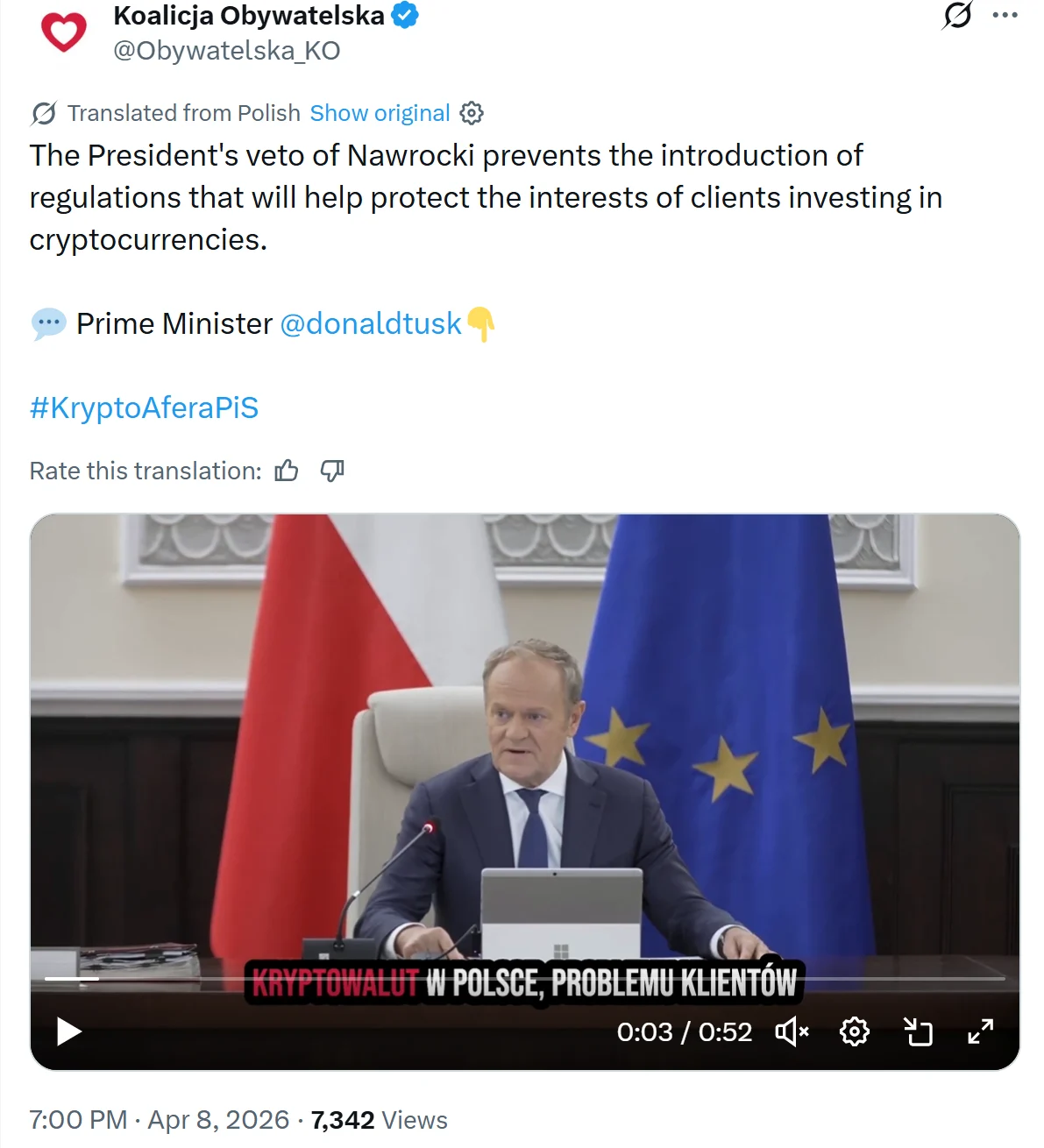
The Polish Sejm, the lower house of the nation’s parliament, has failed in its latest attempt to bypass a presidential veto on a comprehensive digital assets regulation bill, deepening a constitutional and regulatory deadlock that has left the country as a significant outlier within the European Union. In a high-stakes vote held on Friday, lawmakers were unable to garner the necessary three-fifths majority required to overturn the decision of President Karol Nawrocki, who has repeatedly blocked the legislation on the grounds that it imposes an undue burden on the domestic fintech sector. The failure to override the veto marks a significant setback for Prime Minister Donald Tusk’s administration, which had prioritized the bill as a critical step toward aligning Poland with the European Union’s landmark Markets in Crypto-Assets (MiCA) regulation.
The final tally in the Sejm saw 243 Members of Parliament (MPs) voting to reject the presidential veto, while 191 supported the President’s position. Under the Polish Constitution, an override requires 263 votes, assuming all 460 members are present. The shortfall of 20 votes effectively kills the current iteration of the bill, leaving the Polish crypto market in a state of regulatory uncertainty at a time when the rest of the European bloc is moving toward a standardized framework for digital finance. The legislative paralysis has raised concerns among both domestic investors and international observers, as Poland remains the only EU member state yet to formally integrate the MiCA framework into its national legal system.
A Growing Divide: The Origins of the Legislative Conflict
The conflict over the crypto bill is emblematic of the broader political friction between the pro-EU government of Donald Tusk and President Karol Nawrocki, who is often aligned with the conservative opposition. The legislation in question was designed to establish a robust legal foundation for the issuance, trading, and custody of digital assets. Central to the bill was the designation of the Polish Financial Supervision Authority (KNF) as the primary regulator for the crypto sector, granting it the power to issue licenses, conduct audits, and impose sanctions on non-compliant firms.
Government officials argue that the bill is a necessary evolution of Poland’s financial laws. Finance Minister Andrzej Domański has been a vocal proponent of the measure, asserting that the absence of clear, enforceable rules has turned the Polish market into a potential "El Dorado for fraudsters." Domański has frequently highlighted the risks posed to retail investors who lack the legal protections afforded to those in traditional banking and securities markets. By implementing MiCA-compliant standards, the government aimed to sanitize the industry, attract institutional capital, and ensure that Polish crypto-asset service providers (CASPs) could operate seamlessly across the EU through "passporting" rights.
However, President Nawrocki has maintained a steadfast opposition to the bill’s current form. In his official communications regarding the veto, the President cited concerns over "regulatory overreach" and a lack of transparency in how the new rules would be enforced. Nawrocki has argued that the bill, as drafted, places an "excessive burden" on small and medium-sized enterprises (SMEs) within the blockchain space, potentially stifling innovation and driving Polish startups to relocate to more business-friendly jurisdictions like Malta or Lithuania. He has also criticized the government for what he perceives as a rush to comply with Brussels at the expense of domestic economic interests.
Chronology of a Stalemate: From December to the Present
The legislative journey of the crypto bill has been fraught with repetitive failures and escalating rhetoric. The saga began in earnest in late 2024, when the first version of the MiCA-alignment bill was passed by the Sejm.
- December 2024: President Nawrocki issued his first veto of the crypto regulation bill. He argued that the legislation was "imperfect" and failed to account for the specific needs of the Polish tech sector. In response, the Tusk government vowed to reintroduce the bill immediately.
- Late December 2024: Lawmakers resubmitted the bill, claiming it was an "improved" version that addressed some of the President’s concerns. However, critics within the opposition and the crypto industry noted that the core tenets of the bill remained largely unchanged, leading to accusations that the government was attempting to force the President’s hand.
- February 2025: President Nawrocki vetoed the legislation for a second time. In a pointed statement, he remarked, "I will not sign a wrong law just because it was passed again by the parliamentary majority. A wrong law that passed a hundred times still remains a wrong law."
- April 2025: The failure of the Friday vote to override the February veto represents the most recent chapter in this ongoing struggle. The inability to reach the 263-vote threshold suggests that the government may need to seek a broader consensus or significantly alter the bill’s language to secure presidential approval.
The Zonda Controversy: Political Squabbles and National Security
Adding a layer of complexity to the legislative debate is the ongoing controversy surrounding Zonda (formerly BitBay), Poland’s largest cryptocurrency exchange. The platform has become a lightning rod for political tension, with Prime Minister Tusk recently making explosive allegations regarding the exchange’s origins and its current operations.
During a parliamentary session, Tusk cited intelligence reports suggesting that Zonda may have historical links to Russian criminal networks and illicit funding streams. These allegations were used by the government to underscore the urgent need for the very regulations that the President has vetoed. Tusk suggested that without the oversight provided by the proposed bill, the state lacks the tools to properly vet the ownership structures of major financial platforms operating within its borders.
Zonda’s leadership has vehemently denied these claims. CEO Przemysław Kral took to social media to label the accusations as "absurd" and "harmful to the Polish innovation market." Kral argued that the exchange is being used as a political football in a domestic power struggle. He further clarified that he has initiated legal steps to protect his reputation and the integrity of the firm.

The situation at Zonda is further clouded by a "withdrawal crisis" and reports of an inaccessible crypto wallet containing approximately 4,500 BTC (valued at roughly $330 million). Kral has stated that he does not have access to these funds, claiming they were under the control of the exchange’s founder, Sylwester Suszek, who disappeared under mysterious circumstances in 2022. The lack of regulatory clarity in Poland has made it difficult for authorities or users to find recourse in such high-stakes disputes, a point the Tusk government continues to emphasize.
Understanding MiCA and the Cost of Non-Compliance
The Markets in Crypto-Assets (MiCA) regulation, which the Polish bill seeks to implement, is the first comprehensive framework for digital assets in a major global jurisdiction. Introduced by the European Union, MiCA aims to provide legal certainty for crypto-assets not covered by existing financial services legislation. It sets strict requirements for issuers of stablecoins, mandates transparency and disclosure for all crypto-asset service providers, and establishes rules against market manipulation.
For Poland, the delay in MiCA implementation carries significant economic and legal risks. Under EU law, member states are required to transpose directives and implement regulations within specific timeframes. Continued failure to do so could result in the European Commission initiating infringement procedures against Warsaw, which may lead to substantial fines.
Furthermore, Polish crypto firms are finding themselves at a competitive disadvantage. Under MiCA, a firm licensed in one EU member state can "passport" its services to all other member states. Because Poland has no MiCA-compliant framework, Polish firms cannot obtain these licenses at home. Consequently, many of the country’s most successful blockchain companies are reportedly seeking licenses in France, Germany, or the Netherlands, leading to a "brain drain" of talent and a loss of tax revenue for the Polish state.
Market Analysis: Implications for Investors and the Fintech Sector
The immediate fallout of the failed veto override is a continuation of the "gray zone" in which the Polish crypto market currently operates. For retail investors, this means a lack of standardized consumer protection. In the event of an exchange failure or a fraudulent Initial Coin Offering (ICO), Polish investors have fewer legal avenues for recovery compared to their counterparts in MiCA-compliant nations.
From an institutional perspective, the lack of a clear legal framework acts as a deterrent to entry. Large-scale financial institutions and traditional banks are generally hesitant to engage with digital assets in jurisdictions where the rules of engagement are undefined. This has slowed the integration of blockchain technology into Poland’s broader financial infrastructure, potentially hampering the country’s goal of becoming a regional hub for financial technology.
Economic analysts suggest that the President’s concerns regarding small businesses are not entirely without merit. Compliance with MiCA involves significant administrative and legal costs, which can be prohibitive for small startups. However, the prevailing sentiment among industry experts is that some regulation is better than none. The current state of limbo creates a "regulatory vacuum" that is often more damaging to business confidence than even a strict set of rules.
The Path Forward: Diplomacy or Further Deadlock?
With the Friday vote failing to break the impasse, the Tusk administration faces a difficult choice. It can attempt to draft a third version of the bill that incorporates more of the President’s specific demands—such as reduced reporting requirements for smaller firms or a longer transition period—or it can wait for a change in the political climate.
The upcoming presidential elections in Poland may also play a role in how this legislative battle unfolds. If the government believes it can win the presidency, it may choose to stall until it has a more cooperative partner in the Presidential Palace. Conversely, if the pressure from Brussels and the domestic financial sector continues to mount, a compromise may be reached out of necessity.
For now, the Polish crypto industry remains in a state of watchful waiting. The failed override is a stark reminder of the challenges inherent in regulating a fast-moving, globalized asset class within the confines of a divided national government. As the rest of Europe moves toward a unified digital financial market, Poland’s struggle highlights the difficult balance between national sovereignty, economic protectionism, and the mandates of international integration. Until a resolution is found, the Polish digital asset market will continue to navigate a landscape defined more by political maneuvering than by clear legal principles.