Nila Kartika Wati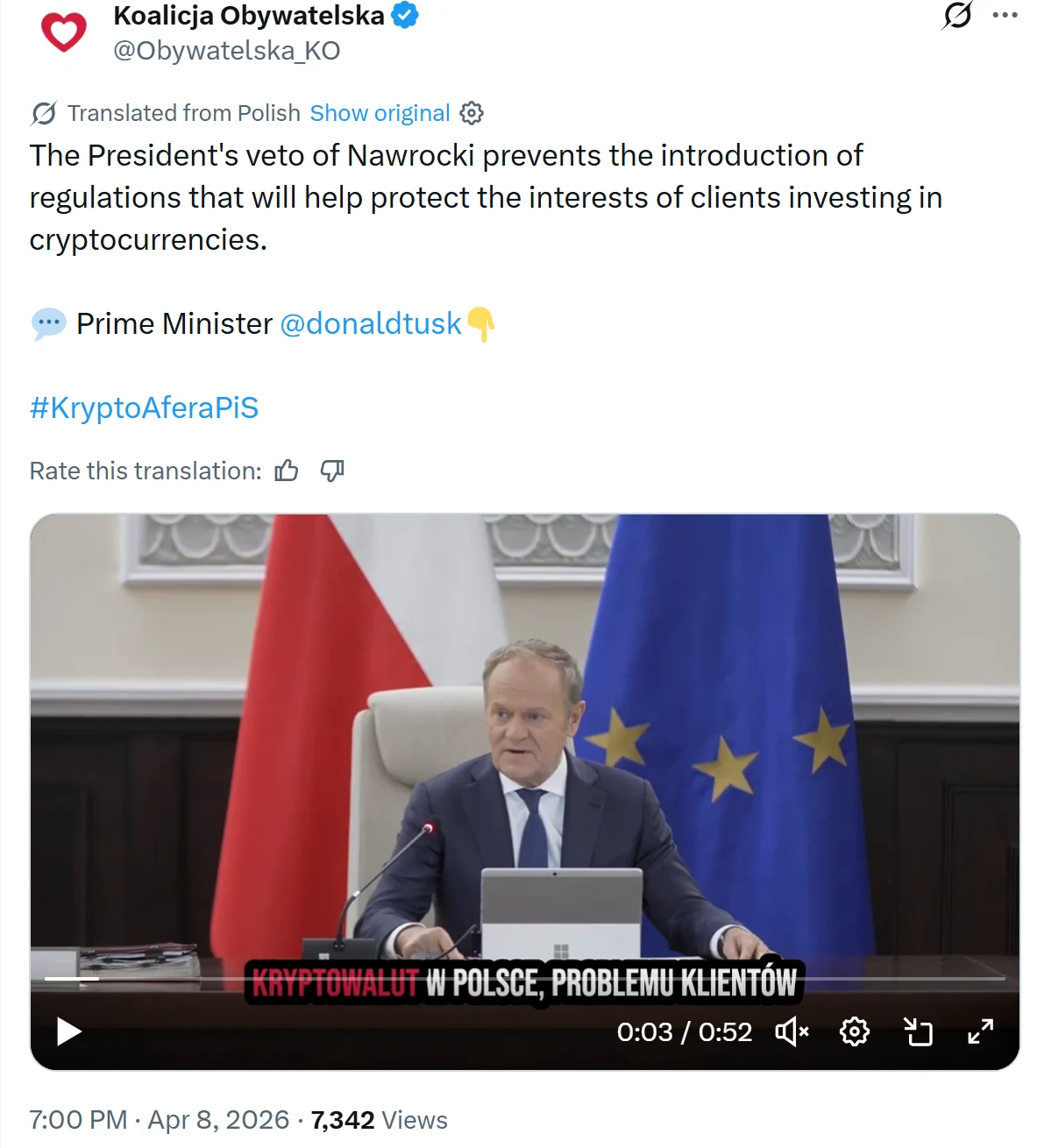
Warsaw, Poland – The legislative saga surrounding Poland’s crucial cryptocurrency regulation bill has taken another complex turn, with the nation’s parliament once again failing to muster the necessary votes to override a presidential veto. This latest setback, unfolding on Friday, prolongs the political deadlock over how Poland, a key member state of the European Union, should oversee its burgeoning digital assets market, leaving it as the sole EU country yet to implement the bloc’s landmark Markets in Crypto-Assets Regulation (MiCA).
Parliamentary Vote and Its Immediate Aftermath
The vote, a critical juncture in the legislative process, saw lawmakers fall short of the 263 votes required to overturn the veto previously issued by President Karol Nawrocki. According to reports from local outlet TVP World, a total of 243 Members of Parliament (MPs) voted against the veto, indicating their support for the bill, while 191 MPs supported the President’s decision. This result underscores the deep divisions within the Polish political landscape regarding the regulation of digital assets, a debate that has significant implications for investor protection, market stability, and Poland’s standing within the European Union. The failure to override the veto means the bill, which aimed to bring Polish law into alignment with the comprehensive MiCA framework, cannot proceed in its current form, pushing the nation further into regulatory uncertainty.
The Context of MiCA and Poland’s Unique Position
At the heart of this protracted legislative battle is the European Union’s Markets in Crypto-Assets Regulation (MiCA), a pioneering and comprehensive regulatory framework designed to create a harmonized legal environment for crypto-assets across all 27 member states. Introduced in 2024, MiCA aims to provide legal clarity and regulatory certainty for issuers of crypto-assets and crypto-asset service providers (CASPs), covering areas such as authorization requirements, operational rules, consumer protection, and market integrity. Its primary objectives include fostering innovation, ensuring financial stability, and protecting investors from risks associated with the volatile crypto market.
The regulation mandates that all EU member states transpose its provisions into their national laws to ensure a consistent approach across the single market. Poland, however, remains a notable outlier. As the only EU member state yet to fully implement the bloc’s framework, its prolonged internal debate creates a regulatory vacuum that potentially disadvantages Polish businesses and investors, while also raising questions about its commitment to EU-wide harmonization efforts. The Polish bill, championed by Prime Minister Donald Tusk’s government, was specifically crafted to bridge this gap and integrate MiCA’s principles into Polish legal statutes, covering aspects like the issuance and custody of various crypto assets, and establishing licensing requirements for crypto service providers.
Presidential Objections: "Excessive Regulation" and Business Burden
President Karol Nawrocki has consistently defended his decision to veto the crypto regulation bill, articulating a set of concerns that reflect a more cautious and perhaps less interventionist approach to the digital economy. His primary objections, as detailed in reports, revolve around what he perceives as "excessive regulation." The President has argued that the proposed legislation could stifle innovation, particularly for smaller enterprises and startups operating within Poland’s nascent crypto sector. He has voiced apprehension that the stringent requirements of MiCA, as translated into the Polish bill, might impose an undue administrative and financial burden on small businesses, making it difficult for them to comply and potentially driving them out of the market or compelling them to seek licenses abroad.
Furthermore, President Nawrocki has cited concerns regarding "limited transparency" within certain aspects of the proposed regulatory framework. While the specifics of these transparency issues have not been fully elaborated in public statements, they likely pertain to the implementation details, oversight mechanisms, or potentially perceived ambiguities in how the new rules would be applied. This stance reflects a broader ideological divide, where the President’s camp appears to prioritize deregulation and reducing governmental oversight, contrasting with the government’s push for structured market control and consumer protection.
Government’s Stance: Protecting Investors from a "Wild West" Market
In stark contrast to the President’s concerns, Prime Minister Donald Tusk’s government has vehemently argued for the urgent implementation of the crypto regulation bill, emphasizing the critical need for investor protection and market stability. Finance Minister Andrzej Domański has been particularly vocal, reportedly warning that the continued absence of clear regulatory rules risks transforming the Polish crypto market into an "El Dorado for fraudsters." This evocative phrase underscores the government’s deep concern that without a robust legal framework, the market remains susceptible to illicit activities, scams, and exploitative practices, leaving both individual consumers and legitimate businesses highly vulnerable to abuse.
Government officials argue that delaying regulation creates a fertile ground for illicit actors, as it lacks the necessary legal tools for oversight, enforcement, and consumer recourse. They point to the inherent risks of unregulated markets, including price manipulation, insider trading, and outright fraudulent schemes, which can lead to significant financial losses for unsuspecting investors. Moreover, the government stresses that aligning with MiCA is not merely a bureaucratic formality but a fundamental step towards integrating Poland into the broader European digital single market, attracting legitimate investment, and enhancing the country’s reputation as a secure and reliable jurisdiction for digital asset innovation. The current regulatory vacuum, they contend, deters serious institutional investors and forces Polish crypto companies to operate under a cloud of uncertainty or seek more favorable environments elsewhere.

A Tumultuous Legislative Timeline
The recent failed veto override is not an isolated incident but the latest chapter in a protracted and contentious legislative journey for Poland’s crypto bill. The chronology of its attempts to pass highlights the persistent political friction:
- Initial Proposal (Late 2023): The government, under Prime Minister Tusk, first introduced the bill with the explicit aim of transposing MiCA into Polish law. This move was a clear signal of the new administration’s intent to bring Poland into compliance with EU standards.
- First Presidential Veto (December 2023): President Karol Nawrocki exercised his constitutional power to veto the bill shortly after its initial passage by parliament. His reasons at the time were broadly similar to his current stance, citing concerns about overregulation and its potential impact on small businesses. This marked the first significant roadblock.
- Reintroduction of an "Improved" Draft (December 2023): Undeterred by the presidential rejection, Polish lawmakers swiftly reintroduced a new draft of the regulation within days of the first veto. While government proponents claimed this version was "improved," critics quickly pointed out that it was "virtually unchanged" from the original, suggesting a strategic move to bypass the President’s objections rather than genuinely address them. This move indicated the government’s strong commitment to the legislation.
- Second Presidential Veto (February 2024): As anticipated by many, President Nawrocki again vetoed the resubmitted bill. His statement at the time was resolute: "I will not sign a wrong law just because it was passed again by the parliamentary majority. A wrong law that passed a hundred times still remains a wrong law." This firm stance underscored the deep ideological chasm between the executive and the legislative branches on this issue.
- Second Failed Override Attempt (Friday, [Current Date]): The latest development, where parliament failed to secure the 263 votes needed, marks the second unsuccessful attempt to override a presidential veto, effectively stalling the bill once more.
This repeated cycle of legislative action and presidential rejection illustrates a fundamental political and ideological disagreement that extends beyond the specifics of crypto regulation, touching upon the balance of power and policy direction within the Polish government.
The Zonda Controversy: Political Accusations and Industry Repercussions
Adding another layer of complexity and controversy to the debate is the involvement of Zonda, reportedly Poland’s largest crypto exchange. Zonda has been a vocal critic of the proposed bill, actively lobbying against its implementation, aligning with the President’s concerns about excessive regulation. This opposition has, however, drawn the exchange into the broader political crossfire.
Tensions escalated significantly when Prime Minister Tusk publicly accused Zonda of links to illicit funding. Citing intelligence reports, Tusk alleged connections between the platform’s origins and Russian criminal networks, a serious accusation with profound implications. Such claims, made by the head of government, cast a shadow over the legitimacy of the exchange and, by extension, could be interpreted as an attempt to discredit opposition to the bill.
In response, Zonda CEO Przemysław Kral vehemently denied the allegations, taking to social media platform X (formerly Twitter) to state, "Attempts to drag me and Zonda into the current political squabbles are as absurd as they are harmful to the Polish innovation market." Kral also indicated his intention to "take appropriate legal steps to protect my personal rights," signaling a potential legal battle.
Further compounding Zonda’s troubles, Kral recently disclosed that he does not control access to a crypto wallet reportedly holding a staggering $330 million in Bitcoin (approximately 4,500 BTC at the time of the original article’s reference). He claims this significant sum remains inaccessible and was last controlled by former CEO Sylwester Suszek prior to his disappearance in 2022. This revelation adds a dramatic twist, raising questions about internal governance, asset security, and the historical operations of the exchange, further intensifying scrutiny on the platform amidst the political debate. The allegations against Zonda and the ensuing controversy complicate the regulatory discussion, suggesting that the debate is not purely about policy but also involves accusations of impropriety within the crypto industry itself.
Broader Implications and Analysis
The prolonged regulatory uncertainty in Poland carries significant implications across several fronts:
- Economic Impact and Market Migration: The absence of a clear regulatory framework puts Polish crypto businesses at a distinct disadvantage compared to their counterparts in other EU member states. With MiCA now in effect across most of the bloc, businesses in compliant jurisdictions benefit from regulatory clarity, legal certainty, and enhanced investor confidence. Polish firms, facing an uncertain domestic landscape, are increasingly compelled to consider seeking licenses and establishing operations abroad to comply with MiCA and access the wider EU market. This "regulatory arbitrage" could lead to a brain drain and capital flight from Poland, hindering the growth of its domestic digital asset industry. Investors, both domestic and international, may also be hesitant to commit capital to a market lacking robust consumer protection and clear operational guidelines.
- Political Gridlock and Governance Challenges: The repeated presidential vetoes and the government’s inability to override them highlight a deep political division and a significant governance challenge in Poland. The ongoing standoff between the President and the ruling coalition on a critical economic issue underscores the difficulties in enacting legislation, particularly when the executive and legislative branches are controlled by opposing political forces. This friction extends beyond crypto, potentially impacting other legislative priorities and creating an environment of political instability that can deter foreign investment and impede policy implementation. It reflects the checks and balances inherent in Poland’s semi-presidential system, but also the potential for prolonged stalemates when political will diverges sharply.
- EU Relations and Compliance: Poland’s status as the sole EU member state yet to implement MiCA could strain its relationship with the European Commission and other member states. The EU places a high premium on the harmonization of its single market, and non-compliance with a foundational regulation like MiCA could lead to formal infringement proceedings by the European Commission. Such proceedings could result in fines or other penalties, and more broadly, could damage Poland’s reputation within the bloc as a reliable partner committed to common European objectives. The delay undermines the EU’s collective effort to create a secure and integrated digital finance landscape.
- Investor and Consumer Protection: Perhaps the most immediate and tangible impact of the regulatory vacuum is on Polish investors and consumers. Without MiCA-aligned protections, they remain exposed to significant risks. This includes inadequate disclosure requirements from crypto service providers, a lack of clear rules for asset custody, and insufficient mechanisms for dispute resolution. The government’s warning of an "El Dorado for fraudsters" is not mere rhetoric but reflects the very real dangers posed by an unregulated market where bad actors can thrive with relative impunity. Legitimate businesses also suffer, as they struggle to build trust and operate responsibly in an environment devoid of clear legal boundaries.
Future Outlook: A Path Forward?
The current impasse leaves the future of crypto regulation in Poland highly uncertain. The government has several potential avenues, though none are straightforward:
- Further Legislative Attempts: The Tusk government could attempt to draft an entirely new bill, hoping to address the President’s specific concerns in a way that would secure his approval, or at least garner enough cross-party support to override a future veto. This would require significant negotiation and compromise.
- Constitutional Challenge (Unlikely for this issue): While theoretically possible, a constitutional challenge to the President’s veto power on this specific issue is unlikely and would be a drastic, time-consuming measure.
- Political Pressure and Public Debate: The government will likely continue to exert political pressure and engage in public debate, highlighting the risks of non-compliance and the benefits of MiCA to garner broader public support, potentially influencing the President’s stance or future parliamentary votes.
- European Commission Intervention: The European Commission may escalate its pressure on Poland to comply with MiCA, potentially initiating infringement procedures if the delay continues. This external pressure could force a resolution.
For now, the Polish crypto market remains in a state of limbo, caught between the urgent demands of EU harmonization and investor protection, and the deep-seated political divisions within the country’s leadership. The resolution of this standoff will not only shape the future of digital assets in Poland but also serve as a barometer for the broader political landscape and the country’s commitment to European integration.