James Watt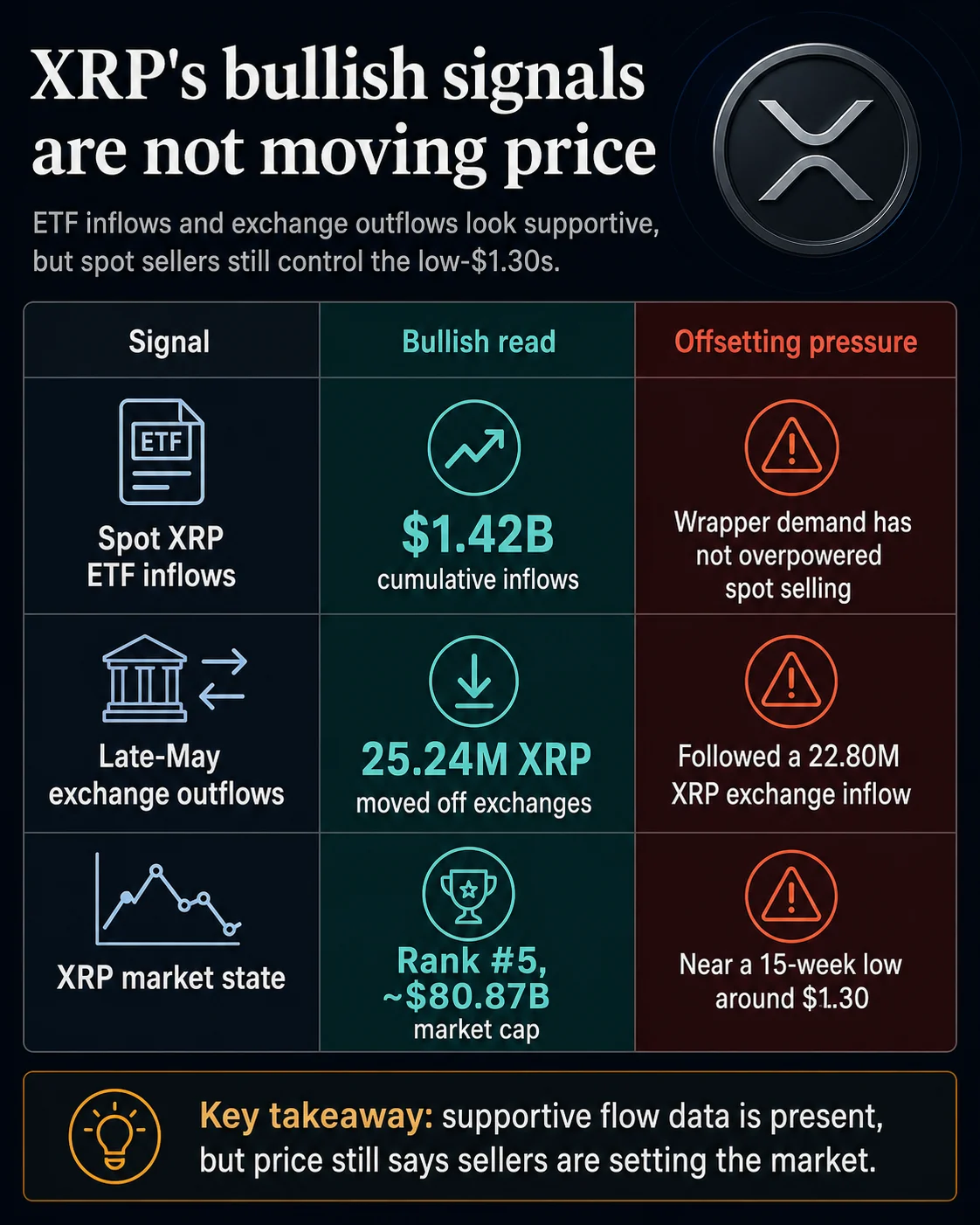
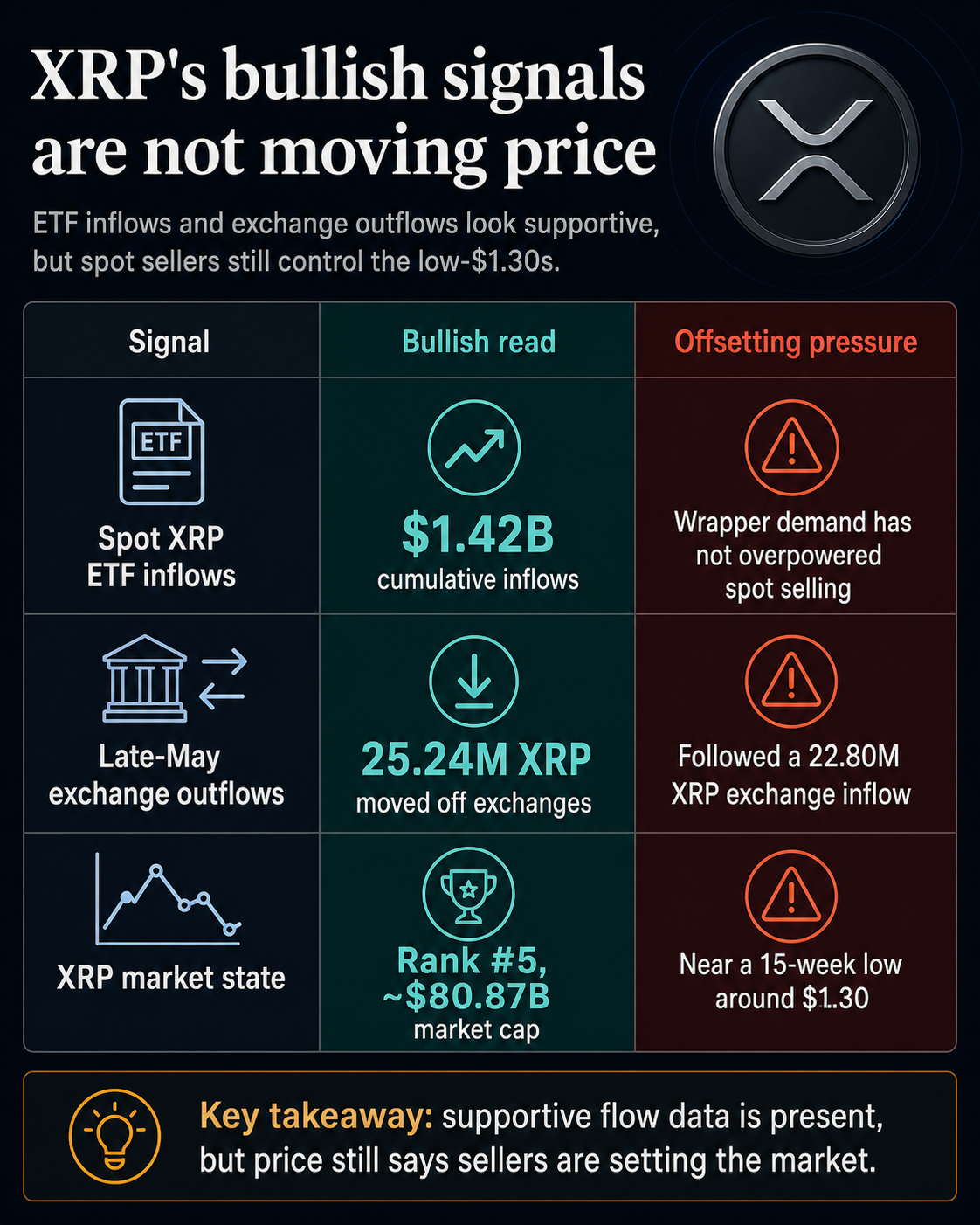
The digital asset XRP is currently presenting market participants with a significant structural contradiction, creating a sharp divergence between bullish on-chain flow data and bearish price action. Despite several key metrics—often viewed as precursors to a bullish reversal—trending in a positive direction, the token has struggled to maintain its footing, sliding toward its weakest valuation in approximately 15 weeks. As of early June, XRP has been fluctuating in the low-$1.30 range, a level that serves as a critical psychological and technical threshold for the fifth-largest cryptocurrency by market capitalization.
The current market environment for XRP is characterized by a "disconnect" where the traditional signals of accumulation are failing to translate into upward price momentum. While spot XRP Exchange-Traded Funds (ETFs) continue to witness steady capital entry and exchange balances show signs of depletion, the spot market remains dominated by aggressive sellers. This phenomenon suggests that while long-term institutional interest and cold-storage accumulation are active, they are currently insufficient to counteract the immediate sell-side pressure on centralized trading venues.
Institutional Demand and the ETF Landscape
A primary pillar of the bullish thesis for XRP has been the sustained performance of regulated investment vehicles. According to data from SoSoValue, spot XRP ETFs have continued to attract capital even as the underlying asset’s price deteriorated. Late-May figures indicated a net inflow of approximately $11.8 million on May 29 alone, contributing to a cumulative net inflow of roughly $1.42 billion.
This consistent inflow into regulated "wrappers" suggests that institutional and accredited investors are viewing the current price levels as an attractive entry point or are executing long-term allocation strategies that ignore short-term volatility. However, analysts note a critical distinction: ETF demand is often indirect. While these inflows represent capital entering the XRP ecosystem, the mechanism by which ETF providers acquire the underlying asset does not always result in immediate, aggressive buying on spot exchange order books. Consequently, the "wrapper" demand can remain isolated from the high-frequency trading environments where the marginal price of XRP is determined.
The persistence of these inflows during a drawdown creates a unique setup. If the price continues to fall while ETF participation rises, it suggests a transfer of ownership from speculative retail hands to more "sticky" institutional custody. Yet, until this institutional demand overpowers the volume of tokens being offloaded on centralized exchanges, the price is likely to remain suppressed.
Exchange Flow Reversals and Supply Dynamics
On-chain metrics provided by Santiment offer further insight into the supply-side contradictions currently at play. In late May, XRP exchange-flow data underwent a notable reversal. Initially, the market observed an inflow of approximately 22.80 million XRP to centralized exchanges—a move typically associated with an intent to sell. However, this was quickly followed by a substantial withdrawal of more than 25.24 million XRP into private wallets.

In a standard market cycle, the movement of tokens off exchanges is interpreted as a reduction in immediately available sell-side supply. When supply on exchanges drops, it theoretically requires less buying pressure to move the price upward. However, the current XRP price action suggests that the 25 million XRP withdrawal, while significant, was not enough to offset the broader sentiment.
The failure of this "supply crunch" signal to spark a rally points toward a deeper issue in market confidence. If tokens are leaving exchanges but the price continues to hit multi-month lows, it indicates that the remaining liquidity on exchanges is being met with even more aggressive selling, or that the "demand vacuum" is so severe that even a diminished supply can satisfy it at lower prices.
Chronology of the 15-Week Decline
To understand the gravity of the current $1.30 support level, it is necessary to trace the trajectory of XRP over the preceding months.
- The Mid-February Surge: XRP experienced a period of relative strength, buoyed by broader market optimism and specific legal developments regarding its regulatory status. During this time, the asset established a base above the $1.15 level.
- March and April Consolidation: As the broader crypto market reached local peaks, XRP tested higher resistance levels but began to show signs of fatigue. During this period, the "sell the rebound" pattern first began to emerge, where every attempt at a breakout was met with heavy distribution.
- May’s Bullish Signal Build-up: Throughout May, the aforementioned ETF inflows and exchange withdrawals began to accelerate. Analysts pointed to rising ledger activity and a constructive on-chain setup, leading many to anticipate a "springboard" effect.
- The June 1 Breakdown: Contrary to expectations, the beginning of June saw XRP plummet to the $1.30 mark. This 15-week low effectively neutralized the bullish narrative of the previous month, forcing a re-evaluation of the asset’s immediate prospects.
This chronology highlights a market that is increasingly insensitive to positive news and on-chain health, focusing instead on the immediate liquidity needs of large-scale sellers.
Market Structure and the Liquidity Trap
The most compelling explanation for why XRP is ignoring bullish flow data lies in its current market structure. Data from CryptoSlate’s market pages indicates that XRP’s 24-hour centralized exchange (CEX) volume recently hovered around $1.62 billion, while decentralized exchange (DEX) volume was a mere $1.4 million. This overwhelming concentration on centralized venues means that the price is highly sensitive to the depth and liquidity of CEX order books.
Recent analysis of exchange liquidity paints a concerning picture. The 30-day XRP liquidity index on Binance, the world’s largest crypto exchange, recently touched 0.043—its lowest level since January 2020. Thin liquidity acts as a volatility multiplier; in such an environment, even relatively small sell orders can cause disproportionate price drops because there are not enough buy orders to absorb the impact.
Furthermore, the derivatives market continues to exert an outsized influence on XRP. With all-exchange open interest sitting near $2.9 billion and futures volume running at nearly seven times the spot volume, the "tail is wagging the dog." In this high-leverage environment, price movements are often driven by liquidations and hedging rather than fundamental spot accumulation. When leverage is high and liquidity is low, the market becomes a "volatility trap," where technical signals and flow data are secondary to the mechanics of the order book.
Comparative Analysis and Market Standing
Despite its recent price struggles, XRP remains a dominant force in the cryptocurrency hierarchy. With a market capitalization of approximately $80.87 billion, it maintains its position as a top-five digital asset. This size provides a certain level of "liquidity insurance" compared to smaller altcoins, yet it has not shielded the token from the broader trend of "selling the bounce."
When compared to Bitcoin (BTC) and Ethereum (ETH), XRP has shown a unique decoupling in terms of ETF rotation. At various points in the second quarter, XRP products saw net inflows while BTC and ETH products experienced outflows. This suggests that a specific subset of the investor class is rotating into XRP as a value play or a diversification hedge. However, this relative strength in the ETF sector has yet to translate into outright price strength against the US Dollar.
Future Outlook: The $1.31 and $1.34 Battlegrounds
Market analysts are now focusing on two specific price levels that will likely determine the medium-term trajectory of XRP.
- The $1.31 Support: This level represents the immediate floor. A sustained break below $1.31, especially if accompanied by continued ETF inflows, would confirm that the spot market is in a state of extreme capitulation, where fundamental data is being entirely ignored in favor of liquidity exits.
- The $1.34 Resistance: Reclaiming the $1.34 area is the first step toward a bullish invalidation of the current trend. A move above this level would suggest that the "supply-off-exchange" narrative is finally gaining traction and that buyers are beginning to absorb the overhead sell-side pressure.
Implications for the Broader Market
The situation with XRP serves as a cautionary tale for the wider digital asset market regarding the limitations of on-chain data. While exchange flows and ETF numbers provide a glimpse into the movement of capital, they do not account for the "conviction" of the participants or the underlying mechanics of exchange liquidity.
If XRP fails to recover despite its constructive flow data, it may signal a shift in how market participants interpret "bullish signals." It suggests that in a mature market, institutional "wrappers" and on-chain supply metrics are only part of the story, and that the ultimate arbiter of price remains the immediate, aggressive liquidity available on centralized spot markets. For now, the contradiction remains: the flows suggest accumulation, but the charts confirm a retreat. Traders and investors must now wait to see if the "smart money" entering through ETFs can eventually exhaust the "marginal sellers" currently dictating the price.