Nila Kartika Wati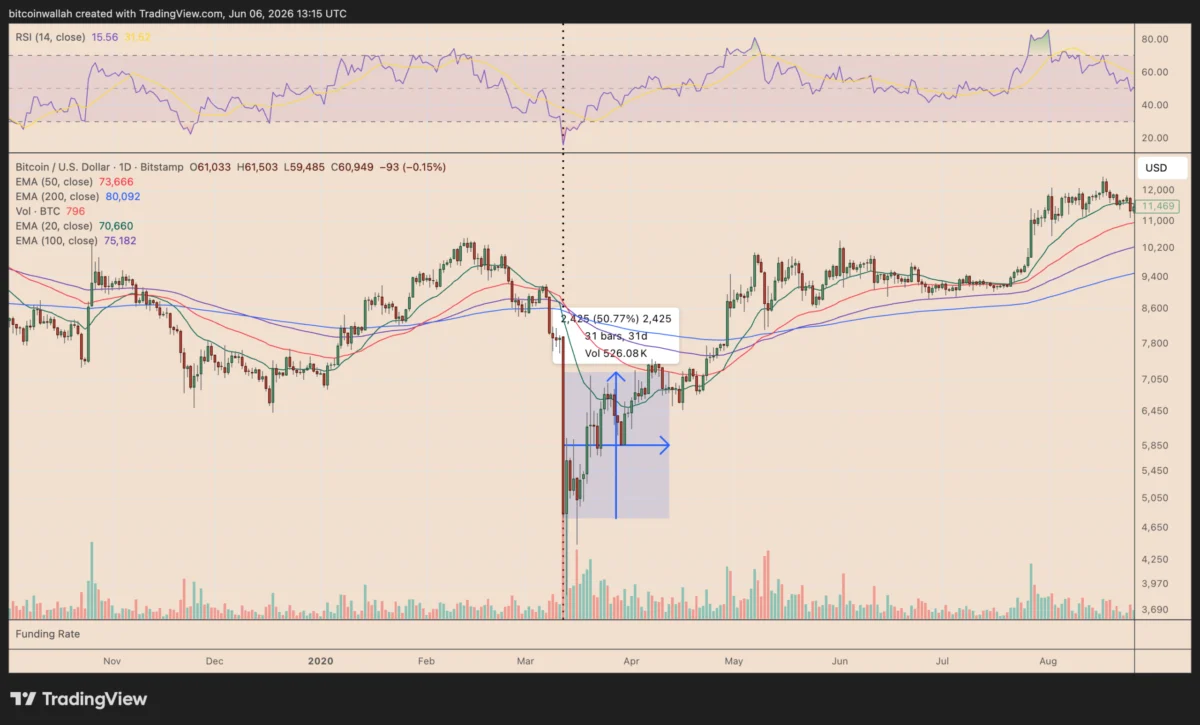
The cryptocurrency market is currently grappling with significant turbulence, as Bitcoin (BTC), the world’s leading digital asset, has flashed its most oversold signal since the unprecedented market crash triggered by the COVID-19 pandemic in March 2020. This stark technical indicator is fueling cautious optimism among analysts and investors, who suggest that a relief rebound towards the $70,000 mark could be on the horizon in the coming weeks, provided the critical $60,000 support level holds firm against persistent selling pressure. The current market dynamics present a complex interplay of macroeconomic headwinds, shifting sentiment, and robust on-chain data that collectively paint a picture of potential capitulation preceding a recovery.
Bitcoin’s Deepest Oversold Signal Since Pandemic Crash
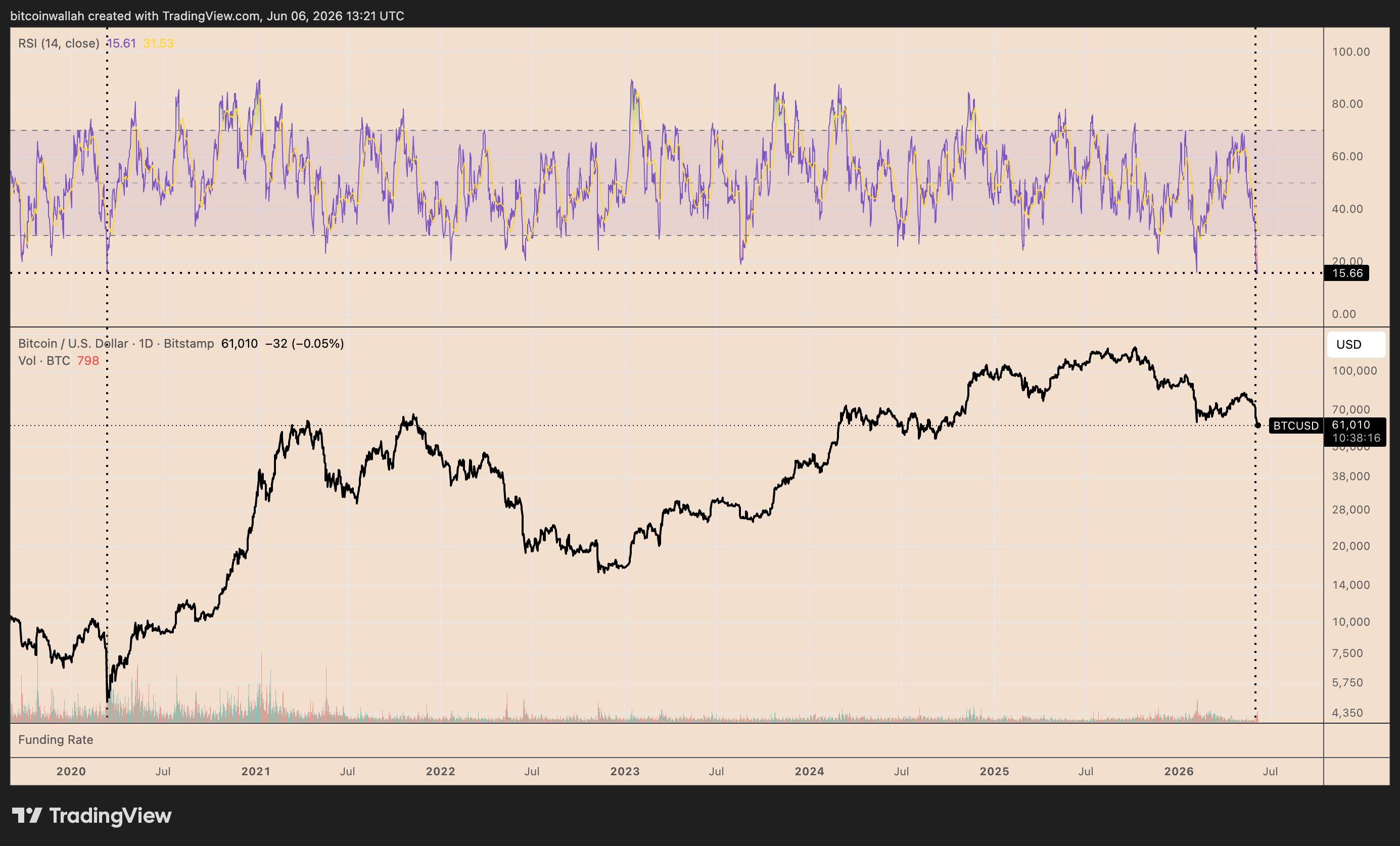
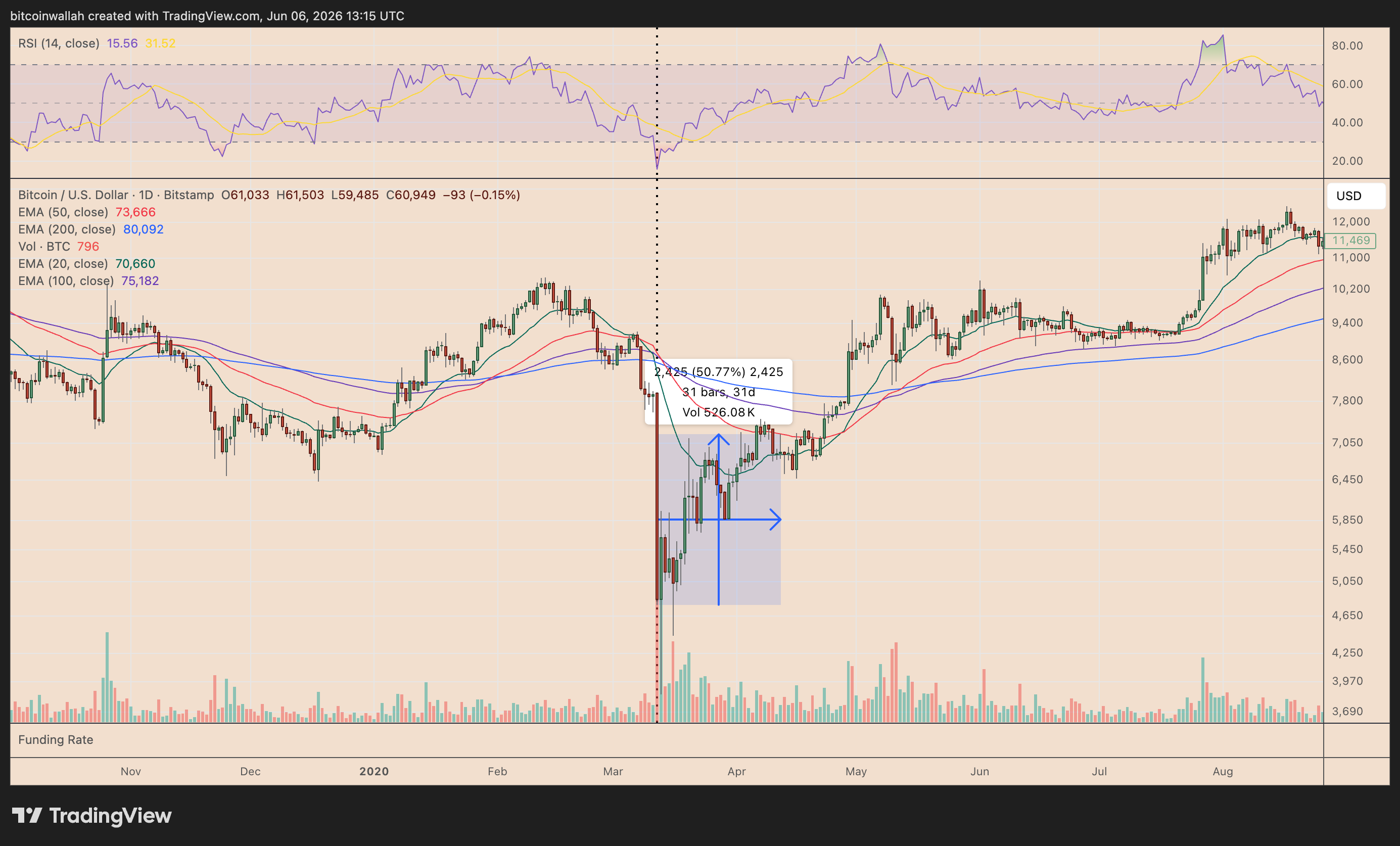
As of the recent weekend, Bitcoin’s daily Relative Strength Index (RSI) registered an exceptionally low reading of approximately 15.5. This figure stands well below the conventional 30-level threshold, which market technicians typically use to identify oversold conditions. Such an extreme reading is not only a rare occurrence but also represents the lowest point recorded since the tumultuous period of March 2020, when global markets, including cryptocurrencies, experienced a dramatic downturn at the onset of the COVID-19 crisis. The RSI, a momentum oscillator, measures the speed and change of price movements, with lower values indicating that an asset has been oversold and may be due for a price correction upwards.
The Technical Read: RSI Plummets Below Critical Threshold
The significance of an RSI reading at 15.5 cannot be overstated. In technical analysis, an asset is considered oversold when its RSI dips below 30, suggesting that selling pressure has been excessive and a reversal could be imminent. A reading this far below 30 points to an extraordinary level of market distress and seller exhaustion. This extreme oversold condition follows a substantial depreciation in BTC’s value, which has seen a decline of roughly 30% over the past month. Despite this intense selling, Bitcoin has demonstrated a notable resilience, consistently refusing to dip decisively below the $60,000 psychological and technical support level, a price point that has previously served as a strong foundation for bullish movements. The defense of this level, even amidst such extreme technical indicators, underscores the underlying strength of demand at these prices, suggesting that a significant portion of the market views this as a buying opportunity rather than a further descent.
Historical Precedents and Their Nuances
History offers compelling, albeit not identical, parallels to the current situation, providing context for potential future price action.
During the March 2020 market crash, Bitcoin’s daily RSI plummeted to a similar level, hovering around 15.56. This precipitous drop was swiftly followed by a remarkable rebound, with BTC appreciating by approximately 50% in the subsequent weeks and months. This recovery was significantly bolstered by unprecedented monetary interventions from central banks globally, most notably the U.S. Federal Reserve. The Fed’s emergency shift to near-zero interest rates and its massive quantitative easing program, involving large-scale bond purchases, injected vast amounts of liquidity into the financial system. This influx of capital, coupled with a growing narrative of Bitcoin as a "digital gold" hedge against inflation, channeled significant funds into risk assets, including cryptocurrencies, catalyzing a sustained bullish run that would eventually see Bitcoin reach new all-time highs.

More recently, in February 2026, Bitcoin’s daily RSI again dipped into deeply oversold territory, reaching around 15.86. Crucially, during this period, the price of BTC successfully held above the critical $60,000 support area. This technical signal, unassisted by major external macroeconomic catalysts, preceded a robust recovery of nearly 30%, pushing Bitcoin’s price towards $82,850. This recent historical example highlights Bitcoin’s inherent market dynamics and its capacity for significant rebounds driven purely by internal technical and sentiment shifts, even without direct external economic stimuli. The current defense of the $60,000 level echoes this earlier 2026 scenario, offering a beacon of hope for a similar, if not equally dramatic, recovery.
Unpacking the Decline: Macroeconomic Headwinds and Market Psychology
The recent 30% drawdown in Bitcoin’s value has not occurred in a vacuum. A confluence of macro and microeconomic factors has contributed to the prevailing bearish sentiment and increased selling pressure over the past month. Understanding these underlying drivers is crucial for assessing the sustainability of any potential rebound.
Geopolitical Tensions and Energy Prices
Global geopolitical risks have played a significant role in dampening investor confidence across traditional and digital asset markets. Ongoing conflicts, particularly in the Middle East and Eastern Europe, continue to foster an environment of uncertainty. Escalations or perceived threats to global stability often lead investors to de-risk their portfolios, shifting capital away from volatile assets like cryptocurrencies and into perceived safe havens such as the U.S. dollar or government bonds. The interconnectedness of global economies means that geopolitical instability can disrupt supply chains, impact trade, and ultimately affect economic growth, creating a ripple effect that touches even the nascent crypto market.
Compounding these geopolitical concerns are surging global oil prices. Higher oil prices directly translate to increased energy costs for businesses and consumers, fueling inflationary pressures. In a period where central banks are striving to bring inflation under control, rising commodity prices present a significant challenge. This inflationary environment can erode purchasing power and reduce discretionary spending, indirectly impacting investment flows into speculative assets.
Federal Reserve’s Stance and Rate Cut Expectations
A major factor contributing to the recent market downturn is the recalibration of expectations surrounding the U.S. Federal Reserve’s monetary policy. Earlier in 2026, market participants had largely priced in multiple interest rate cuts by the Fed, anticipating a looser monetary environment that typically favors risk assets like Bitcoin. However, persistent inflation data, coupled with a robust U.S. labor market, has led to a significant revision of these expectations. The narrative has shifted from anticipated rate cuts to a "higher for longer" interest rate policy, with some analysts now even speculating about the possibility of further rate hikes if inflation remains stubbornly elevated.
The fading hopes for a 2026 Federal Reserve rate cut have had a palpable impact on market sentiment. Higher interest rates increase the cost of capital, making borrowing more expensive for businesses and reducing liquidity in the broader financial system. This environment typically makes riskier assets less attractive compared to fixed-income investments, which offer more competitive yields. For Bitcoin, which often trades as a high-beta asset, a tightening monetary policy acts as a significant headwind, as investors seek less volatile avenues for capital preservation and growth. The absence of easy money diminishes the speculative fervor that has historically propelled Bitcoin’s rallies.
Institutional Selling and Market Sentiment
Another contributing factor to the recent decline, as alluded to in market discussions, has been strategic repositioning or selling pressure from institutional or significant market players. While specific large-scale sales are often difficult to definitively attribute without public disclosures, concerns over such actions can quickly propagate through the market, triggering broader panic selling. The perception that large holders are liquidating positions can erode confidence, particularly among retail investors who may interpret such moves as a sign of impending further declines. This psychological impact can create a self-fulfilling prophecy, where fear drives selling, leading to lower prices, and in turn, more fear. While the impact of any single entity’s sale, such as the mentioned "Strategy’s latest Bitcoin sale," might be minor in isolation (e.g., 32 BTC), the cumulative effect of institutional de-risking can significantly amplify market volatility and downward price momentum.
On-Chain Data Points to Potential Capitulation
Beyond technical indicators and macroeconomic factors, on-chain analytics provide a deeper insight into the behavior of Bitcoin holders and market structure. The latest data from platforms like Checkonchain offers compelling evidence that the market may be nearing a capitulation phase, often a precursor to a bottom.
Short-Term Holders Bear the Brunt of Losses
According to analysis cited by crypto analyst Scott Melker, Bitcoin’s short-term holders (STH) are currently realizing their largest losses on record. The short-term holder realized profit/loss ratio, a metric that tracks whether recent buyers are selling their BTC at a profit or a loss, has plummeted to a new all-time low. This deeply negative reading signifies widespread panic selling among newer market participants, who are exiting their positions below their original cost basis. Historically, such periods of extreme realized losses among STHs have been associated with market bottoms, as "weak hands" are flushed out, leaving only the most convicted holders. The magnitude of these losses surpasses levels seen in previous significant Bitcoin drawdowns, underscoring the severity of the current market stress. This phenomenon is often referred to as "seller exhaustion," where the majority of those willing to sell at a loss have already done so, reducing the immediate supply pressure on the market.
Long-Term Holders Under Pressure
The on-chain data also reveals that approximately 5.3 million BTC held by long-term holders (LTH) are now "underwater," meaning their current market value is below the price at which they were acquired. This figure is significant, surpassing the post-FTX peak and reaching the highest level since the March 2020 COVID crash. Long-term holders are typically considered the "smart money" of the Bitcoin ecosystem, possessing a strong conviction in Bitcoin’s long-term value proposition and often accumulating during price dips. While seeing their holdings underwater can be distressing, LTHs are generally less prone to panic selling and often represent a strong base of support. The fact that such a substantial portion of LTH holdings is currently at a loss suggests a broad-based market correction, but also indicates that even these resilient holders are feeling the pressure. In past cycles, similar stress points among LTHs have often preceded periods of accumulation and subsequent price recovery, as strong hands absorb supply from capitulating STHs.
The Cycle of Market Sentiment: From Euphoria to Despair
Market sentiment, while often subjective, provides crucial insights into investor psychology. Melker aptly notes that "sentiment has tracked price almost perfectly," describing a familiar cycle: "Traders were euphoric at the May peak, then hit peak despair on June 3. That’s usually when the bottom is close. Usually." This observation aligns with the broader understanding of market cycles, where extreme euphoria at market tops gives way to fear and ultimately despair at market bottoms. The current state of "peak despair," as evidenced by the deeply negative STH realized profit/loss ratio and the number of LTHs underwater, often signals a capitulation event—a point at which the majority of sellers have exhausted themselves, paving the way for a potential reversal. The "Fear & Greed Index," another popular sentiment gauge, has also likely registered extreme fear, corroborating this narrative of widespread investor anxiety.
Historical instances further underscore this pattern. Following the FTX collapse in late 2022, Bitcoin bottomed near $15,500 before embarking on an impressive rally of approximately 690% to around $126,000 in 2025. Similarly, after the March 2020 COVID crash, BTC surged by about 1,700% from its low of $3,800 to nearly $69,000. These historical examples highlight the immense rebound potential that has often followed periods of extreme market stress and capitulation.
The Path Forward: Key Levels and Potential Scenarios
The current juncture presents a critical test for Bitcoin, with key price levels dictating the immediate future trajectory. The market is keenly watching whether the established support can withstand further pressure or if a deeper correction is on the cards.
Defending the $60,000 Citadel
Bitcoin bulls are currently engaged in a determined defense of the $60,000 price level. Despite high-volume selling and the extreme oversold conditions, bears have so far failed to secure a decisive breakdown below this psychologically and technically significant support. This resilience at $60,000 is a crucial indicator. A sustained hold above this level significantly increases the probability of an oversold bounce in the coming weeks. Such a rebound would likely target the 20-day exponential moving average (20-day EMA), currently positioned at approximately $70,650. The 20-day EMA is a commonly watched short-term trend indicator, and reclaiming it would signal a shift in short-term momentum from bearish to potentially bullish. A successful test and breakthrough of this level would provide further confirmation of a nascent recovery.
Upside Targets and Downside Risks
Should Bitcoin successfully maintain its position above $60,000 and initiate a relief rally, the immediate upside target remains the $70,650 level, corresponding to the 20-day EMA. Beyond this, further resistance could be encountered around the $75,000 mark, a previous area of consolidation. A sustained move above $70,000 could re-instill confidence and pave the way for a gradual recovery towards the previous all-time highs, although this would require significant sustained buying volume and an improvement in broader macroeconomic conditions.
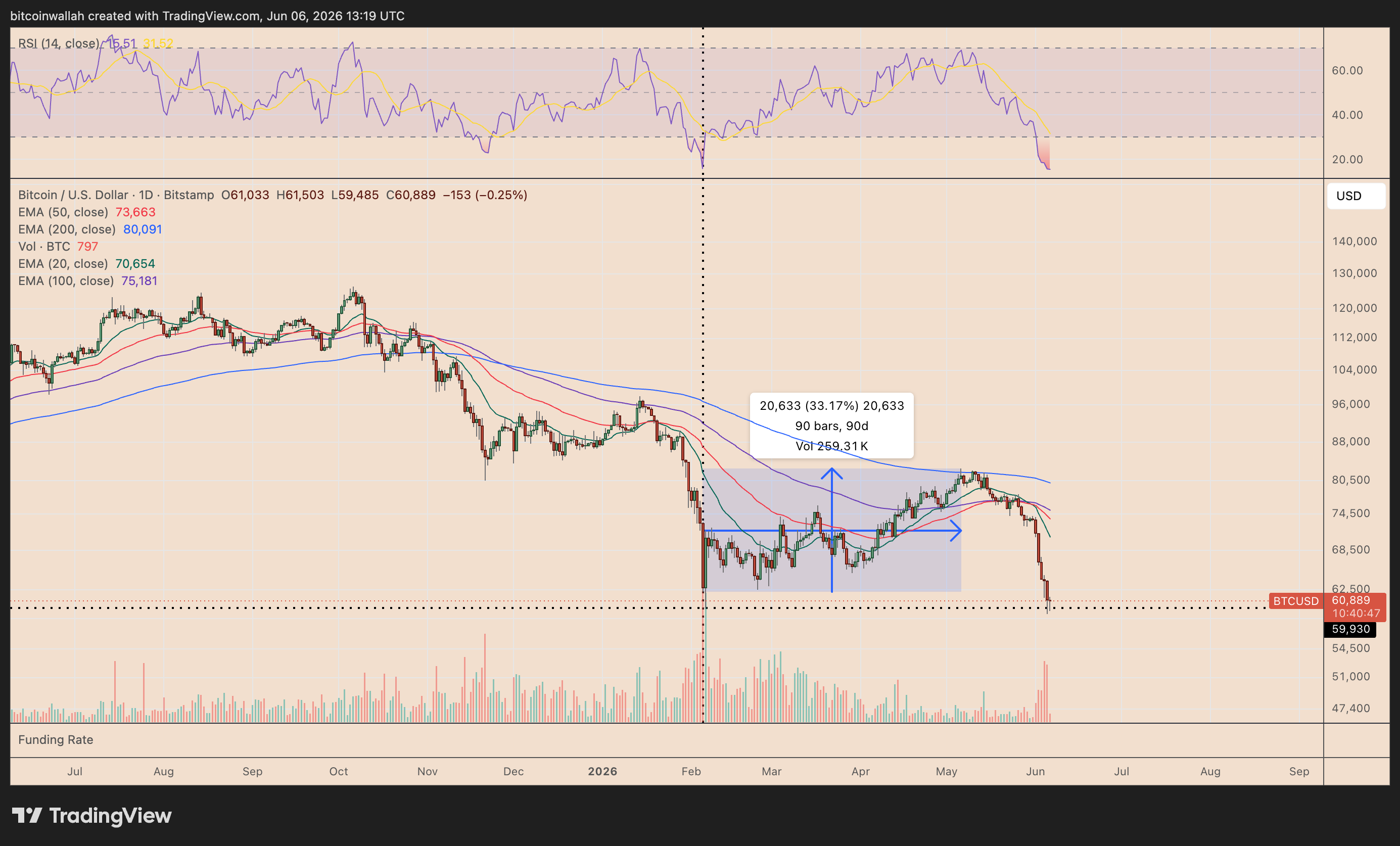
Conversely, a decisive break below the $60,000 support level would represent a significant bearish development. Such a breakdown would weaken the current rebound setup, potentially triggering further cascade selling and opening the door to a deeper price drop. In this scenario, analysts suggest that Bitcoin could look for an oversold bounce in the mid-$50,000s, possibly around the $55,000 to $58,000 range, which could serve as the next major support zone. A move to these levels would signify a more prolonged period of market consolidation or even a bearish trend continuation before any substantial recovery could materialize. The volatility inherent in the cryptocurrency market means that both rapid recoveries and swift declines remain distinct possibilities.
Broader Market Implications and Investor Outlook
Bitcoin’s price action invariably influences the broader cryptocurrency market. A significant rebound in BTC would likely pull altcoins along, leading to a wider market recovery. Conversely, a continued decline or breakdown below key support levels would exert further pressure on the altcoin market, which typically exhibits higher beta to Bitcoin. The current market conditions also present a mixed bag for institutional investors, particularly those involved with Bitcoin spot exchange-traded funds (ETFs). While a price dip might be seen as a buying opportunity for long-term strategic allocations, prolonged volatility could deter new institutional inflows, at least in the short term. However, the consistent defense of key levels and the on-chain data indicating capitulation might also be viewed as signals for smart money accumulation.
The regulatory environment also plays a role in shaping investor confidence. While there haven’t been recent major regulatory shifts directly tied to this price action, ongoing discussions in major economies regarding crypto regulations continue to add a layer of uncertainty that can influence market sentiment during volatile periods. Investors are advised to remain vigilant, conduct thorough independent research, and exercise caution in this highly dynamic market. The coming weeks will be crucial in determining whether the current oversold conditions indeed lead to a robust relief rebound or if the macroeconomic headwinds prove too strong for Bitcoin to overcome in the short term.
This article is produced in accordance with Cointelegraph’s Editorial Policy and is intended for informational purposes only. It does not constitute investment advice or recommendations. All investments and trades carry risk; readers are encouraged to conduct independent research.