Nila Kartika Wati
Ethereum is poised to take a significant step towards future-proofing its accounts against the looming threat of quantum computing, with a novel proposal suggesting the integration of post-quantum protections for as little as $0.07 per account. This groundbreaking initiative, championed by Nicolas Consigny, the project lead for the Ethereum Foundation’s Kohaku project, could enable users to fortify their digital assets without necessitating a complex and time-consuming network-wide hard fork. The proposed solution, dubbed "SPHINCS-", represents a strategic adaptation of SPHINCS+, a robust post-quantum signature standard developed by the US National Institute of Standards and Technology (NIST), engineered for enhanced efficiency within the Ethereum Virtual Machine (EVM) environment.
Consigny unveiled the details of this innovative approach in a recent X post, directing the community to an accompanying paper published on Ethresear.ch. The core objective of SPHINCS- is to dramatically reduce the on-chain verification costs associated with quantum-resistant cryptography, thereby making it economically viable for widespread adoption. Crucially, the design bypasses the need for a fundamental protocol change or the introduction of a new precompile, allowing for a more agile and immediate deployment pathway. Consigny envisions SPHINCS- not merely as a standalone solution, but as an essential stepping stone towards a more advanced, aggregated post-quantum signature system tentatively named "leanSPHINCS," which promises to further optimize verification costs. This proactive measure seeks to neutralize the long-term risk posed by quantum computing to Ethereum’s current Elliptic Curve Digital Signature Algorithm (ECDSA) with an accessible and cost-effective solution, potentially years before a dedicated hard fork for quantum resistance might otherwise be developed.
The Imminent Quantum Threat to Cryptography
The specter of quantum computing has been a growing concern within the cryptographic and blockchain communities for well over a decade. Quantum computers, leveraging principles of quantum mechanics such as superposition and entanglement, possess the theoretical capability to perform certain computations exponentially faster than classical computers. One of the most significant breakthroughs in this field, relevant to cryptography, is Shor’s algorithm. Developed by Peter Shor in 1994, this algorithm demonstrates that a sufficiently powerful quantum computer could efficiently factor large integers and solve the discrete logarithm problem, both of which are foundational to the security of public-key cryptography widely used today.
Current blockchain networks, including Ethereum and Bitcoin, rely heavily on ECDSA for securing transactions and verifying ownership. ECDSA’s security is predicated on the computational difficulty of solving the elliptic curve discrete logarithm problem. While classical computers find this problem intractable for large key sizes (e.g., 256 bits), Shor’s algorithm, if implemented on a sufficiently advanced quantum machine, could render ECDSA-based signatures vulnerable. This would allow an attacker to derive a private key from a public key, effectively compromising an account and enabling unauthorized transactions.
While a quantum computer capable of breaking 256-bit ECDSA keys does not yet exist, the scientific consensus suggests it is a matter of "when," not "if." The timeline for such a development varies widely among experts, ranging from a decade to several decades. However, the "harvest now, decrypt later" threat model adds urgency to the situation. In this scenario, malicious actors could collect encrypted data and public keys today, storing them until quantum computers become powerful enough to decrypt them, potentially compromising past and future transactions. This foresight necessitates proactive measures, making Consigny’s proposal particularly timely.
NIST’s Global Quest for Quantum-Resistant Standards
Recognizing the existential threat quantum computing poses to global digital security, the US National Institute of Standards and Technology (NIST) initiated a multi-year Post-Quantum Cryptography (PQC) Standardization Process in 2016. This ambitious global effort aimed to solicit, evaluate, and standardize new cryptographic algorithms that are resistant to attacks by quantum computers. The process involved several rounds of submissions, rigorous public scrutiny, and cryptanalysis by experts worldwide.
After years of meticulous evaluation, NIST announced its initial set of standardized PQC algorithms in July 2022, with subsequent selections in 2023. Among these chosen algorithms, SPHINCS+ stands out as a stateless hash-based signature scheme. Hash-based signatures, first proposed by Ralph Merkle in the late 1970s, derive their security from the properties of cryptographic hash functions, which are generally believed to be quantum-resistant. Unlike other PQC candidates that rely on lattice-based or code-based cryptography, hash-based signatures offer a different security paradigm, often with larger key and signature sizes but with strong, well-understood security guarantees.

SPHINCS+ was specifically selected for its robust security properties and stateless nature. "Stateless" means that the signer does not need to maintain any state information between signing operations, which is a crucial advantage for practical implementations, especially in distributed systems like blockchains. Stateful hash-based schemes, while often more compact, risk catastrophic security failures if the state is not meticulously managed (e.g., reusing a one-time signature key). SPHINCS+ overcomes this challenge, albeit often at the cost of larger signature sizes compared to traditional ECDSA. NIST’s selection of SPHINCS+ underscores its confidence in the scheme’s long-term viability and security against quantum adversaries.
SPHINCS- on Ethereum: An Innovative Implementation
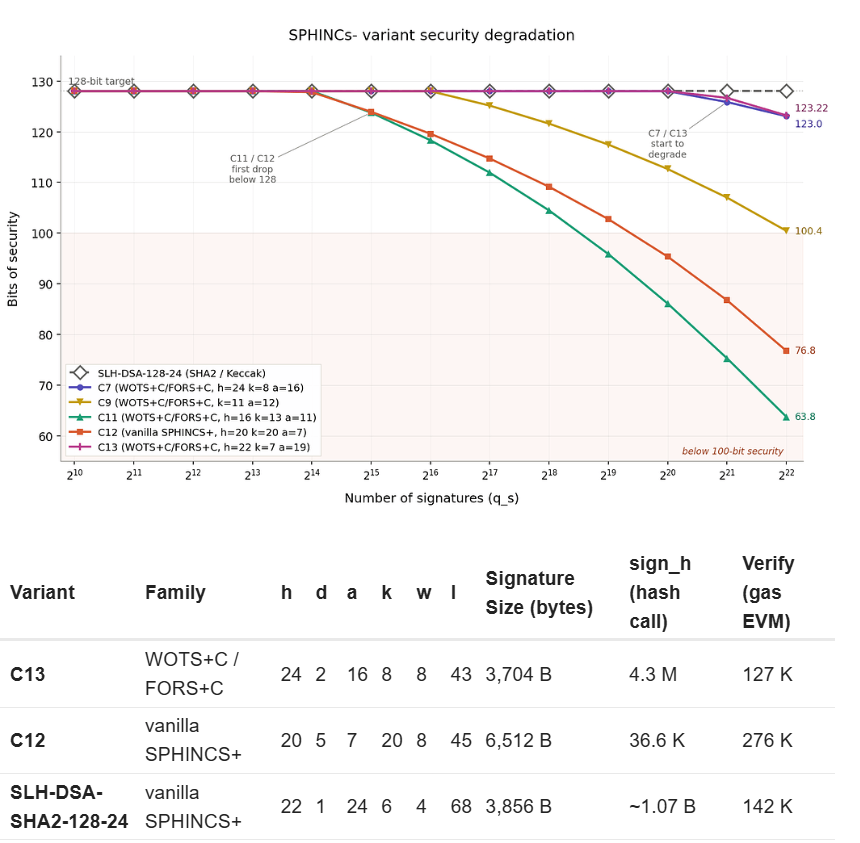
The "SPHINCS-" proposal by Nicolas Consigny addresses the practical challenges of integrating SPHINCS+ into the resource-constrained environment of the Ethereum Virtual Machine (EVM). While SPHINCS+ is robust, its larger signature sizes and more complex verification processes compared to ECDSA can translate into significantly higher gas costs on Ethereum, potentially rendering it impractical for everyday use. SPHINCS- is an optimized variant designed to mitigate these costs.
The core innovation lies in adapting the SPHINCS+ verification process to be more efficient for on-chain execution without compromising its quantum resistance. This involves careful selection of parameters and potentially streamlining certain verification steps that are particularly expensive in terms of EVM gas. The estimated cost of as little as $0.07 per account for adding post-quantum protection is a critical metric, making this security upgrade accessible to a broad user base. To put this into perspective, current transaction fees on Ethereum can vary widely, but an additional $0.07 for a significant security enhancement is remarkably low, especially considering the long-term value of protecting digital assets.
The fact that SPHINCS- can be deployed "without waiting for a hard fork" or requiring a "protocol change or precompile" is a game-changer. Typically, introducing new cryptographic primitives into a blockchain protocol requires a hard fork, a backward-incompatible upgrade that demands widespread consensus and coordination across the network. This process can be lengthy, contentious, and risky. By contrast, SPHINCS- is likely implemented as a smart contract solution or via account abstraction. This means users could opt-in to this protection by interacting with a specific smart contract that acts as a wrapper for their existing accounts or by upgrading their account logic, allowing for a flexible and permissionless rollout. This agility is vital in the race against quantum advancements.
Consigny’s vision extends beyond SPHINCS-, pointing towards "leanSPHINCS" as the next evolutionary step. LeanSPHINCS aims to further reduce verification costs, likely through aggregation techniques. In an aggregated signature scheme, multiple individual signatures can be verified together more efficiently than verifying each one separately. This could be particularly beneficial for batch transactions or for applications where numerous users might adopt post-quantum protections, leading to even greater scalability and cost efficiency.
The Urgency Underscored by Recent Breakthroughs and Vulnerability Analyses
The theoretical threat of quantum computing has been punctuated by recent practical demonstrations that, while not immediately threatening current blockchain security, serve as powerful proofs of concept. In April, researcher Giancarlo Lelli, sponsored by post-quantum startup Project Eleven, successfully used a quantum computer to break a 15-bit elliptic-curve key. This achievement involved deriving the private key from its public counterpart using a variant of Shor’s algorithm. While Bitcoin and Ethereum keys are 256 bits long—vastly more complex than Lelli’s 15-bit key—his work unequivocally demonstrates the algorithm’s practical applicability in a quantum environment, albeit on a much smaller scale. It highlights the principle that once a quantum computer reaches sufficient scale and error correction capabilities, current cryptographic standards will be fundamentally compromised.
This practical demonstration coincides with ongoing analyses by blockchain analytics firms regarding the vulnerability of existing cryptocurrency supplies. Glassnode, for instance, published a report indicating that approximately 1.92 million Bitcoin, constituting nearly 10% of the total supply, are "structurally unsafe" in a future quantum attack scenario. This category primarily includes Bitcoin held in addresses whose public keys have been revealed on-chain (e.g., through transactions) but have not yet been spent. An attacker with a quantum computer could potentially use Shor’s algorithm to derive the private keys for these addresses from their public keys.
Furthermore, Glassnode classified another 4.12 million BTC, or 20.6% of the total supply, as "operationally unsafe" due to certain key or address management practices. This category might include funds held in multi-signature wallets with weak security configurations or those managed with less robust key generation and storage practices that could introduce other vulnerabilities. The combined "unsafe" categories highlight a substantial portion of the Bitcoin supply potentially at risk.
In contrast, Glassnode estimated that the remaining 69.8% of the Bitcoin supply, or 13.99 million BTC, remains unexposed to a quantum computing threat. This portion likely resides in unspent transaction outputs (UTXOs) where only the hash of the public key has been revealed, making it significantly harder for quantum algorithms to derive the private key without the full public key. This estimate aligns broadly with Ark Invest’s March assessment, which suggested that around 65% of the Bitcoin supply was safe. These figures underscore the critical need for post-quantum migration strategies across the entire cryptocurrency ecosystem. Ethereum, with its account-based model, faces similar, if not more complex, challenges in securing existing accounts.
Broader Implications for Blockchain Security and Trust
The introduction of SPHINCS- on Ethereum carries profound implications for the future of blockchain security and trust. By offering an accessible and non-disruptive path to quantum resistance, Ethereum positions itself as a leader in proactive security measures within the decentralized space. This move could significantly enhance the network’s long-term resilience and reinforce user confidence in the face of evolving technological threats.
The ability to deploy PQC without a hard fork also demonstrates the flexibility and extensibility of the Ethereum architecture, particularly through smart contracts and emerging concepts like account abstraction. Account abstraction allows for greater programmability of user accounts, enabling features like custom signature schemes (including PQC), multi-factor authentication, and gas sponsorship. SPHINCS- could leverage these advancements to offer users an upgrade path without requiring core protocol changes.
For the broader blockchain industry, Ethereum’s approach serves as a valuable case study. The "quantum migration" is a challenge that all major cryptocurrencies and decentralized applications must eventually address. While Bitcoin’s community is also actively discussing quantum resistance, often focusing on new address formats or protocol upgrades, Ethereum’s ability to offer a user-initiated, application-layer solution could inspire similar innovations across other chains. The cost-efficiency of SPHINCS- is a crucial factor, as high transaction fees for security upgrades could deter mass adoption.
Moreover, safeguarding against quantum attacks is not just a technical imperative but also a matter of economic stability and trust. A successful quantum attack on a major blockchain could trigger a crisis of confidence, devaluing digital assets and undermining the very foundation of decentralized finance. By investing in and implementing PQC solutions now, foundations like Ethereum are acting as custodians of future digital wealth, ensuring the longevity and integrity of the ecosystem. This proactive stance reflects a mature understanding of potential risks and a commitment to robust, forward-looking security architectures.
The Road Ahead: Adoption, Evolution, and Continuous Vigilance
While the SPHINCS- proposal marks a significant milestone, its journey from paper to widespread adoption involves several critical steps. Further research, peer review by the broader cryptographic and Ethereum communities, and rigorous testing will be essential to validate its security and efficiency. Developers will need to build user-friendly interfaces and wallet integrations that simplify the process for users to upgrade their accounts with post-quantum protections. This might involve new wallet standards, smart contract updates for existing DeFi protocols, or educational campaigns to inform users about the importance and availability of these new security features.
The evolution of quantum computing itself will also necessitate continuous vigilance. As quantum machines become more powerful and sophisticated, so too must cryptographic defenses adapt. The transition from SPHINCS- to leanSPHINCS, with its promise of further cost reductions through aggregation, exemplifies this ongoing evolutionary process. The collaboration between academic researchers, cryptographic experts, and blockchain developers will remain vital in identifying new threats and developing innovative countermeasures.
In conclusion, Nicolas Consigny’s proposal for SPHINCS- on Ethereum represents a forward-thinking and pragmatic approach to addressing one of the most significant long-term threats to digital assets. By offering a cost-effective, non-disruptive method for users to adopt quantum-resistant cryptography, Ethereum is not only securing its own future but also setting a precedent for the broader blockchain industry. This initiative underscores the importance of proactive security measures and continuous innovation in an ever-evolving technological landscape, ensuring that the promise of decentralized finance remains resilient against the challenges of tomorrow.