James Watt
The decentralized governance model, once hailed as the ultimate democratic evolution of corporate and protocol management, faced a transformative crisis in mid-2024 that exposed fundamental structural vulnerabilities. At the heart of this shift was Compound Finance, a pioneering crypto lending protocol governed by a decentralized autonomous organization (DAO). In July 2024, the protocol narrowly avoided what critics described as a "treasury raid," an event that has since prompted intensive academic scrutiny and a re-evaluation of how digital "republics" manage their assets. While the software performed exactly as coded, the outcome revealed that the security rules designed to protect the protocol had inadvertently created a path for a small group of determined actors to seize control of millions of dollars in community funds.
The incident centered on Proposal 289, a governance measure that requested the transfer of 499,000 COMP tokens—valued at approximately $24 million at the time—into a yield-bearing "GoldComp" vault controlled by a small group of voters. This group, often referred to in governance forums as the "Golden Boys" and led by an entity known as Humpy, had attempted similar measures twice before. Proposals 279 and 281 had failed to gain traction, but the third attempt utilized a sophisticated strategy of incremental token accumulation and last-minute voting maneuvers that nearly bypassed the community’s defenses.
The Chronology of a Governance Siege
The attempt to divert Compound’s treasury was not a sudden strike but a calculated four-month campaign. Between March and July 2024, wallets associated with the proponents of Proposal 289 began aggressively accumulating COMP tokens. Analysis by blockchain researchers later revealed that these addresses held a mere 853 COMP tokens before the campaign began. Over the ensuing months, they built a position of more than 682,000 COMP.
The acquisition strategy was multi-pronged. Researchers from the Max Planck Institute for Software Systems and Vrije Universiteit Amsterdam traced 563,790 tokens through four major centralized exchanges. Furthermore, the group utilized the protocol’s own utility against it, borrowing an additional 118,089 COMP through Compound’s lending markets to bolster their voting weight. This "leveraged governance" approach allowed the group to maximize their influence without necessarily owning the underlying assets outright in a traditional sense.
The climax occurred in the final minutes of the voting period for Proposal 289. For much of the duration, the measure appeared destined for defeat, consistent with the previous versions. However, in the final 34 minutes of the window, supporting addresses cast a staggering 563,591 votes, representing 82% of the total support for the proposal. The final decisive block of votes was submitted just eight minutes before the deadline. When the tally closed, the measure passed with 682,191 votes in favor and 633,636 against.
The community was left in a state of shock. Because the DAO’s governance was "trustless" and automated, the passing of the vote triggered a timelock that would automatically execute the transfer of funds. At that time, Compound lacked a formal emergency mechanism or a "veto" role that could pause the execution of a legally passed, yet controversial, vote.
Academic Retrospective The Illusion of Broad Participation
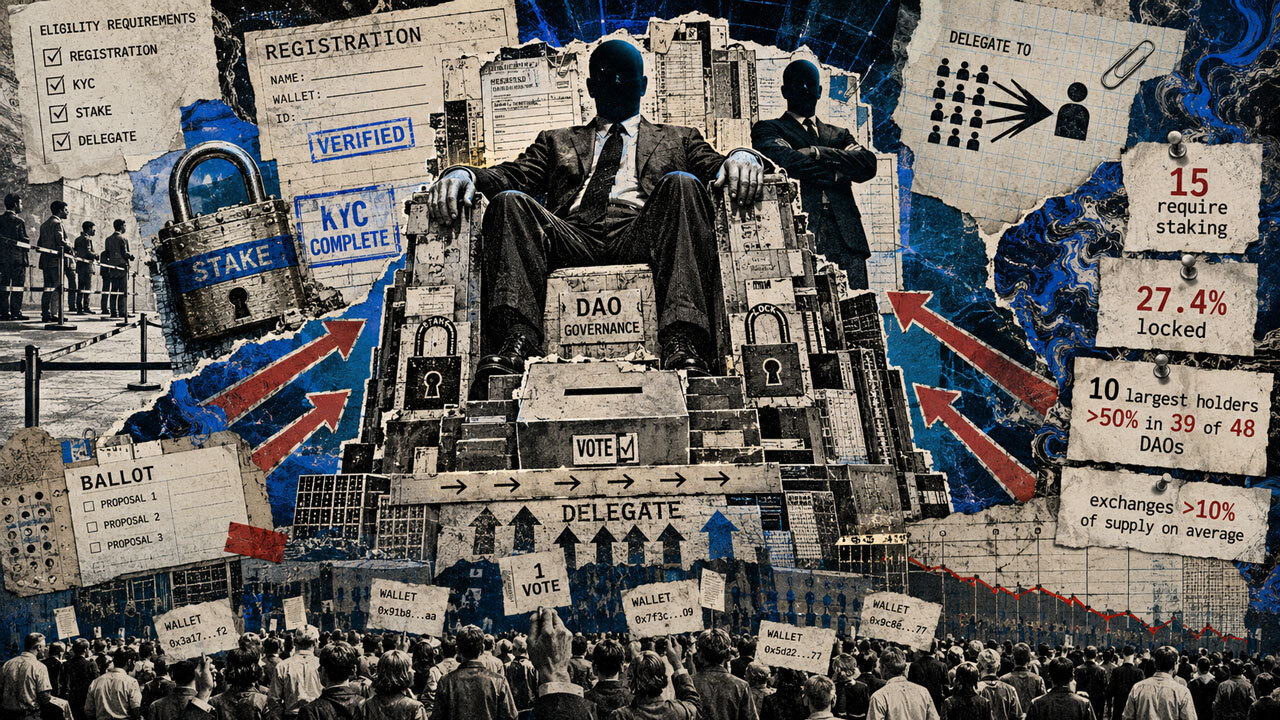
The Compound incident served as a primary case study for two 2026 research papers that mapped the governance landscapes of 48 major Ethereum-based DAOs. These studies, conducted by the Max Planck Institute for Software Systems and Vrije Universiteit Amsterdam, concluded that the very mechanisms intended to secure these protocols often result in a "velvet rope" effect, where participation is restricted to a wealthy or highly technical elite.
The researchers identified three primary "gates" that govern participation: registration, staking, and delegation. While these gates are designed to prevent spam and malicious code injections, they also concentrate power. For instance, across the 36 DAOs that required some form of wallet registration, the average registered share of the total token supply was only 21%. This means that in the typical DAO, the "active electorate" represents barely one-fifth of the total stakeholder base.
The studies found that much of the remaining supply is held by intermediaries. Centralized exchanges (CEXs) held more than 10% of outstanding tokens on average, while DeFi contracts held another 3.5%. In 14 of the DAOs studied, these intermediary wallets controlled more voting power than the entire registered electorate combined. This creates a significant custody dilemma: an exchange wallet represents the collective assets of thousands of retail users, yet the blockchain sees only one address with a massive balance. If an exchange chooses to vote, it becomes a political titan; if it abstains, it disenfranchises its entire customer base.
The Concentration of Voting Power Through Staking and Services
Staking was another mechanism analyzed for its impact on power dynamics. By requiring users to lock their tokens for a set period to gain voting rights, DAOs aim to ensure that voters have "skin in the game" and are financially exposed to the long-term consequences of their decisions. However, this creates a prerequisite of liquid wealth.
To bypass the inconvenience of long lock-up periods, the market developed liquid staking and yield-optimizing services. These platforms, such as Convex, Aura, and StakeDAO, allow users to deposit their tokens in exchange for tradable substitutes while the service retains the original voting rights. The researchers’ data highlighted an extreme concentration of power within these services:
- Curve: Convex controls 53% of the voting power, despite a maximum native lock of four years.
- Frax: Convex controls 46% of the voting power.
- Angle: StakeDAO controls 57% of the voting power.
- Balancer: Aura controls 65% of the voting power.
In these ecosystems, the "decentralized" protocol is effectively governed by a secondary protocol, which itself may have concentrated governance. This layers of abstraction further distance the average token holder from the decision-making process.
Defining the Governance Attack
The second paper from the 2026 study introduced a critical distinction between a "hack" and a "governance attack." A hack involves exploiting a bug in the code; a governance attack involves using the authorized, valid rules of the system to achieve an outcome that harms the organization.
Of the 28 DAO incidents reviewed by the researchers, 16 were classified as attacks that could have been prevented by better mechanism design. Ten of these involved the acquisition or borrowing of tokens specifically to swing a vote. The Compound case was the most prominent example of a "legal" raid. The attackers did not break any rules; they simply exploited the lack of a "speed bump" in the voting process.
The researchers noted that Compound, along with seven other major DAOs—including Uniswap, Radicle, Gitcoin, Silo, Ampleforth, Hop, and Cryptex—shared a specific vulnerability in 2024: exposure to late-stage vote accumulation without the ability to extend the voting window or trigger a manual review.
Settlement and the Evolution of the Veto
The resolution of the Compound crisis came not through code, but through traditional negotiation. Following the controversial vote, the Compound community and the "Golden Boys" group reached a settlement. The group agreed to cancel the $24 million allocation in exchange for the introduction of a new staking product that provided a more legitimate path for COMP holders to earn yield.
More importantly, the incident forced a structural change in Compound’s governance. The protocol added a "veto" role, effectively placing a human-controlled brake on a system that was previously entirely automated. This move, while criticized by decentralization purists, was seen as a necessary defense against the "tyranny of the minority" who could mobilize large amounts of capital for short-term gain.
The broader impact of this event has been a shift in how DAOs are audited. Experts now argue that a "smart contract audit"—which checks for bugs in the code—is insufficient. Protocols now require "constitutional audits" to determine where the actual authority lies. Such an audit examines how much of the supply can realistically vote, how much power is held by intermediaries, and what emergency powers exist to prevent a treasury raid.
Implications for the Future of Decentralized Governance
The lessons of 2024 and the subsequent academic findings suggest that decentralization is not a binary state but a spectrum that requires constant management. The "one token, one vote" ideal is frequently subverted by the realities of capital concentration and the technical barriers to participation.
For the industry to move forward, the research suggests several potential remedies. These include "sliding scale" voting windows that extend automatically if a large number of votes are cast near a deadline, or the implementation of "optimistic governance," where proposals are assumed to pass unless a certain threshold of "no" votes or a veto is triggered.
Ultimately, the Compound Proposal 289 incident served as a wake-up call for the DeFi sector. It demonstrated that in the absence of robust checks and balances, the software will faithfully execute the will of whoever controls the most tokens at the most critical moment, regardless of the long-term health of the protocol. As DAOs continue to manage billions of dollars in assets, the focus has shifted from writing perfect code to designing resilient political systems that can withstand the pressures of both external markets and internal power struggles.