James Watt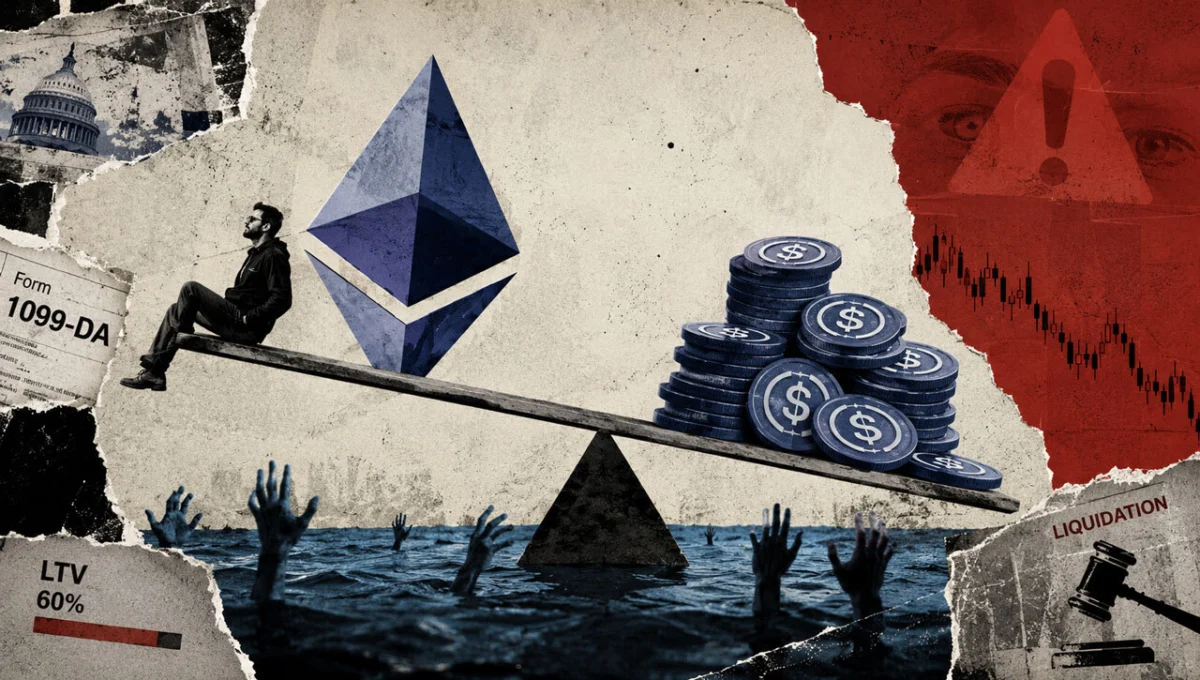
The intersection of tax strategy and decentralized finance (DeFi) has created a complex web of hidden credit risks that automated protocols are currently ill-equipped to measure. In a recent working paper titled "Tax Planning and DeFi Credit Risk," researchers Lisa De Simone of the University of Texas at Austin, along with Peiyi Jin and Daniel Rabetti of the National University of Singapore, explored how the desire to defer capital gains taxes influences borrower behavior on the blockchain. Their findings suggest that the same tax-minimization strategies used by the ultra-wealthy in traditional finance are being replicated in DeFi, often at the expense of protocol stability and systemic liquidity.
Under current United States tax treatment, digital assets are classified as property. When an investor sells an asset like Ethereum (ETH) for a profit, they trigger a taxable event based on the realized gain. For instance, an investor who purchased ETH at $1,000 and sees its value rise to $4,000 would face a significant tax bill upon selling. Specifically, selling $1,000 worth of that ETH (one-quarter of a token) would result in a $750 realized gain. To avoid this, many participants turn to DeFi lending protocols to unlock liquidity without triggering a sale.
The DeFi Adaptation of Buy, Borrow, Die
In traditional finance, high-net-worth individuals often utilize a strategy known as "buy, borrow, die." This involves holding onto appreciating assets, borrowing against them to fund a lifestyle or further investments, and eventually passing the assets to heirs, who receive a "step-up" in basis that effectively eliminates the accumulated capital gains tax.
DeFi has democratized this strategy by replacing the private bank with smart contracts. Protocols like Venus, Aave, and Compound allow users to deposit crypto assets as collateral and borrow stablecoins—tokens pegged to the value of the U.S. dollar—against them. This mechanism provides several immediate benefits to the borrower:
- Tax Deferral: Because a loan is not considered income, the borrower receives spendable capital without a taxable event.
- Price Exposure: The borrower retains full exposure to the underlying asset. If the collateral continues to rise in value, the borrower captures that upside.
- Permissionless Access: Unlike a bank, a smart contract does not require credit checks or income verification. It only requires that the value of the collateral exceeds the value of the debt.
However, this strategy introduces a "fragile math problem." While the borrower avoids a tax bill, they take on debt, interest, and the constant risk of liquidation. If the value of the collateral drops significantly, the loan-to-value (LTV) ratio increases. Once it crosses a predefined threshold, the protocol’s code allows external liquidators to repay the debt and claim the collateral at a discount, often resulting in a permanent loss for the original borrower.
Chronology of the Infrastructure Act and the Shift in Behavior
The research paper centers its analysis on a pivotal moment in U.S. regulatory history: the enactment of the Infrastructure Investment and Jobs Act on November 15, 2021. Section 80603 of this law expanded information-reporting requirements for brokers handling digital assets. While the actual implementation of these rules—such as the issuance of Form 1099-DA—was scheduled for years later (starting in 2025 and 2026), the mere passage of the law changed the expectations of U.S. taxpayers.
The researchers used this event to conduct a natural experiment. By comparing the behavior of likely U.S.-based wallets with international wallets before and after the law’s enactment, they could isolate the impact of tax-motivated decision-making.
The study focused on the Venus Protocol, a leading DeFi lending platform on the BNB Smart Chain. The sample period ran from November 12, 2020, through July 31, 2022, covering the 15 largest tokens on the platform. This window captured both the exuberant bull market of 2021 and the subsequent "crypto winter" of 2022, providing a comprehensive look at how tax incentives interact with market volatility.
Analyzing the Data: Tax Lock-in and Protocol Risk
The researchers analyzed approximately 13 million transactions, which were distilled into 1.36 million daily borrower observations. To identify U.S.-linked wallets in the pseudonymized environment of the blockchain, the team looked for activity patterns consistent with U.S. business hours, inactivity during U.S.-specific holidays (such as Thanksgiving), and the holding of U.S.-regulated stablecoins like USDC.
The data revealed a stark contrast in behavior following the passage of the Infrastructure Act. Likely U.S. borrowers became 24.5% less likely to trade their assets compared to their international counterparts. For those who had borrowed stablecoins against their crypto, the decline in activity was even more pronounced, dropping an additional 23%.
This phenomenon is known as "tax lock-in." Borrowers who are sitting on large paper gains are incentivized to hold their positions longer to reach the one-year mark required for lower long-term capital gains rates. Alternatively, they may simply wish to defer the tax hit into a future year. The study found that this behavior intensified during the final week of December, a period typically associated with tax-loss harvesting or gain-deferral strategies.
While tax lock-in may be beneficial for the individual’s bank account, it creates a "blind spot" for the lending protocol. The smart contract can see the current price of ETH and the size of the debt, but it cannot see the borrower’s entry price or their tax motivation. Consequently, two wallets with identical LTV ratios may have vastly different risk profiles. One owner may be willing to sell to protect their position, while the other—fearful of a massive tax bill—may remain paralyzed as their LTV ratio climbs toward the danger zone.
The Cost of Inactivity: Defaults and Bad Debt
The study’s most significant finding is the correlation between tax-induced illiquidity and credit default. In the context of DeFi, a default is not a missed monthly payment but rather a failure to maintain a healthy collateral ratio. The researchers defined a default as a loan remaining above the 60% LTV limit for at least seven days without the borrower adding more collateral or repaying the debt.
Using an instrumental-variable design to isolate tax-motivated behavior, the researchers estimated that:
- A 1% increase in tax-induced "illiquidity" (inactivity) was associated with an 11.2% increase in the number of defaulted accounts.
- The same 1% increase led to a 39.6% increase in the total value of defaulted loans.
- On average, tax-sensitive U.S. borrowers deferred roughly $3,357 in capital gains tax annually, which represented about 17% of their trading portfolios during the period.
When a borrower remains inactive while their collateral value falls, they pass the risk onto the protocol. If a liquidation event occurs during a period of extreme market volatility or network congestion, the liquidator may not be able to sell the collateral fast enough to cover the debt. This results in "bad debt," where the protocol’s liabilities exceed its assets. These losses must then be absorbed by the protocol’s reserves, its governance token holders, or the lenders who supplied the assets to the pool in the first place.
Broader Impact and Regulatory Implications
The findings of De Simone, Jin, and Rabetti have profound implications for the future of DeFi and the regulation of digital assets. The research suggests that tax policy does not exist in a vacuum; it directly influences the stability of financial markets, even those that operate entirely on-chain.
For DeFi developers, the study highlights the limitations of purely price-based risk models. Currently, protocols like Venus and Aave manage risk by adjusting LTV limits and interest rates based on market volatility and liquidity. However, they do not account for the "human" element of tax incentives. If a large portion of a protocol’s collateral is "tax-locked," the system is more fragile than the raw LTV numbers suggest. Future iterations of DeFi protocols may need to incorporate more sophisticated risk parameters or "stability fees" that account for the holding period of collateral.
From a regulatory perspective, the study provides a nuanced view of the IRS’s efforts to increase transparency. While the goal of the Infrastructure Act was to improve tax compliance and revenue collection, the "announcement effect" of the law appears to have inadvertently increased credit risk within the DeFi ecosystem by discouraging the proactive management of risky positions.
Conclusion: The Persistence of Human Motives in Code
Decentralized finance was built on the promise of removing human bias and institutional gatekeepers through automated code. However, as this research demonstrates, the motives of the people using the code—specifically the desire to minimize tax liabilities—continue to drive market outcomes.
The "buy, borrow, die" strategy, once reserved for the clients of elite private banks, is now a foundational component of the DeFi credit market. But because the blockchain is transparent and permissionless, the risks associated with this strategy are no longer hidden behind bank vault doors; they are part of a shared, public credit market. When a borrower chooses to defer a tax payment by holding a failing position, they are not just making a personal financial decision; they are contributing to a systemic risk that everyone in the lending pool shares.
As the DeFi sector matures and integrates further with traditional financial systems, understanding these "tax-induced" behaviors will be critical for both investors looking to protect their capital and regulators seeking to maintain the integrity of the broader financial landscape. The code may be automated, but the economic incentives that govern it remain as human as ever.