James Watt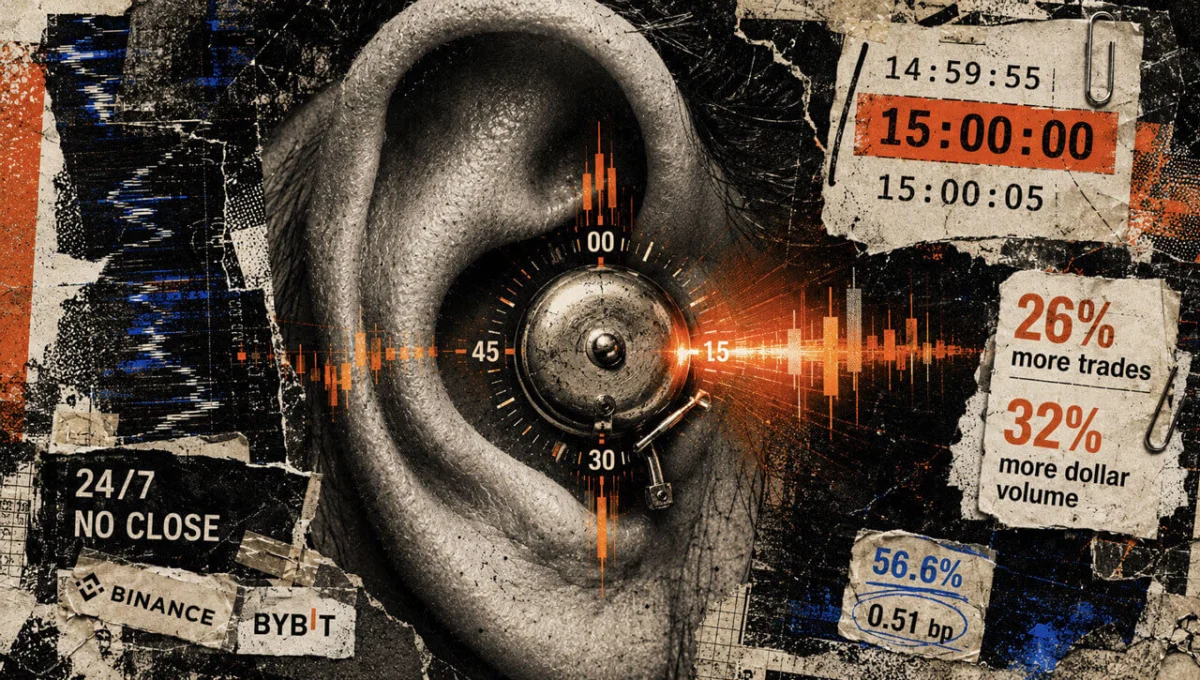
The global cryptocurrency market is often celebrated for its 24/7, borderless, and continuous nature, operating without the traditional opening and closing bells that define the New York Stock Exchange or the London Stock Exchange. However, a landmark study has revealed that the digital asset landscape has developed its own internal "heartbeat"—a recurring pulse of high-intensity trading activity that triggers every 15 minutes. This phenomenon, driven by the rigid synchronization of algorithmic trading software, effectively carves the continuous crypto market into thousands of micro-sessions, creating brief windows of heightened volatility and volume that resemble the "opening bell" of a traditional equity exchange.
The Ghost in the Machine: Defining the 15-Minute Pulse
At precisely 14:59:59 UTC, the market for Bitcoin perpetual futures operates with the standard flickering of orders and price adjustments common to any electronic exchange. Yet, as the clock strikes 15:00:00, the environment undergoes a radical transformation. For the ensuing ten seconds, trade frequency spikes, dollar volume surges, and price ranges expand significantly. This surge occurs without any fundamental news or external catalysts.
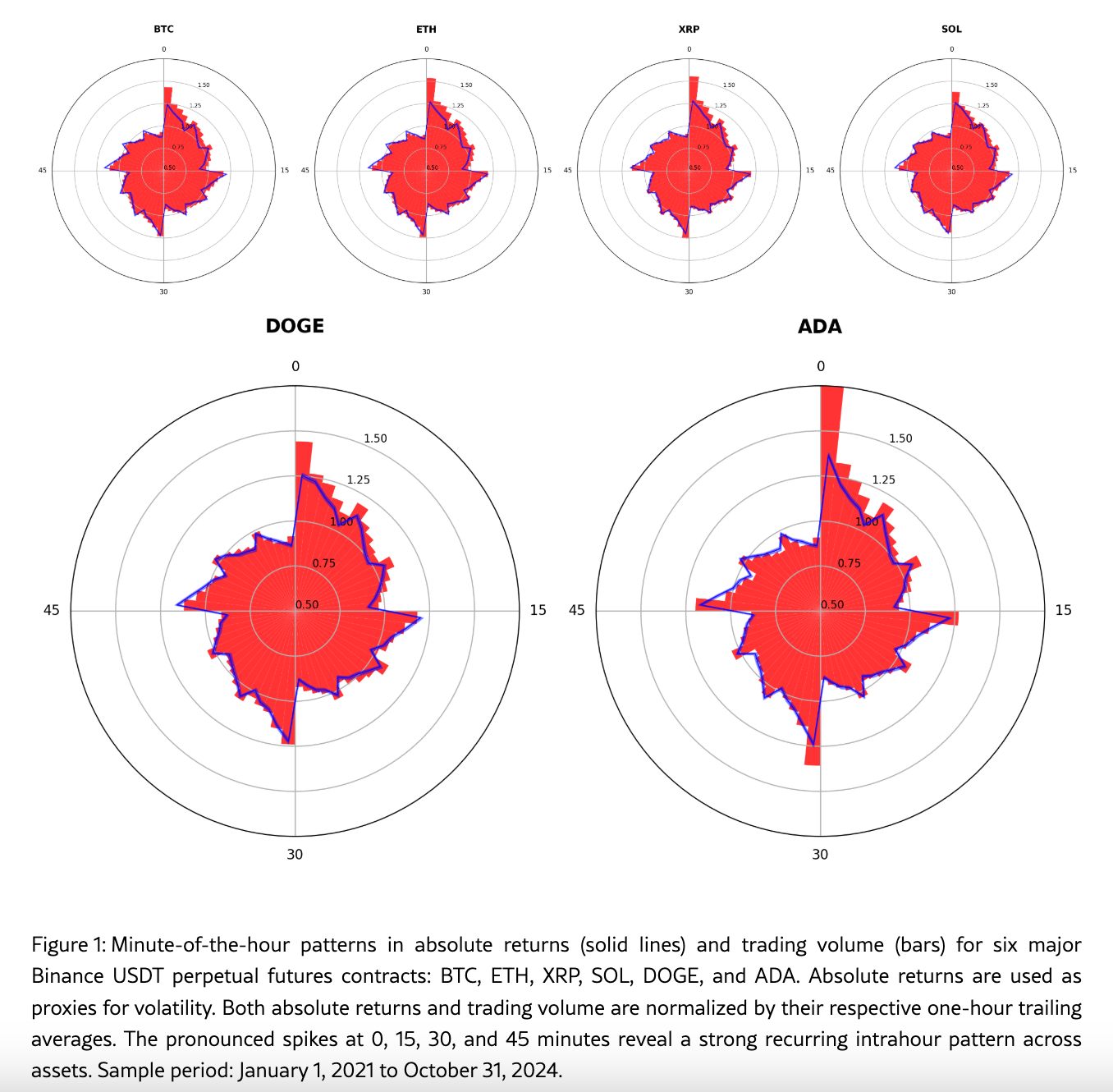
Research conducted by Chan Kim, a policy researcher from South Korea, and Peter Reinhard Hansen of the University of North Carolina, has meticulously documented this pattern. Their study, titled "The 15-Minute Pulse in Crypto Futures," analyzed six major Binance futures markets—Bitcoin (BTC), Ethereum (ETH), XRP, Solana (SOL), Dogecoin (DOGE), and Cardano (ADA)—over a period spanning January 1, 2021, to October 31, 2024. Across 1,400 days of nonstop trading, the researchers found that this "pulse" returns with mechanical regularity at the start of every hour and at the 15, 30, and 45-minute marks.
While smaller bursts are detectable at five-minute boundaries and the start of every minute, the most significant activity is concentrated at the top of the hour and the quarter-hour intervals. This suggests that the software infrastructure used by global traders has imposed a discrete structure onto a continuous market.
The Dominance of Perpetual Futures
To understand the impact of this 15-minute cycle, one must understand the vehicle through which it manifests: the perpetual future, or "perp." Unlike traditional futures contracts, which have a set expiration date (such as the end of a quarter), perpetual futures have no expiry. Traders can maintain their positions indefinitely, provided they have sufficient collateral.
The price of a perp is kept in alignment with the underlying spot market through a mechanism known as the "funding rate." When the perp price is higher than the spot price, those in "long" positions pay a fee to those in "short" positions. Conversely, if the perp trades below the spot price, shorts pay longs. These payments typically occur every eight hours, but the calculation of the rate is often continuous or based on snapshots taken at specific intervals.
Perpetual futures now account for the vast majority of crypto trading volume, often dwarfing spot market activity. Because perp prices serve as a primary reference for arbitrageurs, hedgers, and market makers, the volatility generated during these 15-minute bursts inevitably spills over into the spot markets, affecting the price of Bitcoin and other assets for every participant in the ecosystem.
Quantifying the Burst: Volume and Volatility Data
The data provided by Kim and Hansen illustrates a "star-shaped" pattern when trading volume and price movements are mapped onto a circular 60-minute clock. The four points of the star represent the 0, 15, 30, and 45-minute marks.
Key findings from the study include:
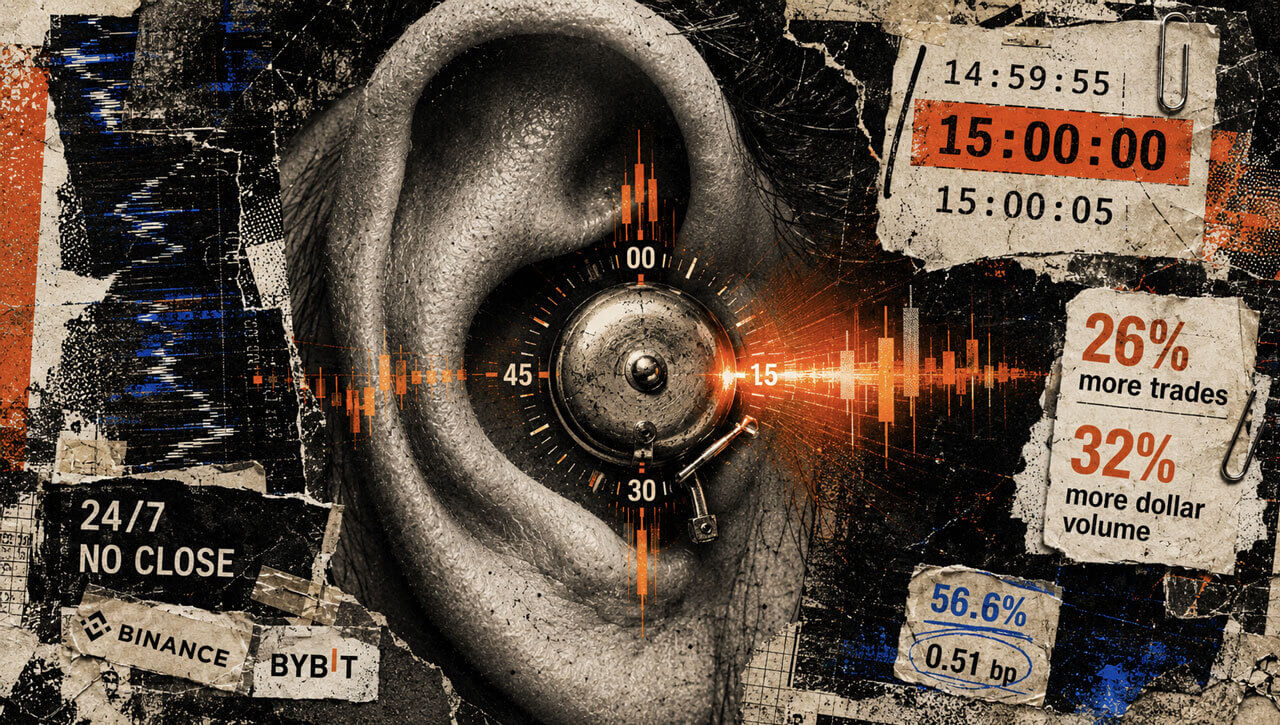
- Trade Frequency: During the first ten seconds of a quarter-hour interval, the number of completed trades increases by an average of 26% compared to an ordinary ten-second window.
- Dollar Volume: The dollar value of assets traded during these windows jumps by 32%.
- Absolute Returns: Price movement—measured as absolute return to capture volatility in both directions—is 26% larger during the pulse.
The consistency of this pattern across different assets is perhaps the most striking revelation. Bitcoin, the market leader, averaged $14.58 billion in daily contract volume during the sample period. Cardano, with a much smaller market footprint, averaged roughly $544 million. Despite the massive disparity in liquidity and market cap, both assets followed the exact same 15-minute rhythm, indicating that the behavior is a function of the trading environment rather than the specific asset.
The Algorithmic Fingerprint: Round Numbers vs. Machine Precision
A central challenge in market analysis is distinguishing between human traders and automated systems. Kim and Hansen utilized a "behavioral fingerprint" based on the precision of trade sizes to solve this.
Human psychology favors "round numbers." A retail trader is likely to buy 0.5 BTC or $5,000 worth of Solana. In contrast, algorithms execute trades based on complex formulas involving volatility, available margin, and execution slices. These calculations frequently result in highly specific, non-round quantities (e.g., 0.1034291 BTC).
By analyzing the prevalence of "trailing zeros" in trade sizes, the researchers discovered that the proportion of round-number trades drops significantly during the 15-minute pulses. The decline in round-number frequency was most pronounced at the top of the hour, where the "machine participation" effect was five times stronger than during an ordinary minute. This suggests that the 15-minute heartbeat is almost entirely an algorithmic phenomenon, triggered by automated strategies reacting to the close of a "time candle."
Why the 15-Minute Mark?
The reliance on 15-minute intervals is a byproduct of how data is visualized and processed in the financial industry. Most trading platforms and APIs (Application Programming Interfaces) aggregate price data into "candles" representing specific timeframes—commonly one minute, five minutes, 15 minutes, one hour, and one day.
When a 15-minute candle closes, several things happen simultaneously:
- Technical Indicators Reset: Moving averages, Relative Strength Index (RSI) levels, and Bollinger Bands are recalculated based on the new closing price.
- Automated Strategy Execution: Many "bot" strategies are programmed to execute trades only upon the confirmation of a candle close to avoid "fakeouts" during the formation of the candle.
- Execution Algos: Large institutional orders are often broken into smaller "slices" to minimize market impact. These slices are frequently scheduled to be released at the start of new time intervals.
- Market Maker Adjustments: Liquidity providers, anticipating a surge in volume at the quarter-hour, may adjust their quotes or spreads to account for the expected flow.
This creates a feedback loop. Because everyone knows the machines will move at the 15-minute mark, faster "latency-sensitive" systems attempt to front-run that activity, further intensifying the burst of volume in the first few seconds of the interval.
The Profitability Paradox
While the 15-minute pulse is statistically significant and highly predictable, it does not necessarily offer a "get rich quick" scheme for the average trader. The researchers developed a rolling forecast model to see if they could predict the direction of the price move during the ten-second burst.
The model was successful in a statistical sense, predicting the correct direction 56.6% of the time—a figure well above the 50% threshold of a random guess. However, the magnitude of the predicted move was exceptionally small, averaging just 0.51 basis points (0.0051%) per trade.
To put this in perspective:
- Gross Return: $0.51 on a $10,000 trade.
- Binance Taker Fee: Roughly $5.00 on a $10,000 trade (at the 5 basis point level).
For the retail trader, the cost of executing the trade is nearly ten times higher than the expected gross return. This explains why the pattern persists: if it were highly profitable after fees, arbitrageurs would trade it until the price movement was smoothed out. As it stands, the "alpha" or profit potential is swallowed by the exchange’s fee structure, leaving the pattern visible but unexploitable for most.
Broader Implications for Market Microstructure
The existence of the 15-minute heartbeat has significant implications for how we understand market stability and liquidity. For institutional players and market makers, these bursts represent periods of "toxic flow," where one-sided aggressive buying or selling can momentarily overwhelm the order book.
The study found that "order imbalance"—the difference between aggressive buying and selling—at the 15-minute mark has predictive power over longer horizons, specifically four to 12 hours. This suggests that the 15-minute pulse is not just "noise," but a moment where significant information is processed and baked into the price.
Furthermore, the research highlights a vulnerability in the decentralized ideal of crypto. While the markets never close, the heavy reliance on a few centralized exchanges (like Binance) and a few standardized software defaults has created a synchronized "opening bell" effect. If a major glitch were to occur at the top of an hour when algorithmic participation is at its peak, the resulting volatility could trigger a cascade of liquidations.
Conclusion: The New Clockwork of Finance
The 15-minute pulse in crypto perpetual futures serves as a powerful reminder that even in a world of decentralized assets and 24/7 trading, human-designed systems tend toward synchronization. By choosing 15 minutes as a standard interval for charts and data packets, developers have inadvertently hard-coded a rhythmic heartbeat into the global financial system.
As the crypto market continues to mature and integrate with traditional finance, these algorithmic patterns will likely become even more entrenched. For now, the "ghost in the machine" remains a fascinatng case study in market microstructure—a predictable, mechanical surge that proves that even in the most chaotic markets, there is a hidden, rhythmic order dictated by the clock.