Nila Kartika Wati
Liquid Network Faces $319 Million Bitcoin Drain Amid "White Hat" Claims
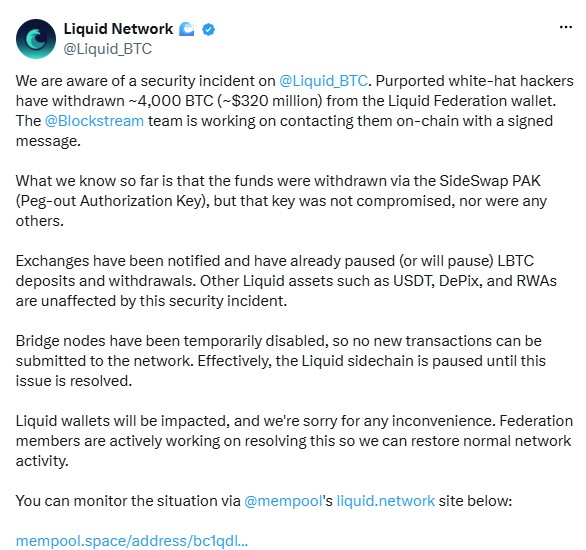
The Liquid Network, a prominent Bitcoin sidechain operated by Blockstream, has suffered a significant security incident resulting in the unauthorized withdrawal of nearly 4,000 Bitcoin (BTC), valued at approximately $319 million. The incident, which saw the network’s federation wallet balance plummet from 4,200 BTC to a mere 207.275 BTC, has been attributed by an unverified on-chain message to "white hat" hackers claiming responsibility. The message, embedded in an OP_RETURN transaction, simply stated: "we are whitehats. contact us on chain." This claim immediately sparked debate within the crypto community regarding the nature of the event – a security test gone public or a sophisticated theft disguised as ethical hacking.
Background of the Liquid Network
Launched by Blockstream in 2018, the Liquid Network serves as a Bitcoin sidechain designed to facilitate faster, more confidential, and institutional-grade transactions. Its primary function is to enable users to "peg-in" Bitcoin from the main blockchain, converting it into Liquid Bitcoin (LBTC), which can then be transacted on the sidechain with enhanced features like Confidential Transactions and faster settlement times. Conversely, "peg-out" allows LBTC to be burned on the sidechain, releasing the equivalent amount of native Bitcoin back to the main chain. This process relies on a federated network of functionaries, typically major exchanges and financial institutions, who collectively secure the funds through a multi-signature (multisig) scheme. Under normal operating conditions, a peg-out transaction requires authorization from at least 11 of the 15 federation members and typically involves sending funds to an approved whitelist of addresses to prevent unauthorized withdrawals.
Chronology of the Incident and Initial Response
The event unfolded rapidly, beginning with the substantial withdrawal of Bitcoin from the Liquid Network’s primary federation wallet. The Liquid explorer, a public tool for tracking sidechain activity, quickly reflected the drastic reduction in funds, alarming users and participants. Following the suspicious activity, Blockstream swiftly moved to mitigate further risk. The company announced the temporary disabling of bridge nodes, effectively pausing all new transactions on the Liquid sidechain. Furthermore, exchanges integrated with Liquid were advised to halt LBTC deposits and withdrawals, isolating the network while the Blockstream team initiated efforts to contact the purported attackers and identify the underlying security vulnerabilities.
In an official statement released shortly after the incident, Liquid Network confirmed that "the funds were withdrawn via the SideSwap PAK (Peg-out Authorization Key), but that key was not compromised, nor were any others." This assertion adds a layer of complexity to the investigation, suggesting that the breach might not have been a direct compromise of individual keys but rather an exploit of the protocol’s mechanics or a coordinated action involving multiple functionaries. The statement reiterated the temporary halt of operations: "Bridge nodes have been temporarily disabled, so no new transactions can be submitted to the network. Effectively, the Liquid sidechain is paused until this issue is resolved."
Expert Analysis and Unanswered Questions
The "white hat" claim immediately drew scrutiny. Crypto analyst DBCrypto observed that "the coins aren’t running and they’re just sitting on Bitcoin and haven’t been mixed. That’s more consistent with a whitehat extraction than a theft." The lack of immediate movement or attempts to obscure the funds’ origin on the Bitcoin blockchain lends some credibility to the "white hat" assertion. However, DBCrypto also highlighted critical security questions arising from the incident: "Either 11 of 15 functionaries signed this off, or the whitelist built to prevent exactly this didn’t hold. Neither answer makes Liquid look good."
This analysis points to a fundamental flaw, regardless of the attackers’ intent. If 11 of 15 federation members colluded or were compromised to sign off on an unauthorized transaction, it would represent a severe breach of trust and operational security within the Liquid federation. Alternatively, if the whitelist mechanism – designed precisely to prevent funds from being sent to unapproved addresses – failed, it would expose a critical vulnerability in the sidechain’s core security architecture. Both scenarios pose significant challenges to Liquid Network’s reputation and the trust placed in its federated security model.
Broader Implications and Industry Reactions

The incident has sent ripples through the crypto industry, particularly among projects relying on sidechains and multi-signature security models. While Blockstream and its CEO, Adam Back, had not yet issued public statements on X (formerly Twitter) at the time of reporting, Samson Mow, CEO of Jan3 and a prominent figure in the Bitcoin space, offered a message of reassurance. Mow stated, "Everyone is actively working to resolve this… These are difficult times but we’ll pull through." His comments suggest a concerted effort behind the scenes to address the breach and restore confidence. The implications for Liquid Network’s future adoption, especially by institutional players seeking robust security, are significant. The industry will closely watch how Blockstream identifies the exploit, recovers the funds, and reinforces its security protocols. This event underscores the inherent risks and constant vigilance required in securing digital assets, even within supposedly robust and institutionally backed solutions.
Bitcoin ETF Inflows Surge: Strongest Three-Week Run of 2026 Fuels Bullish Sentiment
Despite lingering uncertainty regarding Bitcoin’s ability to definitively hold above its 50-week moving average – a key technical indicator often signaling the confirmation of a bull market – a wave of positive indicators suggests a robust return of bullish conditions. Most notably, US spot Bitcoin Exchange-Traded Funds (ETFs) have just concluded their strongest three-week inflow streak of 2026, attracting billions in fresh capital as Bitcoin maintains a trading price just above the $80,000 mark.
Record-Breaking Inflow Data
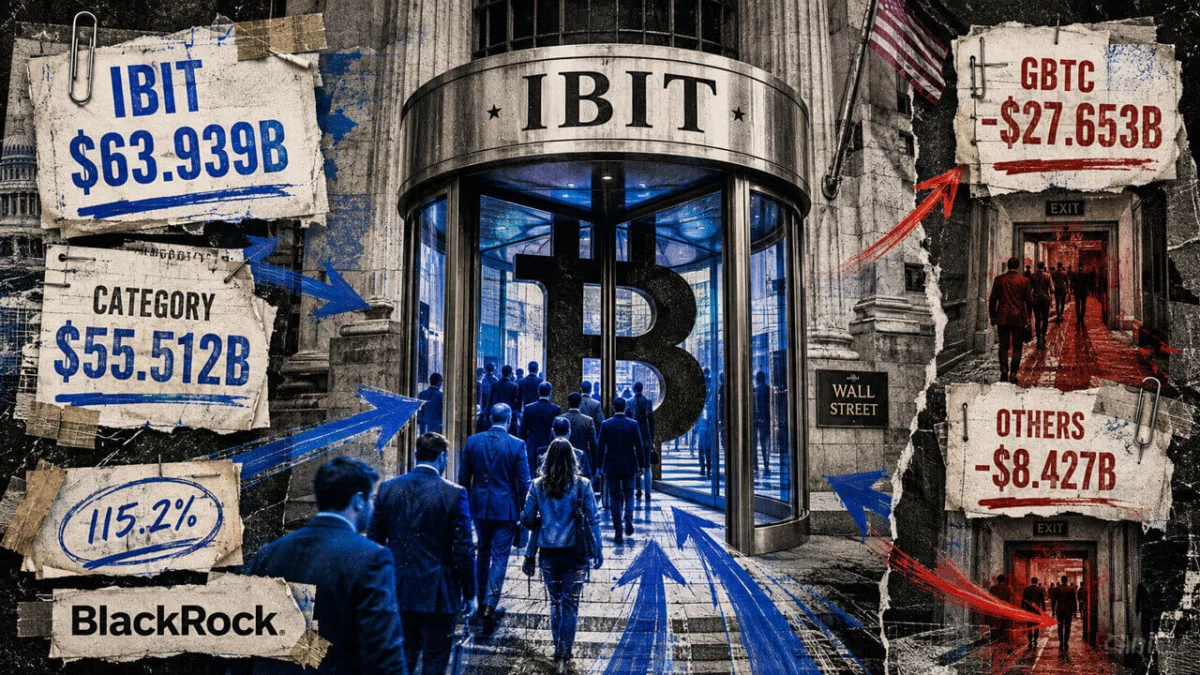
According to data compiled by SoSoValue, the US spot Bitcoin ETFs collectively garnered an impressive $986.9 million in net inflows during the week concluding last Friday. This substantial weekly influx contributed to a staggering total of $3.8 billion in net inflows over the past three weeks, marking a period of unprecedented institutional engagement this year. The consistent accumulation of Bitcoin through these investment vehicles underscores a growing appetite among traditional investors for exposure to the leading cryptocurrency.
The cumulative net inflows across all US spot Bitcoin ETFs have now reached an impressive $55.6 billion, pushing the total net assets under management to an astounding $101.3 billion as of Friday. This milestone highlights the rapid maturation and acceptance of Bitcoin as a legitimate asset class within mainstream finance. A particularly strong day was recorded last Thursday, when the Bitcoin ETFs saw $730.9 million in net inflows, representing their most robust daily performance since January 14, indicating a resurgence of demand not seen since the initial excitement surrounding their launch earlier in the year.
Context of Spot Bitcoin ETFs
The approval of spot Bitcoin ETFs in the United States marked a watershed moment for the cryptocurrency market. Prior to their introduction, institutional investors faced significant hurdles in gaining direct, regulated exposure to Bitcoin. These ETFs provide a regulated, accessible, and familiar investment vehicle, effectively bridging the gap between traditional finance and the nascent digital asset ecosystem. Their performance is widely seen as a barometer of institutional interest and broader market sentiment. The current surge in inflows suggests that initial concerns about institutional hesitancy or profit-taking after the initial launch period have largely subsided, replaced by sustained buying pressure.
Implications for Bitcoin’s Market Trajectory
The consistent and significant inflows into spot Bitcoin ETFs are a powerful bullish signal. They suggest that institutional capital is not merely dipping its toes but actively re-allocating substantial funds into Bitcoin. This sustained demand provides a strong foundation for Bitcoin’s price, helping to absorb selling pressure and potentially drive further appreciation. While the technical confirmation of a bull market via the 50-week moving average remains a psychological benchmark for many traders, the ETF data provides tangible evidence of real-world capital flowing into the asset.
Furthermore, the robust performance of these ETFs could influence other traditional financial institutions to explore Bitcoin-related products or direct investments. The increasing integration of Bitcoin into mainstream investment portfolios could also lead to decreased volatility over the long term, as a more diverse and institutional investor base tends to be less prone to speculative swings. As Bitcoin trades above $80,000, these strong ETF inflows provide crucial support, hinting that the market may indeed be entering a new phase of growth driven by institutional adoption.
AMC CEO Adam Aron Clashes with Robinhood Over Tokenized Stocks: A Legal Showdown Looms
The burgeoning world of tokenized assets has ignited a fierce public and potentially legal battle between AMC Entertainment CEO Adam Aron and the popular trading platform Robinhood. While Robinhood’s Ethereum Layer-2 (L2) platform, PONS, has seen remarkable success – leading chains in daily fees, flipping Solana’s 24-hour DEX volume, and launching its native token into the Top 100 with a stunning 140% gain – its innovative pairing of memecoins with tokenized traditional stocks, such as AMC, has drawn the ire of corporate America.
The Spark: Tokenized AMC Stock on PONS
Robinhood’s PONS platform has quickly become a hub for crypto enthusiasts, often referred to as "degens," who are drawn to its unique offerings. The ability to trade tokenized versions of popular "meme stocks" like AMC alongside cryptocurrencies has fueled its rapid growth and public interest. Tokenized stocks are digital representations of traditional shares, issued on a blockchain, theoretically allowing for fractional ownership and 24/7 trading. However, this innovation operates in a legal grey area, particularly concerning securities regulations.
Adam Aron’s Outrage and Legal Threats
AMC CEO Adam Aron wasted no time in expressing his profound disapproval of Robinhood’s actions. Taking to X (formerly Twitter), Aron launched a scathing critique, vehemently threatening legal action against Robinhood for tokenizing AMC stock without his company’s explicit permission. His series of posts conveyed a deep sense of indignation:
"I find this practice to be contemptible, outrageous, disgusting, detestable, inexcusable, vile. How can it possibly be legal? We have no connection to this at all, and do not condone it in any way."
Aron’s strong language underscored his belief that Robinhood’s actions were not only morally reprehensible but also potentially illegal, infringing upon AMC’s corporate rights and circumventing established securities laws.
Robinhood’s Defiant Stance
The initial reaction from Robinhood co-founder Vlad Tenev was a seemingly blithe and provocative question: "What’s the concern?" This response further inflamed Aron, who promptly unleashed another impassioned rant, labeling Robinhood’s conduct as "shocking and shameful." He then issued a stark warning, demanding that Robinhood "CEASE AND DECIST (sic)" and stating his intention to involve regulatory bodies: "The SEC could not possibly support Robinhood’s sham ignoring of US securities laws. You can be sure we will be asking them."
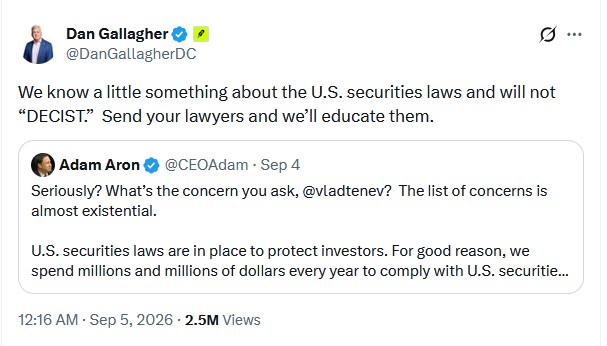
However, Robinhood’s legal team was quick to respond with equally defiant rhetoric. Dan Gallagher, Robinhood’s chief legal officer and a former SEC commissioner, issued a sharp retort on X, directly addressing Aron’s threats:
"We know a little something about the U.S. securities laws and will not ‘DECIST.’ Send your lawyers and we’ll educate them."
Gallagher’s pointed message, laced with an undeniable air of confidence, suggests that Robinhood believes its tokenized stock offerings are operating within legal bounds or, at the very least, that they are prepared to defend their position vigorously in court.
Implications for Tokenized Securities and Regulation
This public spat highlights the growing tension at the intersection of traditional finance, blockchain innovation, and regulatory frameworks. The tokenization of real-world assets, while offering potential benefits like increased liquidity and accessibility, often pushes the boundaries of existing securities laws. AMC’s stance, rooted in the traditional corporate governance and intellectual property rights, directly clashes with Robinhood’s embrace of decentralized and permissionless blockchain technology.
The potential legal battle between AMC and Robinhood could serve as a landmark case, setting precedents for how tokenized stocks are treated under US securities law. It will undoubtedly draw increased scrutiny from the Securities and Exchange Commission (SEC) and other regulatory bodies, potentially accelerating the development of clearer guidelines for this emerging asset class. The outcome could significantly impact the future of tokenized securities, influencing whether they become a mainstream investment option or remain confined to a niche, legally ambiguous segment of the crypto market. For Robinhood, a company that has often navigated regulatory challenges, this confrontation represents another test of its "move fast and break things" philosophy in a highly sensitive and regulated environment.
Financial Titans Unite: 21 Institutions Plan Stablecoin Launch as G20 Backs Digital Asset Innovation
A formidable consortium of 21 of the world’s leading financial institutions has announced ambitious plans to establish a new company dedicated to the development and issuance of stablecoins. This groundbreaking initiative signals a significant shift in the perception and adoption of digital assets by traditional finance, further solidified by a recent joint statement from G20 member nations supporting digital asset innovation.
The Stablecoin Consortium: A New Era for Digital Currency
The consortium, unveiled on Tuesday, boasts an impressive roster of banking and investment giants, including Bank of America, Goldman Sachs, Citi, Deutsche Bank, UBS, Santander, MUFG, and Fidelity Investments. This collective powerhouse intends to launch a US dollar-denominated stablecoin in the first half of 2027, contingent upon the successful formation of the new company and the fulfillment of various regulatory and operational conditions.
The strategic vision extends beyond a single currency. The group ultimately aims to expand its offerings into stablecoins denominated in other G7 currencies, with a euro-backed stablecoin identified as its immediate next priority. This phased approach underscores a comprehensive strategy to establish a robust and globally relevant stablecoin ecosystem within the traditional financial landscape.
Why Stablecoins? The Institutional Imperative
Stablecoins are cryptocurrencies designed to minimize price volatility by being pegged to a stable asset, typically a fiat currency like the US dollar. They serve as a crucial bridge between the volatile world of cryptocurrencies and the stability of traditional financial systems, facilitating faster, cheaper, and more efficient cross-border payments, remittances, and digital asset trading.
For years, the stablecoin market has been dominated by crypto-native entities like Tether (USDT) and Circle (USDC). However, the entry of major banks signifies a recognition of stablecoins’ potential to revolutionize wholesale and retail payments, enhance liquidity management, and streamline settlement processes within the existing financial infrastructure. These institutions bring unparalleled trust, regulatory expertise, and vast customer networks, which could accelerate the mainstream adoption of stablecoins and address concerns around stability and regulatory compliance that have often plagued existing offerings.
G20 Endorsement: Paving the Way for Responsible Innovation
Further bolstering the narrative of crypto’s integration into the mainstream, G20 member nations recently issued a joint statement unequivocally supporting digital assets as a transformative force capable of fostering "broad-based economic growth." This high-level endorsement marks a significant evolution in global policy, moving from a position of cautious skepticism to one that actively embraces responsible innovation in the digital asset space.
The G20 statement committed member nations to "advancing responsible and effective regulatory and supervisory frameworks that preserve financial stability, support economic growth, and establish clear pathways for sound digital financial and digital assets innovation." This commitment is critical for initiatives like the stablecoin consortium, as it signals a global effort to create a more predictable and supportive regulatory environment for digital assets. Such clarity is essential for major financial institutions, which operate under strict compliance requirements, to confidently invest in and deploy blockchain-based solutions.
Implications for the Future of Finance
The combined force of institutional stablecoin development and favorable G20 policy pronouncements heralds a new era for finance. This convergence suggests a future where traditional banking and blockchain technology are increasingly intertwined, leading to a hybrid financial system that leverages the best of both worlds. The competition from these institution-backed stablecoins could spur innovation among existing crypto-native stablecoin providers, potentially leading to enhanced transparency, security, and efficiency across the board. Ultimately, this move by major financial players, backed by global regulatory support, legitimizes stablecoins as a core component of the evolving global financial architecture, paving the way for broader adoption and the eventual realization of blockchain’s transformative potential in everyday transactions.
Kalshi Bans George Santos for Life as Prediction Market Faces Supreme Court Showdown
The prediction market platform Kalshi has imposed a lifetime ban on former Republican lawmaker George Santos, citing alleged insider trading activities related to event contracts. This unprecedented move marks one of the first lifetime bans issued by the company since its inception in 2021 and shines a spotlight on the ethical and regulatory complexities of prediction markets. Simultaneously, the entire prediction market industry in the United States faces an existential challenge as New Jersey’s Attorney General has petitioned the US Supreme Court to resolve a critical jurisdictional dispute between state authorities and federal agencies.
George Santos’s Alleged Insider Trading
Kalshi’s decision to ban George Santos stems from accusations that he utilized privileged, non-public information to trade on markets related to his own actions. Specifically, Kalshi stated that Santos "engaged in trading activity in certain markets related to his attendance at the State of the Union address" in February 2026. Given Santos’s controversial political career, which ended in his expulsion from Congress amid numerous allegations of fraud and misconduct, these new accusations of leveraging his position for personal financial gain on a prediction market add another chapter to his public controversies.
In response to the ban, Santos dismissed Kalshi as an "unserious company," demonstrating his characteristic defiance. However, Kalshi’s actions highlight a serious concern for prediction markets: how to prevent participants with direct knowledge of an event’s outcome from exploiting that information, thereby undermining the market’s integrity and fairness. While prediction markets are often touted for their ability to aggregate dispersed information and forecast future events, they are also susceptible to manipulation if insider trading is not effectively policed.
The Looming Supreme Court Battle: State vs. Federal Jurisdiction
Adding to the industry’s challenges, New Jersey’s Attorney General has officially petitioned the US Supreme Court to hear a landmark case that could determine the regulatory future of prediction markets. The core of the dispute revolves around whether state gaming authorities or federal agencies, specifically the Commodity Futures Trading Commission (CFTC), hold primary jurisdiction over these platforms.
The petition cites civil cases brought by gaming authorities in "at least 20 states," underscoring the widespread confusion and conflict regarding regulatory oversight. State officials argue that prediction markets, particularly those dealing with political or sporting events, resemble traditional sports betting or gambling, which typically fall under state-level gaming laws. The New Jersey Attorney General articulated this position clearly:

"These companies have no right to offer their sports bets without following state law, which is why dozens of States across the ideological spectrum have opposed them […] We’re calling on the Supreme Court to resolve this issue and recognize that Congress did not silently make the sports-betting industry immune from state law."
Implications for Prediction Markets and Regulatory Frameworks
The Supreme Court’s decision will have profound implications for Kalshi and other prediction market platforms operating in the US. Kalshi, unlike many other less regulated platforms, has explicitly sought and obtained regulatory approval from the CFTC, which classifies its event contracts as "designated contract markets." However, the states’ challenge directly questions the scope of the CFTC’s authority and whether it supersedes state laws that might view these activities as illegal gambling.
If the Supreme Court sides with the states, prediction markets could face a patchwork of differing regulations across the country, making nationwide operation incredibly complex, if not impossible. This could stifle innovation in a sector that proponents believe offers valuable tools for forecasting and risk management. Conversely, a ruling in favor of federal preemption would provide much-needed clarity and a more unified regulatory landscape, potentially accelerating the growth and mainstream acceptance of prediction markets. The Santos ban, while an isolated incident, serves as a stark reminder of the ethical considerations that must be balanced with regulatory clarity as this nascent industry strives for legitimacy and broad adoption.
Weekly Crypto Market Review: Gains, Predictions, FUD, and Deep Dives
The past week in cryptocurrency saw a mixed bag of significant market movements, bold predictions, persistent FUD (Fear, Uncertainty, and Doubt), and insightful long-form journalism, reflecting the dynamic and often tumultuous nature of the digital asset landscape.
Market Performance: Winners and Losers
At the close of the week, the major cryptocurrencies exhibited modest gains, signaling a period of consolidation after earlier surges. Bitcoin (BTC) edged up 2.6% to trade at $80,234, while Ethereum (ETH) climbed 2.3% to reach $2,513. XRP (XRP) also posted a respectable 3% gain, hitting $1.42. The total cryptocurrency market capitalization, according to CoinMarketCap, stood at $2.72 trillion.
Among the top 100 cryptocurrencies, several altcoins distinguished themselves with remarkable performance. Pons (PONS), closely associated with Robinhood’s L2 platform, emerged as the week’s top gainer with an astounding 140% surge, likely fueled by the platform’s burgeoning popularity and controversial tokenized stock offerings. Arbitrum (ARB) followed with a robust 116% gain, reflecting strong interest in Layer-2 scaling solutions for Ethereum. Dash (DASH) also saw significant traction, rising by 66%.
On the other side of the spectrum, some altcoins experienced declines. Pump.fun (PUMP) was down 13.2%, Canton (CC) fell by 6.9%, and Official Trump (TRUMP) saw a 4.1% decrease, indicating a cooling off in specific niche segments of the market.
Top Prediction of the Week: Arthur Hayes on BTC and ETH
BitMEX founder Arthur Hayes, a prominent and often contrarian voice in crypto, delivered a bullish long-term outlook for Bitcoin while revealing his current investment strategy. Speaking to Cointelegraph, Hayes predicted that Bitcoin could reach $1 million by 2030. His reasoning hinges on a confluence of macroeconomic factors, including the anticipated collapse of the AI bubble, "massive" global money printing by central banks, and potential US yield curve control measures. Hayes articulated his confidence, stating, "We have the ingredients. The time is now. So I think the $58,000 was probably the bottom in Bitcoin, and now it’s going to grind higher in this hate f*ck rally."

However, despite his long-term Bitcoin optimism, Hayes revealed a tactical shift in his personal portfolio. He believes "the best risk reward adjusted bet in crypto right now wasn’t Hyperliquid, but ETH," confirming that he has been amassing a sizeable position in Ethereum. He elaborated, "That doesn’t necessarily mean that Hyperliquid won’t rise in price. I just don’t think it’s poised for a 5x, and like where I think Ethereum could do, you know, 3x to 5x pretty quickly." This perspective highlights the ongoing debate among investors about where the highest growth potential lies within the broader crypto ecosystem.
Top FUD of the Week: El Salvador, Fake Apps, and Mining Shifts
The week also brought its share of "Fear, Uncertainty, and Doubt" (FUD), prompting closer examination of various crypto-related developments.
-
El Salvador’s Bitcoin Holdings: Reports emerged this week from the International Monetary Fund (IMF) suggesting that El Salvador utilized no public funds for its Bitcoin accumulation after the first review of its financing program in June 2025. Documents supplied by Salvadoran authorities reportedly verified that any increase in holdings came from private donations, implying government resources were not used. The IMF also noted the transfer of majority ownership and operational control of the Chivo wallet to a private operator, with the government retaining a minority stake. However, President Nayib Bukele vehemently denied these claims, labeling them "fake news" and asserting that the transfer of Bitcoin returns to a private party was "TOTALLY FALSE." He pointed to the IMF’s own link as evidence, clarifying that "the only thing that was transferred were Chivo shares, something that was offered a year and a half ago, and NOT the Bitcoin Strategic Reserve." This highlights the ongoing scrutiny and political sensitivity surrounding El Salvador’s pioneering Bitcoin adoption.
-
Fake Claude Desktop App Spreads Crypto-Stealing Malware: Cybersecurity researchers issued a critical warning about a fake Claude desktop application being used to distribute "RevStealer," a potent Windows malware strain. This sophisticated malware is designed to exfiltrate a wide array of sensitive data, including cryptocurrency, passwords, and browser information. According to a Monday report by cybersecurity company Morphisec, RevStealer was previously spread through GitHub repositories and game-cheat-themed sites. However, the most concerning new vector is a fake "Claude Opus 5 Free Desktop" project that impersonates AI developer Anthropic, luring unsuspecting users with promises of free access to the advanced AI. The researchers noted the malware’s stealthy design, leaving few traces while targeting over 50 cryptocurrency wallets, browser databases, cookies, password-manager records, VPN and remote-access settings, messaging data, screenshots, and selected documents. This incident serves as a stark reminder of the persistent and evolving threat of crypto-stealing malware and the importance of vigilant cybersecurity practices.
-
Hyperscale Data Exits Bitcoin Mining for AI: Hyperscale Data announced the cessation of all Bitcoin mining operations at its Michigan facility, signaling a strategic pivot towards the booming artificial intelligence data center market. On Wednesday, the company confirmed that all Bitcoin miners at the facility had been switched off, with plans to sell the associated mining equipment. This move is driven by a lucrative opportunity: an AI customer has contracted for 20 megawatts (MW) of computing capacity under a 10-year master services agreement, with two optional five-year extensions. This agreement is projected to generate over $1.2 billion over its maximum 20-year term, with an additional 32 MW option potentially lifting total revenue above $3 billion. The site is ultimately expected to support 340 MW. To fund this AI buildout, Hyperscale has significantly reduced its Bitcoin holdings, which dropped from 1,006 BTC at the end of July to approximately 215 BTC today. This strategic shift by a mining company underscores the intense demand for AI infrastructure and the economic calculus influencing resource allocation within the tech sector, potentially impacting the broader Bitcoin mining landscape.
Top Magazine Stories of the Week: Deep Dives into Crypto’s Nuances
Cointelegraph’s long-form journalism this week provided deeper insights into some of the crypto space’s most intriguing and debated topics:
-
Mystery surrounds why an OG burned $1M in Bitcoin: This article delved into the perplexing case of a Bitcoin "OG" who deliberately burned 20 BTC, valued at $1 million. The piece explored the motivations behind such a seemingly irrational act, prompting questions about the individual’s intent, the nature of value, and the symbolic gestures within the crypto community.
-
Does the Bitcoin rally mean we haven’t wasted our lives in crypto? As crypto markets show renewed signs of life, this reflective piece examined the journey of early believers. It questioned whether the current rally validates a decade of building and struggle, contemplating if the biggest wins align with the initial visions for a decentralized future.
-
Token buybacks are booming. But are they good for crypto projects? This analysis explored the increasing trend of crypto projects spending hundreds of millions to buy back their own tokens. It scrutinized whether these buybacks genuinely