
 admin
admin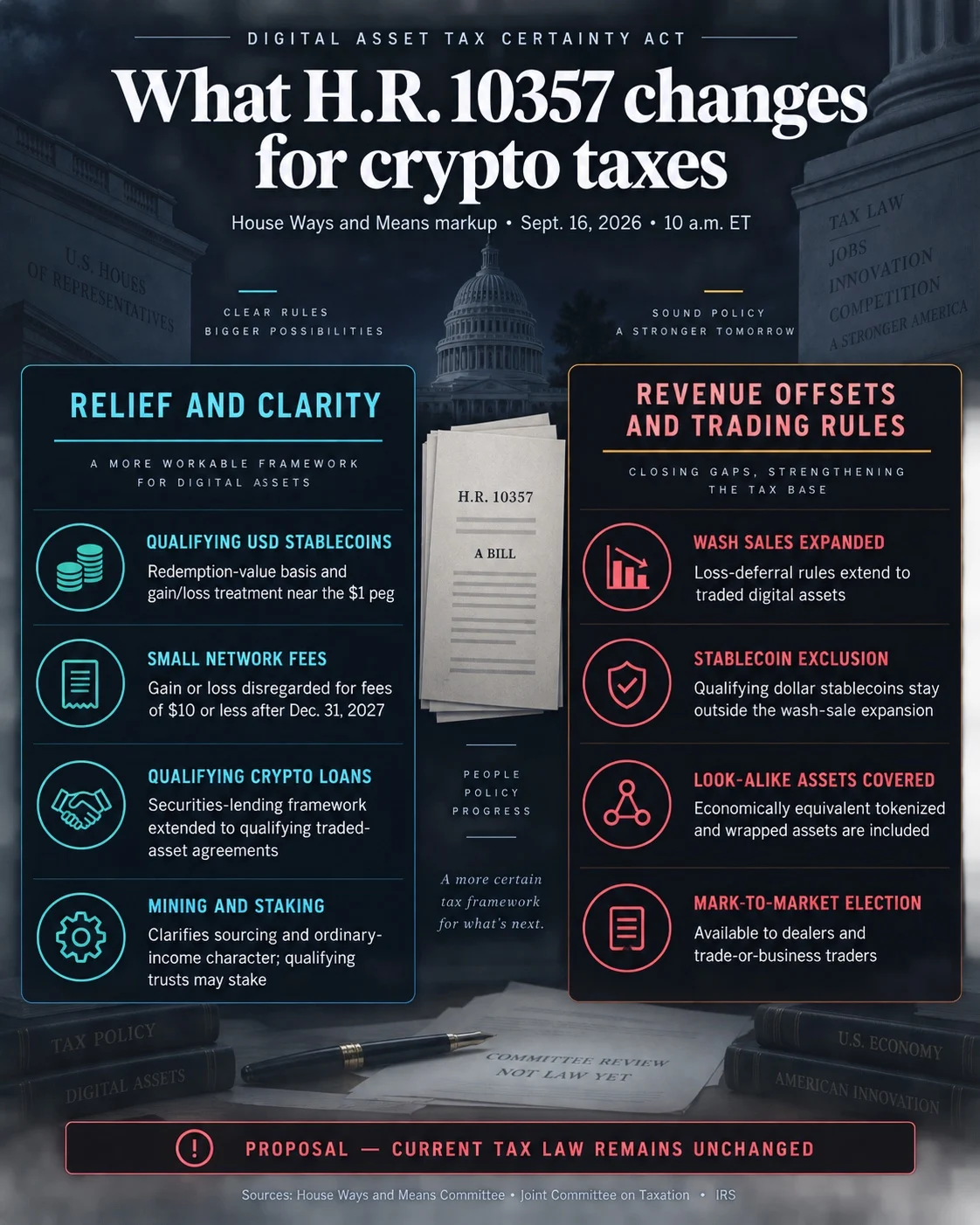
The House Ways and Means Committee is poised to deliberate on H.R. 10357, the Digital Asset Tax Certainty Act, on September 16th, marking a significant legislative effort to redefine the taxation of digital assets. This broad rewrite of crypto taxation comes after months of intricate negotiations aimed at determining how closely digital currencies should be regulated and taxed akin to traditional financial instruments. The Joint Committee on Taxation (JCT) has projected that this legislation could bolster federal receipts by approximately $500 million net over the fiscal years 2027 through 2036. This projection accounts for a delicate balance of provisions designed to both increase and decrease government revenue, reflecting a strategic trade-off by lawmakers. The core of the bill aims to alleviate some of the tax complexities that currently encumber routine cryptocurrency activities, while simultaneously extending securities-style regulations to traders, which is anticipated to generate substantial additional revenue. Andrew Gordon, a prominent crypto tax lawyer, characterized the proposed legislation as a "massive step forward for crypto investors who simply want rules on tax," emphasizing the critical need for clarity in tax regulations for all participants.
A Pivotal Markup Session and the Fiscal Balancing Act
The scheduled markup session of H.R. 10357 by the House Ways and Means Committee represents a crucial juncture in the long-standing debate surrounding cryptocurrency taxation. For years, the digital asset industry has operated within a tax framework that, while evolving, has often been perceived as ambiguous and burdensome. This proposed legislation seeks to inject much-needed certainty, a sentiment echoed by industry participants. The JCT’s revenue estimate of $500 million net gain underscores the legislative strategy: provide relief in certain areas to foster adoption and reduce friction, while implementing measures that are projected to yield greater returns over the long term. This approach acknowledges the dual nature of the cryptocurrency ecosystem – its innovative potential and its increasing integration into the broader financial landscape. The bill’s comprehensive nature is evident in its inclusion of rules governing stablecoins, transaction fees, trading losses, digital asset lending, staking, and even provisions for addressing past tax violations. This holistic approach suggests a concerted effort to create a more robust and predictable tax environment for digital assets.
Stablecoin Relief: A Calculated Concession
A significant component of H.R. 10357 addresses the unique challenges posed by stablecoins, particularly those pegged to the U.S. dollar. The bill proposes special tax treatment for qualifying U.S. dollar stablecoins to mitigate the tax implications of minor fluctuations around their $1 peg. Currently, even minuscule movements can theoretically trigger taxable gains or losses, creating an administrative burden for users engaging in frequent transactions. Under the proposed rules, the redemption value of these stablecoins would generally determine their basis and proceeds for qualifying transactions that fall within specified bands around the peg. This provision is designed to streamline the process and prevent the taxation of trivial price variations. However, this relief is not universal. Traders, brokers, and dealers are excluded from this favorable treatment, as are certain users who conduct more than 5,000 counted transactions. Furthermore, taxpayers whose functional currency is not the U.S. dollar will not benefit from these provisions.
The legislation also seeks to ease the tax burden associated with using digital assets for smaller, routine payments. Specifically, it would disregard gains or losses when digital assets are used to pay network or transaction fees of no more than $10. This aims to cover costs such as blockchain gas fees and certain trading or liquidity charges, which are integral to the functioning of many decentralized networks. This provision is set to take effect for dispositions occurring after December 31, 2027. However, this particular relief measure comes with a substantial projected cost. The JCT estimates that the small-fee exemption alone would reduce federal receipts by $2.365 billion through 2036. It is crucial to note that this measure does not establish a blanket $10 exemption for purchases made with cryptocurrencies like Bitcoin. The exclusion is specifically tied to transaction-related fees, leaving most general purchases subject to the existing tax treatment of digital assets as property.
Rebalancing the Scales: Ending Crypto’s Tax Advantage
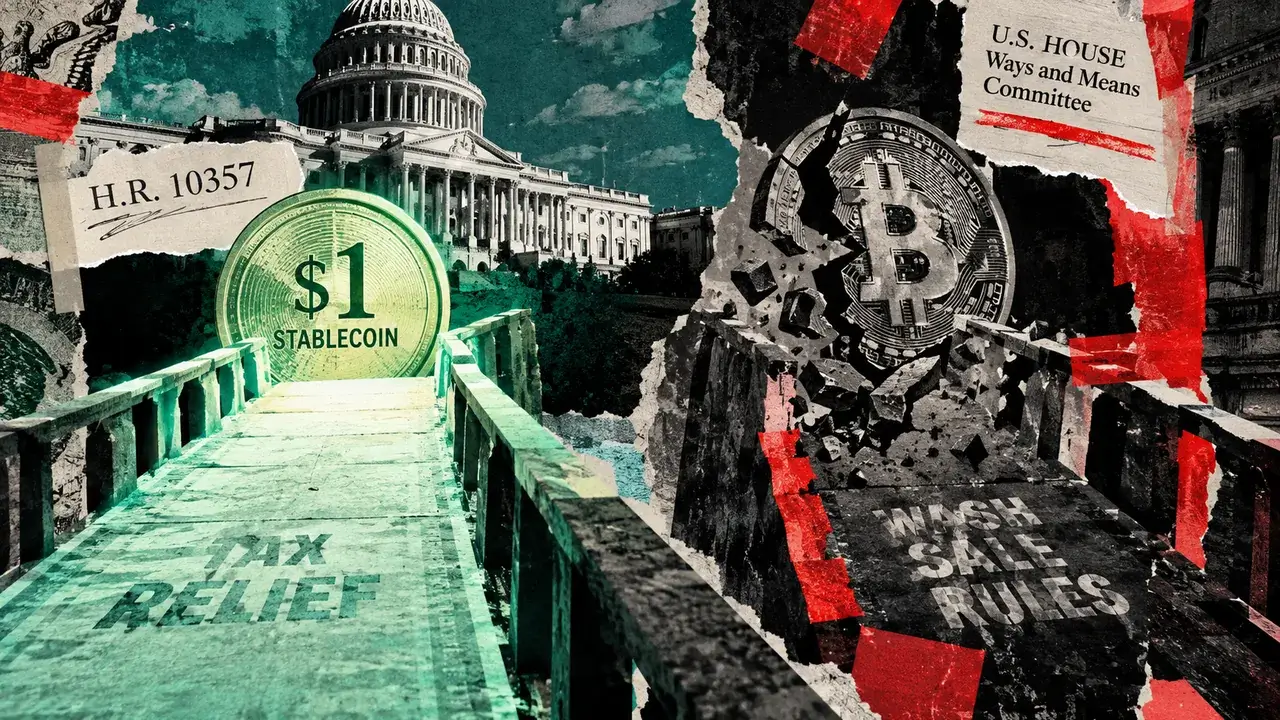
To offset the revenue forgone from stablecoin and small-fee relief, the legislation introduces measures that align the tax treatment of digital assets more closely with that of traditional securities, thereby ending a long-standing tax advantage for some crypto investors. A key provision extends the "wash sale" rule to traded digital assets, excluding qualifying U.S. dollar stablecoins. Under current tax law, investors can often sell an asset at a loss and immediately repurchase it, still claiming the loss for tax purposes, as the wash-sale regime primarily applies to stocks and securities. H.R. 10357 aims to close this loophole for digital assets, preventing investors from artificially generating losses. This restriction would also encompass economically equivalent assets, including wrapped and tokenized versions of digital assets. The JCT projects that this change alone will increase federal receipts by $1.707 billion over the budget window.
Furthermore, the bill expands access to mark-to-market accounting for digital asset dealers and traders whose activities rise to the level of a trade or business. Mark-to-market accounting allows taxpayers to value their assets at current market prices, recognizing unrealized gains and losses. This provision is expected to generate an additional $2.332 billion in federal receipts through 2036. Collectively, these two trading-related provisions are anticipated to generate over $4 billion in revenue, significantly contributing to the overall revenue neutrality or surplus of the bill, thereby absorbing the costs associated with tax reductions elsewhere. This strategic revenue generation highlights the legislative intent to create a more equitable tax system across different asset classes.
Traditional Finance Parallels: Lending and Staking Evolve
Beyond trading activities, H.R. 10357 also seeks to bring the taxation of digital asset lending and staking activities closer to the established frameworks for traditional financial instruments. The legislation extends tax treatment similar to that available for securities lending to qualifying digital asset loans. This aims to clarify whether the temporary transfer of cryptocurrency under a lending agreement constitutes a taxable sale. Qualifying arrangements, provided they meet specific requirements concerning the return of equivalent assets and transaction economics, would generally avoid immediate recognition of gains or losses. This provision could foster greater participation in crypto lending markets by reducing tax uncertainty.
Another targeted change benefits investment trusts. The bill proposes to prevent a qualifying trust from losing its tax-exempt status solely because its trustee stakes digital assets held by the trust. This is a significant development for investment products seeking to earn staking rewards, potentially removing a barrier to entry and innovation in this growing sector. However, the proposed changes are more constrained for individual miners and stakers. The bill classifies validation income as ordinary income and establishes sourcing rules. Crucially, it retains the existing timing framework, which generally recognizes staking rewards at the point a taxpayer gains control over them. This means the package falls short of a key industry proposal to defer taxation of newly generated mining or staking rewards until the assets are eventually sold.
Addressing Past Compliance and the Road Ahead
For taxpayers who have fallen behind on their reporting obligations, H.R. 10357 includes a provision directing the Treasury Department to establish a Digital Asset Voluntary Disclosure Program. This program would offer an avenue for eligible taxpayers to rectify past filings, settle outstanding tax liabilities and interest, and potentially receive relief from certain penalties. This initiative underscores a desire to bring a greater number of participants into tax compliance, rather than solely focusing on punitive measures.
The upcoming markup session is the initial legislative test for these carefully negotiated compromises. Committee members have the prerogative to propose amendments before voting on whether to advance the bill. Following a successful markup, H.R. 10357 would still need to navigate a House floor vote, subsequent consideration in the Senate, and ultimately, presidential action. Any modifications made during the markup, particularly concerning the wash-sale, fee, or stablecoin provisions, could alter the JCT’s projected $500 million net revenue gain. This would necessitate a critical decision by lawmakers on the extent of tax relief they are willing to offer, ensuring that the broader package does not devolve into a net revenue loser. The evolving nature of digital assets and their integration into the global economy necessitates a dynamic and adaptable regulatory framework, and H.R. 10357 represents a significant step in that direction. The legislative journey ahead will be closely watched by industry participants, tax professionals, and policymakers alike, as it has the potential to shape the future of digital asset taxation for years to come. The implications of these changes extend beyond mere revenue collection; they touch upon market stability, investor confidence, and the overall integration of digital assets into the mainstream financial system.








