
 admin
admin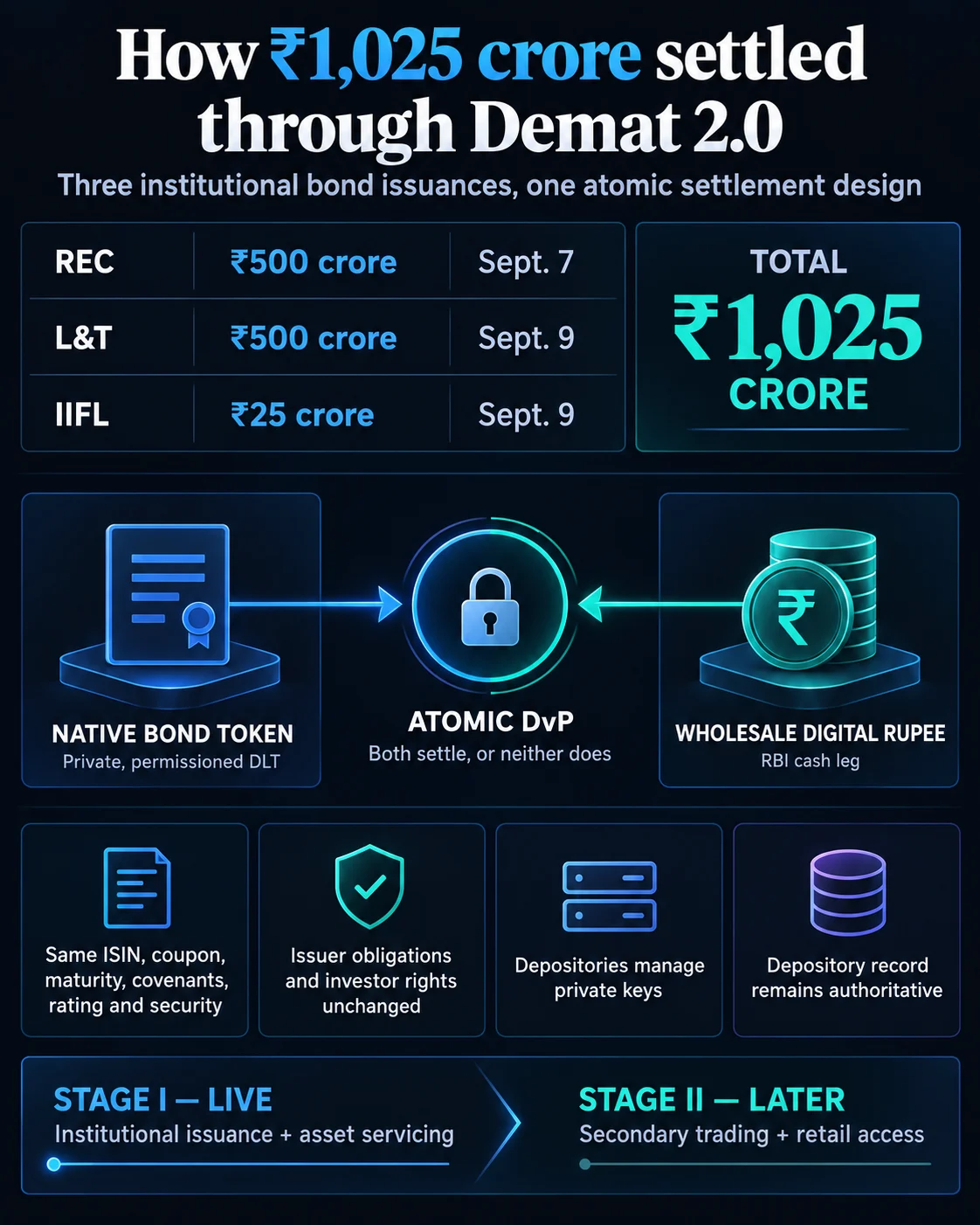
India’s securities regulator has successfully initiated a groundbreaking pilot project, Demat 2.0, which integrates corporate bonds and their cash settlement onto interconnected digital rails. This landmark initiative has already facilitated the settlement of ₹1,025 crore across its initial three issuances, meticulously preserving the existing legal and economic parameters of the securities involved. The Securities and Exchange Board of India (SEBI) announced the commencement of Demat 2.0 on September 10, following the completion of tokenized bond issuances by REC Limited, L&T Limited, and IIFL on September 7 and September 9. These initial transactions collectively represent ₹500 crore from REC, ₹500 crore from L&T, and ₹25 crore from IIFL, as detailed in SEBI’s official release. The pilot program is currently ongoing with further Stage I issuances.
The core innovation of this pilot lies in the synchronized settlement process between the security and its payment. Corporate bonds are now being issued as native digital tokens on a private, permissioned distributed ledger technology (DLT) network. Simultaneously, the payment for these bonds is being executed using the Reserve Bank of India’s (RBI) wholesale digital rupee, a central bank digital currency (CBDC) specifically designed for interbank and institutional transactions.
Atomic Settlement: A New Paradigm for Efficiency
SEBI’s technical frequently asked questions (FAQ) document elucidates that the digital bond tokens and the wholesale digital rupees are linked through an atomic delivery-versus-payment (DvP) mechanism. This means that a transaction is only considered complete if both the bond and the corresponding cash payment are settled simultaneously. If either leg of the transaction fails, the entire process is reversed, ensuring that neither party is left exposed. This synchronization effectively eliminates the settlement risk inherent in traditional systems, where a time lag can exist between the transfer of funds and the delivery of securities. Crucially, this innovation does not alter the underlying credit risk associated with the issuer.
The token itself represents the corporate bond directly, rather than being a mere digital representation of a conventionally held security. It retains all the essential characteristics of a traditional dematerialized bond, including its International Securities Identification Number (ISIN), coupon rate, maturity date, covenants, credit rating, and any associated security. Furthermore, the issuer’s obligations, the investors’ rights, and the prevailing regulatory treatment remain unchanged throughout this transition.
Building on Existing Infrastructure: A Controlled Ecosystem
The network underpinning this pilot is designed to be private and institutionally managed. India’s central securities depositories hold ownership of this infrastructure, continuing to serve as the statutory and authoritative record keepers for beneficial ownership. Market infrastructure institutions have been instrumental in the development and operation of this system, with depositories and stock exchanges initially responsible for operating the network’s validating computers. In a move that preserves the familiar intermediated custody model, depositories also manage investors’ private keys, ensuring a secure and controlled environment.
This carefully constructed architecture ensures that the established custody chain remains intact. Investors gain access to the tokenized ledger without the necessity of directly managing the private keys associated with their bond tokens. Moreover, it obviates the need to replace the existing depository records that legally establish ownership of securities.
Background and Chronology of the Demat 2.0 Initiative
The concept of leveraging blockchain and distributed ledger technology for securities settlement in India has been a subject of exploration for several years. The Demat 2.0 initiative represents a significant step forward from earlier discussions and proof-of-concept projects.
- Early Explorations: Discussions around DLT in capital markets gained momentum in the mid-2010s, with various industry participants and regulatory bodies exploring its potential to enhance efficiency, transparency, and security.
- Pilot Projects: SEBI, in collaboration with market participants, has previously overseen pilot projects to test the feasibility of DLT for different aspects of securities settlement. These efforts helped identify technical challenges, regulatory hurdles, and operational requirements.
- Focus on Corporate Bonds: The decision to initially focus the Demat 2.0 pilot on corporate bonds stems from their established dematerialized form and the potential for significant efficiency gains in their issuance and trading lifecycle. Corporate bonds, unlike government securities, often involve more complex issuance processes and a diverse range of institutional investors.
- Integration with Digital Rupee: The integration of the RBI’s wholesale digital rupee was a crucial development, signifying the convergence of traditional financial infrastructure with emerging digital currency technologies. This strategic alignment ensures that the digital settlement process is underpinned by a robust and regulated form of central bank money.
- Announcement and Launch: SEBI’s formal announcement of Demat 2.0 on September 10, 2026, marked the culmination of extensive preparatory work. The subsequent successful completion of tokenized bond issuances by REC, L&T, and IIFL on September 7 and 9 validated the technical and operational readiness of the system for institutional participants.
Supporting Data and Transaction Details
The initial phase of the Demat 2.0 pilot has seen a substantial volume of transactions. The total value settled across the first three institutional issuances amounts to ₹1,025 crore. This includes:
- REC Limited: ₹500 crore
- L&T Limited: ₹500 crore
- IIFL: ₹25 crore
This figure represents the initial capital raised through these tokenized bond issuances. The success of these transactions underscores the operational capability of the DLT-based platform for handling large-value corporate debt instruments. The fact that these are "native bond tokens" signifies that the digital representation is the primary form of the bond, rather than an overlay on existing physical or dematerialized certificates.
Official Responses and Perspectives
While direct quotes from specific officials were not provided in the initial announcement, the actions and statements from SEBI and the RBI indicate a unified approach towards fostering innovation in the financial markets.
SEBI’s announcement highlighted the "successful launch of Demat 2.0 pilot project for tokenised corporate bonds," emphasizing the project’s objective to "modernize the securities market infrastructure" and "enhance efficiency and transparency." The regulator’s technical FAQ also demonstrates a commitment to providing clarity and addressing potential concerns from market participants regarding the technical and operational aspects of the pilot.
The RBI’s active participation through its wholesale digital rupee infrastructure is a testament to its strategic vision for a digitized economy. The digital rupee is designed to complement existing payment systems and facilitate innovation in financial services. Its integration into the Demat 2.0 pilot signifies its readiness for use in institutional wholesale transactions, providing a secure and efficient settlement mechanism.
Industry observers and market participants are likely to view this development as a positive step towards a more technologically advanced and efficient financial ecosystem. The involvement of prominent issuers like REC, L&T, and IIFL signals strong industry buy-in and confidence in the pilot’s potential.
Broader Impact and Implications: Stage Two and Beyond

The current phase of the Demat 2.0 pilot is focused on institutional issuance and ledger-based asset servicing. SEBI has explicitly reserved the implementation of tokenized secondary-market trading and broader retail participation for Stage II of the project. This phased approach allows for a controlled rollout and iterative refinement of the system.
Stage I: Institutional Issuance and Servicing
- Streamlined Issuance: The pilot demonstrates how the creation and distribution of new debt securities can be significantly expedited through tokenization and atomic settlement.
- Enhanced Asset Servicing: The DLT platform can potentially facilitate more efficient management of corporate actions, such as coupon payments and redemptions, directly on the ledger.
- Reduced Operational Costs: By automating and synchronizing processes, tokenization can lead to reduced operational overheads for issuers and intermediaries.
Stage II: Secondary Trading and Retail Access
The true test of the Demat 2.0 initiative will lie in its ability to support robust secondary market liquidity and cater to a wider investor base.
- Secondary Market Efficiency: Enabling tokenized trading on the DLT platform could lead to faster, cheaper, and more transparent settlement of bond trades between investors. This could significantly reduce the time and cost associated with traditional post-trade processing.
- Retail Investor Participation: Expanding access to tokenized bonds for retail investors, potentially through user-friendly platforms, could democratize access to debt markets and offer new investment opportunities. This would require careful consideration of investor protection measures and simplified user interfaces.
- Interoperability Challenges: A key challenge for Stage II will be ensuring seamless interoperability between the tokenized bond market and existing traditional financial market infrastructure, including exchanges and payment systems.
- Regulatory Evolution: As the pilot progresses, regulatory frameworks will need to adapt to accommodate the nuances of tokenized securities, including aspects like custody, trading, and investor recourse.
Analytical Outlook
The successful implementation of Demat 2.0’s first stage represents a significant milestone in India’s journey towards digitalizing its financial markets. By integrating tokenized corporate bonds with the RBI’s wholesale digital rupee, the pilot showcases a powerful synergy between DLT and central bank digital currencies. The atomic settlement mechanism addresses a critical pain point in traditional finance – settlement risk – thereby enhancing efficiency and reducing counterparty exposure.
The phased rollout, with institutional participation preceding retail access, is a prudent strategy that allows for rigorous testing and refinement of the technology and operational processes. The preservation of existing legal and economic rights for bondholders is a crucial factor in ensuring market acceptance and investor confidence.
Looking ahead, the success of Stage II, particularly in facilitating secondary market trading and enabling retail participation, will be pivotal. If the pilot can successfully demonstrate its ability to enhance liquidity, reduce transaction costs, and broaden investor access in the secondary market, it could pave the way for a fundamental transformation of India’s debt capital markets. This evolution has the potential to not only benefit institutional investors but also to empower a new generation of retail investors with greater access to diverse investment opportunities, all underpinned by a more secure, efficient, and technologically advanced financial infrastructure. The ongoing developments in Demat 2.0 will be closely watched by financial markets globally as a bellwether for the future of digital asset adoption in regulated environments.








