Lina Irawan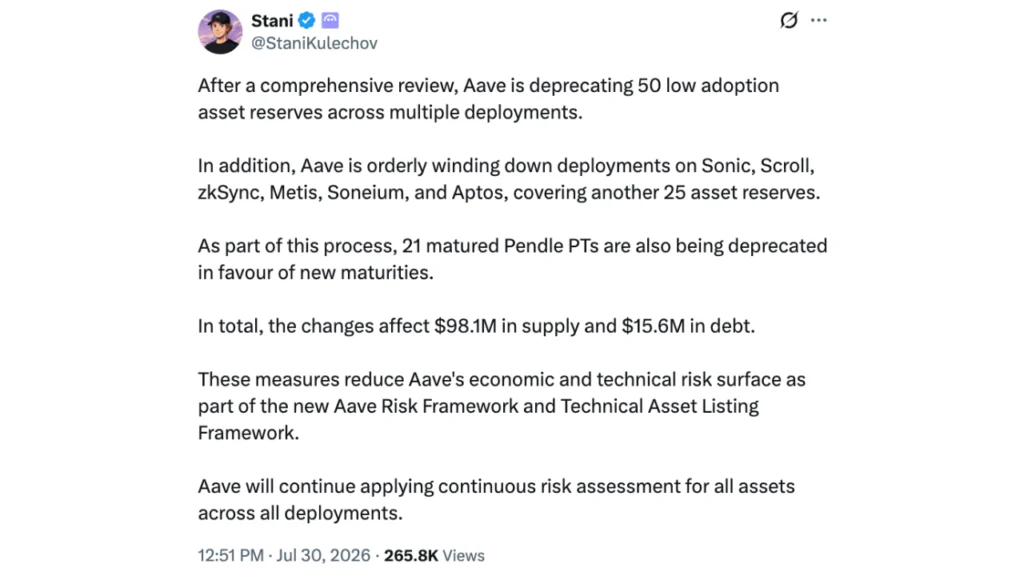
Aave, the world’s largest decentralized lending protocol, is poised to significantly streamline its multi-chain presence by retiring deployments on six blockchain networks and de-listing numerous underutilized asset markets. This strategic move, currently under governance review, aims to curtail operating costs, mitigate risks, and reallocate resources towards networks exhibiting stronger user engagement and economic viability. The proposal, spearheaded by LlamaRisk in collaboration with Aave’s risk providers, signifies a pivotal moment in the protocol’s evolution, prioritizing efficiency and sustainable growth over expansive, but potentially uneconomical, multi-chain proliferation.
The proposed changes would see Aave phase out its operations on Sonic, Scroll, zkSync, Metis, Soneium, and Aptos. Concurrently, dozens of low-adoption reserves and matured Pendle Principal Tokens (PTs) are slated for removal from the platform. This consolidation affects approximately $98 million in supplied assets. Importantly, the protocol intends to facilitate a phased migration for affected users, allowing them ample time to unwind their positions rather than face immediate liquidations, thereby mitigating potential market disruption and user hardship. This measured approach underscores Aave’s commitment to responsible protocol management and user protection.
A Cost-Driven Strategic Shift Towards Efficiency
The initiative stems directly from Aave’s updated Risk Framework and Technical Asset Listing Framework, underscoring a commitment to data-driven decision-making. Maintaining a presence on each blockchain network necessitates substantial investment in dedicated infrastructure. This includes the upkeep of oracle price feeds, robust liquidation systems, continuous monitoring, and ongoing risk management protocols. While these infrastructural costs are largely fixed, a growing number of smaller deployments have failed to generate sufficient revenue to justify their continued operational expense.
Analysis presented within the proposal reveals a stark economic disparity between Aave’s core deployments and those targeted for retirement. Each of the six affected networks currently generates less than $5,000 in quarterly revenue. Metis, Soneium, and Aptos, in particular, each bring in under $1,000 per quarter, a negligible contribution to the protocol’s overall financial health. In stark contrast, Ethereum remains the undisputed revenue engine for Aave, generating over $142 million annually. Even newer, rapidly growing deployments like Base are contributing a respectable approximately $4.7 million per year. This widening revenue gap clearly illustrates the economic inefficiency and unsustainable cost burden associated with maintaining numerous underperforming markets.
This strategic recalibration signals a departure from a strategy of widespread expansion across every emerging blockchain. Instead, Aave is pivoting towards a more focused approach, concentrating liquidity and development efforts on deployments that demonstrate sustained user demand and a clear path to profitability. This disciplined approach is crucial for long-term sustainability and allows the protocol to allocate its valuable development resources to areas with the highest potential for impact and return.
User Activity Declines Sharply Across Targeted Networks
The rationale behind the proposed closures is further substantiated by a significant and sustained decline in liquidity across the six affected networks over the past six months. This trend indicates a clear exodus of users and capital, rendering these deployments increasingly untenable.

On Sonic, deposits have plummeted by 74%, from an unspecified previous high to approximately $7.6 million. Scroll has experienced an even more dramatic contraction, with deposits falling by 86% to roughly $2.2 million. zkSync has seen its deposited value shrink by 88%, now standing at approximately $844,000. Metis has witnessed a 79% decline, with deposits currently around $297,000. Soneium has suffered the most severe erosion of liquidity, with deposits plunging by 95% to just about $173,000. On Aptos, available liquidity has contracted by 94%, leaving approximately $1.7 million supplied to the protocol.
Cumulatively, the deposits across these six deployments now amount to a mere $13 million. This figure represents less than 1% of Aave’s total value locked (TVL), which stands at approximately $14 billion across its 23 active blockchain networks. This marginal contribution underscores the limited impact these networks have on Aave’s overall ecosystem and highlights the efficiency gains to be realized by consolidating resources.
Beyond Chain Closures: A Comprehensive Asset De-listing Strategy
The proposed consolidation extends beyond simply retiring entire blockchain deployments. Aave’s plan also encompasses the removal of dozens of specific asset markets that have become inactive, redundant, or have failed to gain traction. This includes:
- Low-borrowed assets: Numerous assets with substantial deposits but minimal borrowing activity are being considered for removal. This indicates a lack of utility within the Aave ecosystem, as users are not actively leveraging these assets for borrowing.
- Matured Pendle Principal Tokens (PTs): As Pendle PTs reach maturity, they naturally cease to function as active financial instruments within Aave. Their removal simplifies the protocol’s asset offerings and reduces potential confusion.
- Redundant Bridged Assets: Bridged versions of stablecoins like USDC are slated for phase-out where native USDC is already available and actively utilized. This streamlines asset management and reduces the complexity of dealing with multiple versions of the same asset.
- Assets with Discontinued Support: Tokens like MaticX are earmarked for removal following announcements from their respective issuers, such as Stader Labs, regarding the discontinuation of support for these liquid staking derivatives.
The elimination of these inactive or redundant assets is a critical step in simplifying protocol management. It significantly reduces the operational burden on Aave’s governance bodies and risk management teams, allowing them to focus on more impactful initiatives. This meticulous approach to asset management contributes to a more robust and user-friendly platform.
A Phased Exit Strategy for Existing Users
Crucially, the proposed changes are designed to avoid abrupt disruption for existing users. The plan outlines a phased transition that encourages the gradual unwinding of positions, providing ample opportunity for users to exit without incurring undue losses.
The initial phase of the transition will involve freezing affected markets. This means that new deposits, borrowing, and collateral usage will be prohibited. However, existing lending and borrowing positions will remain active, allowing users to continue managing their current engagements. Subsequently, supply and borrowing caps will be progressively reduced to a single token. This measure will effectively halt new activity while permitting existing markets to unwind organically as users repay loans and withdraw their supplied assets.
For deployments slated for complete retirement, Aave proposes a significant increase in the reserve factor to 99%. This action will direct nearly all borrower interest to the protocol’s treasury, while substantially diminishing depositor yields. Additionally, a 5% base borrowing rate will be introduced to further incentivize borrowers to repay their loans and withdraw their liquidity.

If necessary, borrowing rates and liquidation parameters can be further adjusted to accelerate market inactivity. Once markets are largely dormant, live oracle feeds will be replaced with fixed-price oracles before each deployment is permanently retired. This methodical approach ensures a smooth and controlled exit for all parties involved.
Aave’s Broader Evolution: A Focus on Sustainability and Innovation
The proposal to consolidate deployments and de-list assets is not an isolated event but rather a manifestation of Aave’s broader strategic evolution. In recent months, the protocol has demonstrably prioritized operational efficiency, disciplined expansion, and strengthened governance mechanisms. Previous community discussions had already raised concerns about the product-market fit of several newer blockchain deployments, with members advocating for minimum revenue thresholds to guide future expansion decisions.
Simultaneously, Aave continues to invest heavily in forward-looking initiatives. This includes the development of Aave V4, the expansion of institutional DeFi products, and significant infrastructure upgrades aimed at enhancing performance and security on its larger, more active markets. Aave founder Stani Kulechov has articulated this strategic shift as a primary risk-reduction measure, emphasizing the importance of simplifying operations and optimizing resource allocation for long-term resilience. This focus on core strengths and sustainable growth positions Aave to navigate the dynamic landscape of decentralized finance effectively.
Governance Vote Still Pending: A Path Forward
The proposed changes are currently in the Aave Request for Comment (ARFC) stage, signifying the initial phase of the protocol’s governance process. Before implementation, the proposal must successfully navigate community discussion, an off-chain Snapshot vote, and a final on-chain Aave Improvement Proposal (AIP). This multi-stage governance framework ensures transparency and community consensus, allowing all stakeholders to voice their opinions and contribute to the decision-making process.
Until the governance process is complete and the proposal is formally approved, users are not required to take any immediate action. The outcome of this vote will represent one of Aave’s most significant operational consolidations to date. It unequivocally underscores a strategic pivot from broad, often costly, multi-chain expansion towards a more focused and efficient deployment strategy. This new direction prioritizes sustainable growth, operational excellence, and long-term resilience, solidifying Aave’s position as a leader in the decentralized finance ecosystem. The protocol’s ability to adapt and optimize its infrastructure in response to market dynamics and economic realities is a testament to its mature and forward-thinking governance model.