James Watt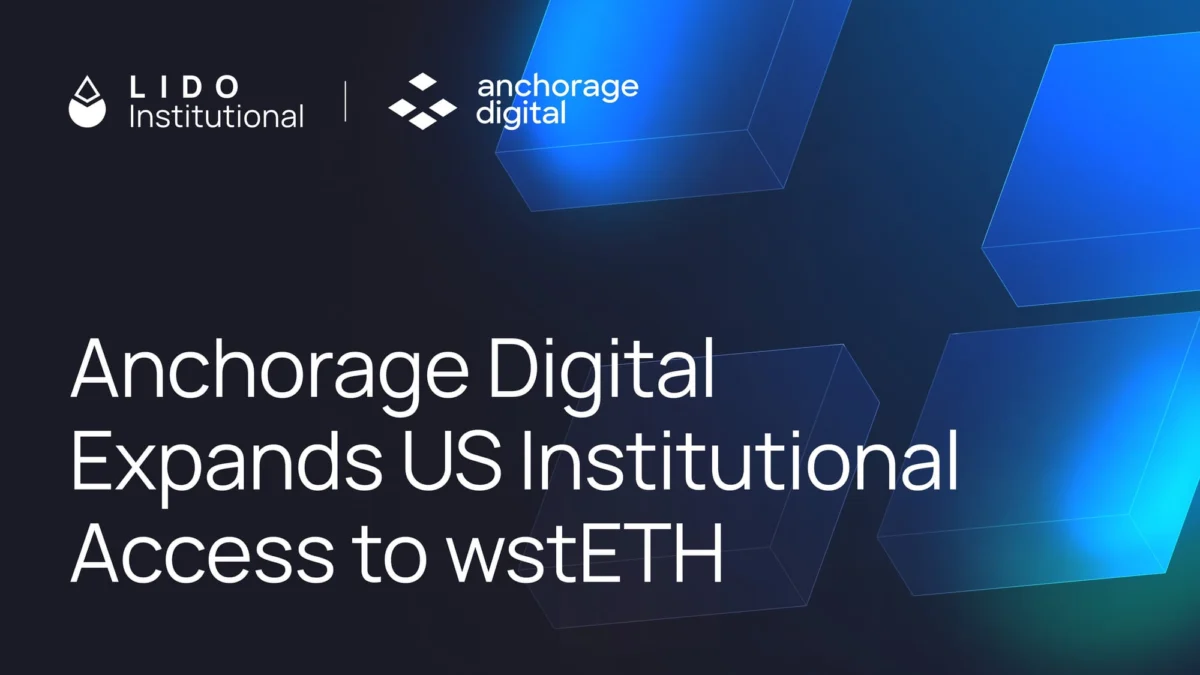
Anchorage Digital, a pioneer in institutional digital asset infrastructure, has announced a significant integration enabling its clients to access wstETH, the wrapped form of Lido’s liquid staking token, directly through its established platform. This development marks a pivotal moment for institutional engagement with Ethereum staking, offering a compliant, secure, and streamlined pathway for asset managers, hedge funds, corporate and protocol treasuries, and even nascent ETF issuers to participate in one of the most compelling yield-generating opportunities in the digital asset space. The integration leverages Anchorage Digital’s unique position as the first federally chartered crypto bank in the United States, providing an environment specifically designed to meet the rigorous policy and control needs of sophisticated institutional clients.
The Genesis of Institutional Interest: Ethereum Staking and the Rise of Liquid Staking
Ethereum’s transition to a Proof-of-Stake (PoS) consensus mechanism, famously known as "The Merge" in September 2022, fundamentally reshaped its economic model and operational security. Under PoS, validators "stake" their ETH to propose and validate new blocks, earning rewards for their contributions to network security and stability. This mechanism offers a native yield opportunity for ETH holders, distinct from traditional financial instruments, attracting considerable interest from institutions seeking diversified revenue streams and exposure to the burgeoning digital economy.
However, direct participation in Ethereum staking presents several operational challenges for institutions. It typically requires locking up ETH for an indefinite period, running and maintaining validator nodes (which demands significant technical expertise and infrastructure), and managing potential penalties (slashing) for validator misbehavior. These complexities create barriers to entry for large-scale allocators accustomed to traditional financial market structures.
This is where liquid staking protocols, particularly Lido Finance, have emerged as transformative solutions. Liquid staking allows users to stake their ETH while receiving a liquid staking token (LST) in return. This LST represents their staked ETH plus accumulated rewards and can be freely traded, used as collateral in decentralized finance (DeFi) protocols, or otherwise deployed, thereby resolving the illiquidity issue inherent in native staking. Lido Finance has rapidly become the market leader in this category, commanding a substantial share of staked ETH and establishing stETH as the benchmark LST.
Understanding wstETH: The Institutional Choice
While Lido’s primary liquid staking token is stETH, the integration with Anchorage Digital specifically focuses on wstETH (wrapped stETH). The distinction between stETH and wstETH is critical for institutional adoption. stETH is a rebasing token, meaning its balance automatically increases daily to reflect staking rewards. This rebasing mechanism, while efficient on-chain, poses significant accounting and integration challenges for traditional financial systems and custody solutions that are not designed to handle fluctuating token balances without explicit transactions.
wstETH addresses this by being a non-rebasing wrapper for stETH. When stETH is wrapped into wstETH, the balance of wstETH remains fixed. Instead of the token balance increasing, the value of wstETH relative to stETH appreciates over time, reflecting the embedded staking rewards. This structure fits seamlessly with institutional custody, accounting workflows, and reporting requirements. It simplifies integration across various DeFi platforms and, crucially, traditional financial infrastructure that prioritizes fixed balances and predictable accounting entries. This design choice is a testament to the industry’s evolving understanding of what is required to bridge the gap between decentralized innovation and conventional financial operations.
Anchorage Digital: A Cornerstone of Institutional Crypto Infrastructure
Anchorage Digital’s role in this integration cannot be overstated. Founded in 2017, Anchorage has distinguished itself by focusing exclusively on institutional clients and building a robust, secure, and compliant infrastructure from the ground up. Their most significant milestone came in January 2021 when they received a charter from the Office of the Comptroller of the Currency (OCC) to operate as a national trust bank, making them the first federally chartered crypto bank in the U.S. This charter is not merely a regulatory approval; it signifies a profound level of trust and adherence to the stringent capital, liquidity, and operational standards typically applied to traditional financial institutions.
This regulatory status is a powerful differentiator, providing institutional clients with an unparalleled level of assurance regarding custody, security, and compliance. For asset managers, pension funds, corporate treasuries, and sovereign wealth funds contemplating exposure to digital assets, working with a federally regulated entity significantly de-risks their participation. Anchorage Digital’s platform is engineered to meet complex governance, reporting, and settlement requirements, which are often insurmountable hurdles for institutions interacting directly with less regulated crypto service providers. Their existing suite of services, including qualified custody, staking, and settlement for a wide array of digital assets, positions them as a trusted gateway for institutions navigating the digital asset landscape.
Nathan McCauley, Co-Founder & CEO at Anchorage Digital, underscored this point, stating, "Liquid staking has become one of the most important building blocks for institutional participation in Ethereum. By integrating with Lido, we’re giving institutions access to wstETH without the operational or security tradeoffs that have historically kept large allocators on the sidelines. It’s another step in making advanced onchain infrastructure institution-grade." His comments highlight Anchorage’s strategic imperative to enable sophisticated on-chain activities within a framework that aligns with traditional finance’s expectations.
The Mechanics and Benefits of the Integration
The integration means that Anchorage Digital clients can now seamlessly access wstETH within the same platform they already utilize for their digital asset custody and management needs. This "single pane of glass" approach significantly reduces operational friction. Instead of needing to manage multiple accounts across different providers, perform complex on-chain transactions themselves, or grapple with the intricacies of self-custody for liquid staking, institutions can now leverage Anchorage’s established infrastructure.
Key benefits for Anchorage Digital clients include:
- Simplified Access: Direct access to wstETH without leaving their familiar, regulated Anchorage environment.
- Enhanced Security: Leveraging Anchorage’s institutional-grade security protocols and cold storage solutions for wstETH.
- Regulatory Compliance: Ensuring all activities are conducted within the framework of a federally chartered bank, easing compliance burdens for clients.
- Streamlined Operations: Integrating wstETH into existing custody, reporting, and settlement workflows, making it easier for institutions to manage their positions and reflect staking rewards in their financial statements.
- Diversified Portfolio Strategies: Enabling institutions to earn staking yield on their ETH holdings while maintaining liquidity and the ability to deploy wstETH in other DeFi protocols if desired.
This integration eliminates many of the "harder questions" asset managers face regarding how staking can fit their existing custody, governance, reporting, and settlement requirements. It provides a blueprint for how complex DeFi primitives can be safely and compliantly integrated into traditional institutional portfolios.
Lido’s Market Dominance and Broader Institutional Footprint
Lido Finance has cemented its position as the market-leading liquid staking token on Ethereum, boasting the deepest liquidity and the widest integration footprint within the category. As of mid-2024, Lido consistently accounts for a significant portion of all staked ETH, with its stETH token enjoying robust trading volumes across centralized and decentralized exchanges. The protocol’s reliance on a distributed set of over 900 node operators contributes to the decentralization and resilience of the Ethereum network, further enhancing its appeal to institutions concerned with single points of failure.
The widespread adoption of stETH extends beyond DeFi. It serves as the underlying asset for regulated financial products in Europe, exemplified by WisdomTree’s 100% staked stETH ETP. This product, listed on major European exchanges, allows traditional investors to gain exposure to staked ETH returns through a familiar, regulated investment vehicle. This combination of scale, liquidity, and integration depth has positioned stETH as a de facto reference point for how institutions can hold Ethereum staking exposure, utilize it as collateral, and incorporate it into broader portfolio strategies.
Kean Gilbert, Head of Institutional Relations at Lido Ecosystem Foundation, commented on the significance of this expansion: “Institutional adoption depends on whether access fits the way institutions actually operate. Anchorage Digital’s integration brings wstETH into an important US institutional platform and strengthens the role of stETH and the Lido protocol in institutional Ethereum staking.” His statement encapsulates the strategic alignment between Lido’s innovative liquid staking solution and Anchorage’s institutional-grade infrastructure, both working to lower barriers for sophisticated investors.
A Growing Trend: Institutional Embrace of Staked ETH
The Anchorage Digital integration is not an isolated event but rather part of a broader, accelerating pattern of institutional embrace of staked ETH. Across the globe, various trends indicate this shift:
- ETF Issuers: Following the success of products like WisdomTree’s ETP, other financial product issuers are actively exploring and building new offerings backed by staked ETH, particularly in jurisdictions with evolving regulatory clarity.
- Corporate and Protocol Treasuries: Entities holding significant ETH reserves are increasingly moving from passive ETH balances into staked positions, recognizing the opportunity to generate yield on otherwise dormant assets, often through liquid staking solutions to maintain flexibility. The Enterprise Ethereum Alliance’s treasury deployment into staked positions serves as a notable example.
- Custodial Support Expansion: Major custodians worldwide continue to widen their support for stETH and wstETH, signaling increasing demand from their institutional client bases. This includes not only custody but also the integration of staking services for these assets.
This widespread institutional interest is driven by a maturing understanding of Ethereum’s economic model, the attractive yield opportunities, and the increasing availability of compliant and secure access points. As the digital asset market continues to mature, sophisticated financial products built on foundational blockchain technologies like Ethereum are becoming increasingly integrated into traditional investment frameworks.
Broader Implications for the Digital Asset Ecosystem
The collaboration between Anchorage Digital and Lido Finance carries significant implications for various facets of the digital asset ecosystem:
For Anchorage Digital: This integration solidifies Anchorage’s position as a leading institutional digital asset platform. By offering access to a market-leading liquid staking solution through a federally regulated entity, Anchorage enhances its value proposition, attracting a wider array of institutional clients seeking compliant access to advanced DeFi yield opportunities. It reinforces their commitment to building "institution-grade" infrastructure for complex on-chain activities.
For Lido and the Liquid Staking Ecosystem: The expansion into a prominent U.S. institutional platform like Anchorage Digital significantly broadens Lido’s reach and legitimizes liquid staking as a core component of institutional digital asset strategies. It sets a precedent for other sophisticated DeFi protocols seeking institutional adoption, highlighting the importance of regulatory compliance and institutional-grade access points. This move further entrenches stETH and wstETH as the preferred standard for institutional Ethereum staking exposure.
For Ethereum and the Proof-of-Stake Network: Increased institutional participation in liquid staking through trusted custodians contributes directly to the security and decentralization of the Ethereum network. More capital flowing into staking means a stronger, more robust network. Furthermore, the accessibility of wstETH through regulated channels can lead to a more diversified validator set over time, enhancing the network’s censorship resistance and overall health.
For the Intersection of Traditional Finance and DeFi: This integration serves as a powerful bridge between traditional finance (TradFi) and decentralized finance (DeFi). It demonstrates how the innovative yield-generating mechanisms of DeFi can be repackaged and presented in a manner that aligns with the stringent requirements of TradFi institutions. This convergence is crucial for the long-term growth and mainstream adoption of digital assets, paving the way for other complex DeFi primitives to eventually gain institutional access.
For the Regulatory Landscape: Such integrations, involving federally chartered entities offering access to innovative blockchain products, will inevitably inform and influence future regulatory discussions. As institutions demand more clarity and regulated pathways, policymakers will be prompted to develop more comprehensive frameworks for digital asset services, including staking and DeFi protocols. This collaborative effort between regulated entities and leading protocols contributes to the maturation of the regulatory environment.
Conclusion
The integration of Lido’s wstETH into Anchorage Digital’s institutional platform represents a landmark development in the evolution of institutional digital asset management. By combining Lido’s market-leading liquid staking technology with Anchorage Digital’s federally chartered, institution-grade infrastructure, this collaboration addresses critical pain points for sophisticated investors. It provides a secure, compliant, and operationally efficient pathway for institutions to access Ethereum staking yield, driving further adoption of liquid staking and solidifying the bridge between traditional finance and the burgeoning decentralized economy. As institutional interest in digital assets continues to grow, such strategic partnerships will be instrumental in shaping the future landscape of finance.