James Watt
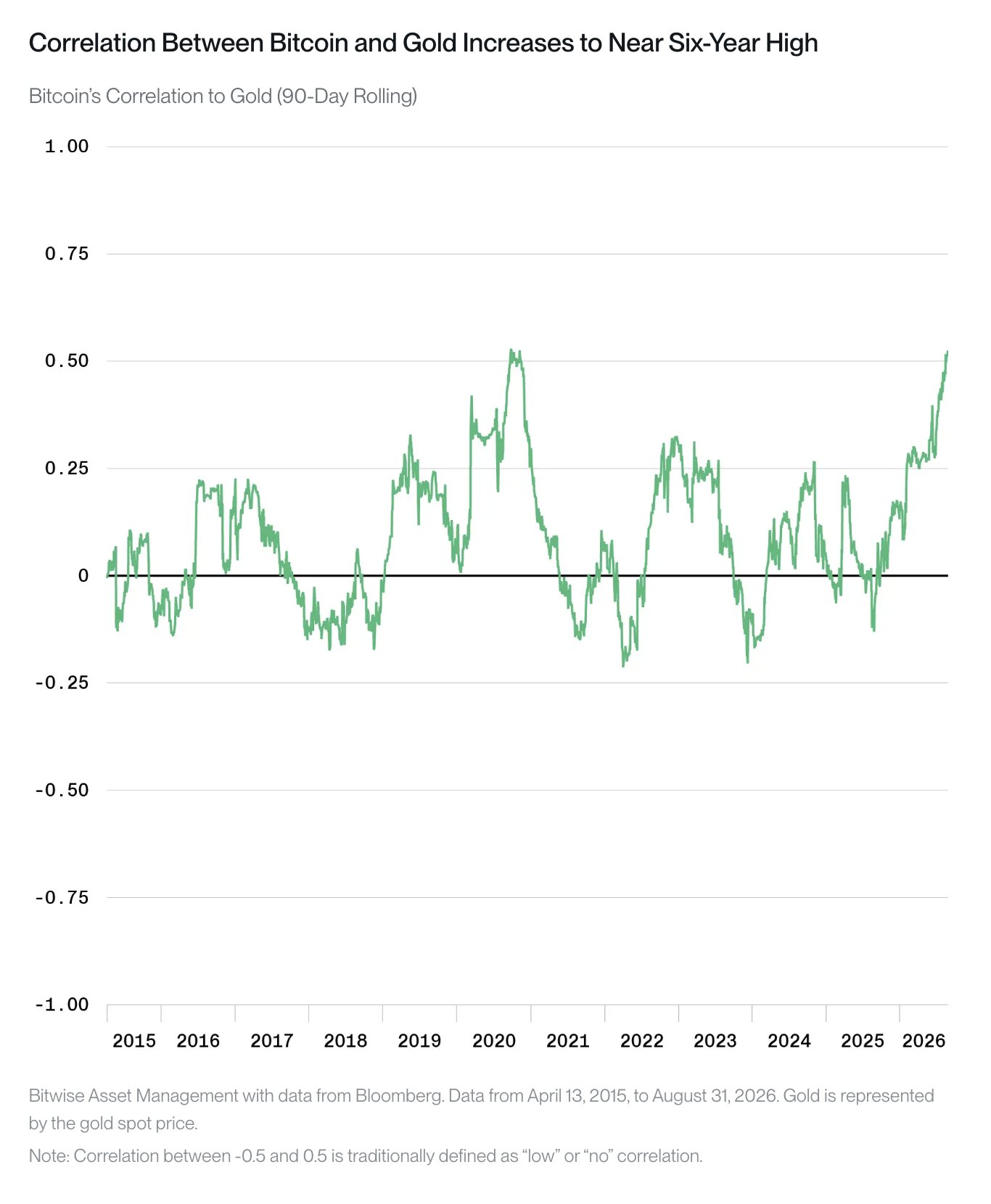
The financial landscape of 2026 has witnessed an unprecedented alignment between two historically distinct asset classes, as Bitcoin and gold trade with a level of synchronicity not seen since the global economic disruptions of 2020. This tightening relationship comes at a time when traditional safe havens are experiencing unusual turbulence, while the world’s leading cryptocurrency adopts a more stabilized profile. Data indicates that the 90-day correlation between Bitcoin and gold has climbed to approximately 0.55, marking its highest point in nearly six years. Simultaneously, the volatility gap between the two assets has narrowed to a historic low, fundamentally challenging long-held perceptions of Bitcoin as a purely speculative vehicle and gold as a steady, low-risk anchor.
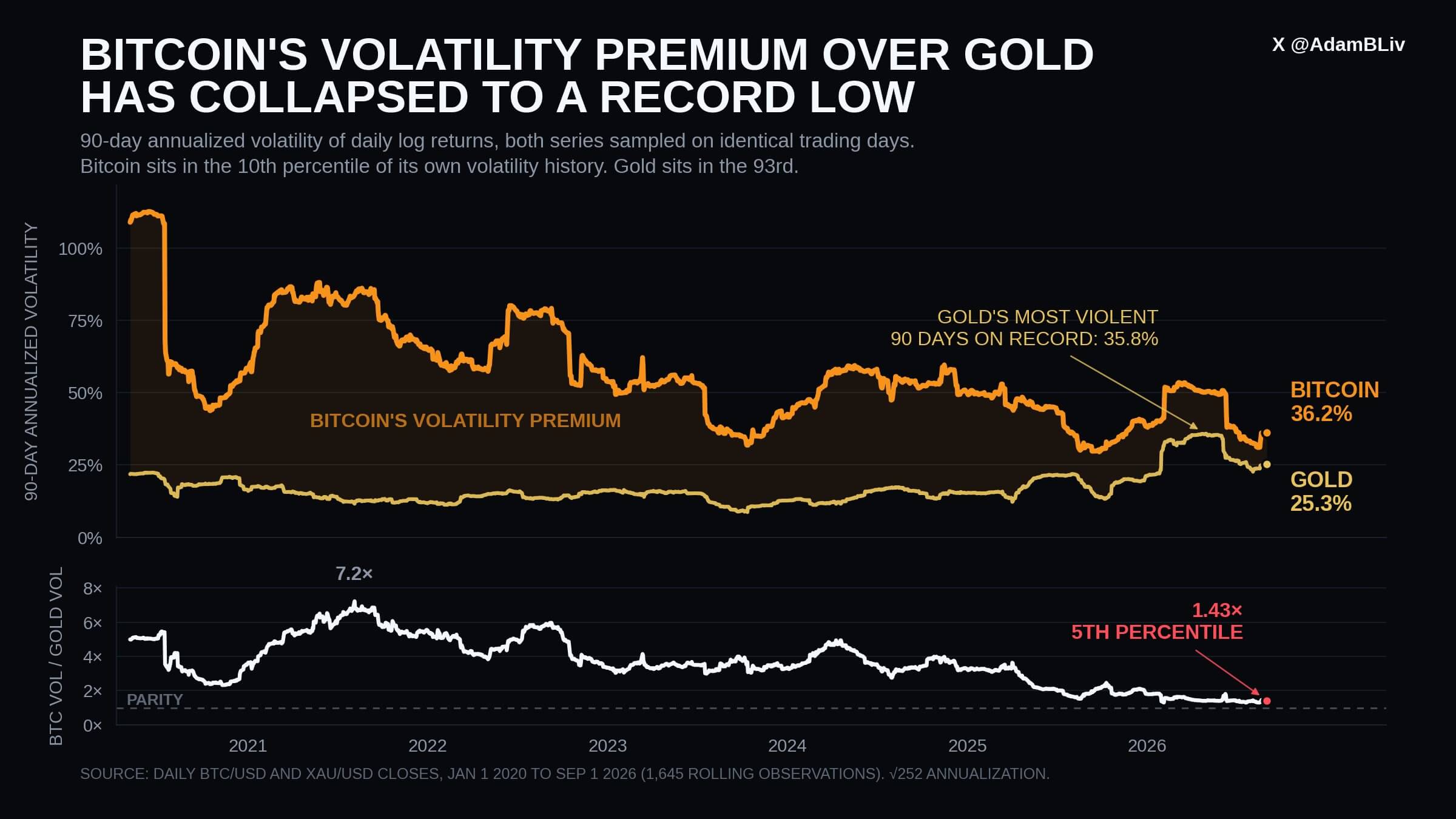
Current market metrics reveal that Bitcoin’s 90-day volatility stands at 36.2%, a figure that contrasts sharply with gold’s 25.3%. While Bitcoin remains the more volatile of the two, the ratio between their respective volatilities has plummeted to 1.43. This represents a significant departure from 2021, when Bitcoin was 5.6 times more volatile than the precious metal. The convergence is not merely a result of Bitcoin stabilizing; rather, it is heavily driven by a surge in gold’s price fluctuations. For 177 consecutive sessions, the volatility ratio has remained below two, a streak that dwarfs the combined 82 days of such behavior recorded between 2020 and 2025.
The Macroeconomic Catalyst: Fiscal Deficits and Monetary Policy
The primary engine behind this convergence is a shared sensitivity to worsening macroeconomic conditions. In late August 2026, the United States federal debt surpassed the $40 trillion threshold, a milestone that has reignited concerns regarding currency debasement and sovereign creditworthiness. This fiscal backdrop has pushed investors toward "hard assets" that sit outside the traditional fiat banking system.
The relationship between these assets was put to a rigorous test during the final week of August and the first week of September. As long-term Treasury yields surged and expectations for Federal Reserve rate hikes intensified, gold experienced a sharp correction. The metal plunged from a peak of nearly $4,700 on Aug. 25 to a low of $4,342 by Sept. 1. During this same window, Bitcoin displayed remarkable resilience. While gold was sliding, Bitcoin maintained a range near $77,000, only a few percentage points below its August highs, before staging a recovery to move above the $80,000 mark.

The divergence during this specific stress test highlights the different transmission mechanisms at play. Gold remains acutely sensitive to "real yields"—the interest rate on government bonds minus inflation. When yields rise, the opportunity cost of holding non-yielding gold increases, often leading to sell-offs. Bitcoin, while also influenced by rates, has been buoyed by a more favorable supply-demand dynamic and a "cleaning out" of speculative leverage.
A Chronology of Market Stress and Rebound
The recent period of market volatility can be traced through a specific sequence of events that began in mid-August.
On Aug. 25, gold reached a local top of $4,696 as traders initially hedged against geopolitical uncertainty. However, the narrative shifted rapidly as the U.S. Treasury announced an expansion of its purchases of longer-dated securities. This intervention, intended to stabilize the bond market, had the side effect of stoking inflation fears. In the week following this intervention, Bitcoin surged 22.4%, outperforming both gold and the broader equities market.
By Sept. 1, the market faced a "hawkish" shock. Rising oil prices and resilient economic data led traders to assign a 60% probability to a Federal Reserve rate hike in September. This drove the U.S. 10-year yield toward 4.8%, causing gold to hit its monthly low of $4,342. Bitcoin, however, managed to absorb this tightening shock with significantly less damage, trading firmly above the $76,000 support level.
The tide turned again on Sept. 3, when Federal Reserve Governor Christopher Waller provided a more dovish outlook. Waller signaled that he might support holding rates steady if inflation data continued to show improvement. This prompted a rapid repricing of rate expectations, causing the dollar and Treasury yields to ease. Gold responded with a 2% jump toward $4,473, while Bitcoin hit an intraday high exceeding $81,000.
Statistical Shift: Decoupling from the Nasdaq
One of the most significant developments in the 2026 market cycle is Bitcoin’s decoupling from traditional risk assets, specifically the technology-heavy Nasdaq 100. According to data from Grayscale, Bitcoin’s 90-day correlation with the Nasdaq 100 has fallen from over 60% to approximately 33%. In contrast, its correlation with gold has risen from near zero at the start of the year to over 50% by late August.
Bloomberg Intelligence senior ETF analyst Eric Balchunas noted that over the past six months, Bitcoin has exhibited a lower correlation with U.S. stocks than even small-cap equities or emerging-market stocks. While Balchunas cautioned that historical correlations often revert to a mean of around 0.40, he acknowledged that the current shift is striking. He suggested that part of this phenomenon is due to traditional "safe havens" like Treasuries becoming more correlated with equities, leaving Bitcoin and gold as the primary outliers in a changing financial ecosystem.
The Role of Institutional Rails and ETF Flows
The stabilization of Bitcoin is largely attributed to the maturation of institutional infrastructure. Ryan Lee, chief analyst at Bitget, suggests that Bitcoin’s resilience during the late-August gold sell-off was due to "cleaner positioning." Recent liquidations had flushed excess leverage out of the crypto market, leaving a higher concentration of "spot" holders.
U.S. spot Bitcoin ETFs have played a pivotal role in providing a price floor. Despite uneven daily flows, these funds have attracted more than $3 billion in net inflows over the past 30 days. For instance, on Sept. 2, the ETFs recorded $101.2 million in net inflows, reversing a $236.5 million outflow from the previous day. This persistent demand from institutional and retail ETF investors provides a cushion that the gold market—which is more susceptible to the fluctuations of the central bank reserve managers and large-scale commodity traders—sometimes lacks.
Analyst Perspectives and Future Implications
Industry experts are divided on whether this convergence is a permanent shift or a temporary anomaly. Adam Livingston, a prominent Bitcoin analyst, points out that gold is currently in its 93rd percentile of historical volatility, while Bitcoin is in its 10th percentile. This suggests that the "narrowing gap" is as much about gold becoming more unstable as it is about Bitcoin maturing. Every session in the last six years where gold’s 90-day volatility exceeded 25% has occurred within the current year of 2026.
Ole Hansen, head of commodity strategy at Saxo Bank, noted that gold’s recent struggles are tied to its inverse relationship with oil prices and bond yields. "For now, gold’s inverse correlation with oil prices and bond yields remains a key focus, sidelining other potentially supportive drivers," Hansen stated. He emphasized that while the long-term case for gold remains strong due to debt concerns, the short-term pressure from rising energy costs and restrictive monetary policy is a significant headwind.
From a portfolio management perspective, the rising correlation between Bitcoin and gold suggests that they are increasingly serving the same purpose in a diversified basket: a hedge against the "fiscal dominance" of the U.S. government. As federal debt continues to climb, the distinction between "digital gold" and physical gold is blurring for many institutional allocators.
Conclusion: A Unified Front Against Fiat Instability?
The data from 2026 confirms that Bitcoin and gold are being shaped by the same macro forces: sovereign debt, currency debasement, and shifting interest rate regimes. While they react differently to immediate shocks—gold being more sensitive to the dollar and yields, and Bitcoin more influenced by market leverage and ETF flows—their long-term trajectories are becoming increasingly intertwined.
The narrowing volatility gap marks a coming-of-age for Bitcoin. By trading with a volatility profile that is only 1.43 times that of gold, Bitcoin is shedding its reputation as a "wild card" and gaining credibility as a legitimate store of value. However, the true test for this relationship will lie in how these assets perform if the global economy enters a period of stagflation. In such a scenario, the convergence between the oldest form of money and the newest may not just be a statistical curiosity, but a fundamental realignment of the global financial order. For now, the "volatility gap" that once defined the chasm between traditional finance and the crypto world is closing, leaving investors to navigate a landscape where the lines between the two are thinner than ever before.