James Watt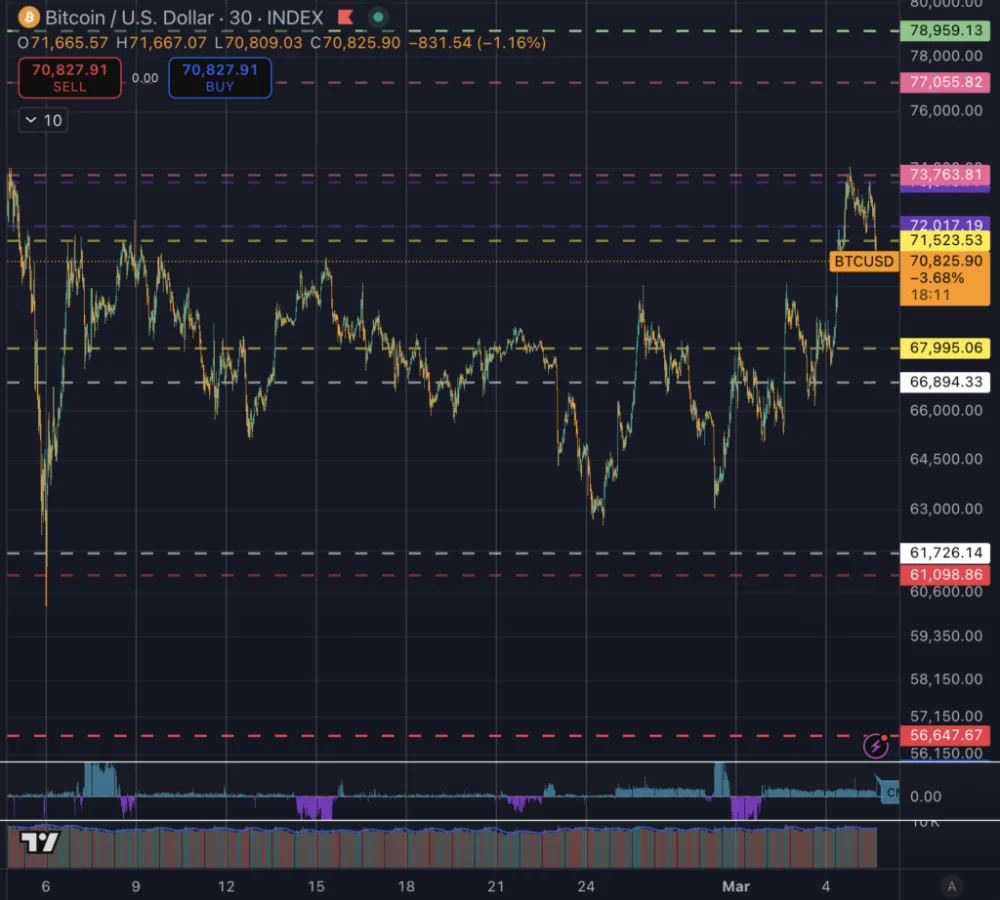
The failure to hold $71,500 is not merely a localized technical event but is deeply intertwined with a broader shift in the global macroeconomic landscape. As oil prices climbed and U.S. Treasury yields moved higher, investors began pivoting toward a "risk-off" posture, putting downward pressure on speculative assets. The current market structure now places Bitcoin in a precarious middle ground, trapped between a rigid overhead ceiling and a series of historical support shelves that may soon be tested if the current downward momentum persists.
The Technical Breakdown of the $71,500 Rejection
The most recent price action has revealed a troubling pattern for bullish traders. While previous attempts to break the $71,500 level often involved aggressive buying pressure that pushed directly into the resistance, the latest move displayed signs of diminishing strength. After reaching a peak near $73,700, Bitcoin’s retracement below $71,500 was characterized by a "lower high" on shorter-term timeframes. In technical analysis, a lower high during a retest of resistance often signals that the pool of aggressive buyers is thinning, and sellers are beginning to gain the upper hand at lower price points.
Market participants typically look for "acceptance" above a resistance level—a period where the price remains stable above the breakout point, allowing short-sellers to cover their positions and new long positions to form. Bitcoin has consistently failed to achieve this at $71,500. Instead, the price action has been defined by "wicks"—brief spikes above the level followed by rapid reversals. This suggests that the liquidity sitting above $71,500 is being used by large-scale holders to exit positions rather than by new buyers to initiate a breakout.

Currently, Bitcoin is trading within a well-defined range. The upper boundary is anchored by the $71,500 to $73,800 zone, while the lower boundary is supported by a ladder of liquidity shelves. The immediate focus for traders has shifted to the $68,000 support level, which represents the first major line of defense in the event of a continued pullback.
Historical Significance and the 2025 Context
To understand why the $71,500 level carries such weight, one must look back at the market cycle of mid-2025. During that period, $71,500 acted as the primary upper boundary of a multi-month consolidation phase. When Bitcoin finally achieved a structural breakout above that ceiling, it triggered a massive wave of momentum that eventually propelled the asset to its historical high of approximately $126,000 by October 2025.
In financial markets, former breakout points often transform into critical "retest" zones during subsequent corrections or cycles. Traders view these levels as areas of high conviction. The fact that Bitcoin is currently struggling to reclaim this level suggests that the market is reassessing the asset’s valuation in the context of current liquidity conditions. The inability to flip $71,500 back into support serves as a warning that the parabolic momentum seen in late 2025 has not yet returned, and the market may require a deeper period of consolidation or a "cleansing" of leveraged positions before another attempt at all-time highs can be made.
Macroeconomic Headwinds: Oil, Yields, and Inflation
The technical struggles of Bitcoin on March 5 coincided with a deteriorating macroeconomic environment. Global markets shifted into a defensive posture as Brent crude oil prices surged into the mid-$80 range. This spike was largely driven by escalating geopolitical tensions in the Middle East and concerns regarding potential disruptions to vital energy shipping routes in the Gulf.

Higher energy costs are a traditional catalyst for inflation expectations. In response, the U.S. bond market reacted sharply. Rather than serving as a safe haven, U.S. Treasuries saw a sell-off, pushing the 10-year yield to approximately 4.22%. Higher yields are generally toxic for risk assets like Bitcoin and technology stocks because they increase the cost of capital and provide a guaranteed return on "risk-free" government debt, making speculative investments less attractive by comparison.
The prevailing narrative in the traditional financial sector has shifted toward a "higher-for-longer" interest rate environment. If energy-driven inflation remains persistent, the Federal Reserve may be forced to delay anticipated rate cuts. This macro backdrop creates a significant headwind for Bitcoin, which thrived in the low-rate, high-liquidity environment of previous years. As equity markets slipped and volatility indices (VIX) ticked upward, Bitcoin followed the broader trend, reinforcing its current correlation with high-beta risk assets.
ETF Inflows and Institutional Sentiment
Despite the bearish price action, institutional interest via Spot Bitcoin Exchange-Traded Funds (ETFs) has shown resilience, though it remains insufficient to overcome the overhead supply. Data from the first week of March shows a series of strong inflow days:
- March 2: $458 million in net inflows
- March 3: $225 million in net inflows
- March 4: $461 million in net inflows
These figures represent a significant reversal from the outflows witnessed in late February. However, the market’s failure to rally in the face of nearly $1.1 billion in three-day inflows suggests that "organic" selling pressure or profit-taking from long-term holders is currently offsetting institutional demand. It also highlights a disconnect between ETF-driven accumulation and the broader derivatives market. While ETF buyers typically hold for the medium-to-long term, the short-term price discovery is often driven by highly leveraged traders on offshore exchanges.

The Liquidity Grid: Support Levels to Watch
With the $71,500 resistance holding firm, the market’s attention is now turning to the downside. Bitcoin’s price movement historically follows a "liquidity grid"—a series of price levels where high volumes of orders are clustered. If the current pullback intensifies, the following levels will serve as the primary roadmap for the market:
- $68,000 (Immediate Support): This is the first major shelf within the current trading range. A daily close below this level would signal a shift from a neutral to a bearish short-term bias.
- $66,900 (Intermediate Liquidity): A secondary cluster where buyers have previously stepped in to defend the trend.
- Low $61,000s (Major Structural Support): This zone represents a significant historical consolidation area. A drop to this level would constitute a major correction but would still keep the medium-term bullish structure intact.
- $55,700 and $49,800 (Deep Support): These levels represent the "floor" of the current cycle’s liquidity grid. While a move to $49,800 seems distant, some analysts maintain that a test of this deep liquidity pool may be necessary to completely flush out over-leveraged "long" positions before a sustainable bull market can resume.
According to data from Coinglass, approximately $340 million in liquidations occurred across the crypto market in the 24 hours leading up to the March 5 rejection. While this is a substantial figure, it does not yet represent a full-scale "capitulation" event. Often, the most durable market bottoms are formed after a massive liquidation spike that exceeds $1 billion, suggesting that more volatility may be required to clear the path for higher prices.
Analysis of Market Implications
The repeated failure at $71,500 suggests a shift in market psychology. When a resistance level is tested and rejected multiple times, it can lead to a "weary buyer" syndrome. Traders who bought near the top in hopes of a breakout become "underwater" and may choose to sell at break-even during the next slight recovery, creating further overhead pressure.
Furthermore, the divergence between rising ETF inflows and falling prices is a classic sign of a market that is "heavy." It indicates that the supply being brought to market—likely from miners or early "whale" wallets—is currently greater than the record-breaking demand from Wall Street.

If Bitcoin cannot reclaim $71,500 within the coming sessions, the likelihood of a "staircase down" scenario increases. In this model, the price drops to a support shelf (like $68,000), bounces weakly, and then breaks to the next lower level. This process continues until a price point is reached that is attractive enough to trigger a massive, high-volume reversal.
Conclusion and Future Outlook
Bitcoin stands at a critical juncture. The $71,500 level has evolved from a simple price target into a barometer for the market’s overall health and appetite for risk. The combination of technical exhaustion, rising Treasury yields, and geopolitical instability has created a perfect storm for a pullback.
While the long-term institutional thesis remains supported by consistent ETF inflows, the short-term reality is one of weakening momentum. For the bullish case to be reinstated, Bitcoin must not only break above $71,500 but achieve a sustained daily close above $73,800 to invalidate the current "lower high" pattern. Until then, the path of least resistance appears to be toward the support shelves located between $68,000 and $61,000.
Investors and traders will be closely monitoring the upcoming U.S. economic data releases and energy market trends. Should oil prices stabilize and bond yields retreat, Bitcoin may find the breathing room necessary for an eighth attempt at the ceiling. However, if the macro environment continues to tighten, the "staircase down" may become the dominant narrative for the remainder of the month, potentially bringing the asset back toward the major buy zones in the $50,000 to $60,000 range.