
 James Watt
Total daily mining revenue, which includes both block subsidies and transaction fees, has climbed from a mid-summer low of approximately $27 million in July to as much as $48 million in recent weeks. This financial windfall is directly correlated with Bitcoin’s aggressive market recovery, which saw the digital asset climb roughly 45% from a support level of $58,000 to a recent peak exceeding $83,000. For an industry that operates on razor-thin margins and faces fixed costs in fiat currency, this price appreciation has served as a critical lifeline, recalibrating the balance sheets of both publicly traded mining giants and smaller private pools.
The Resurgence of Hashprice and Operational Economics
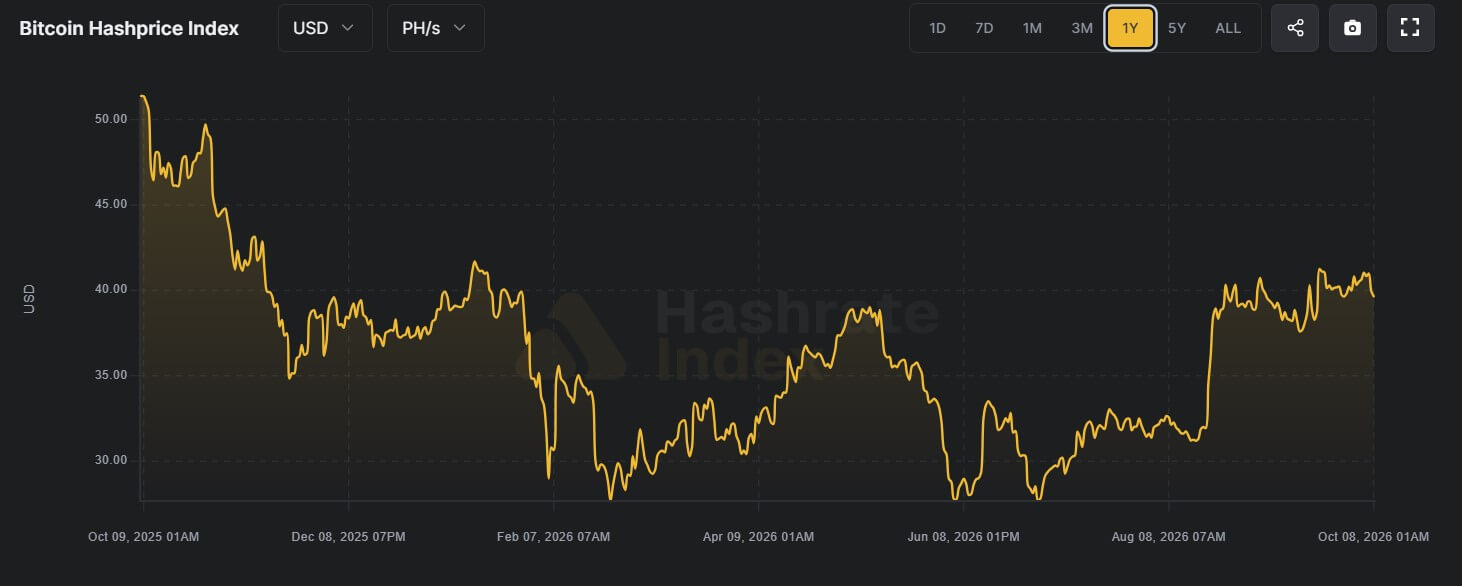
Central to this recovery is the rebound of "hashprice," a vital industry metric that quantifies the expected daily revenue a miner can expect to earn from a specific unit of computing power—typically measured in petahashes per second (PH/s). Data from the Hashrate Index reveals that this metric recently breached the $40 per PH/s per day threshold, its highest level since the beginning of the year. While the figure has since stabilized around $39, the jump represents a profound improvement from the "danger zone" seen earlier in the year.
In June, research from CoinShares indicated that the hashprice had plummeted to approximately $27.70. This decline was the result of a "perfect storm" of negative factors: stagnant Bitcoin prices, anemic transaction fee volume, and a network mining difficulty that remained stubbornly high despite falling revenues. At those levels, many older-generation mining rigs, such as the Bitmain Antminer S19 series, became borderline unprofitable for operators paying average industrial electricity rates. The current recovery to $40 per PH/s has effectively brought a significant portion of the global fleet back into profitable territory, encouraging a renewed "arms race" for computational dominance.

Chronology of the Turnaround: From Underpaid to Fairly Compensated
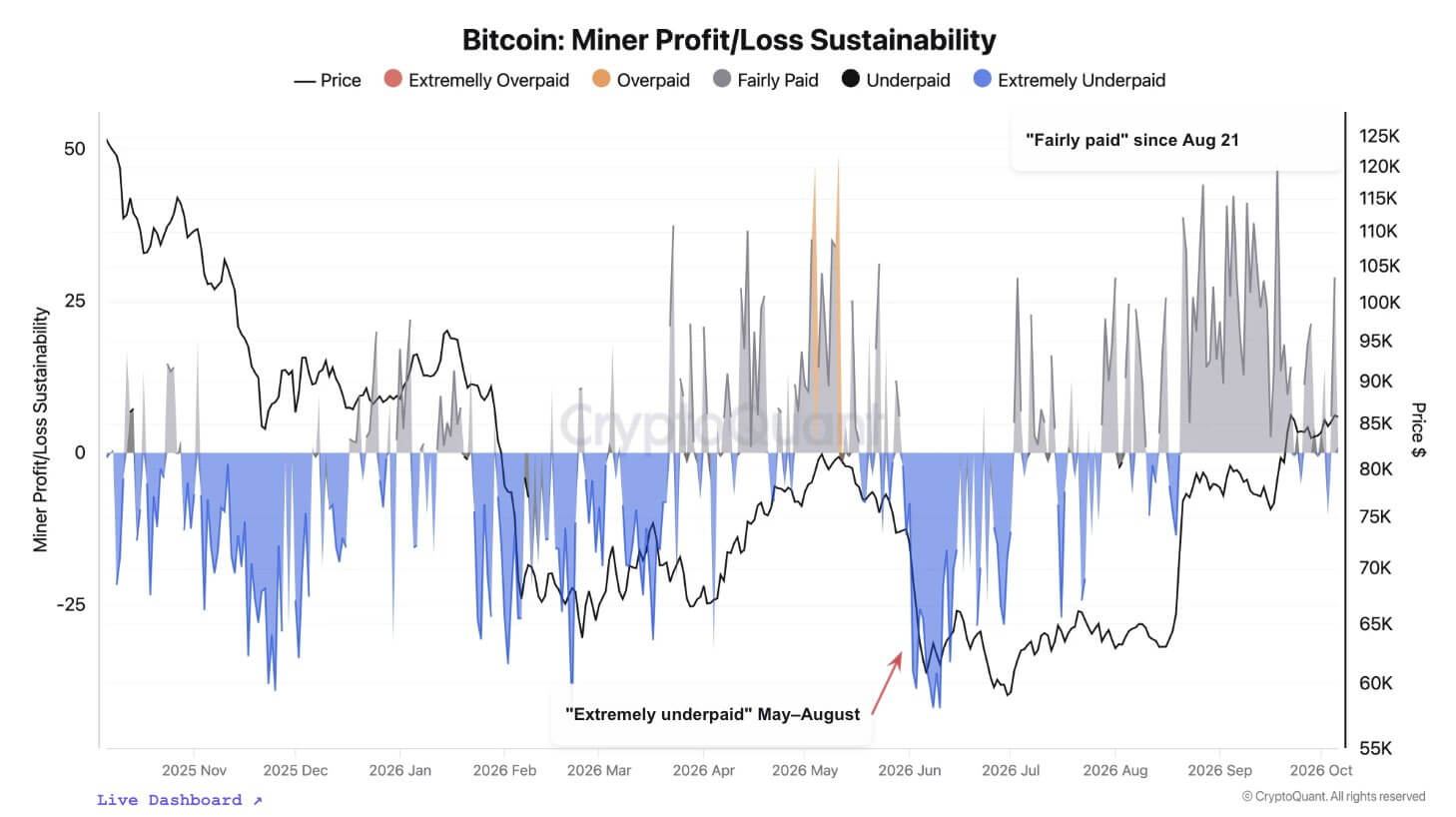
The trajectory of the mining sector over the last six months provides a clear timeline of distress followed by stabilization. Between May and early August, the industry was mired in what analysts call a "capitulation phase." CryptoQuant’s Miner Profit/Loss Sustainability indicator—a proprietary tool that assesses whether revenue is sufficient relative to the network’s difficulty—consistently classified miners as “extremely underpaid.”
This period of distress reached its nadir in late July, when the network hashrate saw an 18% drawdown from its peak. As margins collapsed, less efficient miners were forced to disconnect their hardware, leading to a drop in total network hashrate to 899 exahashes per second (EH/s) by July 31. The turning point arrived on August 21, when Bitcoin’s price moved toward the $76,000 mark. On this date, the sustainability indicator shifted from "underpaid" to the "fairly paid" category for the first time in months.
Since late August, the network hashrate has staged a robust recovery, climbing back to approximately 962 EH/s. This 7% increase in total computational power suggests that miners are not only keeping their existing machines running but are also actively deploying new, more efficient hardware—such as the S21 and T21 series—to capture the increased dollar value of the block rewards.
The Role of Transaction Fees and Block Subsidies
Despite the overall revenue growth, a granular look at the data shows that the recovery remains heavily dependent on Bitcoin’s market price rather than network utility. Daily transaction fees, measured on a seven-day moving average, have seen a modest increase from $195,000 to roughly $275,000. While this is a step in the right direction, these figures are a far cry from the $400,000 to $800,000 range observed during periods of high network congestion and "Ordinals" activity in 2025.
Consequently, the block subsidy—the fixed 3.125 BTC awarded to miners every ten minutes—remains the primary driver of the industry’s top line. This reliance on the subsidy creates a structural vulnerability; if Bitcoin’s price were to experience a significant correction, or if network difficulty were to rise faster than the price, miners could quickly find themselves back in a state of financial contraction. The current environment favors operators who have secured low-cost power purchase agreements (PPAs) and those who have diversified their revenue streams, such as by providing high-performance computing (HPC) services for artificial intelligence applications.
Shifting Miner Behavior and Reduced Selling Pressure
One of the most significant implications of improved profitability is the change in how miners manage their Bitcoin treasuries. During periods of financial duress, miners are often forced to sell their earned BTC to cover operational expenses like electricity and debt servicing. This "miner dumping" can create a significant supply overhang that weighs on the broader market.
However, CryptoQuant’s data suggests that this selling pressure has eased considerably. The last major spike in miner outflows occurred on August 21, when approximately 29,000 BTC were moved out of miner-associated wallets. Since then, daily outflows have normalized to around 12,000 BTC. While wallet outflows do not always equate to immediate market sales—as they can represent internal transfers or moves to custody—the lack of extreme spikes indicates that the urgency to liquidate holdings has subsided.
Furthermore, the behavior of "Satoshi-era" miners—those who have held coins since the network’s earliest years—reflects a similar trend of stabilization. Excluding addresses linked to the founder Patoshi, these ancient wallets moved only 600 BTC in September, a 70% decrease from the 2,000 BTC moved in January. Additionally, mid-tier miners holding between 100 and 1,000 BTC have halted the depletion of their balances, which had fallen from 64,000 BTC in late 2025 to 51,000 BTC in early September. This stabilization suggests that the industry is moving from a phase of "survival selling" to one of strategic holding.
Technical Support Levels and Future Outlook
As the industry looks toward the final quarter of the year, several technical levels will determine whether this recovery is sustainable. Analysts at CryptoQuant have identified Bitcoin’s 365-day moving average, currently situated near $80,000, as a critical support level for the mining industry. If Bitcoin remains above this threshold, the majority of the network will likely remain in the "fairly paid" zone.
A secondary support level exists at the 200-day moving average, near $71,000. A breach below this level would likely trigger another wave of miner distress, particularly for those using older hardware or those with high financing obligations. The "difficulty ribbon"—a metric that tracks the impact of mining difficulty on the market—is currently flashing signs of caution, as the rapid return of hashrate is expected to trigger an upward difficulty adjustment in the coming weeks.
The broader impact of this recovery extends beyond the balance sheets of individual companies. A healthy, profitable mining sector is essential for the long-term security and decentralization of the Bitcoin network. When miners are profitable, they are less likely to consolidate, and the network remains resistant to 51% attacks. However, the current trend toward industrialization means that the gap between high-efficiency "mega-miners" and smaller operators is widening.
In conclusion, while the 78% revenue jump has provided a much-needed reprieve for the Bitcoin mining industry, the sector remains in a delicate balance. The recovery is currently "price-led" rather than "fee-led," making it susceptible to the inherent volatility of the cryptocurrency markets. For the recovery to become a durable expansion, the industry will need to see either a continued climb in Bitcoin’s market value or a significant resurgence in on-chain transaction activity to bolster the fee market. For now, the "fairly paid" status of the world’s miners suggests that the immediate threat of a mass industry exit has been averted, providing a stable foundation for the network’s continued growth.








