
 James Watt
The global Bitcoin mining sector is currently undergoing a robust financial recovery, with daily industry revenues climbing 78% from the lows recorded earlier this year. This resurgence follows a period of intense economic pressure characterized by a "survival of the fittest" environment, which was exacerbated by the April 2024 halving event. According to the latest weekly report from CryptoQuant, total daily mining revenue has surged from approximately $27 million during the July troughs to as much as $48 million in October. This dramatic turnaround is primarily attributed to Bitcoin’s roughly 45% price recovery, which saw the digital asset climb from a summer low of $58,000 to levels exceeding $83,000.
The recovery marks a critical turning point for an industry that has spent much of the last six months grappling with compressed margins and rising operational costs. As Bitcoin’s market value appreciates, the dollar-denominated value of the block subsidy—the primary source of income for most operators—has increased significantly, providing much-needed liquidity to mining firms that were previously operating at or below their breakeven points.
The Resurgence of Hashprice and Mining Economics
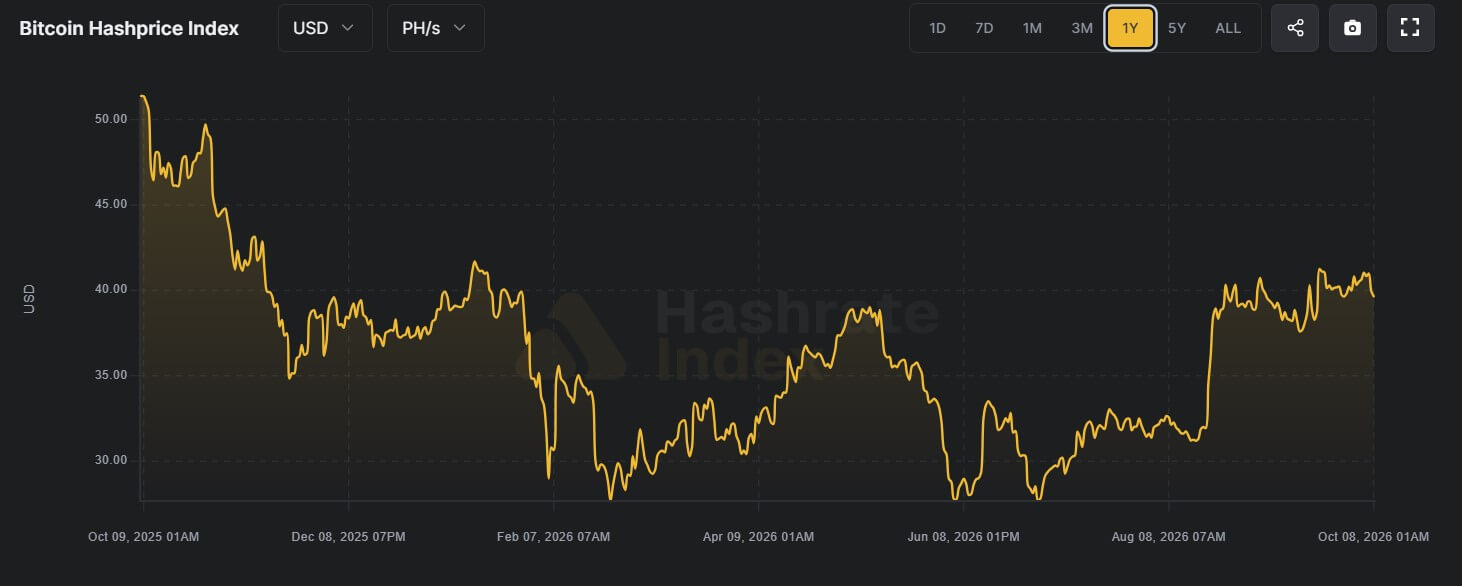
A central metric in this recovery is the "hashprice," a term used to describe the expected daily revenue generated by a unit of computing power, specifically measured in dollars per petahash per second per day ($/PH/s/day). Hashprice is a comprehensive indicator because it accounts for Bitcoin’s price, network difficulty, and transaction fee volumes. Data from the Hashrate Index reveals that this metric recently surpassed $40 per PH/s, marking its highest level since January. Although it has since stabilized around $39, the recovery from the June lows of $27.70 is substantial.
The decline in hashprice during the second quarter of 2024 was driven by a combination of factors: stagnant Bitcoin prices, persistently low transaction fees, and a network difficulty that remained stubbornly high despite the reduced block rewards following the halving. For many operators, particularly those using older generation hardware like the Antminer S19 series, the sub-$30 hashprice environment made profitable operations nearly impossible without access to exceptionally cheap electricity.

The recent climb back toward $40 per PH/s suggests that the industry’s economic fundamentals are normalizing. This improvement allows miners to cover their fixed costs, such as equipment financing and facility maintenance, while also meeting variable costs like power consumption. However, analysts note that the benefits of this recovery are not distributed equally. Large-scale, vertically integrated miners with long-term power purchase agreements (PPAs) and the latest-generation hardware, such as the Antminer S21 or Whatsminer M60 series, are seeing significantly higher profit margins compared to smaller, less efficient operations.
From Underpaid to Fairly Paid: The Sustainability Shift
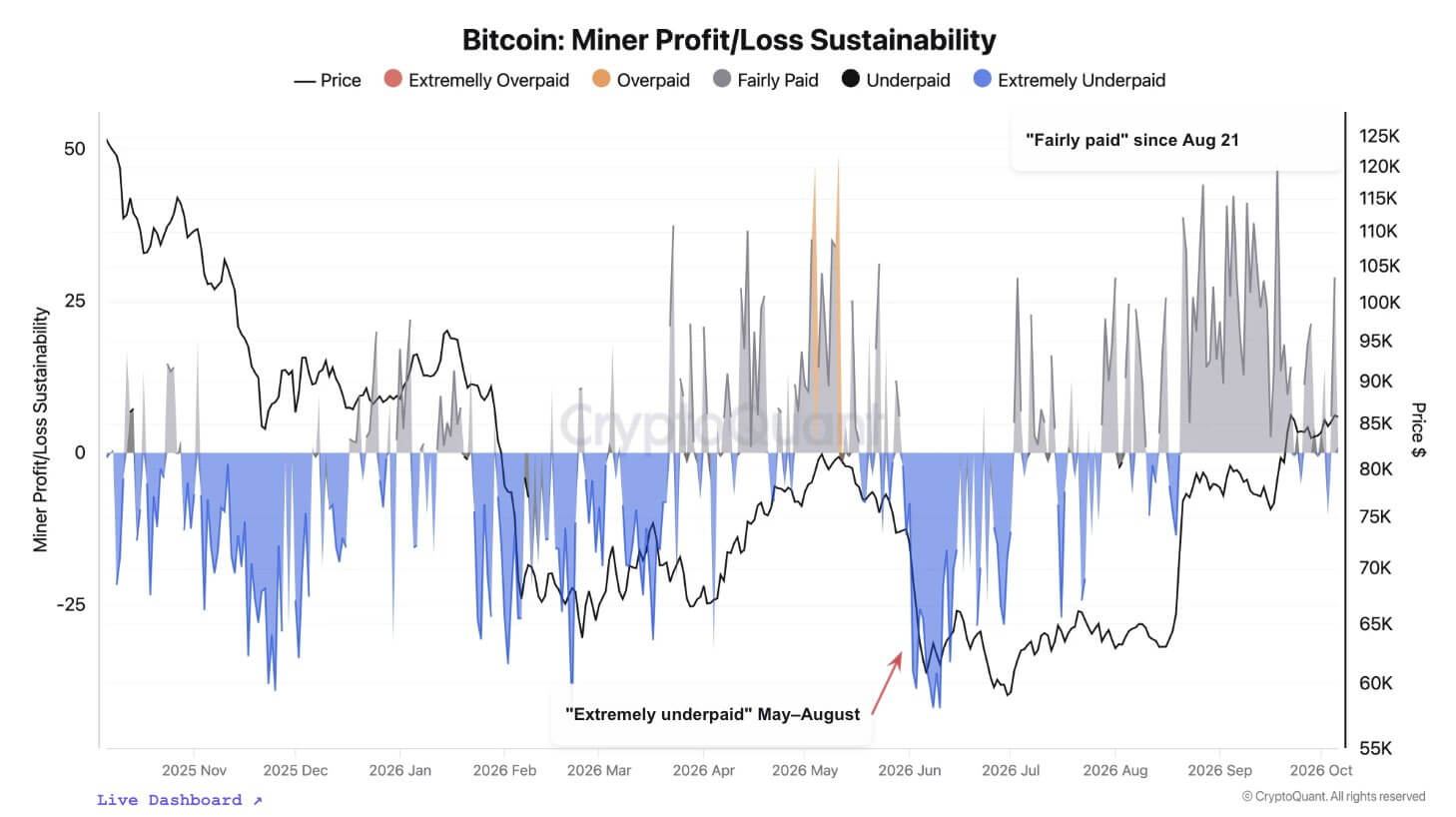
The shift in miner sentiment and financial health is further evidenced by CryptoQuant’s Miner Profit/Loss Sustainability indicator. This proprietary metric compares mining revenue against the network’s computational difficulty to determine if operators are being adequately compensated for the resources they provide to secure the blockchain.
From May through August, the indicator classified the majority of miners as “extremely underpaid.” During this four-month stretch, the computational effort required to mine a block exceeded the financial rewards for many, leading to a "miner capitulation" phase where less efficient participants were forced to disconnect their machines. This period of distress began to lift on August 21, when Bitcoin’s price reached approximately $76,000. Since that date, the indicator has transitioned into the “fairly paid” category.
This transition is vital for the long-term security of the network. When miners are "fairly paid," they are less likely to liquidate their Bitcoin holdings to cover immediate operational expenses. Because mining rewards are denominated in BTC while expenses like electricity and payroll are denominated in fiat currency, a higher BTC price acts as a natural buffer, allowing firms to hold onto their coins in anticipation of further price appreciation.
Network Hashrate and Competition Dynamics
As profitability has returned, the network hashrate—the total amount of computational power securing the Bitcoin blockchain—has also begun to climb. CryptoQuant reports that the hashrate has recovered to approximately 962 exahashes per second (EH/s), up from 899 EH/s in late July. This recovery suggests that miners who had previously mothballed their equipment during the summer slump are now bringing that capacity back online.
The network’s hashrate drawdown, which peaked at an 18% decline in July, has now narrowed to 13%. While a rising hashrate is a sign of a healthy and competitive industry, it also introduces a self-correcting mechanism: as more miners compete for the same fixed number of Bitcoin rewards, the network’s difficulty increases. If the hashrate continues to grow faster than the price of Bitcoin, it could once again compress the hashprice and squeeze margins for the least efficient operators.
Currently, the industry remains heavily dependent on the block subsidy rather than transaction fees. While daily transaction fees (on a seven-day average) rose from $195,000 to $275,000 recently, these figures are a far cry from the $400,000 to $800,000 range seen during the height of the Ordinals and Runes protocol craze in 2025. Without a significant resurgence in network activity, miners will remain vulnerable to Bitcoin price volatility.
Easing Selling Pressure and Changes in Miner Behavior
One of the most significant implications of the return to profitability is the reduction in selling pressure from mining pools and individual operators. During periods of financial distress, miners are often forced to sell their mined Bitcoin—and sometimes their treasury reserves—to stay afloat. This "forced selling" can create a feedback loop that weighs on Bitcoin’s market price.
According to CryptoQuant, extreme miner outflows have not been recorded since the August 21 price surge. On that day, approximately 29,000 BTC moved out of miner-associated wallets as the price approached $76,000. Since then, outflows have returned to a normal range of roughly 12,000 BTC per day. It is important to note that wallet outflows do not always equate to market sales; they can represent internal transfers or the movement of coins to custody providers for use as collateral. However, the lack of "extreme" spikes indicates that the urgency to liquidate has subsided.
This trend is also visible among "Satoshi-era" miners—those who have been active since the network’s earliest years. Transfers from these ancient wallets (excluding those linked to the Patoshi pattern) fell to 600 BTC in September, a 70% decrease from the 2,000 BTC moved in January. Collectively, these early participants hold approximately 590,000 BTC. Their decision to hold rather than sell is often viewed by the market as a signal of long-term confidence.
Furthermore, mid-sized miners—those holding between 100 and 1,000 BTC—have stopped the aggressive depletion of their reserves. This cohort saw its aggregate balance drop by 20% between December 2025 and early September 2024. Since the price recovery began, their balances have stabilized, suggesting they have reached a point where current revenues are sufficient to cover costs without further tapping into their "HODL" reserves.
Broader Implications and Support Levels to Watch
The recovery of the mining sector has broader implications for the Bitcoin ecosystem and the wider financial markets. For investors, the stabilization of miner balances removes a significant "overhang" of potential supply. Historically, Bitcoin bull markets have often been preceded or accompanied by a shift from miner selling to miner accumulation. While the industry has not yet returned to a sustained accumulation phase, the cessation of aggressive selling is a prerequisite for the next leg of a price rally.
However, the path forward is not without risks. Analysts have identified two key technical levels that will serve as a test for mining profitability in the coming months. The 365-day moving average, currently near $80,000, is viewed as a critical support level. Should Bitcoin fall and sustain a price below this mark, the "fairly paid" status of the mining industry could be revoked, potentially triggering a new wave of miner capitulation. A deeper support level exists at the 200-day moving average, currently around $71,000.
Industry experts also point to the growing influence of institutional and public mining companies. Firms like Marathon Digital, Riot Platforms, and CleanSpark have access to capital markets that smaller private miners do not. These entities are increasingly using their balance sheets to acquire more efficient hardware and expand their energy footprints even during downturns. This institutionalization of the mining sector may lead to a more resilient network, but it also raises the barrier to entry for smaller participants.
In conclusion, while the 78% surge in daily revenue has provided a vital lifeline to the Bitcoin mining industry, the recovery remains in its early stages. The industry’s health is currently tethered to Bitcoin’s market price rather than organic network utility through transaction fees. For the recovery to be considered durable, the sector will need to see a sustained period where revenue gains outpace the rising network difficulty, allowing operators to move from merely surviving to actively rebuilding their Bitcoin reserves. As the market looks toward the final quarter of the year, the stability of the $80,000 price level will likely determine whether the "mining winter" is truly over or if another period of consolidation awaits.








