Nila Kartika Wati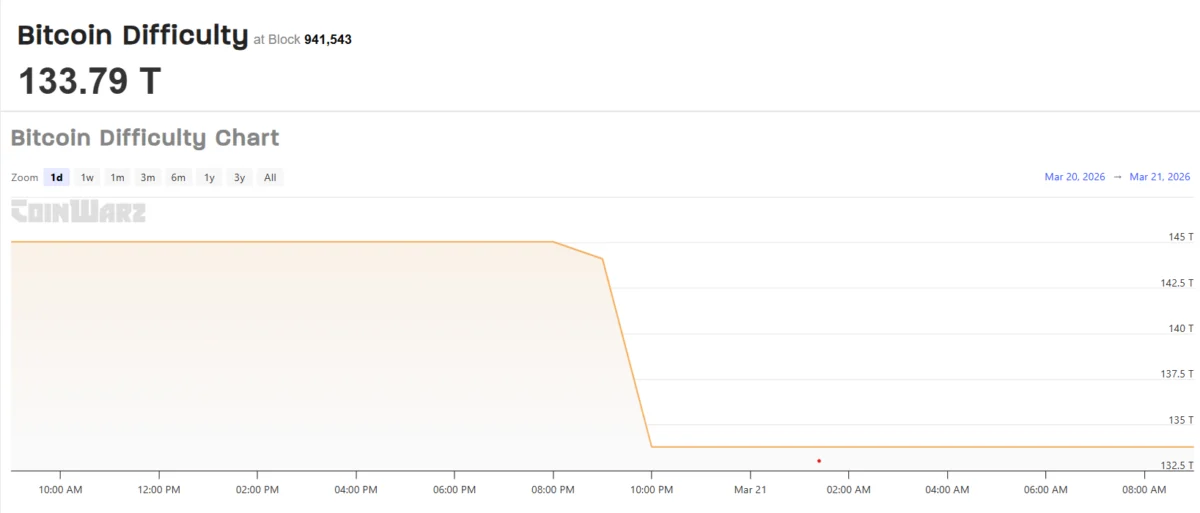
Bitcoin’s mining difficulty experienced a significant downward adjustment of approximately 7.7% on March 20, recalibrating to 133.79 trillion at block 941,472. This marked the sharpest decline in the network’s computational challenge since February, according to data compiled by CoinWarz. The substantial reduction reflects a dynamic shift in the Bitcoin mining landscape, driven by a confluence of factors including fluctuating profitability, escalating energy costs, and a burgeoning strategic pivot by several major mining operations towards high-performance computing (HPC) and artificial intelligence (AI) workloads.
Understanding Bitcoin’s Difficulty Mechanism
The Bitcoin network is ingeniously designed to maintain a consistent block production rate, targeting approximately one new block every 10 minutes. This predictable issuance schedule is fundamental to Bitcoin’s economic model, ensuring a steady supply of new coins and contributing to its scarcity. The mechanism that enforces this consistency is the "mining difficulty," a measure of how hard it is for miners to find a valid hash—a cryptographic solution—for the next block.
Every 2,016 blocks, which typically takes around two weeks (2,016 blocks * 10 minutes/block = 20,160 minutes = 14 days), the network automatically evaluates the average time it took to mine the preceding blocks. If blocks were mined faster than the 10-minute target, it indicates that more computational power, or "hashrate," has joined the network, making it easier to find solutions. In response, the difficulty increases to make mining harder, slowing down block production back towards the 10-minute target. Conversely, if blocks were mined slower than the target, it signifies that hashrate has left the network. The difficulty then decreases, making mining easier for the remaining participants and accelerating block production back to the desired pace.
This self-adjusting algorithm is crucial for Bitcoin’s robustness. It ensures network security by requiring significant computational effort, prevents inflationary spirals by controlling coin issuance, and adapts seamlessly to changes in miner participation and technological advancements. Without it, a sudden influx of powerful mining hardware could quickly exhaust the Bitcoin supply, or a mass exodus of miners could grind transactions to a halt. The latest adjustment on March 20 was a direct response to average block times extending significantly beyond the 10-minute ideal, specifically averaging around 12 minutes and 36 seconds over the prior 2,016 blocks, as reported by CloverPool data. This prolonged period of slower block production necessitated the network’s recalibration to a lower difficulty setting.
A Volatile Start to the Year: A Timeline of Recent Adjustments
The recent 7.7% drop is not an isolated event but rather part of a more volatile pattern observed in Bitcoin’s difficulty adjustments in early 2024. The difficulty had reached approximately 148 trillion at the start of the year, steadily increasing to around 145 trillion by mid-March, before the latest decline. This trajectory underscores the dynamic and often unpredictable nature of hashrate participation.
February saw a particularly sharp difficulty drop, which was largely attributed to severe weather-related disruptions across the United States. Intense winter storms, notably in Texas, temporarily knocked large American mining facilities offline. These facilities, often operating on interruptible power contracts, faced mandates to curtail operations or experienced direct power outages. The sudden removal of significant hashrate from the network caused block times to slow considerably, triggering a downward difficulty adjustment. However, as power conditions normalized and affected miners brought their operations back online, the hashrate quickly rebounded, leading to a subsequent difficulty increase of about 15% in the following adjustment cycle. This rapid fluctuation within a short period highlights the sensitivity of the network’s difficulty to external, often localized, events impacting large-scale mining operations.
The current drop, while similar in magnitude to the February event, appears to stem from different underlying pressures, specifically the strategic decisions of miners rather than purely external environmental factors. The cumulative effect of these adjustments has seen the network’s difficulty move from its peak, signaling a reduction in overall computational power dedicated to securing the Bitcoin blockchain. The next difficulty adjustment is currently projected for April 3, though this estimate is fluid and subject to change based on real-time block production rates.
Impact on Bitcoin Miners: Profitability and Operational Shifts
For Bitcoin miners, a lower difficulty translates directly into improved profitability per unit of hashrate. With less computational work required to find a block, the chances of earning the fixed block reward (currently 6.25 BTC, plus transaction fees) increase for the same amount of hashing power. This can provide a much-needed reprieve for firms grappling with rising operational costs, primarily electricity, and the fluctuating price of Bitcoin.
The energy cost component is particularly critical. Mining Bitcoin is an energy-intensive process, and power prices vary significantly by region and contract type. When Bitcoin’s price is high and difficulty is low, even miners with relatively high electricity costs can remain profitable. However, when the price declines or difficulty rises, the margin for profit shrinks, pushing less efficient operations or those with expensive power contracts towards unprofitability. The current difficulty reset, therefore, offers a momentary boost to the operational economics of those miners who remain online, potentially extending the lifespan of older, less efficient mining rigs that might otherwise be shut down.

The sustained pressure on profitability, however, extends beyond mere difficulty adjustments. The upcoming Bitcoin halving event, anticipated in April 2024, is set to cut the block reward from 6.25 BTC to 3.125 BTC. This pre-programmed supply shock will halve the primary revenue stream for miners, intensifying the need for efficiency and cost reduction. Many miners are already preparing for this by upgrading to more energy-efficient hardware, seeking cheaper power sources, or, as observed recently, diversifying their business models.
The Allure of Artificial Intelligence: Miners Diversify for Stability
A significant trend emerging in the Bitcoin mining sector, closely linked to the profitability pressures, is the strategic pivot towards Artificial Intelligence (AI) and high-performance computing (HPC) infrastructure. Several listed mining companies are actively reallocating their data center capacity and power resources to serve the booming demand for AI computation, seeking steadier and potentially more lucrative returns.
The rationale behind this pivot is multifaceted. Bitcoin mining, by its nature, is a commodity business with revenue directly tied to the volatile price of Bitcoin and the ever-changing network difficulty. This introduces significant revenue unpredictability. AI and HPC services, on the other hand, often involve long-term contracts for computing power, offering more stable and predictable revenue streams. Miners possess vast data center infrastructure, specialized cooling systems, and access to large blocks of cheap electricity – assets that are highly transferable to AI workloads, which also demand immense computational power.
This trend has sparked considerable debate within the crypto community. Crypto trader Ran Neuner, for instance, controversially argued that AI has become "Bitcoin mining’s biggest competitor," going as far as to declare that "AI has killed Bitcoin forever." While such a statement is undoubtedly hyperbolic and designed to provoke discussion, it underscores a genuine competitive dynamic. Both Bitcoin mining and AI data centers vie for access to cheap, abundant electricity, and high-quality data center space. As the demand for AI compute continues to surge, it puts upward pressure on power prices and infrastructure costs, directly impacting Bitcoin miners who operate on razor-thin margins. The opportunity cost of dedicating resources to Bitcoin mining versus AI becomes a critical strategic decision.
Key Players and Their Strategic Moves
Numerous prominent Bitcoin mining firms have already made significant strides in diversifying their operations:
- Core Scientific: One of the largest publicly traded Bitcoin miners, Core Scientific has been actively exploring and securing partnerships for its HPC infrastructure. In a notable move, the company recently announced securing up to a $1 billion credit facility from Morgan Stanley, explicitly earmarked for the development of its data center capacity, much of which is intended to support HPC and AI initiatives. This financial backing signals a serious commitment to expanding beyond pure Bitcoin mining.
- MARA Holdings (Marathon Digital Holdings): While still a leading Bitcoin producer, Marathon has also indicated an interest in leveraging its vast infrastructure for other compute-intensive applications. The company has invested heavily in expanding its data center footprint and exploring opportunities to monetize its energy assets beyond just mining Bitcoin.
- Hut 8: Hut 8 has been particularly vocal about its pivot. The company recently reported a significant quarterly loss but concurrently highlighted its strategic shift, anchoring its future growth on a $7 billion AI data center lease. This move positions Hut 8 to provide high-performance computing services, effectively leveraging its existing data center assets for a more diversified revenue stream away from solely relying on Bitcoin block rewards.
- Cipher Mining: Cipher Mining has also been exploring opportunities in the HPC space, particularly in regions with favorable power markets. The company’s strategic acquisitions of data center sites, such as those in the PJM power market in Ohio, are designed not only for Bitcoin mining but also with an eye towards accommodating future HPC and AI demands.
- Bitdeer: Bitdeer’s actions provide a stark illustration of the intense financial pressures some miners face. On February 21, the company liquidated 943 BTC from its reserves and sold newly mined coins, effectively cutting its corporate Bitcoin holdings to zero. In its latest weekly update on March 21, Bitdeer confirmed that its BTC holdings remained at zero. This aggressive move to de-risk its balance sheet from Bitcoin price volatility and secure operating capital demonstrates a proactive response to the challenging market conditions and the need to fund operational shifts, potentially including investments in alternative revenue streams like AI.
Beyond these large players, many smaller and less efficient operators have simply reduced their hashrate or completely shut down older, less profitable rigs. This ongoing consolidation and strategic reallocation of resources are directly contributing to the observed fluctuations in the global Bitcoin hashrate and, consequently, the network’s difficulty.
Broader Implications for the Bitcoin Network and Future Outlook
While a 7.7% drop in difficulty might seem substantial, it’s important to contextualize it within the overall robustness of the Bitcoin network. Bitcoin’s hashrate remains immense, making it incredibly secure against 51% attacks. A temporary reduction in hashrate, even of this magnitude, does not fundamentally compromise the network’s security, given its vast scale and distributed nature. The difficulty adjustment mechanism is precisely designed to absorb such fluctuations without disruption.
However, the trend of miners diversifying into AI does raise questions about the long-term dedicated hashrate for Bitcoin. If a significant portion of the mining industry gradually shifts away, could it lead to a more centralized mining landscape, where only the most efficient and well-capitalized firms remain purely focused on Bitcoin? Or will the dual-purpose model become the norm, allowing miners to flexibly allocate resources based on market conditions?
The impending halving event in April 2024 will undoubtedly intensify these pressures. With the block reward cut in half, only the most efficient operations will thrive. This could lead to a further shake-out of less efficient miners, potentially causing more significant hashrate drops and subsequent difficulty adjustments. However, historical halvings have also been followed by periods of Bitcoin price appreciation, which would naturally improve miner profitability and attract new hashrate.
Ultimately, the current difficulty adjustment and the broader trend of miner diversification highlight the evolving maturity of the Bitcoin mining industry. Miners are no longer solely dependent on the price of Bitcoin but are becoming sophisticated infrastructure providers, adapting to market demands and seeking to optimize their substantial investments in power and computing hardware. This dynamic interplay between network mechanics, market economics, and technological innovation will continue to shape the future of Bitcoin mining and, by extension, the broader cryptocurrency ecosystem. The estimated next difficulty adjustment on April 3 will offer another data point in this fascinating and complex narrative.