
 admin
admin
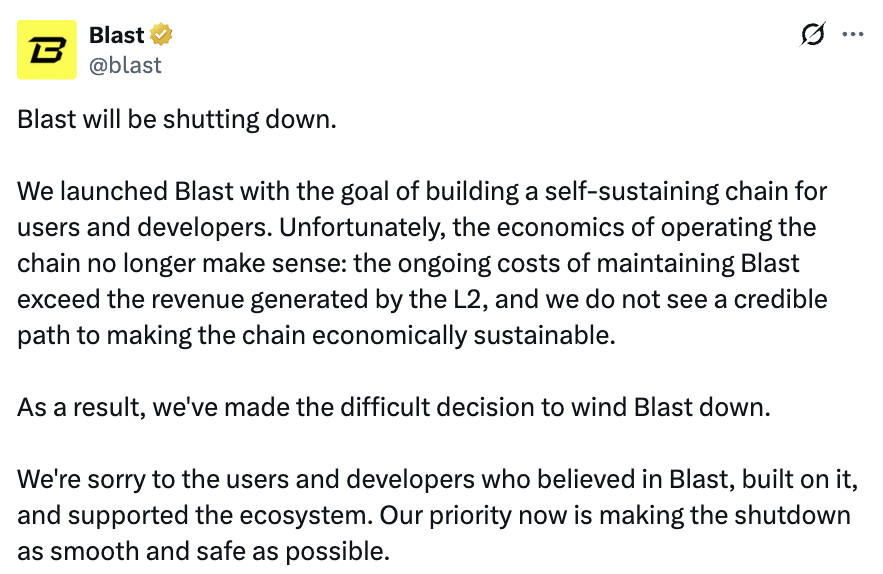
The Ethereum layer-2 scaling solution Blast has officially announced the cessation of its operations, citing a lack of a sustainable economic model as the primary driver for the decision. In an announcement released on Friday via social media platform X, the Blast development team informed the community that the network’s operating costs had significantly exceeded its generated revenue, leaving the project with no "credible path" toward financial viability. This development marks a sudden end for a project that once commanded over $2 billion in total value locked (TVL) and was viewed as a disruptive force in the Ethereum ecosystem.
Effective immediately, the network has entered a wind-down phase, with the team urging all users to migrate their assets back to the Ethereum mainnet. To facilitate this transition, Blast has adjusted its withdrawal protocols, reducing the standard withdrawal delay to 24 hours. However, the team noted that withdrawals are currently undergoing a temporary suspension while the network unwinds its staked positions in Lido. This liquidity process is expected to take approximately one week to complete, after which users will have a window of several weeks to exit the ecosystem through the platform’s official interface.
The Economic Reality of Layer-2 Infrastructure
The decision to shut down Blast highlights a growing concern within the blockchain industry regarding the long-term sustainability of layer-2 (L2) networks. While L2s were designed to scale Ethereum by processing transactions off-chain and submitting bundled proofs to the mainnet, the competition for users and liquidity has become increasingly fierce.
"We launched Blast with the goal of building a self-sustaining chain for users and developers," the team stated in their official communication. "Unfortunately, the economics of operating the chain no longer make sense."
For a layer-2 network to remain solvent, the revenue generated from transaction fees (often referred to as sequencer revenue) must exceed the costs of posting data to the Ethereum mainnet and maintaining the physical and digital infrastructure required to run the network. In the case of Blast, the decline in network activity meant that the income from these fees was insufficient to cover the overhead. This imbalance became insurmountable as the broader crypto market shifted its focus toward more established or incentivized ecosystems, such as Coinbase’s Base or Arbitrum.
A Timeline of the Blast Ecosystem
The trajectory of Blast was characterized by a meteoric rise followed by a precipitous decline. To understand the network’s current predicament, it is necessary to examine the timeline of its development and the strategies employed by its leadership.
November 2023: The Controversial Launch
Blast was unveiled by Tieshun "Pacman" Roquerre, the founder of the NFT marketplace Blur. The project launched with an aggressive "invite-only" bridge that allowed users to deposit ETH and stablecoins to earn "Blast Points" and native yield. Within just a few days, the protocol attracted hundreds of millions of dollars in deposits, despite the fact that the actual layer-2 network had not yet been built. Critics at the time pointed to the bridge’s one-way nature, as users could not withdraw their funds until the mainnet launch in 2024.
February 2024: Mainnet Deployment
The Blast mainnet officially went live in late February 2024. At the time of launch, the network boasted over $2 billion in total value locked, making it one of the largest L2s by TVL almost instantly. The network’s unique selling point was its "native yield," which automatically passed rewards from Lido (staked ETH) and MakerDAO (on-chain T-bills) to users’ wallets.
June 2024: The Peak and the Airdrop
Activity on the network reached its zenith in June 2024, coinciding with the long-awaited $BLAST token airdrop. Many users had deposited funds specifically to farm these tokens. Following the distribution of the airdrop, the network experienced a common phenomenon in the decentralized finance (DeFi) space: a "liquidity exodus." As the primary incentive for staying on the network—the airdrop—had been realized, capital began to flow toward other opportunities.
October 2024: The Final Shutdown
By early October, the TVL on Blast had plummeted from its $2.2 billion high to less than $40 million, representing a decline of more than 98%. With the user base eroded and the token price struggling to find a floor, the operational costs of maintaining the network became a liability that the development team was no longer willing to subsidize.
Asset Withdrawal and Migration Procedures
Blast has provided a clear roadmap for users to reclaim their assets, though it emphasizes that time is of the essence. The primary deadline for users is October 26, 2024. Until this date, the Blast dashboard and user interface will remain operational, allowing for a simplified withdrawal process.
The team has outlined the following technical steps for the wind-down:
- Lido Unwinding: The network is currently liquidating its staked Ethereum positions. This process is mandatory to ensure that the bridge contracts on the Ethereum mainnet have sufficient ETH to cover all user withdrawals.
- 24-Hour Delay: Once the Lido unwinding is complete, the security delay for withdrawals will be shortened from the previous multi-day period to just 24 hours.
- Interface Cutoff: After October 26, the official website and interface will likely be decommissioned. While the assets will remain secure within the Ethereum bridge contracts, retrieving them will become significantly more complex.
- Direct Contract Interaction: For users who miss the October 26 deadline, withdrawals will require manual interaction with the Blast bridge smart contracts on the Ethereum mainnet. The team has promised to publish a guide for this "emergency" withdrawal method to ensure that no user funds are permanently lost.
The Influence of Blur and the NFT Market Downturn
The fate of Blast is inextricably linked to the fortunes of Blur, the NFT marketplace also founded by Roquerre. Blur rose to prominence in late 2022 by implementing a high-frequency trading model for NFTs, eventually overtaking OpenSea in terms of trading volume. However, the NFT market has faced a prolonged "crypto winter," with volumes on major platforms dropping by over 90% from their bull market peaks.
As Blur’s activity waned, so did the synergistic potential for Blast. The network was intended to serve as the backend for a new generation of NFT-focused DeFi applications. When the underlying NFT market failed to recover, the demand for a specialized L2 like Blast evaporated. Data from DefiLlama shows that Blur’s own TVL has followed a similar downward trend, falling from $200 million to approximately $27 million in recent months.
Broader Implications for the Ethereum L2 Landscape
The shutdown of Blast serves as a cautionary tale for the "L2 Wars." Currently, there are dozens of active layer-2 networks on Ethereum, many of which are competing for the same pool of liquidity and developers. The Blast incident highlights several key challenges facing the sector:
The Fragility of Incentive-Driven Growth
Blast’s initial success was built almost entirely on the promise of an airdrop and native yield. When those incentives were removed or diluted, the network lacked the "sticky" utility required to retain users. This raises questions about the long-term viability of other "yield-bearing" chains that rely on inflationary rewards rather than organic transaction demand.
The High Cost of Security and Maintenance
Operating a layer-2 is not free. Even with the Ethereum "Dencun" upgrade, which significantly reduced the cost of posting data to the mainnet via EIP-4844 "blobs," the infrastructure required to maintain sequencers, explorers, and RPC nodes is substantial. For smaller or declining networks, these fixed costs can quickly become unsustainable.
The Consolidation of Liquidity
Network effects are powerful in blockchain ecosystems. Users and developers gravitate toward platforms with the most liquidity and the most robust security. As the market matures, it is likely that liquidity will continue to consolidate into a few dominant players, such as Arbitrum, Optimism, and Base, leaving little room for niche or late-entry competitors.
Official Responses and Industry Reaction
While the Blast team has been transparent about the reasons for the closure, the reaction from the broader crypto community has been mixed. Some industry analysts have praised the team for their honesty regarding the network’s economics, noting that a controlled shutdown is preferable to a "rug pull" or a slow, unmanaged decay.
Others, however, have pointed to the project as an example of the excesses of the current venture-capital-backed "points" meta. Critics argue that the project was designed to extract value through airdrop hype rather than to provide a meaningful technical contribution to Ethereum’s scaling roadmap.
The development team has stated that they will focus their remaining resources on supporting the transition for users and ensuring that the bridge contracts remain accessible. "We are committed to making this transition as smooth as possible for our community," the team added. "We thank everyone who supported the Blast vision during its operation."
As the October 26 deadline approaches, the industry will be watching closely to see how effectively Blast manages the migration of its remaining assets. The success or failure of this wind-down process will likely set a precedent for how other struggling protocols handle the end of their lifecycles in an increasingly competitive and unforgiving market environment.








