James Watt
Cactus Custody, a leading institutional digital asset custodian, has officially announced its comprehensive support for Lido V3 stVaults through its innovative DeFi connector, Cactus Link. This pivotal integration empowers Cactus Custody’s extensive institutional client base to seamlessly create and manage stVaults directly from their existing custody accounts, marking a significant stride in bridging traditional finance with the burgeoning decentralized finance (DeFi) ecosystem. The collaboration is poised to redefine how large-scale institutional players engage with liquid staking, offering enhanced control, flexibility, and security within a regulated framework.
Cactus Custody: A Pillar of Institutional Trust in Digital Assets
Founded in February 2019 as the institutional digital asset custody solution of BIT (formerly Matrixport), Cactus Custody has rapidly established itself as a cornerstone for secure digital asset management. The platform’s robust infrastructure is designed to safeguard digital assets across more than 60 blockchain ecosystems, catering to a diverse clientele of over 400 institutional entities. This includes prominent investment funds, asset managers, cryptocurrency exchanges, over-the-counter (OTC) providers, payment platforms, mining pools, and sophisticated institutional DeFi participants.
Cactus Custody’s commitment to security and compliance is underscored by its impressive suite of regulatory licenses and attestations. It holds a Hong Kong Trust or Company Service Provider (TCSP) license, a crucial credential for operating in one of Asia’s key financial hubs. Furthermore, its recent acquisition of a Bhutan Gelephu Mindfulness City Authority (GMCA) Financial Services Licence (FSL) highlights its proactive approach to expanding its regulatory footprint and adhering to emerging global standards. Beyond licensing, the platform boasts SOC 1 Type II and SOC 2 Type II attestations, independently audited by Deloitte, which rigorously validate its custody operations’ internal controls and security posture. This multi-layered approach to compliance and security instills confidence among institutions navigating the complex digital asset landscape.
The architectural foundation of Cactus Custody is a sophisticated blend of Hardware Security Module (HSM)-backed cold storage and an institutional-grade Multi-Party Computation (MPC) offering. This hybrid model provides clients with unparalleled flexibility, allowing them to choose between a qualified-custodian configuration, where Cactus assumes full custody, and a self-custody-style setup, where clients retain greater control over their private keys through MPC while still benefiting from institutional-grade security infrastructure. This adaptability is critical for institutions with varying internal risk appetites and compliance mandates.
Lido V3 stVaults: A New Paradigm for Institutional Staking
At the heart of this integration lies Lido V3 stVaults, Lido protocol’s innovative modular staking infrastructure. Lido, a leading liquid staking solution, has been instrumental in democratizing access to Ethereum staking, allowing users to stake ETH and receive stETH (staked ETH) in return, which remains liquid and usable across the DeFi ecosystem. stVaults represent an evolution of this offering, specifically tailored to meet the stringent requirements of large staking entities, including institutions, Exchange Traded Funds (ETFs), Exchange Traded Products (ETPs), and traditional asset managers.
The defining feature of stVaults is their single-operator architecture. Unlike pooled staking approaches where assets are commingled and operational control is largely centralized within the protocol, stVaults enable institutions to deploy dedicated, customizable vaults. This grants them an unprecedented level of control over critical parameters such as validator choice, fee terms, and the underlying infrastructure. Simultaneously, stVaults retain the crucial advantage of on-demand liquidity through optional stETH minting, effectively resolving the long-standing control-versus-liquidity tradeoff that has historically challenged institutional participation in staking.
This modular design addresses several key pain points for institutional stakers. It allows them to select their preferred validator counterparties, ensuring alignment with internal operational standards and trust frameworks. Furthermore, institutions can define specific geographic or jurisdictional parameters for their validator operations, a vital consideration for regulatory compliance and risk management. The ability to configure Maximal Extractable Value (MEV) routing strategies and implement bespoke insurance mandates further enhances the customization, enabling institutions to align staking activities with their specific internal risk policies and governance frameworks. This granular control is a game-changer for entities accustomed to stringent oversight in traditional financial markets.
The Strategic Nexus: Bridging Custody and Decentralized Finance
The integration of Lido V3 stVaults into Cactus Custody’s ecosystem via Cactus Link represents a significant strategic development for both entities and the broader institutional DeFi landscape. It builds upon Cactus Custody’s existing support for Lido’s liquid staking tokens, stETH and wstETH, which are already held in custody by numerous institutional clients. Now, these institutions can seamlessly combine their holdings of Lido’s liquid staking tokens with direct stVault operations and access other DeFi protocols through the Cactus Link connector, creating a powerful synergy between secure custody and active DeFi participation.
Sam, Head of DeFi at Cactus Custody, underscored the importance of this integration, stating, "Our collaboration with Lido on stVaults is a testament to our commitment to providing institutions with secure and compliant access to the most innovative DeFi protocols. By enabling clients to manage their stVaults directly from their custody accounts, we’re not just offering a new service; we’re providing a critical pathway for traditional finance to engage with decentralized staking in a way that meets their rigorous standards for control, security, and reporting." This statement highlights the mutual benefit, positioning Cactus Custody at the forefront of institutional DeFi enablement and Lido as a protocol that understands and caters to the sophisticated needs of institutional capital.
From Lido’s perspective, this partnership is crucial for expanding its institutional footprint. While Lido has dominated the retail liquid staking market, attracting institutional capital requires bespoke solutions that address concerns around custody, control, and compliance. By partnering with a qualified custodian like Cactus Custody, Lido V3 stVaults gain a credible and secure conduit to a vast pool of institutional funds, further decentralizing and strengthening the Ethereum network.
How the Integration Works: A Seamless Operational Flow
The operational connection between Cactus Custody and Lido V3 stVaults is facilitated through Cactus Link, a user-friendly browser extension designed to mimic the functionality of a standard hot wallet while being securely tethered to the institutional custody account. The setup process is streamlined, involving two primary steps: first, establishing the connection between the client’s Cactus Custody account and the Cactus Link extension, and second, configuring the necessary permissions and whitelisting.
Once connected, designated vault owners gain comprehensive control over their stVaults. They can perform a range of day-to-day operations, including supplying or withdrawing ETH, minting or repaying stETH, continuously monitoring vault health, triggering rebalancing operations, initiating vault closure procedures, and executing emergency protocols as needed. Detailed, step-by-step instructions for the full setup and ongoing management are meticulously documented in the dedicated Cactus Custody user guide for stVaults, ensuring clarity and ease of use for institutional clients.
A critical security measure for institutions is the mandatory whitelisting of stVaults smart contract addresses prior to any interaction. This proactive step ensures that all on-chain transactions are directed only to approved and verified smart contracts, mitigating risks associated with unauthorized access or malicious code. The complete list of necessary addresses is readily available in the Qualified Custodians overview section of the Lido documentation. It is important to note that this specific operational flow is tailored for vault owners – institutions that intend to create and actively operate their own dedicated stVaults. Institutions are advised to confirm availability and policy settings with their dedicated Cactus account manager, as support may vary based on jurisdiction, entity type, and the scope of their onboarding.
Security and Risk Management: A Multi-faceted Approach
Engaging with Ethereum staking, even through institutional-grade solutions like stVaults, inherently involves certain risks. The standard Ethereum staking risks, such as slashing, validator downtime, and smart contract vulnerabilities, apply. Lido’s comprehensive Risk Assessment Framework for stVaults provides a detailed breakdown of these potential risks, emphasizing transparency and proactive risk mitigation.
To enhance the security posture of Lido V3 and its integration with Cactus Custody, several critical measures have been implemented. These include rigorous smart contract audits by reputable third-party security firms, an active bug bounty program designed to incentivize ethical hackers to identify and report vulnerabilities, and robust operational controls within both the Lido protocol and Cactus Custody’s infrastructure. While these measures are designed to significantly reduce protocol and market risks, it is important to acknowledge that they do not entirely eliminate all underlying risks, and additional, unforeseen risks may still exist.
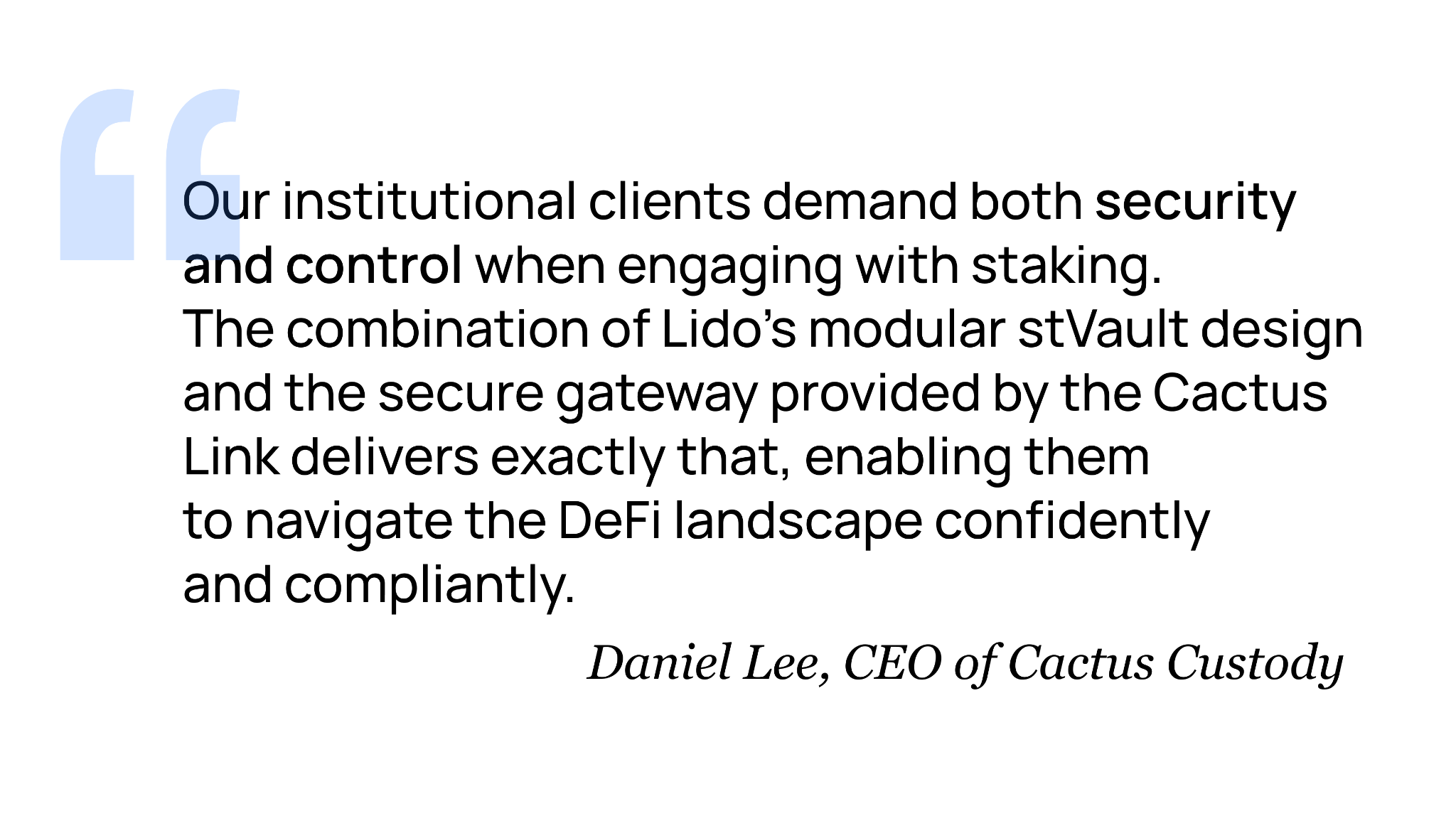
For institutional participants, a key advantage of operating stVaults through Cactus Custody is the ability to leverage a familiar security model. On-chain actions, such as initiating transactions or modifying vault parameters, can be gated by existing Cactus Custody policies, including multi-signature approvals and transaction limits, aligning with established internal governance procedures. Furthermore, the Lido V3 contracts have undergone extensive audits and incorporate clearly defined emergency procedures, providing a structured response mechanism in unforeseen circumstances. Despite these robust safeguards, institutions are strongly encouraged to conduct their own thorough due diligence on smart-contract risks, operational risks, and regulatory compliance. Establishing internal approvals and continuous monitoring frameworks before initiating live operations is paramount to responsible institutional participation.
Broader Implications: Institutionalizing DeFi and the Future of Staking
The partnership between Cactus Custody and Lido V3 stVaults is more than just a product integration; it signifies a maturing trend in the digital asset space: the institutionalization of DeFi. For years, DeFi has been perceived as a largely retail-driven and high-risk frontier. However, as the underlying technology proves resilient and protocols like Lido innovate to meet institutional demands, the barriers to entry for large financial players are steadily diminishing.
This development holds several profound implications:
- Accelerated Institutional Adoption: By providing a secure, compliant, and controllable pathway to liquid staking, this integration is likely to encourage a greater influx of institutional capital into the Ethereum ecosystem. This capital can contribute to the network’s security and decentralization.
- Evolution of Custody Services: Custodians like Cactus are evolving beyond mere storage providers. They are becoming critical intermediaries, enabling secure interaction with complex DeFi protocols. This trend will likely drive further innovation in custody solutions, focusing on enhanced DeFi connectivity and risk management.
- Increased Demand for Tailored Solutions: The success of stVaults highlights the specific needs of institutions for customization, control, and reporting in DeFi. This will likely spur other protocols to develop similar modular and institution-friendly offerings.
- Bridging TradFi and DeFi: The seamless integration of a regulated custodian with a leading DeFi protocol accelerates the convergence of traditional finance and decentralized finance. It demonstrates that the two ecosystems can coexist and even complement each other, with custodians acting as crucial bridges.
- Regulatory Clarity and Dialogue: As more regulated entities engage with DeFi, it naturally fosters a more robust dialogue with regulators. This could lead to clearer guidelines and frameworks, further legitimizing the digital asset space.
The global market for digital asset management, projected to reach hundreds of billions of dollars in the coming years, is heavily influenced by the availability of secure and compliant institutional-grade infrastructure. Solutions like Lido V3 stVaults, accessible through trusted custodians, are essential components in unlocking this potential. They address the inherent cautiousness of traditional financial institutions, which prioritize security, regulatory adherence, and operational robustness above all else.
This integration serves as a powerful testament to the ongoing maturation of the crypto industry, where innovation is increasingly focused on enabling broad-based participation from all market segments. As the digital asset landscape continues to evolve, partnerships between cutting-edge DeFi protocols and regulated financial infrastructure providers will be pivotal in shaping its future.
For institutions seeking to explore these advanced staking opportunities, direct engagement with the Lido Institutional team is recommended. Further details and bespoke consultations can be arranged to ensure a tailored understanding of the capabilities and compliance aspects.