Nila Kartika Wati
Major prediction market platform Kalshi has experienced an extraordinary surge in its US web traffic and trading volume over the past year, propelling it to the forefront of the burgeoning prediction market industry. This rapid expansion, however, has simultaneously drawn intense scrutiny from regulators and courts, culminating in a significant legal battle that now looms before the US Supreme Court, poised to redefine the regulatory landscape for event contracts.
According to detailed traffic estimates from Similarweb, reviewed by Cointelegraph, Kalshi recorded an astounding 15.4 million visits from the United States in July 2026. This figure represents an astonishing increase of approximately 1,520% from just under 1 million visits observed in August 2025. The data underscores not only the platform’s burgeoning popularity but also its deep entrenchment within the American market, as US traffic accounted for nearly 80% of Kalshi’s total global visits in July, up from 72.8% a year prior. This concentrated growth highlights the platform’s strategic focus and significant penetration within the country, even as its legal status remains a contentious point.
The Phenomenal Ascent of Trading Volume
While web traffic metrics provide a compelling narrative of user engagement, the financial activity on Kalshi’s platform reveals an even more dramatic trajectory. The surge in web visits has been accompanied by an even faster acceleration in trading volume, signaling a profound shift in how individuals engage with event-based financial instruments.
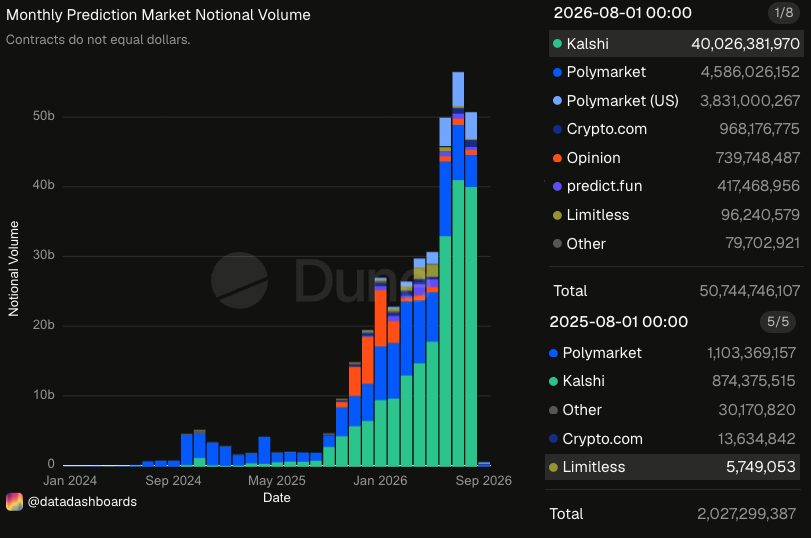
Data compiled by Dune Analytics, a prominent prediction market data dashboard, illustrates this exponential growth. Kalshi reported an estimated $40 billion in monthly notional trading volume in August 2026. This figure represents an astronomical increase of roughly 4,500% from the $874 million recorded just a year earlier. Such a leap in trading activity positions Kalshi as a dominant force within the prediction market ecosystem. Across the entire prediction market industry, monthly notional volume collectively soared to $50.7 billion from approximately $2 billion over the same period, with Kalshi alone commanding nearly 79% of this latest total. This market share dominance underscores the platform’s central role in the rapid expansion of this niche financial sector.
A significant portion of this trading volume is attributed to sports contracts. Barron’s reported that sports-related events constituted 83% of Kalshi’s total trading volume in July 2026, indicating a strong appetite among users for predicting outcomes in the athletic arena. This concentration on sports events is a key point of contention in the ongoing regulatory debate, as it blurs the lines between sophisticated financial instruments and traditional gambling.
Regulatory Quagmire: Kalshi’s Legal Battle for Legitimacy
The explosive growth of Kalshi has not gone unnoticed by regulatory bodies, leading to a complex and high-stakes legal confrontation. At the heart of the dispute is the fundamental question of how prediction markets, particularly those involving sports, should be classified and regulated in the United States. Kalshi operates under the regulatory oversight of the Commodity Futures Trading Commission (CFTC), having been granted Designated Contract Market (DCM) status. This classification implies that Kalshi’s event contracts are considered financial derivatives, akin to futures contracts, which are used for hedging or speculating on future economic events.

However, several state authorities, notably New Jersey and Michigan, have challenged this classification, arguing that many of Kalshi’s offerings, especially those related to sports outcomes, functionally resemble sports gambling. Under this interpretation, such contracts would fall under state gambling laws, which are often much more restrictive and carry different licensing requirements than federal commodities regulations. This divergence in interpretation has ignited a jurisdictional dispute with profound implications for the nascent prediction market industry.
The legal challenge has escalated significantly, with New Jersey taking the dispute directly to the US Supreme Court. The core of New Jersey’s argument is that the CFTC overstepped its authority in allowing Kalshi to offer contracts on events that are, in their view, essentially gambling. They contend that these contracts do not serve a legitimate economic purpose for hedging risk, which is a cornerstone of commodities regulation, but rather provide a mechanism for wagering on uncertain outcomes. Michigan authorities have also actively pursued efforts to block Kalshi, further highlighting the widespread concern among state regulators.
Kalshi, for its part, has consistently defended its business model by asserting that its contracts are legitimate financial instruments. The platform argues that its event contracts allow users to hedge against or speculate on a wide array of future occurrences, from economic indicators and political outcomes to, crucially, sports results. They maintain that these contracts provide a valuable tool for individuals and businesses to manage risk or express views on future events, similar to how traditional futures markets operate. The company emphasizes its adherence to CFTC regulations, including robust market surveillance, risk management protocols, and clear disclosure requirements, to ensure market integrity and investor protection.
A Chronology of Conflict and Innovation
The story of Kalshi’s regulatory entanglement runs parallel to its rapid innovation and expansion.
- 2021: Kalshi receives approval from the CFTC as a Designated Contract Market (DCM), a significant milestone that allowed it to offer event contracts on a wide range of topics, positioning itself as a legitimate financial exchange. This approval was seen by many as a green light for the prediction market industry in the US.
- Late 2024 – Early 2025: Kalshi begins to expand its offerings, including a wider array of sports-related contracts. This period also marks the initial acceleration of its user base and trading volumes, laying the groundwork for the subsequent explosive growth.
- August 2025: The baseline for the recent growth metrics, showing nearly 1 million US web visits and $874 million in monthly notional trading volume, indicating the beginning of its exponential ascent.
- Early 2026: State regulators, including New Jersey, begin to raise formal objections regarding the nature of some of Kalshi’s contracts, particularly those related to sports. They argue these contracts fall outside the CFTC’s purview and into state gambling jurisdiction.
- June 2026: In a strategic move to navigate international regulatory complexities and expand its global footprint, Kalshi partners with Canadian financial services company Wealthsimple. This collaboration allows Canadian users to access nearly 4,000 eligible Kalshi contracts through a separate, compliant application, effectively circumventing direct access restrictions.
- July 2026: Records 15.4 million US web visits and significant trading volume, further solidifying its market presence while simultaneously intensifying the regulatory spotlight.
- August 2026: Reports $40 billion in monthly notional trading volume, highlighting the peak of its recent financial growth.
- Late 2026: The legal dispute escalates, with New Jersey officially petitioning the US Supreme Court to review the CFTC’s authorization of Kalshi’s sports contracts. This move sets the stage for a landmark legal battle that could define the future of prediction markets.
Broader Industry Context and the Future of Prediction Markets
Kalshi’s journey is emblematic of a broader trend in the financial world: the increasing democratization of complex financial instruments and the rise of alternative investment vehicles. Prediction markets, by their very nature, allow individuals to trade on the likelihood of future events, effectively creating a market price for information and uncertainty. Proponents argue that these markets can aggregate dispersed information, improve forecasting accuracy, and even serve as valuable economic indicators.
However, the regulatory challenges faced by Kalshi highlight the inherent tension between financial innovation and existing legal frameworks, particularly in areas that touch upon traditional gambling laws. The industry’s rapid expansion, exemplified by Kalshi’s 79% market share, suggests a significant public appetite for these platforms. Yet, this growth necessitates clear regulatory guidelines to ensure consumer protection, prevent market manipulation, and delineate jurisdictional boundaries.
The outcome of the Supreme Court case will likely set a precedent not just for Kalshi, but for the entire prediction market industry in the United States. A ruling favoring New Jersey could force Kalshi and similar platforms to either cease offering certain types of contracts or seek separate state-by-state gambling licenses, a far more arduous and fragmented regulatory path. Conversely, a ruling upholding the CFTC’s jurisdiction could provide greater regulatory certainty, potentially fueling further innovation and growth within the federal commodities framework.
International Reach and Jurisdictional Complexities
Adding another layer of complexity to Kalshi’s operations is its growing international web traffic, particularly from jurisdictions where direct access and trading are explicitly prohibited by its member agreement. In July 2026, Canada generated approximately 450,000 visits to Kalshi’s website, a substantial increase from roughly 50,000 in August 2025. Similarly, UK traffic surged to 296,000 visits from 31,000 over the same period.
Both Canada and the UK are among the regions where Kalshi’s member agreement currently prohibits users from directly accessing or trading on the platform. While the percentage share of Kalshi’s traffic from Canada slightly slipped to 2.3% from 3.8% and the UK’s share fell to 1.5% from 2.4% between August 2025 and July 2026, the absolute increase in visits from these restricted territories is notable. This phenomenon raises questions about user behavior, the efficacy of geo-blocking measures, and the potential use of VPNs or other methods to circumvent restrictions.
Kalshi’s proactive partnership with Wealthsimple in Canada in June 2026 provides a glimpse into how the platform intends to navigate these international complexities. By integrating its contracts into a locally compliant financial services app, Kalshi can expand its reach while adhering to local regulations. This strategy suggests an awareness of the need for tailored approaches in different jurisdictions, acknowledging that a one-size-fits-all model may not suffice for a globally ambitious platform. The company’s silence when contacted for comment on the traffic from restricted jurisdictions, however, leaves unanswered questions regarding its efforts to enforce its own access policies.
Implications for Financial Innovation and Regulatory Frameworks
The ongoing legal skirmish involving Kalshi represents a pivotal moment for financial innovation in the digital age. The debate touches upon fundamental questions: How should novel financial products be categorized? When does a sophisticated financial instrument cross the line into mere gambling? And which regulatory body holds ultimate authority over these evolving markets?
The implications extend far beyond Kalshi itself. The Supreme Court’s decision could significantly impact other fintech companies exploring similar event-based trading models, potentially chilling innovation or, conversely, providing a clear pathway for future development. It will also test the adaptability of existing regulatory frameworks in an era of rapid technological advancement. Regulators face the delicate task of fostering innovation while simultaneously protecting consumers and maintaining market integrity.
Should the Supreme Court rule in favor of state gambling laws, it could lead to a fragmented regulatory environment, making it exceedingly difficult for prediction market platforms to operate uniformly across the United States. This could stifle growth and complicate compliance, forcing platforms to navigate a patchwork of state-specific rules. Conversely, a ruling affirming the CFTC’s jurisdiction would provide a clearer, more centralized regulatory path, potentially encouraging further investment and development in the prediction market space under federal oversight.
In conclusion, Kalshi’s meteoric rise in web traffic and trading volume underscores the immense public interest and financial potential of prediction markets. Yet, this rapid ascent has inadvertently positioned the platform at the epicenter of a critical legal and regulatory showdown. The outcome of the impending Supreme Court battle will not only determine Kalshi’s operational future but will also cast a long shadow over the entire prediction market industry, shaping the trajectory of financial innovation and regulatory governance for years to come. The stakes are undeniably high, with the balance between entrepreneurial spirit and robust oversight hanging precariously in the balance.